The Whitney Museum: From West Eighth Street to the Breuer Building to the High Line
The Whitney Museum of American Art has had four main homes in Manhattan, and each one marks a stage in how seriously the city took American art. It opened in 1931 in converted row houses in Greenwich Village, spent the postwar years beside the Museum of Modern Art on West 54th Street, moved into Marcel Breuer's granite fortress on Madison Avenue in 1966, and since 2015 has filled a Renzo Piano building at the foot of the High Line in the Meatpacking District. The Breuer building, meanwhile, has had a busy afterlife of its own.
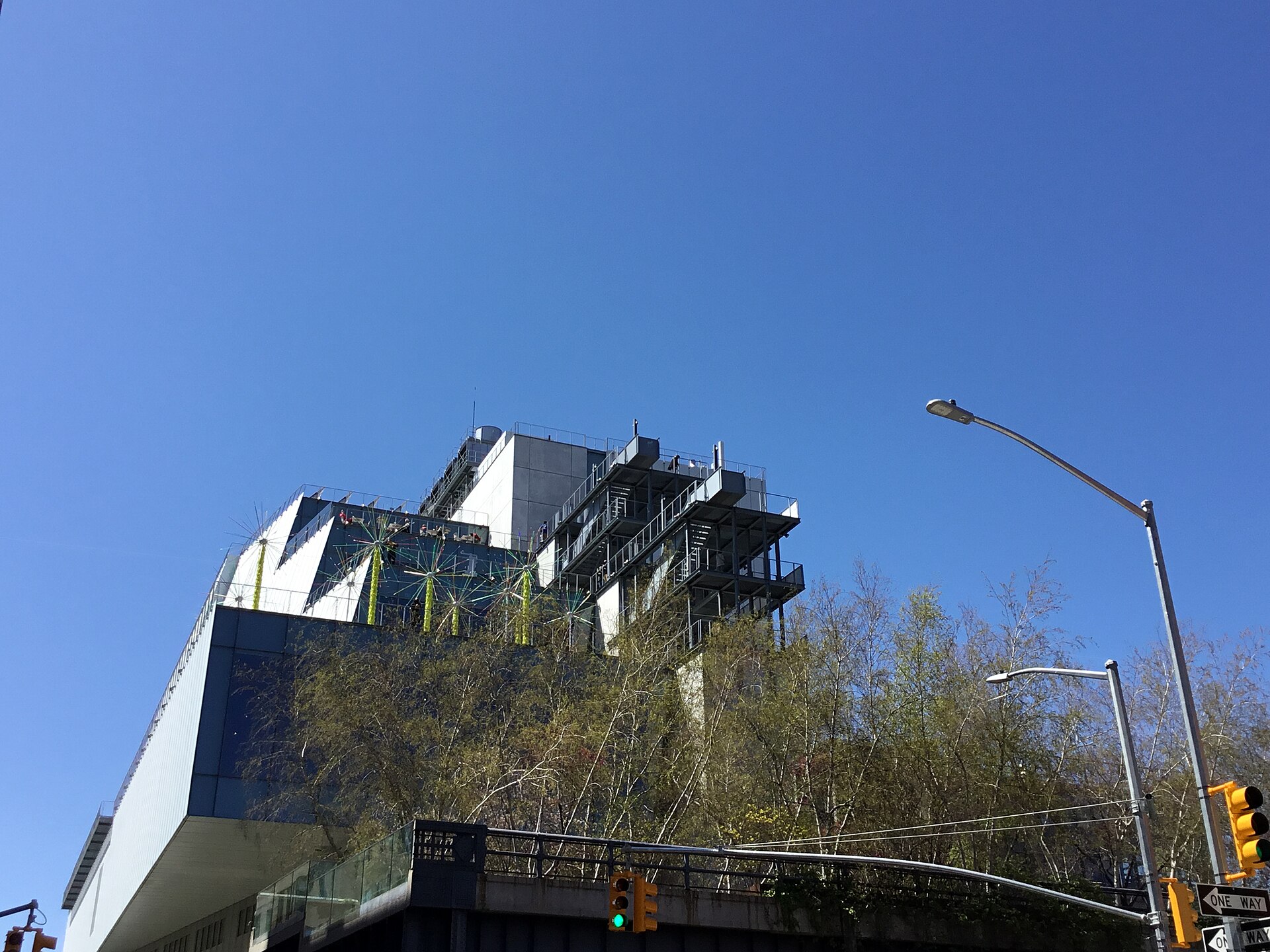
The Whitney Museum of American Art at 99 Gansevoort Street in April 2022. Photograph by Kidfly182, via Wikimedia Commons. CC BY-SA 4.0.
Who started the Whitney?
The museum grew out of one woman's collection and one rejected gift. The Whitney's own history says that Gertrude Vanderbilt Whitney, a sculptor from one of New York's richest families, became the leading patron of American art from 1907 until her death in 1942. The Landmarks Preservation Commission's report on the Breuer building fills in the early geography: in 1907 she moved her sculpture studio into a renovated stable on MacDougal Alley, and in 1914 she opened the Whitney Studio in an adjoining building on West Eighth Street, where she presented exhibitions by living American artists whose work the traditional academies ignored. The Whitney Studio Club, a community space for artists, followed in 1918.
By 1929 she had assembled more than five hundred works. When her offer of the collection to the Metropolitan Museum of Art was declined, she set up her own institution with a distinctive mandate: to focus exclusively on the art and artists of this country. The Whitney Museum of American Art was founded in 1930 and opened in 1931 on West Eighth Street near Fifth Avenue. The LPC report says she donated the five hundred paintings and sculptures that formed the permanent collection, and that the original studio and two adjacent buildings were combined into a museum whose interior was remembered for its intimacy and warmth rather than the coldness of most museums of the time.
Why did the museum keep moving?
Every Whitney move has been a space problem. The sources disagree slightly on the first one: the museum's own history says the Whitney moved in 1954 to an expanded site at 22 West 54th Street, beside the Museum of Modern Art, while the LPC report dates the relocation to 1949. Either way, the arrangement did not last. By 1961, the LPC report says, the West 54th Street building was plainly inadequate, and its proximity to MoMA made it hard for the Whitney to develop an independent identity. The trustees decided the museum needed a substantially larger home that would rank it among the great museums of New York, and if the building made a daring statement, so much the better.
The building committee found a site at the corner of Madison Avenue and East 75th Street, a cleared parcel that had once held six rowhouses. The LPC report says the owner, developer Ian Woodner, had intended an apartment house there but was forced to sell because of debts. The committee met with I.M. Pei, Louis Kahn, Paul Rudolph and Marcel Breuer. Kahn, the report says, was shocked and offended to learn he was not the sole architect under consideration. Breuer sketched a cantilevered concept in his meeting and won the job.
What makes the Breuer building unusual?
Breuer, a Hungarian-born, Bauhaus-trained architect, worked with Hamilton Smith and deliberately rejected the glass office-tower look of Madison Avenue. The LPC report describes his answer: an inverted pyramid in which each level is slightly larger than the one it rests on, creating a stepped cantilever on the main facade, so the heavy masonry museum seems to float above a transparent glass ground floor. The exterior is unpolished granite; the interior walls and built-in furnishings are bush-hammered and board-formed concrete, typical of the Brutalist style, with natural wood and bronze details. The report notes that more than any other Breuer building, the Whitney's space is determined by its section rather than its plan.
The museum was dedicated on September 27, 1966. The LPC says it was the first new museum built in Manhattan since the Guggenheim opened in 1959, and the first devoted exclusively to American art. Not everyone loved it. The Whitney's own page on the building recalls that critics at the time called it somber, heavy and even brutal, and one called it an inverted Babylonian ziggurat. It is now, the museum says, recognized as daring, strong and innovative.
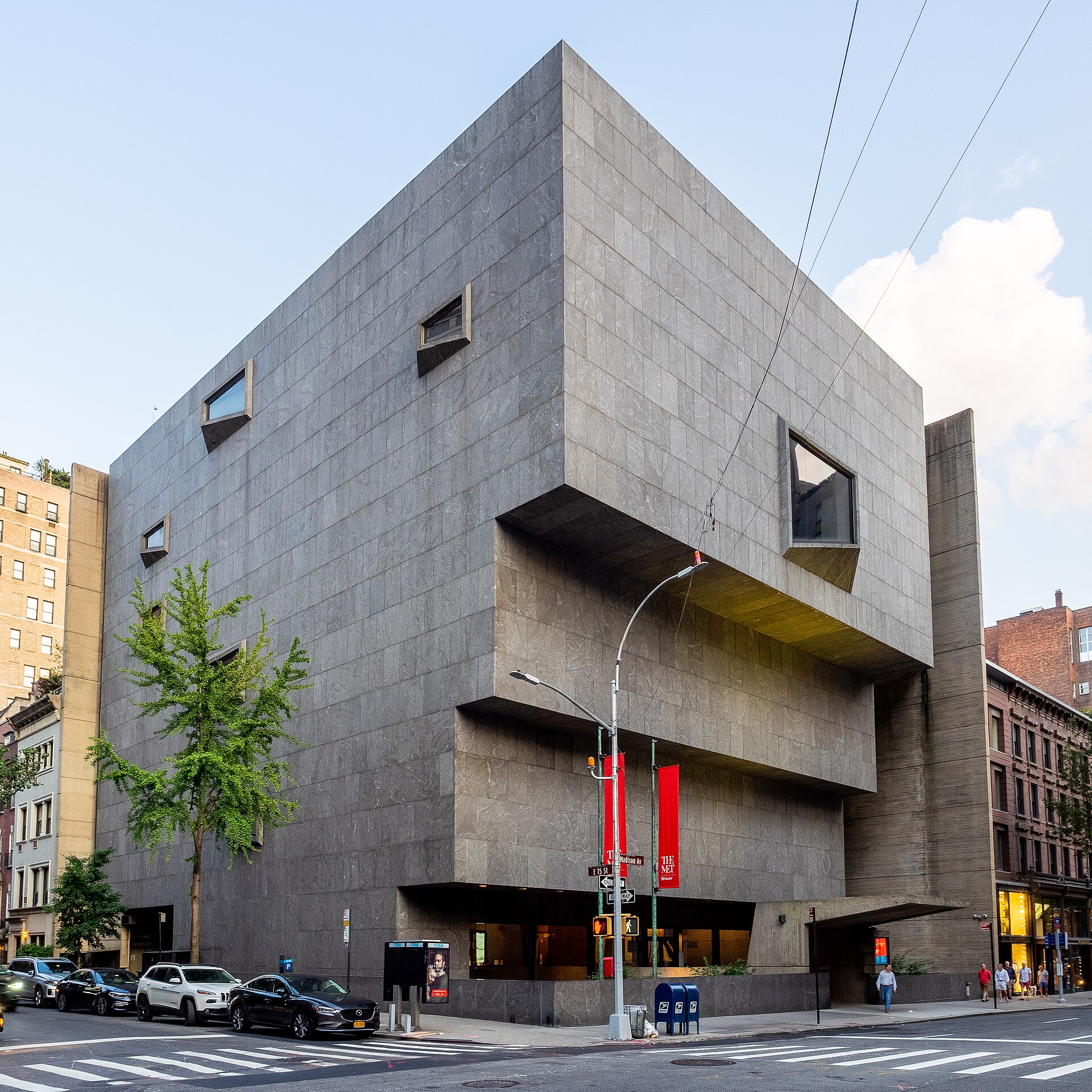
Marcel Breuer's 1966 Whitney building at 945 Madison Avenue, photographed during its years as The Met Breuer. Photograph by Ajay Suresh, via Wikimedia Commons. CC BY 2.0.
Why did the Whitney leave Madison Avenue?
By the 1970s the Breuer building was already too small. The LPC report tracks a long series of expansion attempts. In 1985 the museum hired Michael Graves, whose colorful schemes would have more than doubled the museum's size by building over the Breuer structure; three versions were drawn, and the plan collapsed in controversy. Hamilton Smith wrote in the New York Times that Breuer would rather have seen his museum torn down than disfigured. In 1998 Richard Gluckman completed a restrained expansion into adjacent townhouses that increased gallery space by about 30 percent. A proposed eleven-story tower by Rem Koolhaas was abandoned in 2003, and a Renzo Piano tower design, though approved by the Landmarks Preservation Commission in 2006, was dropped when the museum instead engaged Piano to design a new building downtown.
The new site was in the Meatpacking District, at Gansevoort and Washington Streets, between the High Line and the Hudson River. The city's Economic Development Corporation says the museum broke ground in May 2011 on former City-owned property at the southern entrance to the High Line, and describes a $720 million building and endowment campaign. The New York Times put the building's cost at $422 million. Village Preservation says the trustees had decided in 2008 that the museum needed a new venue after decades of failed expansion plans. The nine-floor, 200,000-square-foot building opened to the public on May 1, 2015. Piano described its cantilevered entrance as a big gesture that turns the area outside into a sheltered public gathering place beneath the High Line, with views through the building to the river.
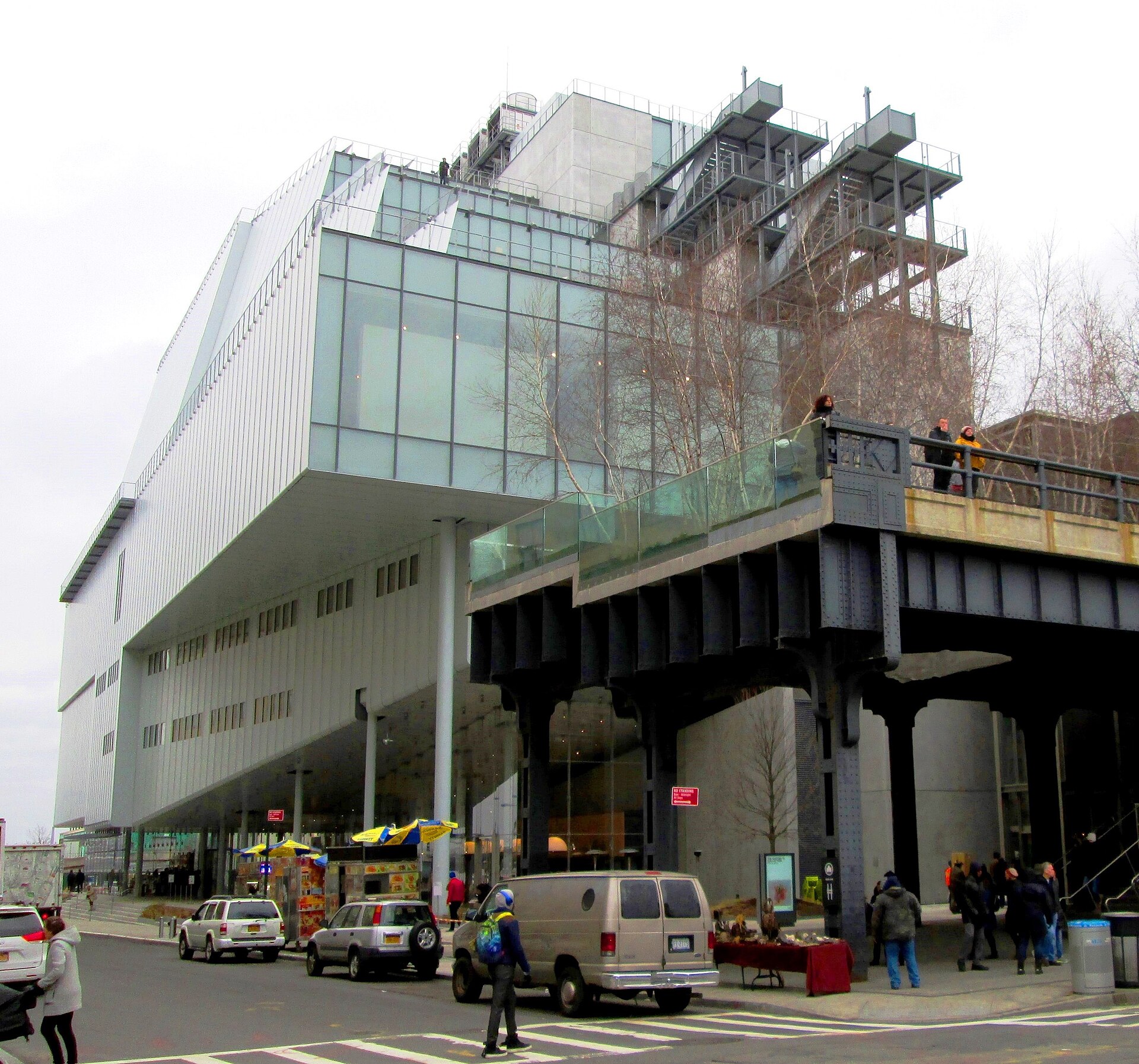
The Whitney at the southern end of the High Line. Photograph by Beyond My Ken, via Wikimedia Commons. CC BY-SA 4.0.
What happened to the Breuer building?
The Whitney's programming at 945 Madison Avenue ended on October 20, 2014. The Metropolitan Museum of Art then moved in: its press office says The Met Breuer opened to the public on March 18, 2016, as the Met's space for modern and contemporary art. After the Met left, the Frick Collection used the building while its own home was renovated; the Frick says Frick Madison ran from March 18, 2021 through March 3, 2024. The auction house Sotheby's then bought the building; the LPC's designation report dates the purchase to 2023, while the Whitney's own Breuer building page says 2024. Sotheby's announced that it opened its new global headquarters there on November 8, 2025, in a renovation by Herzog & de Meuron with PBDW Architects. In between those changes, on May 20, 2025, the Landmarks Preservation Commission voted unanimously to designate the former Whitney both an individual and an interior landmark, calling it an enduring emblem of modern architecture.
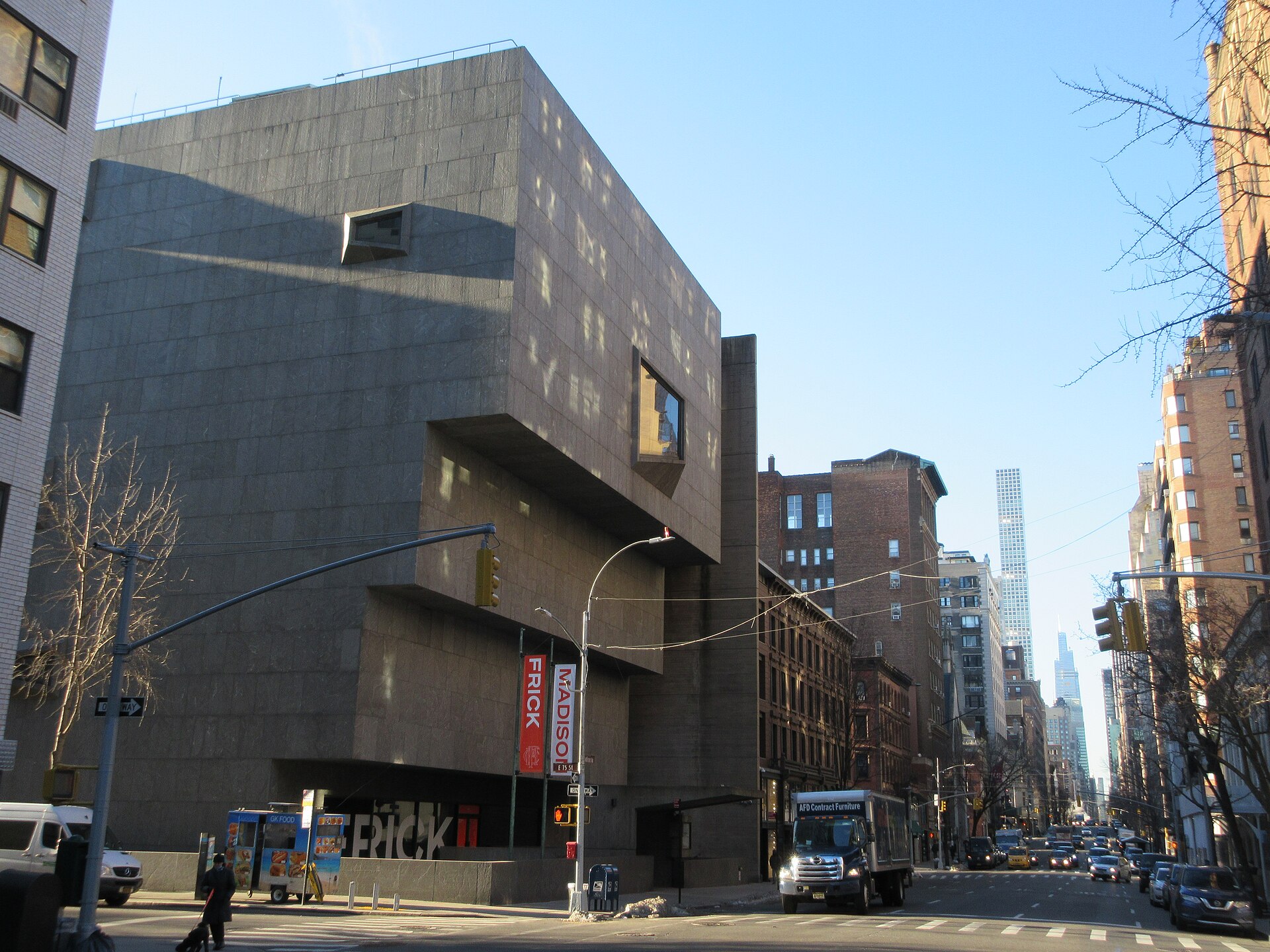
The Breuer building as Frick Madison in 2021. Photograph by Brecht Bug, via Wikimedia Commons. CC BY-SA 2.0.
Who runs the Whitney?
The Whitney Museum of American Art is a private nonprofit museum. Its staff page says Scott Rothkopf became the museum's Alice Pratt Brown Director on November 1, 2023; he had joined the Whitney as a curator in 2009 and rose through its curatorial ranks. The building at 99 Gansevoort Street is the museum's home, and NYCEDC notes the site was formerly City-owned property. I did not find a public source that clearly states the current ownership of the land under the building, so this article does not say.
Where can you eat or drink at the Whitney?
The museum's visit page lists two spots inside the building. Frenchette Café and Bakery, on the first floor, keeps its own hours: 9 a.m. to 6 p.m. most days, closing at 3 p.m. on Tuesdays and staying open until 10 p.m. on Fridays. The Studio Bar, on the eighth floor, follows museum hours more closely: 10:30 a.m. to 5 p.m., closed Tuesdays, and open until 9 p.m. on Fridays. The museum's site notes that hours can change, so confirm before planning around either one. Listings and hours here were read on the official pages on October 21, 2026.
Sources
- Whitney Museum of American Art, History
- Whitney Museum of American Art, The Breuer Building
- New York City Landmarks Preservation Commission, (Former) Whitney Museum of American Art designation report (LP-2685)
- Landmarks Preservation Commission, LPC Designates the (Former) Whitney Museum of American Art as an Individual and Interior Landmark, May 20, 2025
- Village Preservation, Welcome to the New Whitney, August 17, 2015
- New York City Economic Development Corporation, New Whitney Museum
- The New York Times, A New Whitney, April 19, 2015
- The Metropolitan Museum of Art, The Met Breuer Opens to the Public on March 18, 2016
- The Frick Collection, About Frick Madison
- Sotheby's, Sotheby's Opens New Global Headquarters at The Breuer, November 7, 2025
- Herzog & de Meuron, Sotheby's Madison Avenue Opens, November 7, 2025
- Whitney Museum of American Art, Staff Profiles
- Whitney Museum of American Art, Plan Your Visit
Visiting the Whitney Museum
- Address: The museum's visit page lists 99 Gansevoort Street, New York, NY 10014, phone (212) 570-3600, in the Meatpacking District; the A, C, E and L subway lines stop about six blocks away at 14th Street and Eighth Avenue.
- Hours: The visit page lists the museum and shop as open 10:30 a.m. to 6 p.m. on Mondays, Wednesdays, Thursdays, Saturdays and Sundays, 10:30 a.m. to 10 p.m. on Fridays, and closed on Tuesdays.
- Tickets: The visit page lists admission at $30 for adults and $24 for seniors and students, free for visitors 25 and under and for members, with advance tickets recommended. It also lists Free Friday Nights and Free Second Sundays programs.
Facts above come from the Whitney's official visit page. Hours and prices change, so confirm on the museum's site before going.