The TWA Flight Center: When an Airport Learned to Fly
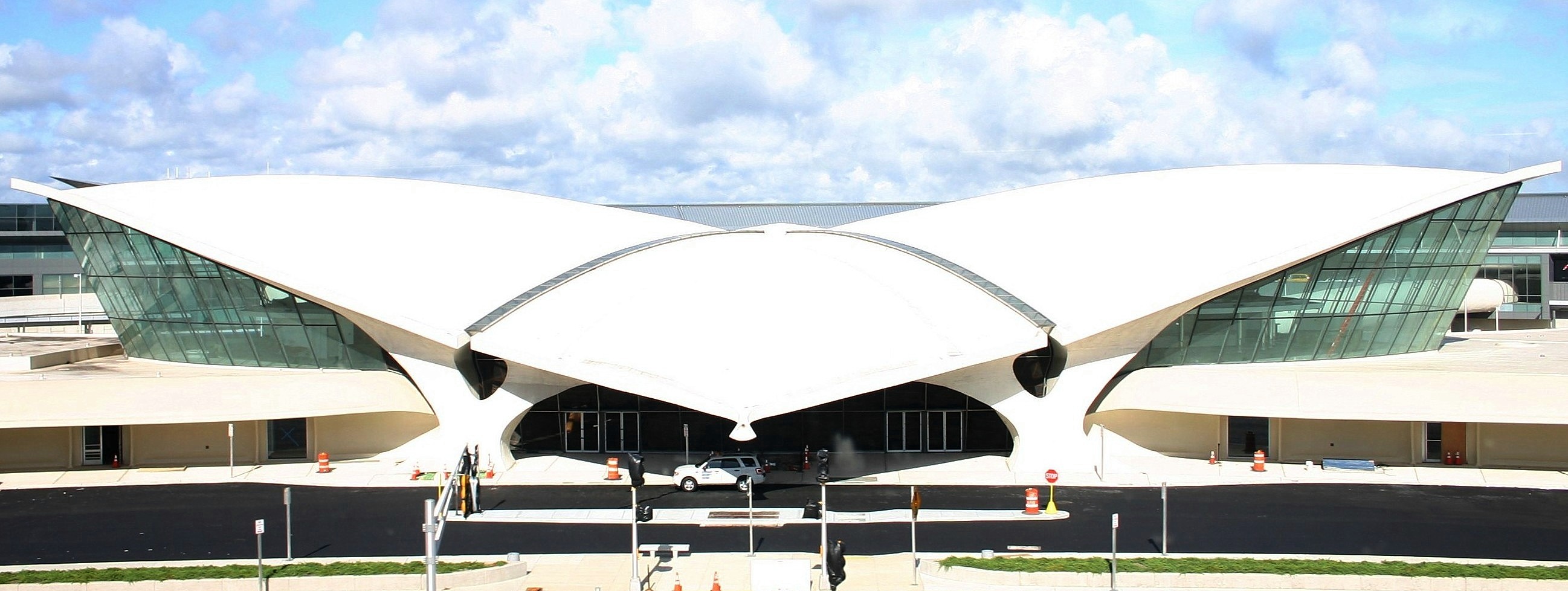
TWA Flight Center in 2010. Photograph by Roland Arhelger, via Wikimedia Commons. CC BY-SA 4.0.
At John F. Kennedy International Airport, Eero Saarinen's TWA Flight Center looks less like a terminal than a bird preparing to leave the ground. Its white concrete shells spread outward from a narrow center, while glass walls, curving bridges, and red-carpeted passageways turn passenger circulation into theater. Opened in 1962, the building gave architectural form to the optimism of the early jet age. Its survival, closure, and rebirth as a hotel show how difficult it can be to preserve a building designed for technology that quickly changes.
Trans World Airlines hired Saarinen's firm in 1956 to create its own terminal at what was then Idlewild Airport. At the time, airlines used architecture as part of their public identity. TWA wanted a building that would make flight feel modern before a passenger ever boarded an airplane. Saarinen's team responded with a plan in which structure, movement, furniture, signs, and color worked as one composition.
The terminal's most recognizable feature is its reinforced-concrete roof. Four thin shells meet at the center and sweep upward at their edges. The shape is often compared to a bird, although Saarinen resisted treating it as a literal sculpture. The roof grew from the interior program: ticketing, baggage, waiting areas, and circulation were gathered beneath one continuous space. From inside, broad windows opened views toward aircraft on the apron, making the machines outside part of the architecture.
Movement was carefully choreographed. Stairs divided and rejoined, bridges crossed the main hall, and enclosed flight tubes curved away toward satellite gates. Instead of hiding the process of getting through an airport, the design made it visible. TWA's red carpets and custom graphics reinforced the sense that passengers were entering a complete designed world.
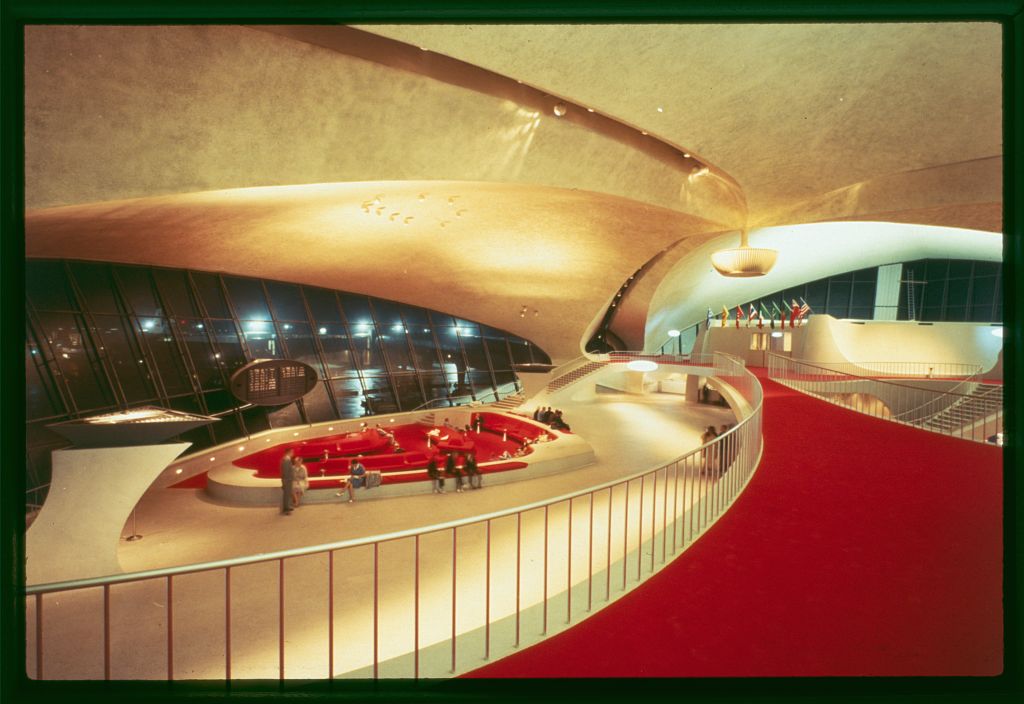
Historic interior of the TWA Flight Center, 1956-62. Photograph by Balthazar Korab. Library of Congress; no known restrictions.
The Flight Center opened on May 28, 1962. Saarinen did not live to see it completed; he died in 1961 at age 51. The building became one of his best-known works, but aviation technology was already moving faster than the terminal. Wide-body aircraft, larger passenger volumes, new security requirements, and changing baggage systems demanded more space and different circulation. Additions altered the complex, yet the original head house remained increasingly difficult to operate as a modern terminal.
New York City designated the exterior and portions of the interior as landmarks in 1994. That early protection proved important after TWA's financial decline. The airline ceased operations in 2001, and the Flight Center closed. JetBlue later built a new terminal behind it, leaving Saarinen's structure preserved but without its original function. The challenge was to find a use that respected the landmark while connecting it to a working airport.
A long preservation and development process produced the TWA Hotel, which opened in 2019. The original Flight Center became the hotel's lobby, dining, and public space. Two new guest-room wings were built behind it, shaped to defer to Saarinen's central structure. A restored Lockheed Constellation aircraft sits nearby as a cocktail lounge, reinforcing the building's connection to TWA's mid-century image.
The conversion is not a return to 1962. It is an adaptation that changes how people use the landmark. Travelers no longer check in for TWA flights beneath the shells, but they can move through the original hall, bridges, and flight tubes. The building remains connected to aviation rather than becoming an isolated museum object.
The TWA Flight Center endures because its architecture captured an emotion as much as a function. Saarinen made air travel feel graceful, public, and slightly glamorous. Airports no longer work the way they did in 1962, but the building still shows what New York once believed flight could be.
Sources
- New York City Landmarks Preservation Commission, TWA Flight Center designation report: http://s-media.nyc.gov/agencies/lpc/lp/1915.pdf
- Library of Congress, Historic American Buildings Survey, TWA Flight Center: https://www.loc.gov/item/ny2019/
- Port Authority of New York and New Jersey, “Giving New Life to a JFK Temple of Flight”: https://portfolio.panynj.gov/2017/03/24/flashback-friday-giving-new-life-to-a-jfk-temple-of-flight/
- Beyer Blinder Belle, TWA Hotel restoration and adaptation: https://www.beyerblinderbelle.com/work/view/twa-hotel/