The New York State Pavilion: Queens’ Space-Age Ruin Moves Toward Renewal
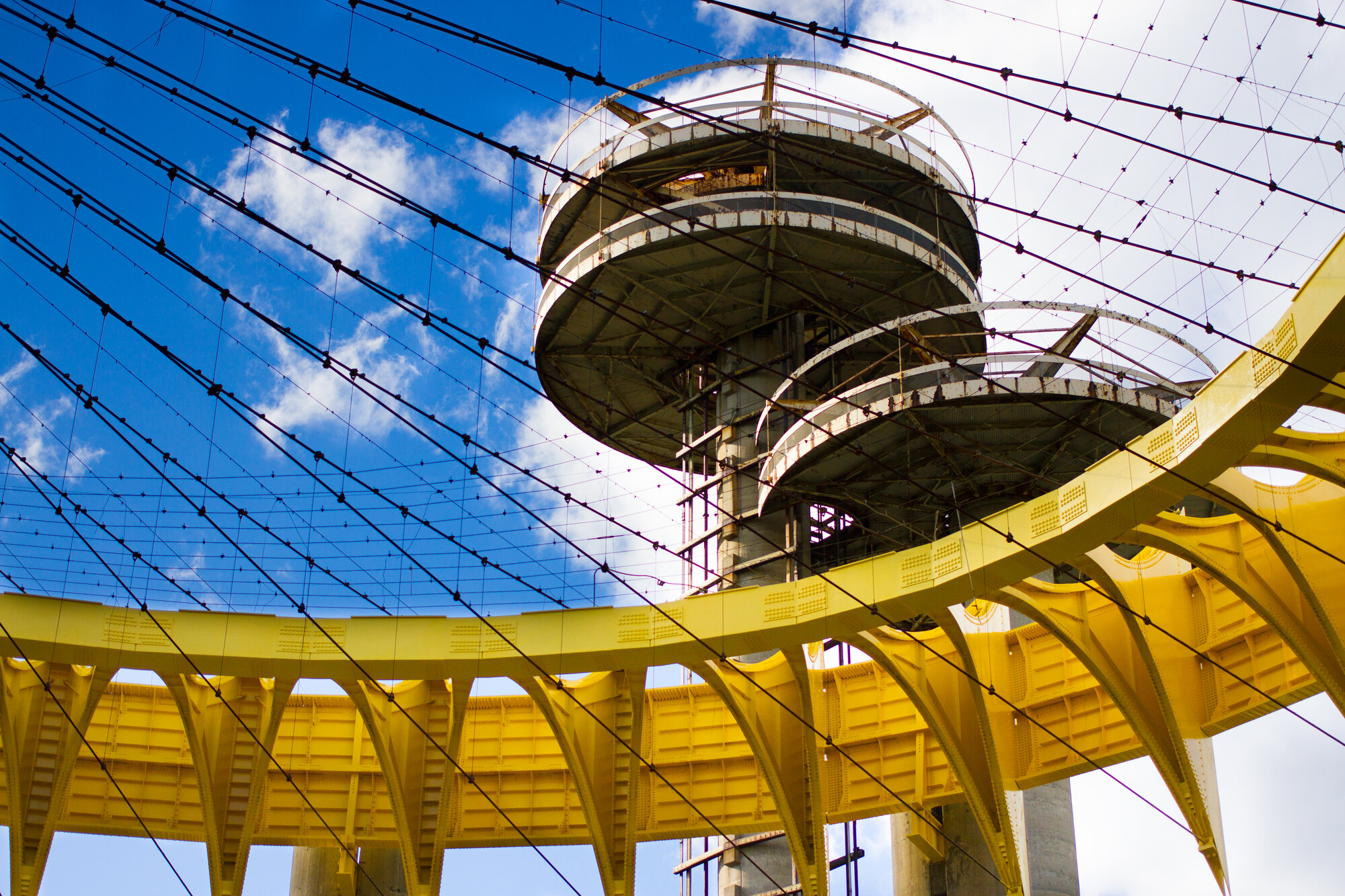
New York State Pavilion in 2015. Photograph by Erin Slonaker, via Wikimedia Commons. CC BY-SA 4.0.
Few New York structures make time visible as dramatically as the New York State Pavilion in Flushing Meadows Corona Park. Its vast elliptical Tent of Tomorrow, three observation towers and former Theaterama were built to embody the future at the 1964-65 New York World’s Fair. Six decades later, the surviving complex is both a landmark of postwar optimism and a case study in the slow, difficult work of preserving experimental architecture.
A State Showcase for the World’s Fair
Governor Nelson Rockefeller commissioned architect Philip Johnson to create a pavilion worthy of the fair’s host state. Johnson worked with architect Richard Foster and structural engineer Lev Zetlin. Commissioned in 1962 and completed two years later, their design was an ensemble rather than a conventional building: the open-air Tent of Tomorrow, three observation towers and the cylindrical Theaterama.
The Tent was the centerpiece. Sixteen hollow concrete columns, each 100 feet high, carried a 2,000-ton cable roof whose roughly 1,500 translucent fiberglass panels formed a brightly colored canopy. The tent’s terrazzo floor was an enormous map of New York State. National Park Service documentation describes the 130-by-166-foot map as the world’s largest road map and the 240-by-320-foot roof as the world’s largest suspended roof at the time.
The observation towers gave the pavilion its unmistakable skyline. Their platforms rose to different heights, with the tallest reaching 226 feet. Fairgoers rode “Sky Streak” capsule elevators to the upper levels; the two shorter towers contained cafeterias, while the tallest offered a viewing deck. According to the National Park Service, Johnson said the towers were added after Rockefeller insisted that New York State’s pavilion be the fair’s tallest structure. Rockefeller announced on opening day that extra money had been spent on the towers’ foundations so they could remain after the fair.
The Theaterama completed the group. During the fair, art appeared on its exterior and films played inside. It later became a theater and survives in active use today as Queens Theatre, giving one part of the original pavilion a continuous civic life that the Tent and towers did not share.
From Attraction to Ruin
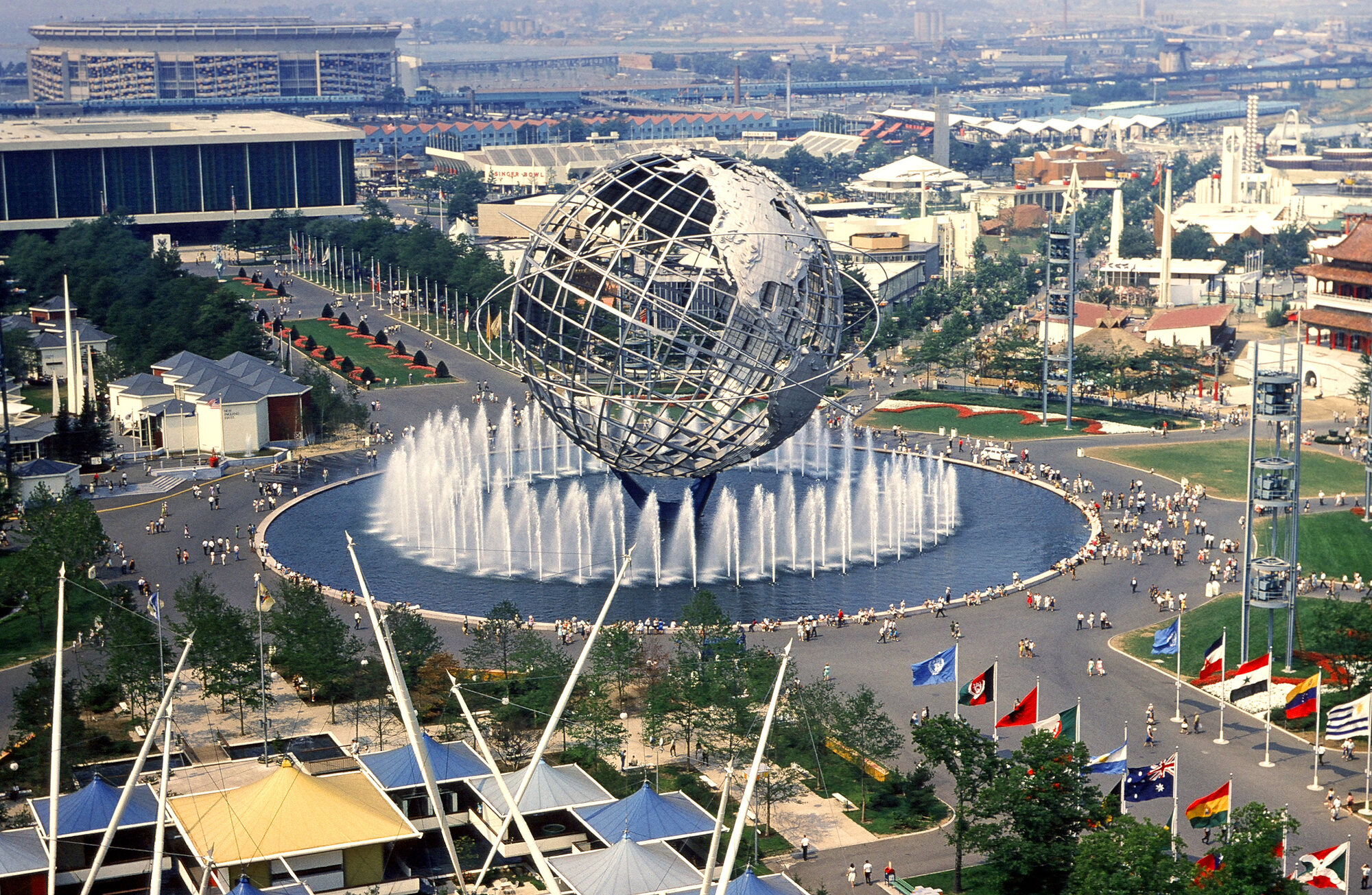
The 1964 New York World’s Fair. Photograph by Anthony Conti, via Wikimedia Commons. CC BY-SA 2.0.
The pavilion was meant to outlast the fair, but permanence did not come with a durable operating plan. In July 1965, New York State transferred it to New York City. The Tent found occasional later use, including as a roller rink, but the city closed it in 1974 after the roof panels became hazardous. The panels were removed in 1976. The observation decks and their elevators also fell out of use, leaving the exposed rings, cables and platforms that became familiar to generations of park visitors.
That decay changed the pavilion’s meaning. What began as a polished advertisement for government, technology and modern design became a romantic ruin. Its strangeness kept it culturally visible, while engineers and preservation groups argued that the remaining structures deserved more than demolition. The pavilion entered the National Register of Historic Places in 2009, recognized for its architectural, engineering and cultural importance.
The immense terrazzo road map presented a special conservation problem. Portions were removed and restored, while much of the surviving floor was protected under layers of sand, fabric and gravel. Volunteers also helped keep public attention on the complex. A 2015 painting campaign returned the Tent’s steel to its original bright “American Cheese Yellow,” with donated labor creating a protective coating as well as a visible symbol of momentum.
Preservation in Progress
Public investment has since moved from studies to construction. In 2019, NYC Parks broke ground on a $24 million preservation project for the observation towers. The work included structural conservation, waterproofing at the tower bases, new stairs, electrical upgrades and architectural lighting.
The city’s current capital-project tracker shows a second phase in active construction. It lists $56.756 million in total funding and an adjusted completion date of October 2026. This phase is described as reconstructing portions of the observation towers. The timetable may continue to change, but the larger shift is clear: the pavilion is being treated as public architecture worth retaining, rather than as leftover scenery awaiting a final decision.
The New York State Pavilion still sits between ruin and reuse. The Tent remains open to the sky, its map largely hidden for protection, and full public access to the towers has not returned. Yet the structures have survived long enough for restoration to become real. Their appeal comes partly from that unfinished condition. They preserve the confidence of 1964, the neglect that followed and New York’s more recent willingness to care for a difficult modern monument.
Sources
- National Park Service, “Investigating and Understanding the New York State Pavilion’s Tent of Tomorrow and Observation Towers”: https://www.nps.gov/articles/000/investigating-and-understanding-the-new-york-state-pavilion-s-tent-of-tomorrow-and-observation-towers.htm
- National Register of Historic Places, New York State Pavilion record: https://npgallery.nps.gov/AssetDetail/NRIS/09000942
- NYC Parks, “NYC Parks Breaks Ground on $24 Million Project to Preserve Historic World’s Fair Pavilion Towers,” November 8, 2019: https://www.nycgovparks.org/news/press-releases?id=21720
- NYC Parks Capital Project Tracker, “New York State Pavilion Observation Towers Reconstruction - Phase 2”: https://www.nycgovparks.org/planning-and-building/capital-project-tracker/project/10751
- NYC Parks, “Tent of Tomorrow Painting Project Preserves and Beautifies Historic World’s Fair Structure,” October 15, 2015: https://www.nycgovparks.org/sub_newsroom/press_releases/press_releases.php?id=21342