Brooklyn Army Terminal: A Concrete Machine for Moving a Nation
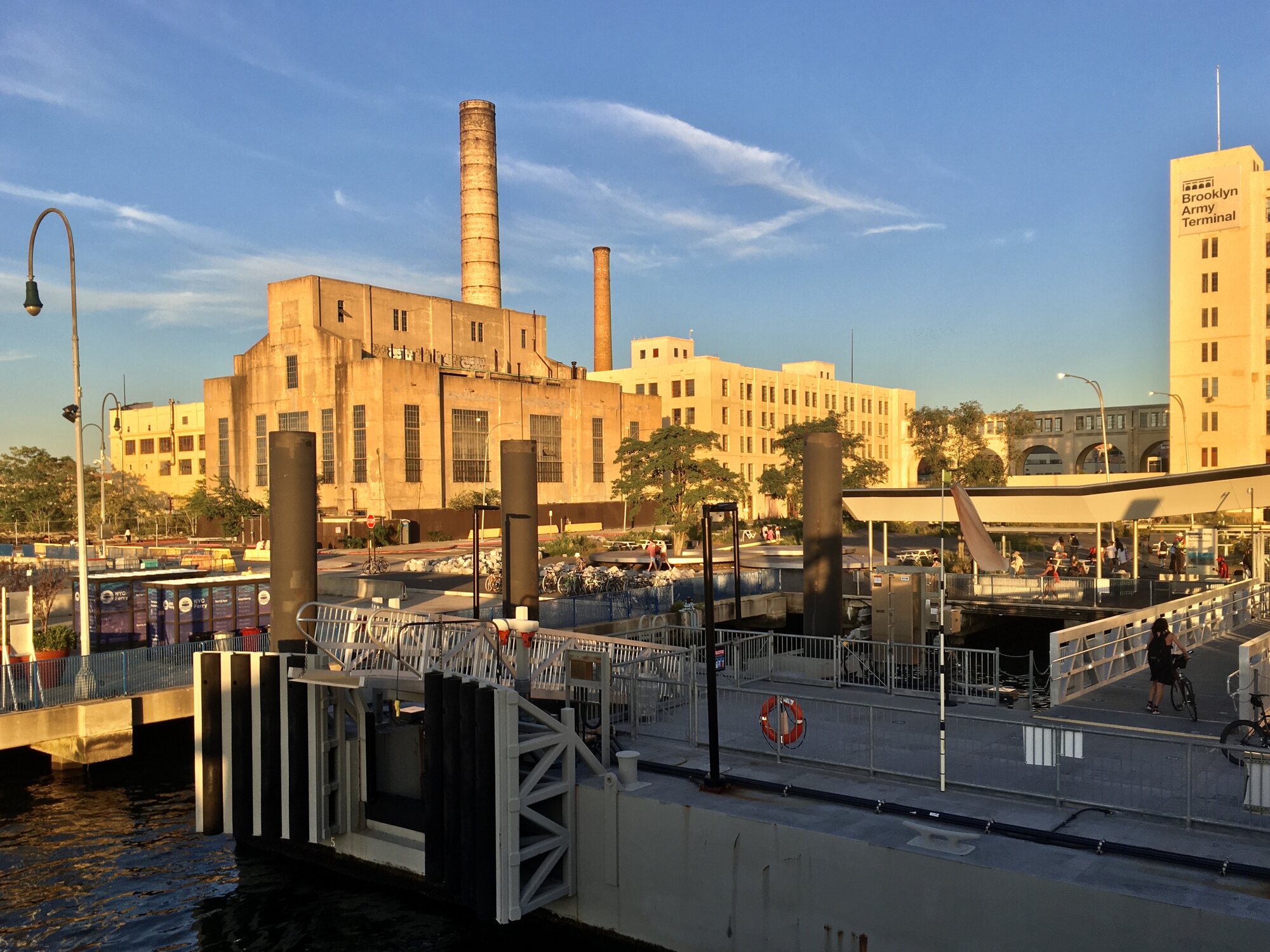
Brooklyn Army Terminal in 2020. Photograph by Andre Carrotflower, via Wikimedia Commons. CC BY-SA 4.0.
Along the Sunset Park waterfront, the Brooklyn Army Terminal stretches from 58th to 65th streets like a city built for cargo. Its enormous warehouses, piers, rail lines, bridges, cranes, and loading platforms were designed to move supplies between trains and ships with industrial speed. Built during World War I and expanded into one of the country's busiest military transportation centers, the complex is now a working example of how New York can reuse heavy infrastructure without erasing its history.
The federal government commissioned the terminal in 1918, when the United States urgently needed better embarkation and supply facilities on New York Harbor. Architect Cass Gilbert, best known for the Woolworth Building, designed the complex. Construction advanced with wartime urgency, using reinforced concrete on a scale that made the project one of the largest poured-concrete structures of its day.
Two vast warehouses dominated the site. Building A stood close to the waterfront. Behind it, Building B enclosed a spectacular central atrium crossed by rail tracks. Staggered concrete balconies projected into that space so cranes could lift freight directly from railroad cars to almost any level. Bridges linked the buildings, while piers connected the base to deep-water shipping. The result was less a conventional building than a three-dimensional logistics system.
The timing was imperfect. The armistice ending World War I came before the terminal could fulfill its original wartime purpose. The Army nevertheless kept the base and used it for storage and transport during the following decades. Its greatest period of activity arrived during World War II. The Brooklyn Army Terminal's official history states that more than 25,000 military and civilian workers were employed there at the peak, while supplies and personnel moved through the harbor on a global scale.
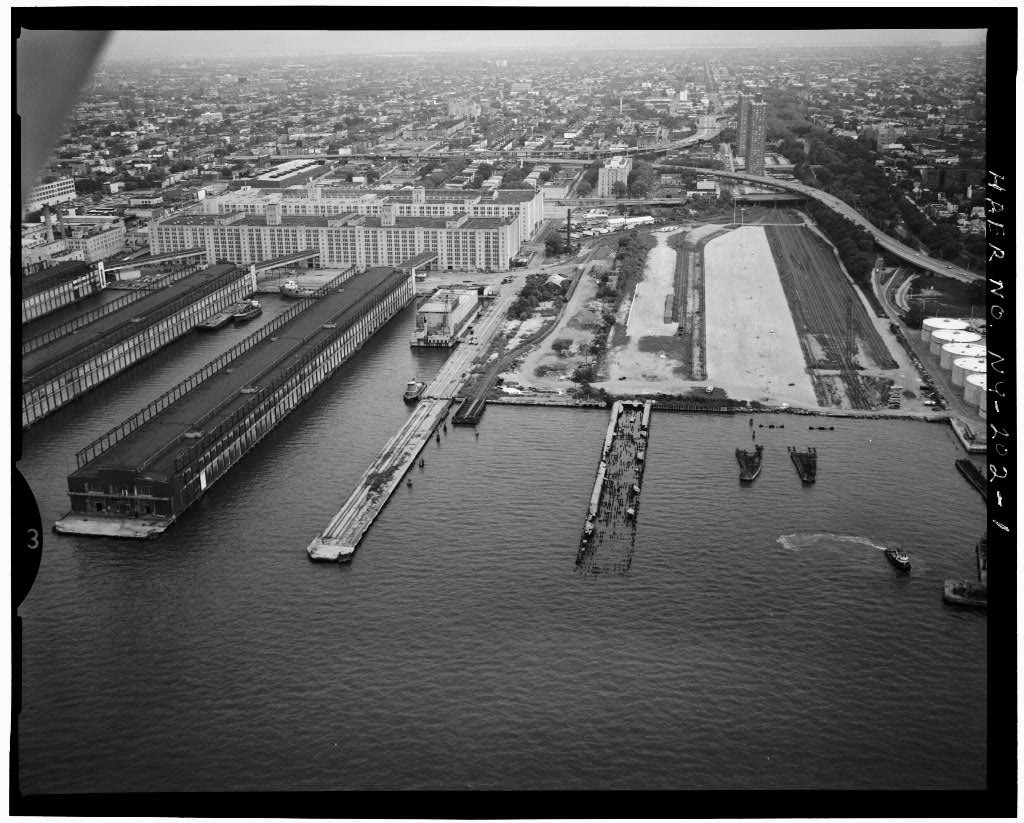
Historic aerial view. Historic American Engineering Record, Library of Congress. Public domain.
For many service members, the terminal was a last view of New York before an overseas posting. That history continued after the war. In 1958, Elvis Presley departed from the terminal for Army service in Germany, a widely photographed event that connected the industrial complex to popular culture. Yet the larger story belongs to the millions of less-famous people and countless tons of equipment that passed through the same system.
The military closed the installation in 1966. Government agencies and private tenants continued to use parts of the campus, but by the 1970s the complex had entered a long period of uncertainty. Its great size was an obstacle as well as an asset: demolishing it would be costly, but bringing its aging infrastructure back into useful condition required major investment.
New York City bought the terminal in 1981. Since 1986, the New York City Economic Development Corporation has managed it and carried out successive renovations. Today the 59-acre campus contains more than 100 businesses and roughly 3,500 jobs. Manufacturing remains its defining purpose: NYCEDC describes tenants in food production, fashion, clean technology, audiovisual design, upcycling, prototyping, and other industrial fields. Those businesses also use office, studio, design, and administrative space within the complex, while on-site services include a café, childcare, banking, and workforce programs. So it is fair to say that the terminal includes offices and some retail-like amenities, but NYCEDC markets and leases it chiefly as an industrial and manufacturing campus, not as a conventional office or shopping center. The atrium, grounds, and waterfront also host public and cultural events.
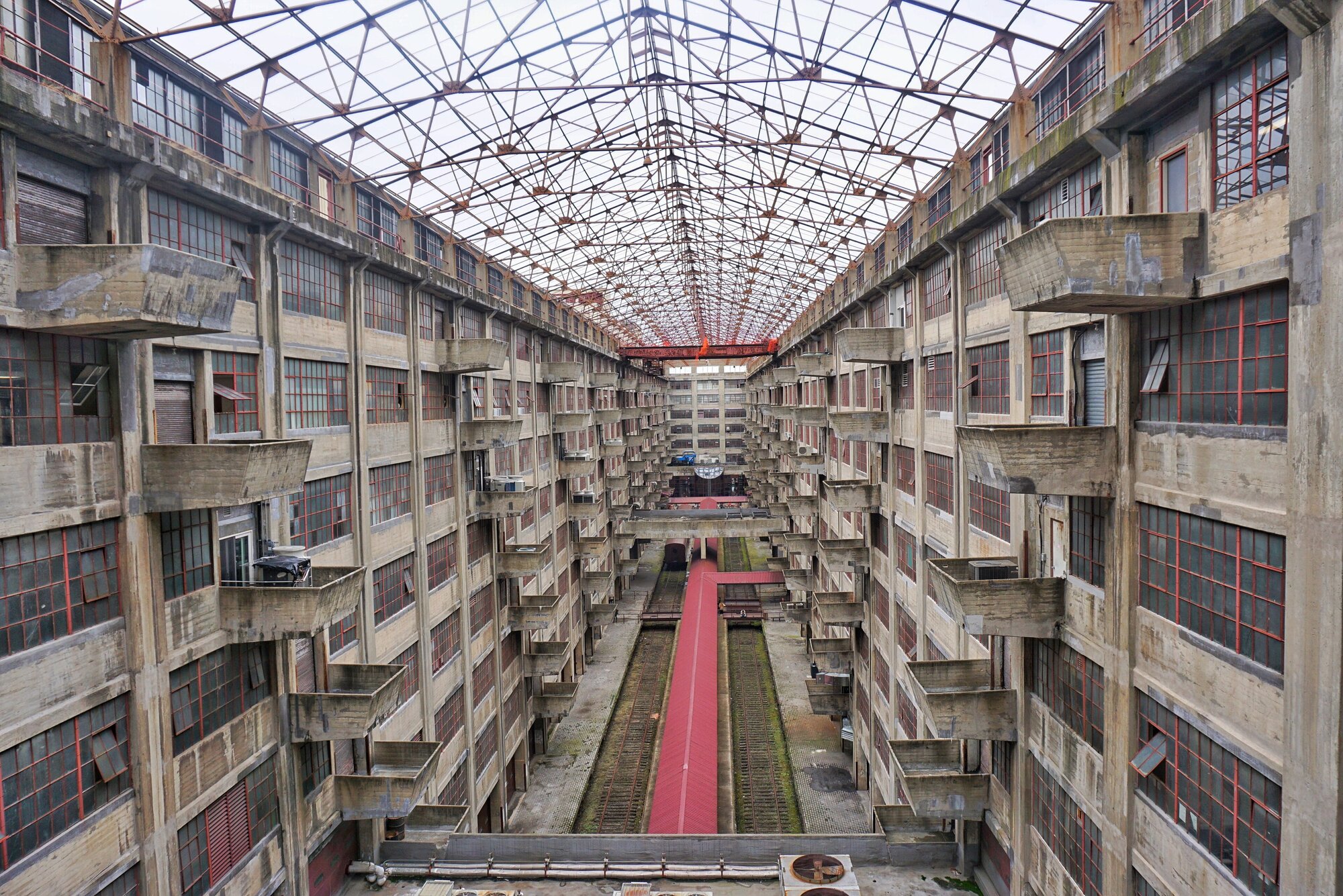
Building B’s central atrium, a shared space around the campus’s industrial, office, studio, and service uses, October 2018. Photograph by Rkadin, via Wikimedia Commons. CC BY-SA 4.0.
That reuse preserves the terminal's most important architectural lesson. Gilbert did not decorate a warehouse to resemble a monument. He made movement itself monumental: rail cars entered the building, cranes rose through the atrium, and concrete platforms turned vertical space into an assembly line. The system is still legible even when the cargo has changed.
Brooklyn Army Terminal matters because it links two versions of New York's waterfront. One was a military and industrial harbor tied to rail and ocean shipping. The other is a modern city trying to retain manufacturing jobs while opening parts of the shoreline to new uses. In Sunset Park, both histories occupy the same concrete frame.
Sources
See the fully linked source list in the review draft. Sources include the official Brooklyn Army Terminal history and Library of Congress engineering documentation.