The South Street Seaport: From the Street of Ships to the Festival Marketplace and Back
For two hundred years the few blocks where Fulton Street meets the East River were the busiest piece of waterfront in America. The packet ships that made New York rich sailed from here, the Fulton Fish Market fed the city from here, and when the shipping left, the neighborhood was saved twice: first by a young couple with a mimeograph machine who founded a museum, and then by the shopping-festival developers who made it a tourist attraction. Today's Seaport is a layered thing - an 1811 counting-house row, a memorial to the Titanic, a museum fleet of tall ships, and a rebuilt pier and food hall that opened within the last decade.
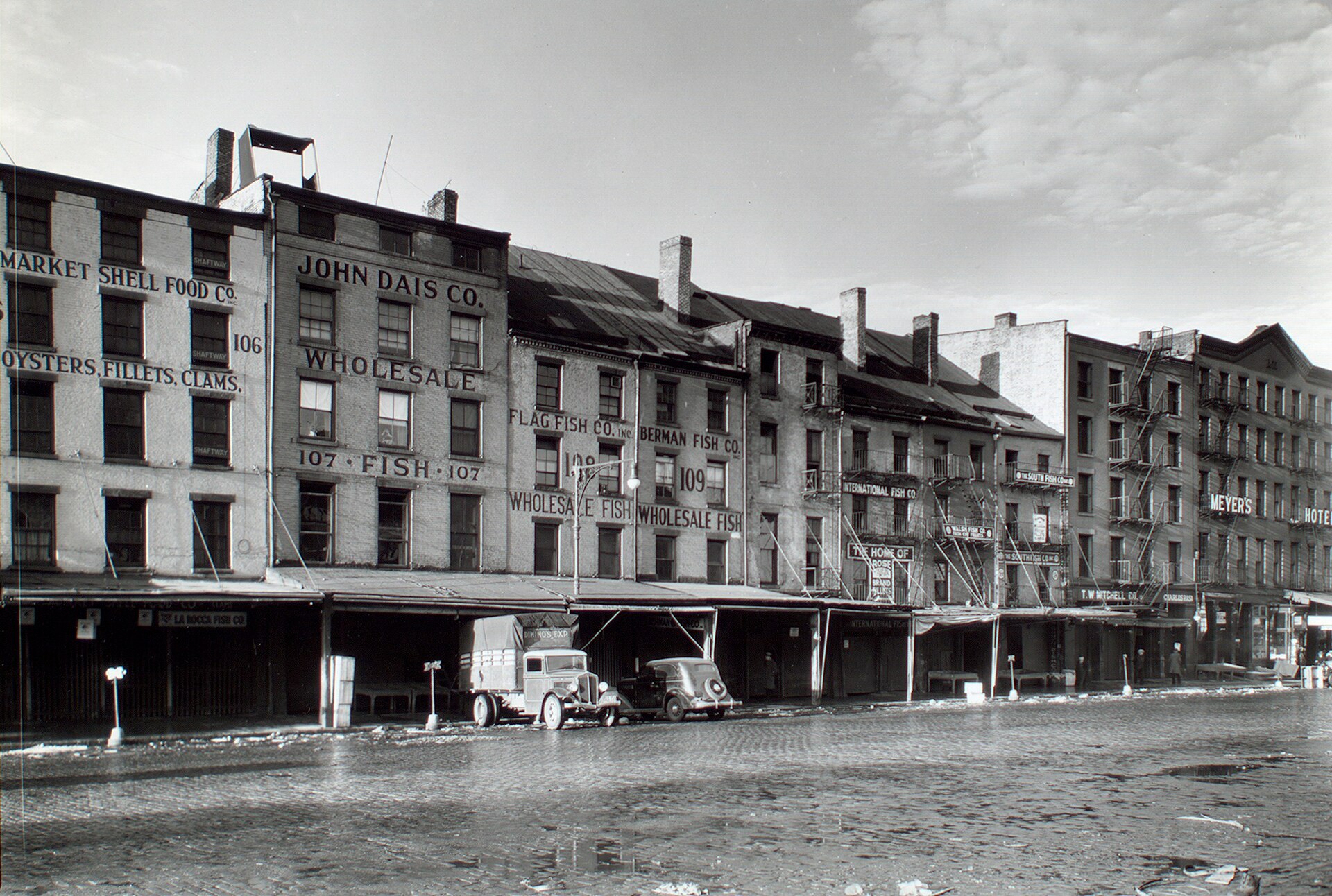
Fish dealers and the Meyers Hotel in the row of buildings along South Street, photographed by Berenice Abbott on November 26, 1935. Via the New York Public Library and Wikimedia Commons. Public domain.
How did the Seaport begin?
Wikipedia traces the first pier here to 1625, when the Dutch West India Company founded an outpost on the East River shore. The original shoreline was today's Pearl Street, named for the shells on the beach; the river was then filled in stages, and the docks reached Water Street, then Front Street, and finally South Street by the beginning of the 19th century. The East River side had the advantage of shelter from the westerly winds and ice that troubled the Hudson piers.
The trade followed quickly. In 1728 the Schermerhorn family opened trade with Charleston, South Carolina, bringing rice and indigo north. On February 22, 1784, the Empress of China sailed from the port for Guangzhou, opening American trade with Qing China. On January 5, 1818, the 424-ton packet James Monroe sailed for Liverpool as the first departure of the Black Ball Line, the first regular scheduled transatlantic service. When the Erie Canal opened in November 1825, the goods of the new western states funneled through the same wharves. A fire on the night of December 17, 1835 destroyed 17 blocks of the district, but the port rebuilt, and by 1850 it was at its peak - a contemporary description quoted on Wikipedia recalls the riverfront from Coenties Slip to Catharine Street so crowded with clippers and packets that their bowsprits reached nearly across South Street.
What is Schermerhorn Row?
The architectural heart of the district is Schermerhorn Row, the block of counting-houses along Fulton Street. The Landmarks Preservation Commission's 1977 designation report calls it one of the finest rows of early commercial architecture in the city. The LPC report says the six buildings were built for Peter Schermerhorn, a merchant and ship owner, beginning in 1811 - the New York Preservation Archive Project gives 1812 - in the Georgian-Federal style. Schermerhorn had bought the land in 1793, when it was still a string of water lots; the report says the site was partially filled by 1797 and completely filled by 1807. Robert Fulton's Brooklyn ferry soon began landing at Schermerhorn's wharf at the foot of the street, and the Fulton Market's move to Fulton Street in 1822 made the block a focal point of the port.
The row was designed as warehouses with counting rooms, leased to other merchants. It is individually designated as a New York City landmark, and it anchors the larger historic district. The Historic Districts Council dates the district's designation to May 10, 1977, with an extension on July 11, 1989; Wikipedia notes the area also went on the National Register of Historic Places on October 18, 1972. The LPC report's argument for the district is simple: it preserves the city's history as the nation's major port after the Erie Canal, in the largest concentration of restored early 19th-century commercial buildings in New York.
What was the Fulton Fish Market?
The Fulton Fish Market opened in 1822 and became the city's great seafood bazaar. Wikipedia records that the first market building burned in 1878 and was replaced with a red-brick Victorian building four years later, and that the Tin Building opened within the market in 1907 - it is one of two surviving market structures and the only one that is itself a designated landmark. The market outlasted the decline of the port around it: as ships grew larger and the East River docks proved too shallow, cargo moved to the West Side and Hoboken by the 1930s, but the fishmongers stayed. In 2005 the Fulton Fish Market finally left, moving to Hunts Point in the Bronx. The Tin Building itself was badly damaged by a fire in 1995 and sat in limbo for two decades.
Who saved the Seaport?
Peter and Norma Stanford. The New York Preservation Archive Project's biography records that the couple founded Friends of South Street in 1966 to advocate for the district, and that the South Street Seaport Museum followed in June 1967 - the museum's own site gives the founding year as 1967. The Stanfords quit their uptown jobs for the cause; Peter Stanford told The New York Times in 1998 that they had watched the barren plazas going up downtown and "knew we were racing the bulldozer." Ada Louise Huxtable, the Times's architecture critic, called their campaign "the first really promising preservation venture that the city has undertaken." At the time, developers were buying the same old buildings with demolition in mind; Wikipedia records that one developer, Atlas-McGrath, ultimately gave the museum the Schermerhorn Row buildings it wanted in exchange for the sites' air rights.
The museum became a fleet as well as a set of buildings. Its own site lists the 1885 tall ship Wavertree, the 1885 schooner Pioneer, the 1908 lightship Ambrose and the 1930 tugboat W.O. Decker. Stanford was eased out in 1976 as the board brought in business managers, but the district he championed won landmark protection in 1977.
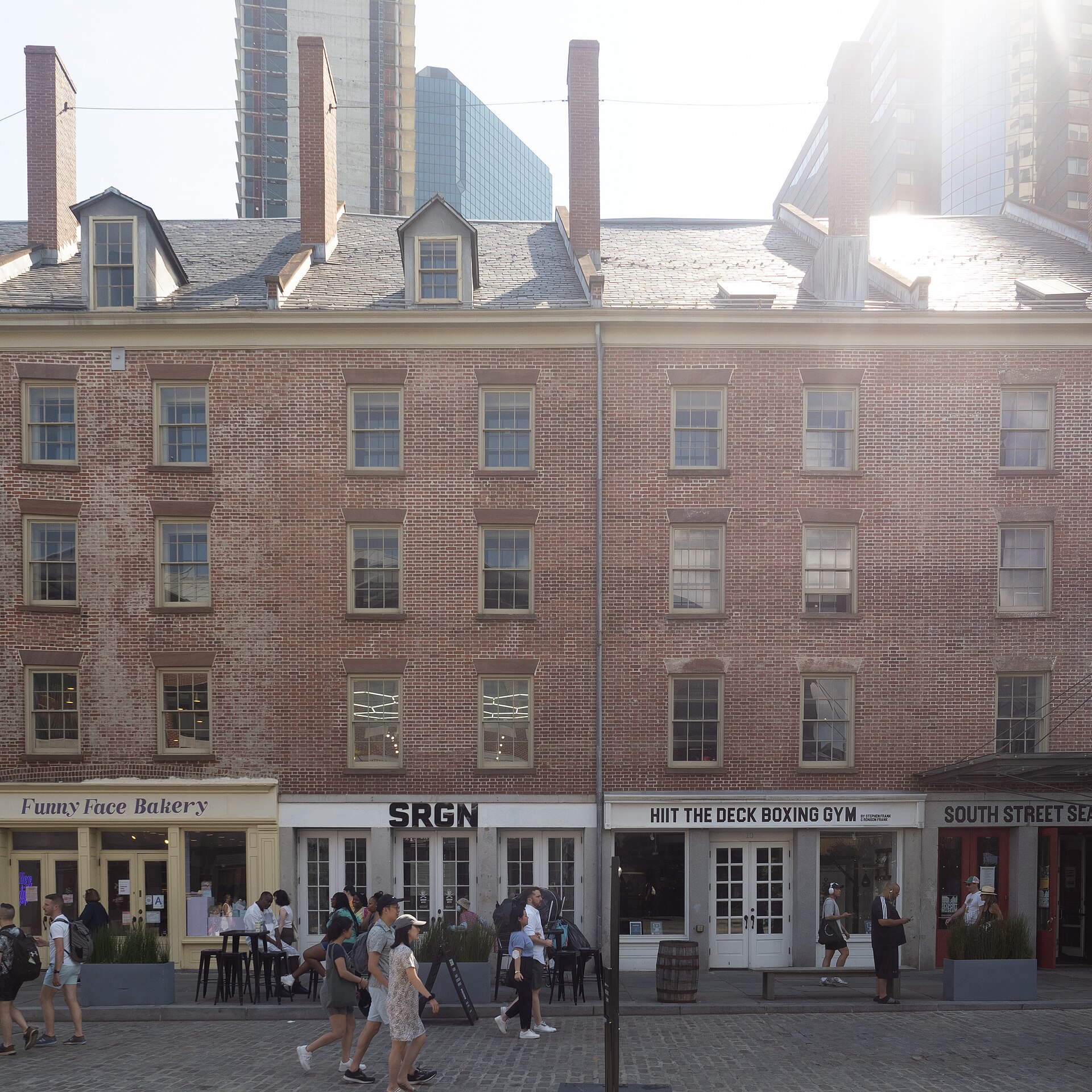
Schermerhorn Row, built for Peter Schermerhorn beginning in 1811, photographed in 2022. Photograph by Ajay Suresh, via Wikimedia Commons. CC BY 2.0.
What is the Titanic Memorial Lighthouse?
At Fulton and Pearl Streets stands a small lighthouse that began life on a rooftop. The Seaport Museum's history page says it was dedicated on April 15, 1913, one year to the day after the Titanic sank, on the roof of the Seamen's Church Institute at South Street and Coenties Slip, 240 feet above the street. The memorial was a nationwide public subscription: the museum records checks from wealthy socialites like Grace Vanderbilt and pennies from schoolchildren. Warren & Wetmore, the architects of Grand Central Terminal, designed the tower, and its time ball - a four-foot bronze-framed sphere - dropped every day at noon from November 1, 1913, activated by telegraphic signal from the Naval Observatory, so that Lower Manhattan could set its watches.
When the Seamen's Church Institute moved out in 1968, the building was to be demolished. Peter Stanford wrote to the demolition company that destroying the memorial would dishonor the victims within the lifetimes of those who remembered them, and the Kaiser-Nelson Steel and Salvage Corporation donated the tower's top to the museum in July 1968. With funds from Exxon, it was erected on its current spot in May 1976. The museum says a restoration it commissioned from preservation architects Jan Hird Pokorny Associates, approved by the Landmarks Preservation Commission, was completed in summer 2026, with a new time ball cast from the original.
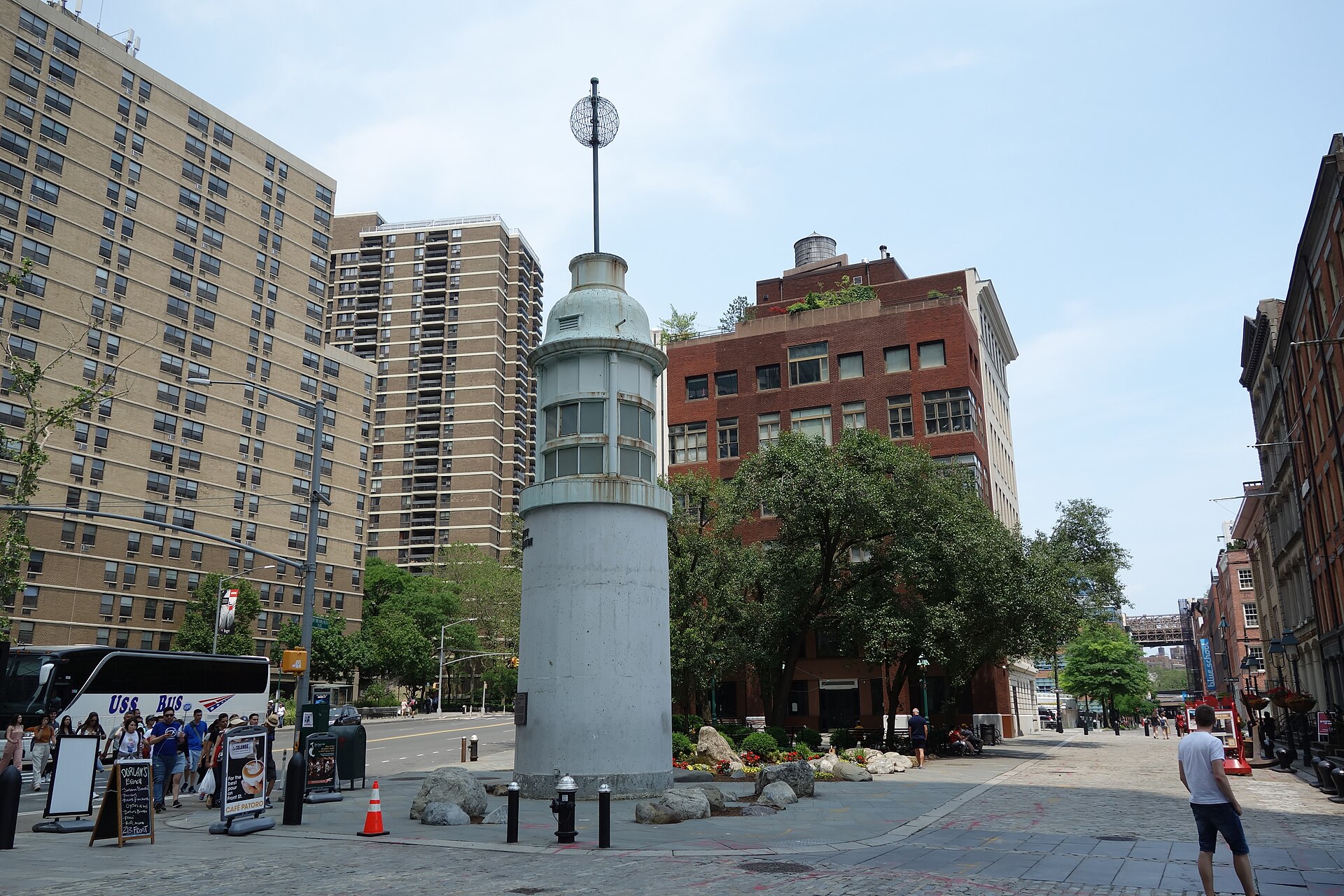
The Titanic Memorial Lighthouse in 2019, before its 2026 restoration. Photograph by Tdorante10, via Wikimedia Commons. CC BY-SA 4.0.
What did the Rouse Company build, and what replaced it?
By the mid-1970s the museum had ships and buildings but little money, and it went looking for a commercial partner. In December 1977 the museum and the Rouse Company - the Baltimore developer behind Boston's Faneuil Hall Marketplace - each put $250,000 into a feasibility study. Wikipedia records that the first phase of the festival marketplace opened July 28, 1983, including a new Fulton Market building of about 95,000 square feet designed by Benjamin C. Thompson, plus the renovation of 14 museum buildings and 12 buildings on Schermerhorn Row. The second phase, the three-story Victorian-style Pier 17 Pavilion, also by Thompson, opened September 11, 1985 with roughly 120 to 150 shops and restaurants. The Seaport became one of the city's biggest tourist draws.
The marketplace era ended in pieces. The museum ceded the Fulton Market back to the city in 1993. General Growth Properties bought Rouse in 2004, proposed towers, and went bankrupt in 2009; the Howard Hughes Corporation took over the Seaport, which Wikipedia says cost $305 million for the lease. The museum closed in March 2011, reopened in January 2012 after a $2 million grant from the Lower Manhattan Development Corporation, and was knocked back again by Hurricane Sandy that October. The Pier 17 Pavilion closed on September 9, 2013 and was demolished the following year.
What stands now is Howard Hughes' rebuild. A new four-story Pier 17 designed by SHoP Architects opened in July 2018 at a cost Wikipedia puts at $425 million, with the 3,500-capacity Rooftop at Pier 17 concert venue above it, programmed with Live Nation. Then, in September 2022, came the Tin Building by Jean-Georges. Howard Hughes' opening announcement describes a 53,000-square-foot culinary marketplace on the site of the old fish market, with six full-service restaurants, five fast-casual counters and a central market under one roof. The company says it catalogued and preserved roughly 300 items from the original 1907 building, rebuilt the pier beneath it on new concrete and steel piles, raised the structure six feet so it stands one foot above the FEMA 100-year floodplain, and spent $789 million over ten years on Pier 17, the Tin Building and the neighborhood. Roman and Williams designed the interiors.
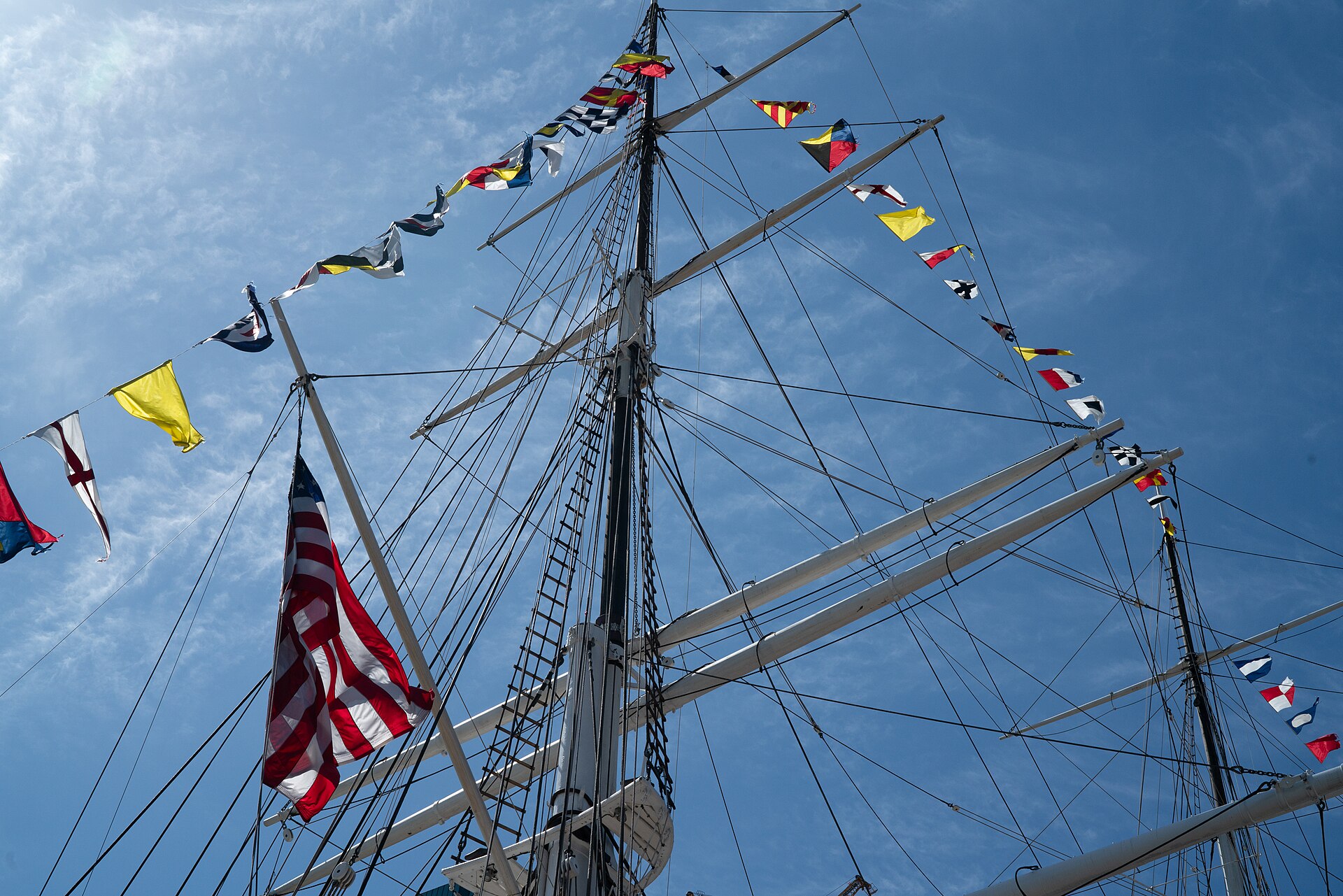
The 1885 tall ship Wavertree at Pier 16 in 2018. Photograph by Billie Grace Ward, via Wikimedia Commons. CC BY 2.0.
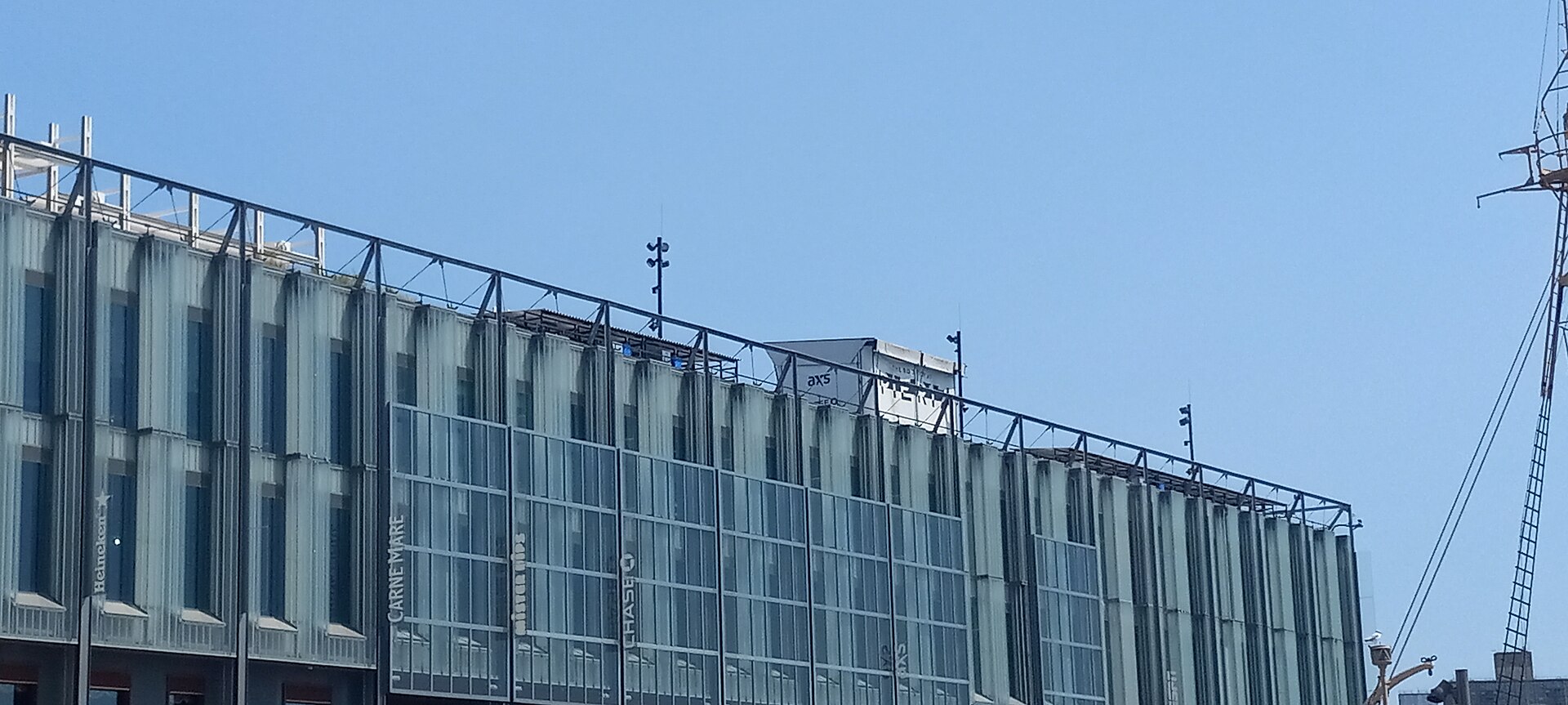
The rebuilt Pier 17, designed by SHoP Architects and opened in 2018, in September 2024. Photograph by Kidfly182, via Wikimedia Commons. CC BY 4.0.
Who owns and runs the South Street Seaport?
It is a split operation. The Howard Hughes Corporation holds the lease and runs the commercial Seaport - Pier 17, the Tin Building by Jean-Georges, the Fulton Market building and the surrounding shops - and has also held a minority stake in Jean-Georges Vongerichten's restaurant company since 2022, according to Howard Hughes' own announcement. The South Street Seaport Museum is a separate nonprofit, founded in 1967, which runs the galleries, the historic ships, Bowne & Co. Stationers and the Titanic Memorial Lighthouse. The land itself belongs to the city, which is why every redevelopment plan passes through public review and, for the landmarked buildings, the Landmarks Preservation Commission.
Where can you eat or drink at the South Street Seaport?
The Tin Building by Jean-Georges is the anchor: Howard Hughes' announcement describes two levels with more than 20 restaurants, bars, markets and counters, all personally curated by Jean-Georges Vongerichten, including a French brasserie, a seafood restaurant, an Asian speakeasy, a breakfast counter, a bakery and a coffee shop around a central marketplace. The Seaport's official eat-and-drink directory lists dozens of other options in the district, among them The Fulton, the Jean-Georges seafood restaurant on Pier 17, plus Carne Mare, Cobble Fish, Mister Dips, Industry Kitchen and neighborhood veterans like Jeremy's Ale House, The Paris Café, Mark Joseph Steakhouse, Fresh Salt and Cowgirl Seahorse. Listings here were read on the official pages on October 23, 2026.
Sources
- NYC Landmarks Preservation Commission, South Street Seaport Historic District Designation Report, 1977
- Historic Districts Council, South Street Seaport Historic District and Extension
- Wikipedia, South Street Seaport
- New York Preservation Archive Project, Peter Stanford
- South Street Seaport Museum, About
- South Street Seaport Museum, About the Titanic Memorial Lighthouse
- South Street Seaport Museum, Plan Your Visit
- The Howard Hughes Corporation, New York City Celebrates Opening of Tin Building by Jean-Georges, September 29, 2022
- The Seaport, Eat & Drink
Visiting the South Street Seaport
- Address: The district centers on Fulton Street between the East River and Pearl Street. The South Street Seaport Museum's address is 12 Fulton Street, (212) 748-8600.
- Museum hours: The museum's site footer lists Wednesday through Sunday, 11am to 5pm; its visit page describes full campus access, including the ships and galleries, Friday through Sunday, 11am to 5pm. Check the museum's site before going.
- Admission: The museum's general admission ticket covers the 1885 tall ship Wavertree and the 1908 lightship Ambrose at Pier 16, the Schermerhorn Row galleries at 12 Fulton Street, and the Maritime City exhibition at 213 Water Street. Bowne & Co. Stationers, the 19th-century-style print shop at 211 Water Street, is free to browse.
- The district: The streets, piers and the Titanic Memorial Lighthouse are public and free. The Rooftop at Pier 17 hosts ticketed concerts, generally May through October; its schedule is on the venue's official site.
Hours and admission facts above come from the museum's and the Seaport's official pages, read on October 23, 2026. I did not verify same-day availability, so confirm before planning around a specific ship or exhibition.