Ellis Island: How a Fire and a Design Competition Built the Gateway to America
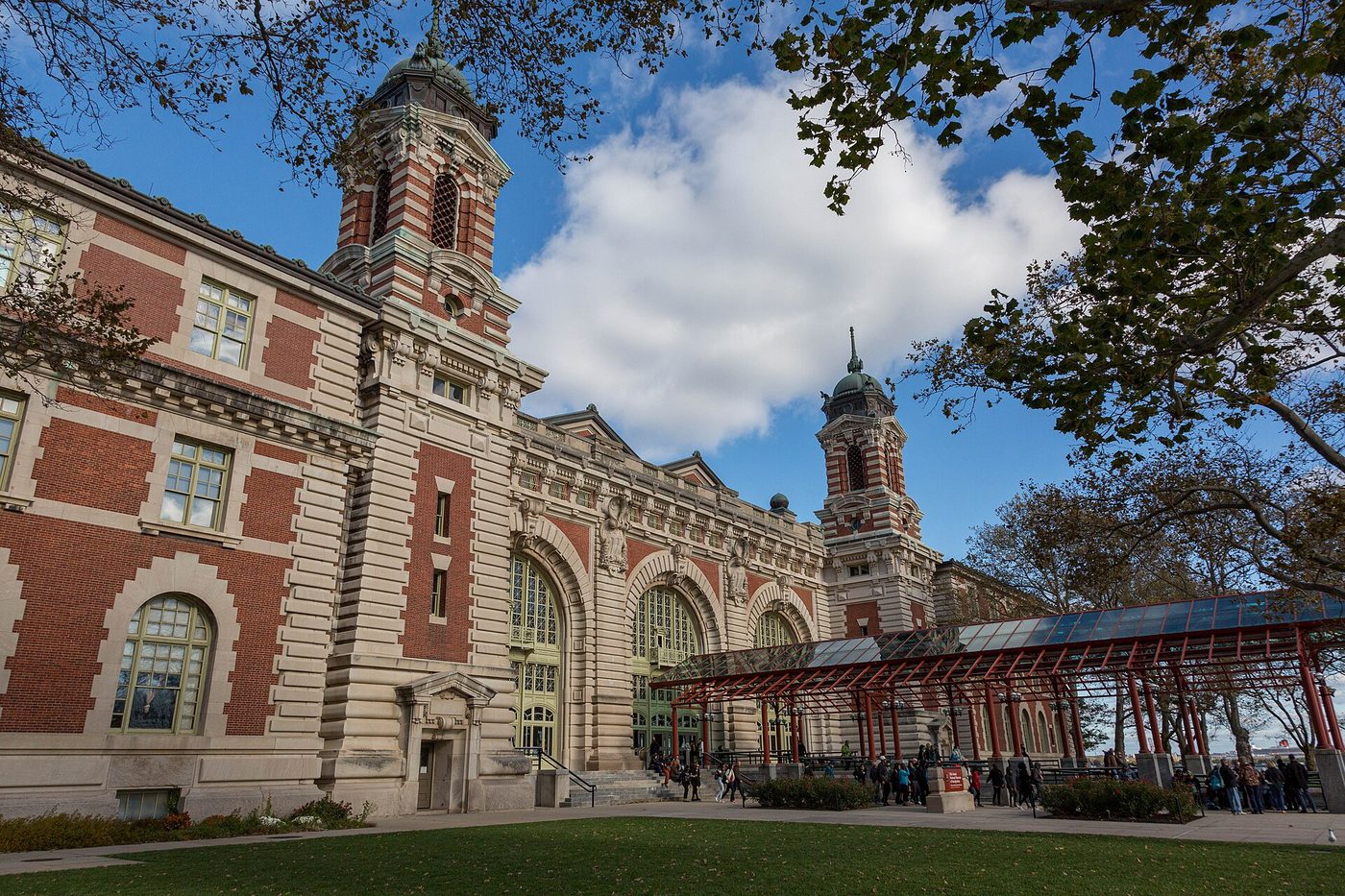
The Main Building on Ellis Island, October 2019. Photograph by David Brossard, via Wikimedia Commons. CC BY-SA 2.0.
Ellis Island opened as the federal immigration station for the Port of New York on January 1, 1892, and stayed in use until 1954. The National Park Service says it processed more than 12 million immigrants. The building most people picture, the brick and limestone Main Building with its four towers, is the second station on the island. The first one, made of wood, burned in 1897. Boring & Tilton, a young New York firm, won the design competition for its replacement, and it opened on December 17, 1900. The Park Service fact sheet says about 40 percent of the country's population is believed to be able to trace its ancestry through the island.
What was Ellis Island before the immigration station?
The island was small, about three acres, and went by several names. The Landmarks Preservation Commission lists Gull Island, Dyre's Island, Bucking Island and Anderson's or Gibbet Island before it took the name of Samuel Ellis, who held it by 1785. The National Park Service says pirates were hanged there in the 1700s, which is how it picked up the name Gibbet Island.
The United States gained ownership in 1808. The Park Service chronology says New York bought the island from the Berry family on behalf of the state and conveyed it to the federal government for $10,000. The Army built a battery there that was named Fort Gibson in 1813, and the Navy later kept a powder magazine on the island. After newspaper reports about the danger to Jersey City and New York, Congress ordered the powder removed in 1890. The same resolution set aside $75,000 for immigration improvements, and the Navy moved the powder to Fort Wadsworth on Staten Island on May 24 of that year.
The first station and the 1897 fire
The first station was a group of wooden buildings. The Landmarks Preservation Commission says the government doubled the island to about six acres by landfill and spent half a million dollars on the main building, a hospital, a laundry and utility buildings. Annie Moore of Ireland was the first person processed, according to the Park Service. By the end of that fiscal year more than 400,000 immigrants had come through, and about one and a half million passed through before 1897.
On June 14, 1897, a fire destroyed the wooden buildings. Staff and immigrants were evacuated, and processing moved for a time to the Barge Office in Battery Park.
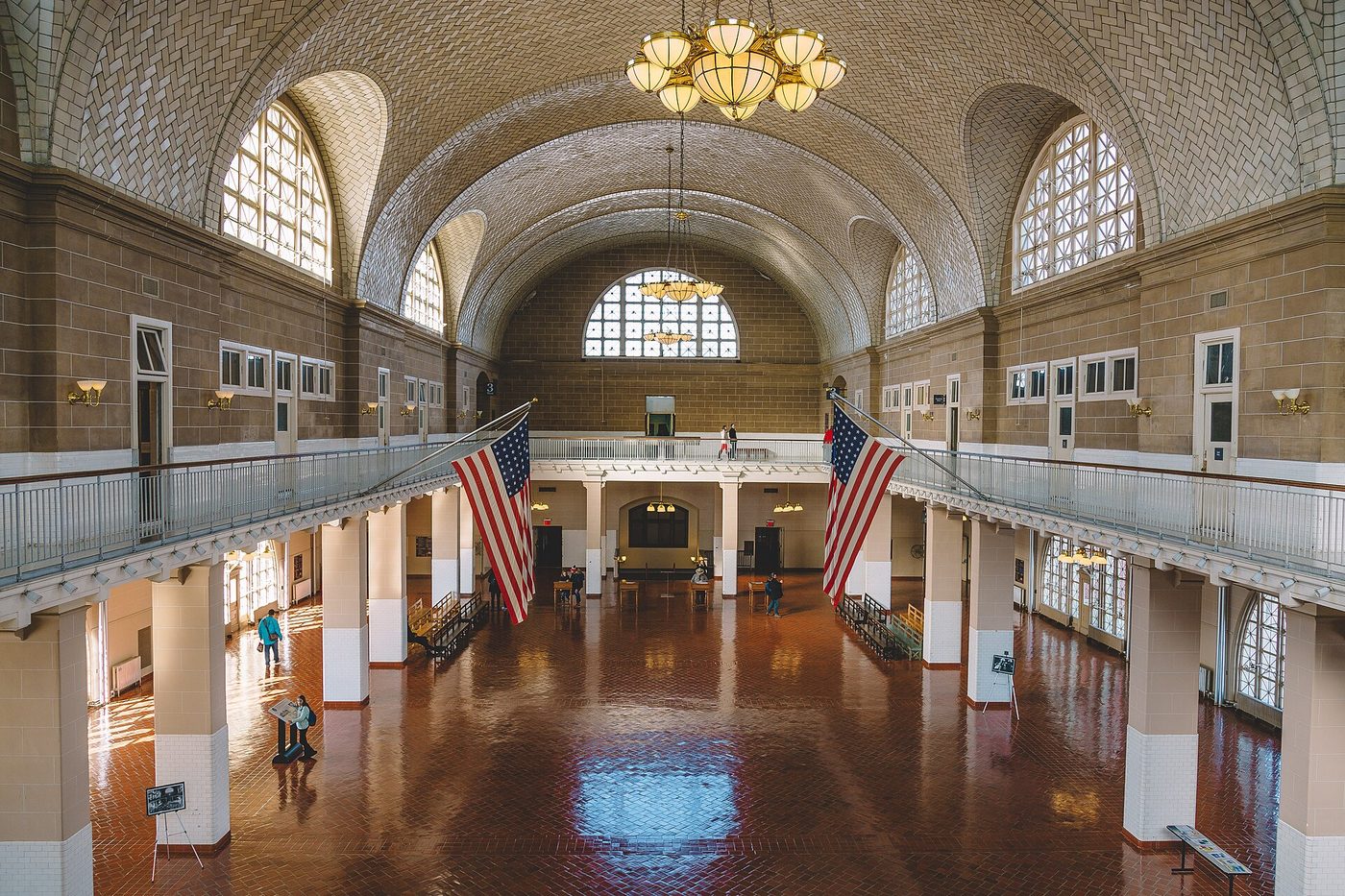
The Registry Room, or Great Hall, today. National Park Service photograph, via Wikimedia Commons. Public domain.
How was the Main Building designed?
Congress required the new buildings to be fireproof. The Landmarks Preservation Commission says the competition was run by James Knox Taylor, the Supervising Architect of the Treasury, under the Tarsney Act of 1893, which let private architects compete for federal work. Entrants included McKim, Mead & White and Carrère & Hastings. The commission went to Boring & Tilton, whose partners, William A. Boring and Edward L. Tilton, had met in the McKim, Mead & White office and studied together at the École des Beaux-Arts in Paris. The commission's report calls Ellis Island their first important work.
The sources differ on where it ranked. The Landmarks Preservation Commission calls it the first major federal commission awarded under the Tarsney Act, while the Park Service says it was the second competition held under the act.
The result is a Beaux-Arts building. The Park Service describes four corner towers topped with copper domes, limestone quoins and a heavy classical entablature, all scaled so they would read from across the water. The Landmarks Preservation Commission says the designers treated the problem like a railway station, a place to land, sort and send on large crowds quickly. It was built in 1898-1900.
What was the Registry Room?
The Registry Room, also called the Great Hall, fills the second and third stories of the central block. The Landmarks Preservation Commission puts it at about 200 feet long, 100 feet wide and 56 feet high, with a balcony running around the whole room. It was planned to handle 5,000 immigrants a day. As first built, iron railings divided the floor into narrow lanes that held the lines, and a staircase from the first floor came up through an opening in the center. The commission quotes the Architectural Record, which reported that 6,500 immigrants had been entered, passed and cleared in nine hours. The commission also says the design won a gold medal at the 1900 Paris Exposition.
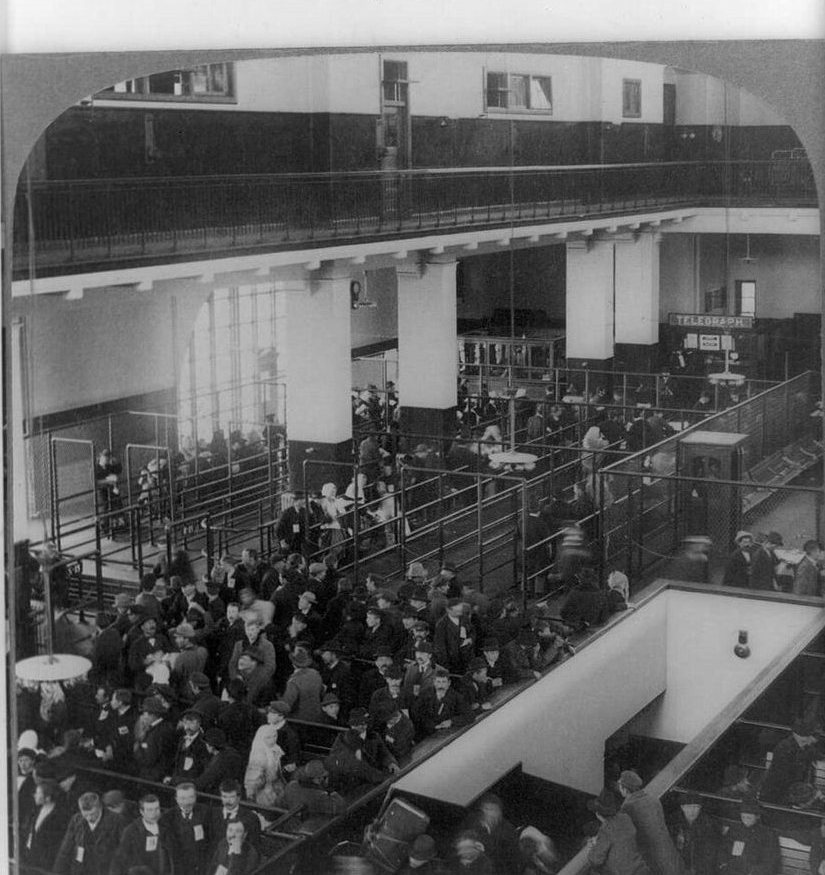
The room changed over the years. The staircase was closed and the railings came out in 1911. In July 1916 German saboteurs blew up a munitions depot on Black Tom Island in New Jersey, and the blast broke windows on Ellis Island. The Park Service says it damaged the original plaster vault. The Landmarks Preservation Commission says a Guastavino tile arched ceiling and a red Ludowici tile floor went in during 1918. The commission calls the ceiling one of the most impressive in New York City.
The busiest years and the decline
The Park Service chronology says 1.2 million people were examined on Ellis Island in 1907, the peak year. The island kept growing by landfill and reached its present 27.5 acres by 1934, from the original 3.3. The Park Service fact sheet says the fill came supposedly from ship ballast and from subway excavation. The hospital complex on the south side, built in stages and finished by 1909, had 750 beds, according to the Park Service.
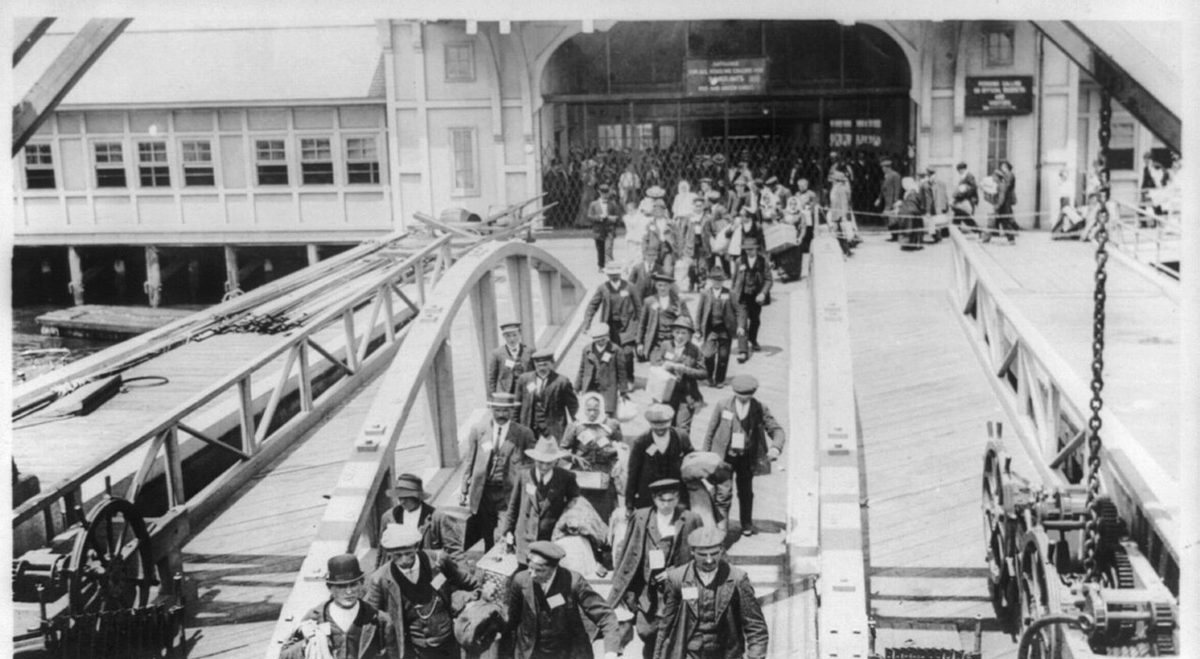
Immigrants on a walkway at Ellis Island. National Photo Company Collection, Library of Congress, via Wikimedia Commons. Public domain.
The National Origins Act of 1924 required immigrants to get visas at American consulates before they sailed, and immigration fell sharply. After that the work on the island turned more to detention and deportation. In May 1942 about 1,000 German, Italian and Japanese people classed as enemy aliens were held there. The Park Service says most immigration functions moved to Manhattan in 1943, and the last detainees left on November 12, 1954. The ferry made its last run on November 29, and the island was left empty.
How was Ellis Island saved?
The government declared the island surplus property in 1955. In 1965 President Lyndon Johnson proclaimed it part of the Statue of Liberty National Monument, which put it under the National Park Service. In May 1982 President Reagan announced a plan to restore the Statue of Liberty and Ellis Island. The restoration ran from 1986 to 1990 and cost $156 million, and Beyer Blinder Belle restored the Main Building. It opened as a museum on September 10, 1990, with the Registry Room restored to look as it did between 1918 and 1924.
The Landmarks Preservation Commission designated the Registry Room and the rest of the second and third story interiors an Interior Landmark on November 16, 1993. The Park Service says the American Family Immigration History Center, now called the Records Discovery Center, opened on the island in spring 2001.
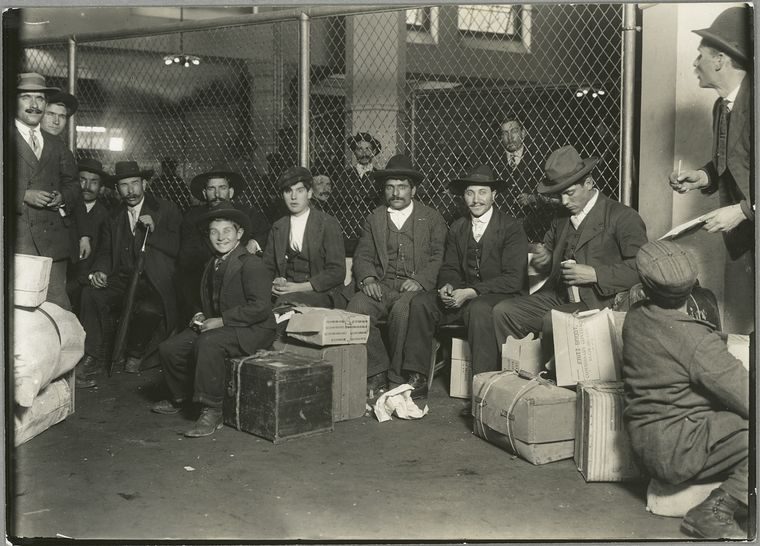
Italian immigrants with their luggage, waiting at Ellis Island. Photograph by Lewis W. Hine, New York Public Library, via Wikimedia Commons. Public domain.
Who owns Ellis Island today?
The federal government has owned the island since 1808, and the National Park Service has managed it since 1965 as part of Statue of Liberty National Monument. Jurisdiction is split between two states. After New Jersey sued, the Supreme Court ruled 6-3 in 1998 to divide sovereignty. New York kept the original 3.3 acres and New Jersey took the roughly 24 acres of landfill. The Park Service chronology describes the ruling as dividing sovereignty between the two states.
Sources
- NYC Landmarks Preservation Commission, Ellis Island, Main Building (Interior) designation report, 1993
- National Park Service, Ellis Island Chronology
- National Park Service, Ellis Architectural Highlights
- National Park Service, Fact Sheet: Ellis Island
- National Park Service, From Immigration Station to Museum
Visiting Ellis Island
- Getting there: Ferries run from The Battery in Lower Manhattan and from Liberty State Park in Jersey City, and private boats may not dock at either island. The Park Service says one ferry ticket covers both Liberty Island and Ellis Island and includes the Ellis Island museum.
- Tickets: The Park Service names Statue City Cruises as the only authorized ticket seller and recommends buying in advance. The time printed on the ticket is when to join the security line, not a ferry departure time, and waits can pass an hour at busy times.
- Open days: Ellis Island is open every day except Thanksgiving and December 25. Ferry times change with the season, so check the Park Service page before you go.
- Hard Hat Tour: A 90-minute guided tour of the hospital complex on the south side of the island is offered through the Park Service's partner Save Ellis Island Inc.
Checked against the Park Service plan your visit page, its directions page and its hours page. Confirm schedules and ticket rules there.