Prospect Park: How Olmsted and Vaux Built Brooklyn's Backyard
Prospect Park is the park Frederick Law Olmsted and Calvert Vaux built after Central Park, and the one they thought was better. Designed in 1865 and begun the following year, it gave the then-independent city of Brooklyn a Long Meadow, the borough's only forest and a lake excavated by hand, all stitched together by one of the most ingenious circulation systems in landscape architecture. The Landmarks Preservation Commission made it a scenic landmark in 1975. Today it belongs to the City of New York and is cared for in partnership with the Prospect Park Alliance, the nonprofit founded in 1987 to rescue it.
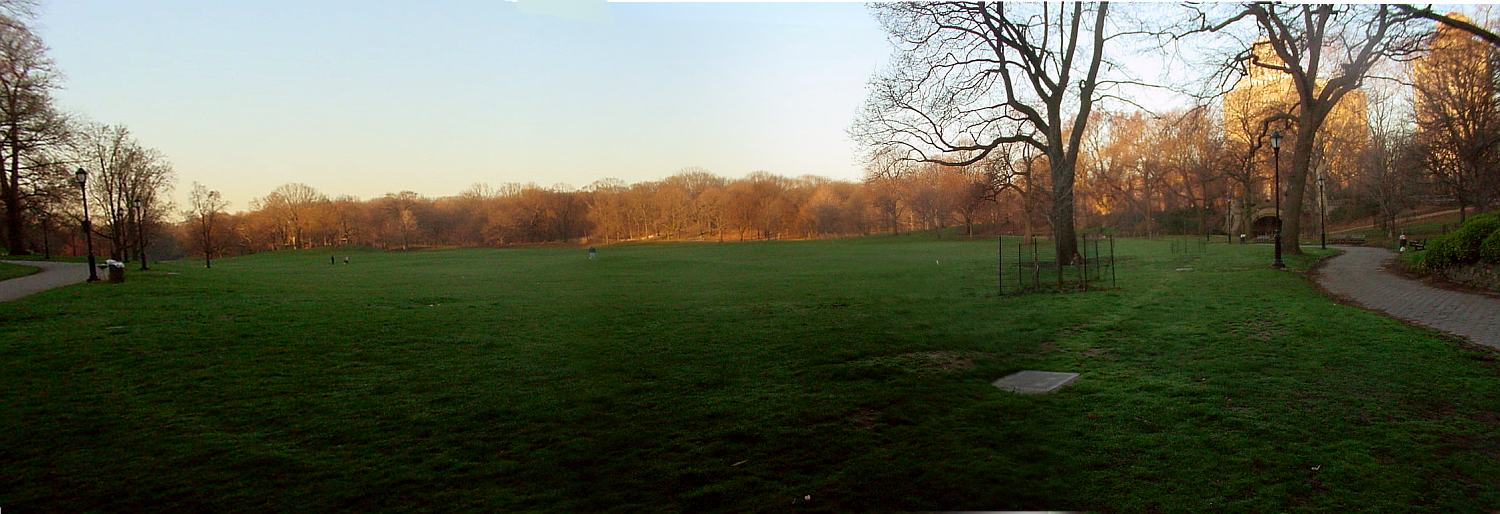
The Long Meadow at dusk. Photograph by Garry R. Osgood, via Wikimedia Commons. CC BY 2.5.
Why did Brooklyn want a park?
Because by 1855 Brooklyn had more than 200,000 people and was the third largest city in the United States, and its street grid made no room for open green space. The Landmarks Preservation Commission's designation report notes that Green-Wood Cemetery, founded in 1838, served as the prime recreational space for thousands of Brooklynites, which says everything about the alternatives. The success of Central Park, begun across the river in 1857, turned a vague envy into a campaign. On April 18, 1859, the State Legislature authorized Brooklyn to select grounds for public parks, and a second act on April 17, 1860, authorized acquiring the recommended site and created a Board of Park Commissioners. The board's president, chosen without salary, was James S. T. Stranahan, who held the job for twenty-two years and became known as the Father of Prospect Park.
The first site was awkward: it straddled Flatbush Avenue and took in a reservoir. The commissioners hired Egbert L. Viele, the chief engineer of Central Park's original plan, to design it, and Viele produced a scheme that he said required "but little aid from art." Then the Civil War stopped everything. The site did carry one argument no plan could manufacture: on August 27, 1776, at the spot now called Battle Pass, four hundred men from the Maryland and Delaware battalions had held off the British long enough for Washington's army to escape, in the first major battle of the Revolution after independence was declared.
How did Olmsted and Vaux take over?
During the war years the commissioners had second thoughts. In January 1865 Stranahan walked the site with Calvert Vaux, and Vaux wrote to his old partner Olmsted, then in California, urging a fresh start: sell the land east of Flatbush Avenue, drop the reservoir, and push the park south and west, where there was room for a real landscape and, as he put it, a lake fit for skating. He also proposed a grand elliptical entrance plaza where Flatbush meets the other avenues. Olmsted signed on; their joint report went to the commissioners on January 24, 1866, and the two were officially appointed landscape architects on May 29, 1866.
Work began on July 1, 1866. The plan rested on three regions, as the commissioners described them: a great open meadow, a hilly district of groves and shaded rambles, and a lake district for skating and rowing. The first visitors were admitted to the eastern section in October 1867; the diarist George Templeton Strong saw it that month and predicted "a formidable rival of our 'Central Park.'" Construction continued steadily until 1873, when the park was largely finished, then stalled with the Panic of 1873. The formal classical entrances that frame the park today were mostly added later, between 1895 and 1905. On November 25, 1975, the Landmarks Preservation Commission designated Prospect Park a scenic landmark, recording what Olmsted and Vaux themselves believed: that this was one of their best and most successful works.
What did they build?
Start with the meadow. The Long Meadow is the pastoral heart of the design, a sweep of green the landmarks report describes as over a mile long and seventy-five acres, "artfully planned to give the viewer an impression of infinite space." The Prospect Park Alliance calls it nearly a mile, and the longest stretch of unbroken meadow in any American urban park; either way, it is the first thing a visitor sees walking in from Grand Army Plaza. Around it lie the wooded districts Olmsted and Vaux called the East, West and Mid Woods, adapted from trees already growing on the site. The Ravine, in the report's words a deep secluded glen strewn with glacial boulders, is what the Alliance calls Brooklyn's only forest.
Then the water. Almost none of it was there. The lake took about four years to excavate and fill; the landmarks report puts it at fifty-seven acres, while the Alliance says sixty, and both agree it gave Brooklyn a bigger sheet of skating ice than Central Park's. A man-made watercourse feeds it: from the Pools by the Long Meadow, down the Ambergill through the Ravine, past the Binnen Water Pool, over a waterfall into the Lullwater, and finally into the lake. Beneath it all runs a vast underground drainage system, the first thing built.
The movement through the park is the quiet masterpiece. Carriage drives, bridle paths and footpaths were kept fully separate, as in Central Park, but Prospect Park has no transverse roads cutting through it at all. Instead, a series of arches carries the drives over the walks: Endale Arch, built 1867 to 1869 in bands of yellow sandstone and brownstone; Meadowport Arch, with its double portal; the triple Nethermead Arches; and the Cleft Ridge Span, cast from a patented concrete called beton Coignet. Olmsted and Vaux wanted the arches half-hidden in foliage, "consistent with their objects," as they wrote, "and with an honest expression of their purpose."
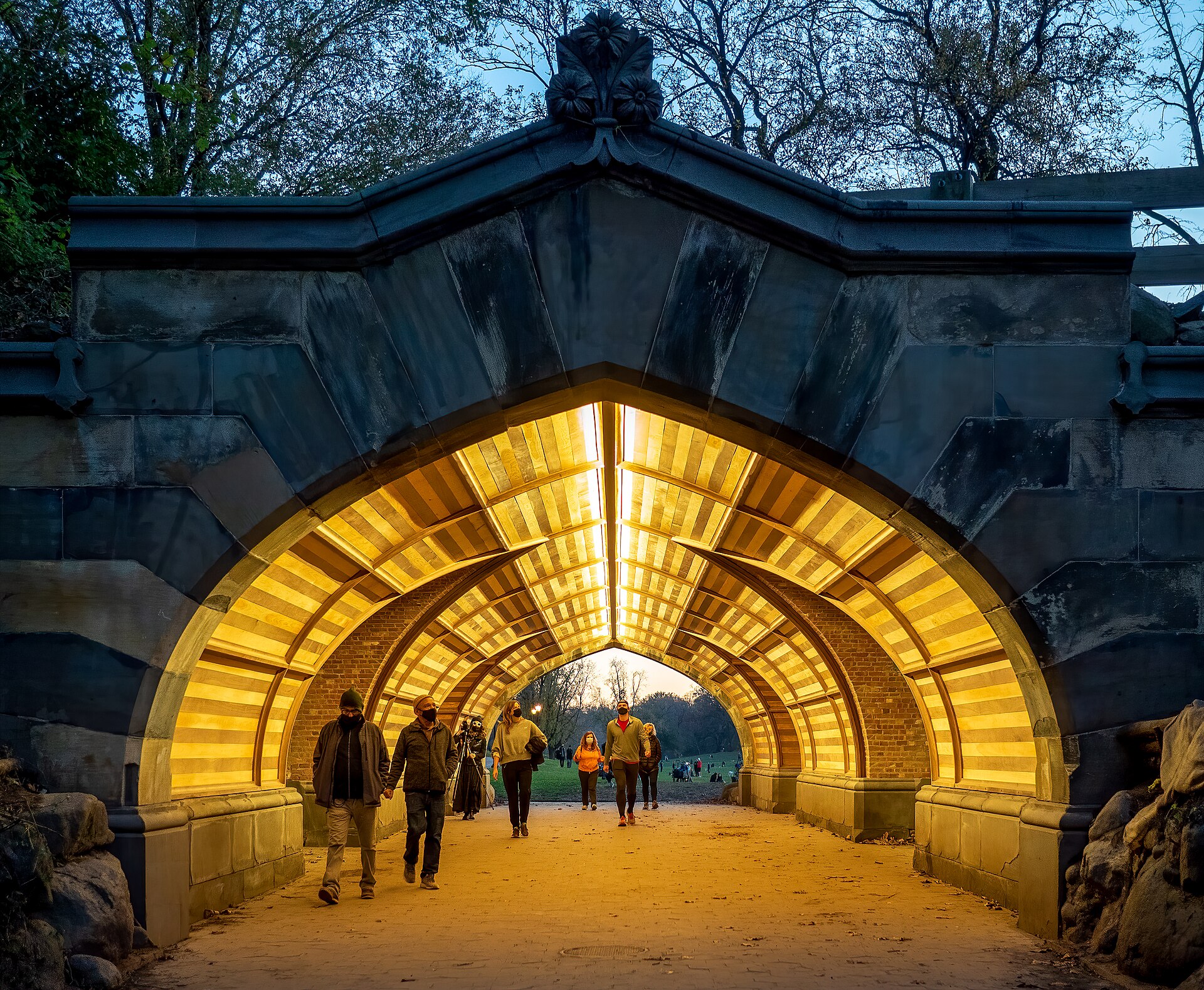
Inside Endale Arch, built from 1867 to 1869. Photograph by Rhododendrites, via Wikimedia Commons. CC BY-SA 4.0.
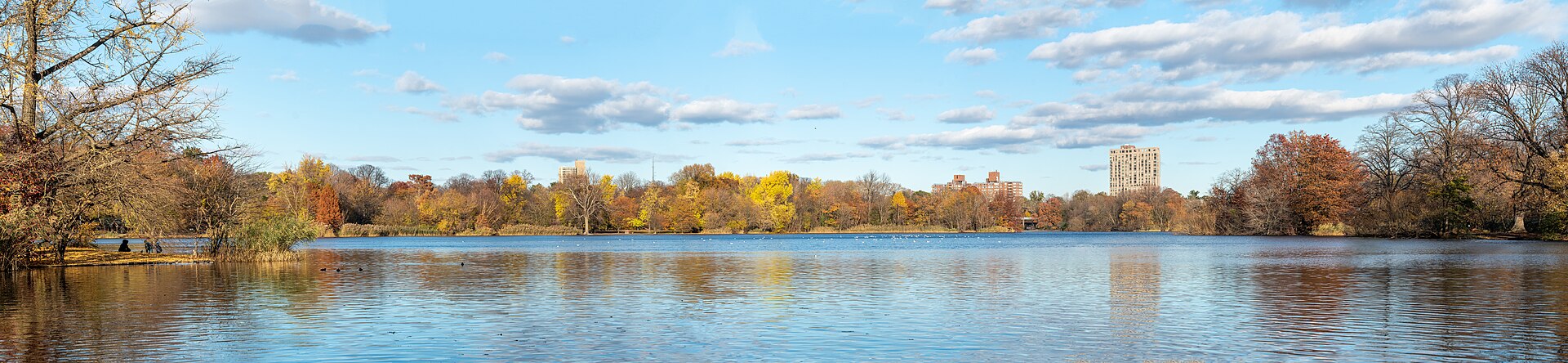
The lake in fall, excavated over about four years as the centerpiece of the design. Photograph by Rhododendrites, via Wikimedia Commons. CC BY-SA 4.0.
What came later?
The formal Brooklyn of the City Beautiful era layered monuments onto the picturesque park. Grand Army Plaza, the elliptical entrance Vaux had sketched, received its Soldiers' and Sailors' Memorial Arch in 1889 to 1892, designed by John H. Duncan and crowned later by Frederick MacMonnies' bronze Quadriga; MacMonnies also made the Horse Tamers at the Park Circle entrance, finished in 1899, and the bronze Stranahan statue unveiled in 1891. The plaza's fountain, designed by Eugene Savage, dates from 1932. McKim, Mead and White gave several entrances their classical dress in the 1890s, and Stanford White designed the column pair at Bartel-Pritchard Circle, erected in 1906.
Buildings were meant to stay subordinate to the scenery, and the best ones do. The Concert Grove of 1870 to 1874, with its Victorian Gothic stonework probably designed by Vaux, still holds a fragment of the Oriental Pavilion, an open-air cafe of 1874; the Music Pagoda followed in 1888. The Boathouse on the Lullwater, built in 1905 by Helmle, Huberty and Hudswell and modeled on a Renaissance library in Venice, is a designated city landmark, as are the Grecian Shelter of 1903 and the Tennis House of 1909. Two older houses sit inside the landmark boundaries: the Litchfield Villa, the 1857 Italianate mansion by Alexander Jackson Davis that now houses Brooklyn's parks headquarters, and the Lefferts Homestead, a Dutch Colonial farmhouse moved into the park in 1918. Near the East Drive, markers remember 1776: the Maryland Monument of 1895 on Lookout Hill and the Battle Pass monument of 1923.
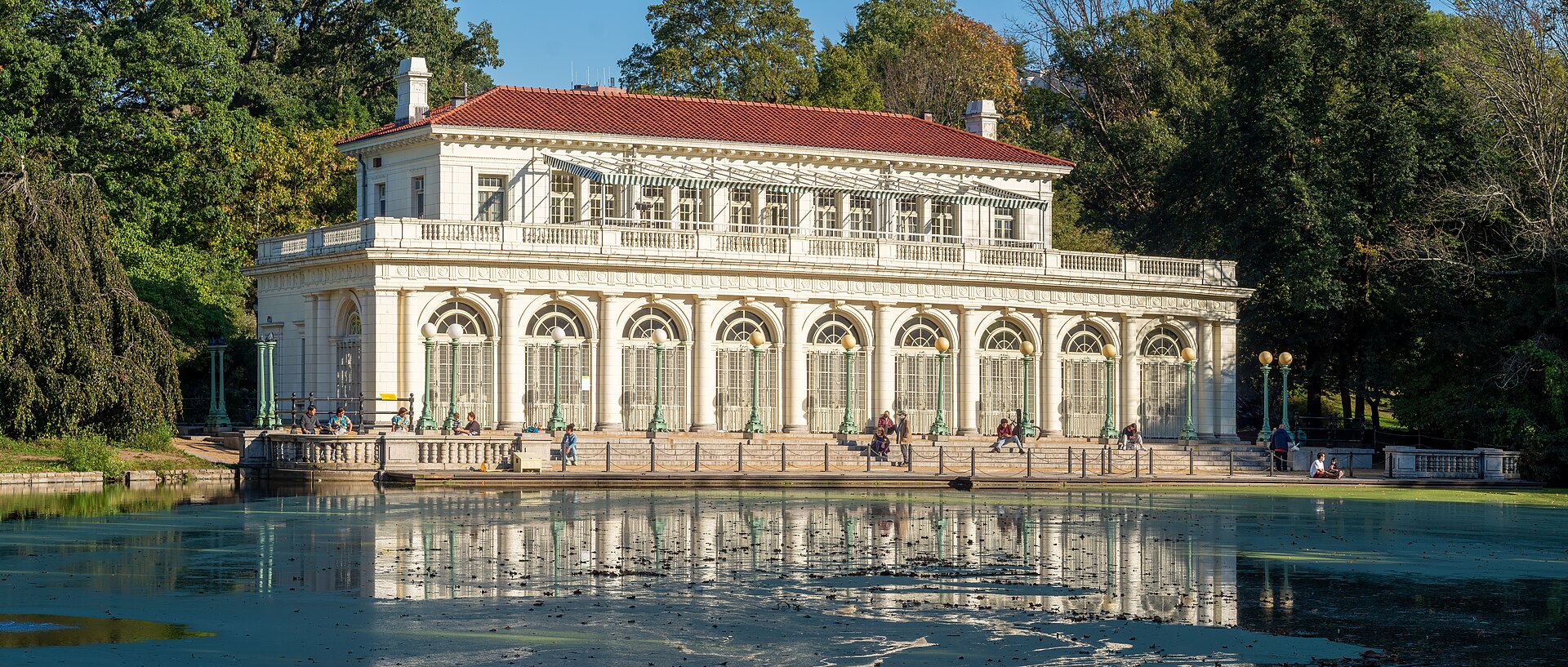
The Boathouse on the Lullwater, built in 1905 and now home to the nation's first urban Audubon Center. Photograph by Rhododendrites, via Wikimedia Commons. CC BY-SA 4.0.
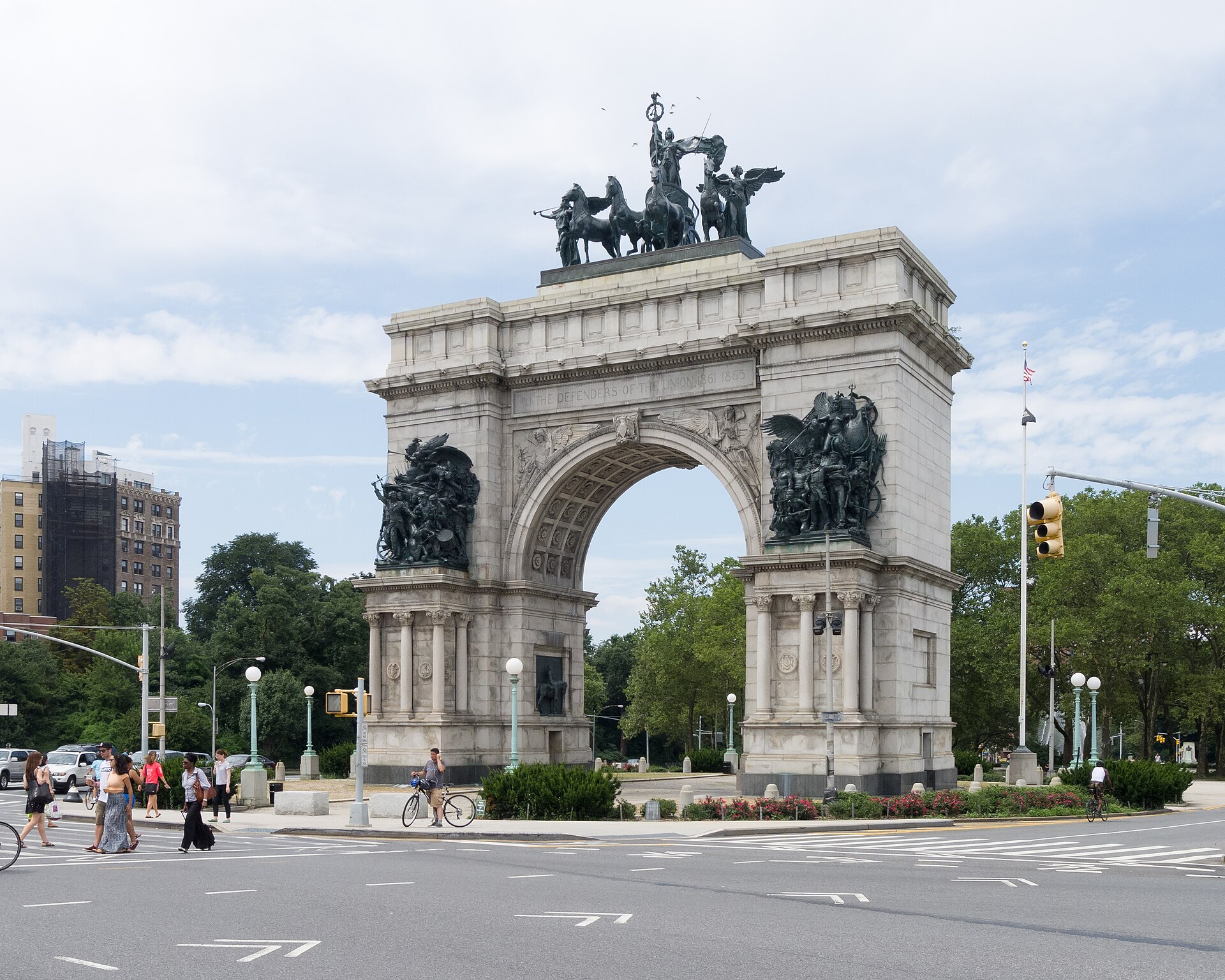
The Soldiers' and Sailors' Memorial Arch at Grand Army Plaza, built from 1889 to 1892. Photograph by King of Hearts, via Wikimedia Commons. CC BY-SA 4.0.
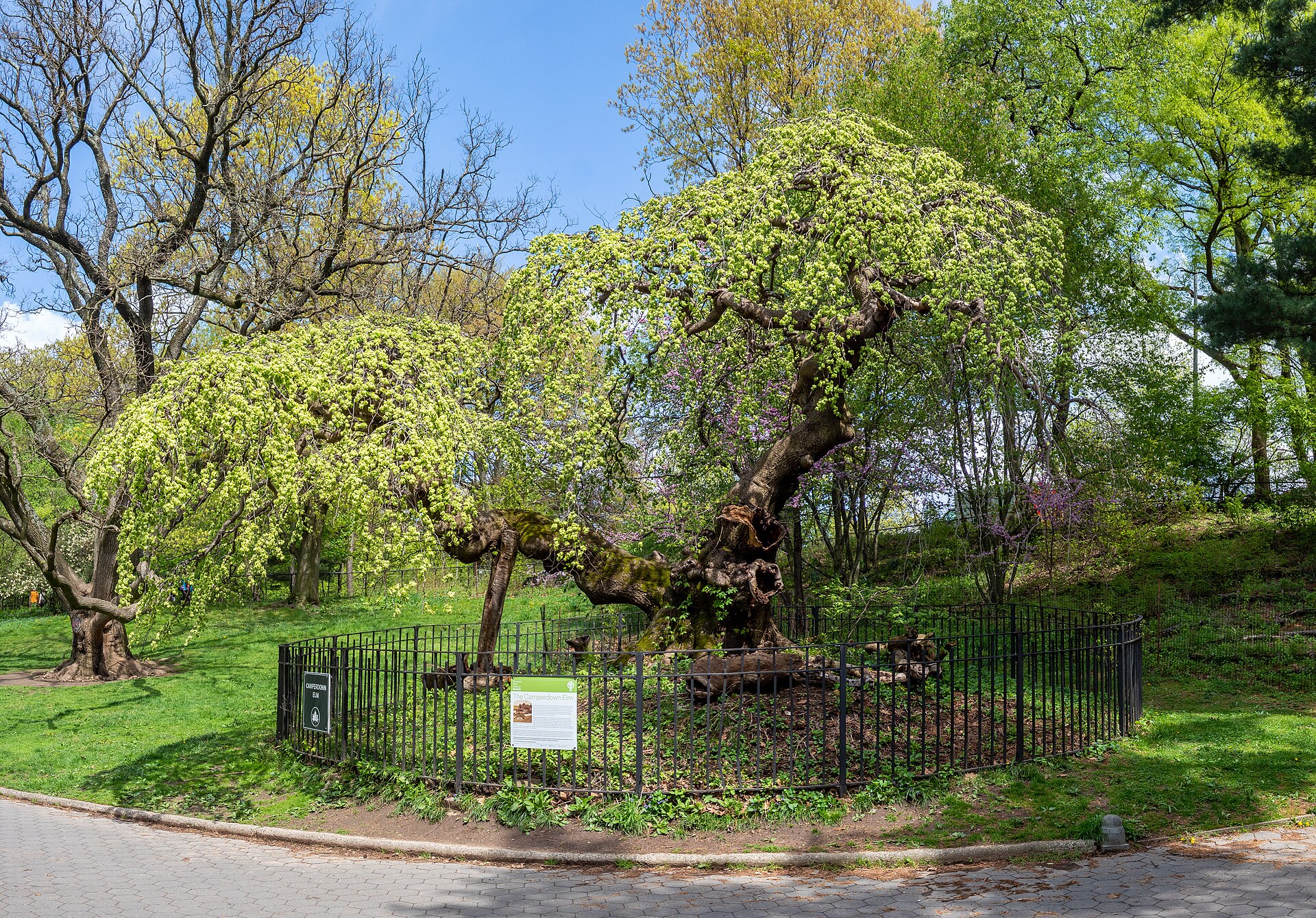
The Camperdown Elm, the park's most famous tree, celebrated in a poem by Marianne Moore. Photograph by Rhododendrites, via Wikimedia Commons. CC BY-SA 4.0.
Who owns Prospect Park today?
The City of New York. Prospect Park is city parkland listed by the Department of Parks and Recreation, which says it was designed and constructed over a thirty-year period from 1865 to 1895. The daily work of caring for it is shared with the Prospect Park Alliance, the nonprofit founded in 1987, after decades of deterioration, to restore the park in partnership with the city. The Alliance says it provides critical staff and resources, cares for the woodlands, restores buildings and landscapes, and runs the park's programs from its offices at 95 Prospect Park West.
How big the park is depends on whom you ask. The Landmarks Preservation Commission and NYC Parks both say 526 acres; the Alliance's visitor pages say 585. The landmarks report is measuring the designated scenic landmark, which excludes the Friends' Cemetery. Attendance figures differ too: the Alliance counts more than ten million visits a year, while an older NYC Parks page said eight million visitors. Both agree the park is, in the Commission's words, the pride of Brooklyn's park system.
Where can you eat or drink at Prospect Park?
The Alliance's Places to Eat page lists two standing options. Smorgasburg Prospect Park, the open-air food market, runs every Sunday from April through October on Breeze Hill near the Lincoln Road entrance. Lark by the Park serves pizza, smash burgers, breakfast sandwiches, smoothies, milkshakes and hot dogs. Seasonal hours change, so confirm before visiting.
Sources
- NYC Landmarks Preservation Commission, Prospect Park scenic landmark designation report (LP-0901), November 25, 1975
- NYC Parks, Prospect Park
- Prospect Park Alliance, About the Alliance
- Prospect Park Alliance, Visit the Park
- Prospect Park Alliance, Places to Eat
- NYC 311, Prospect Park
Visiting Prospect Park
- Where it is: The park fills the rectangle bounded by Prospect Park West, Parkside Avenue, Ocean Avenue and Flatbush Avenue, with Grand Army Plaza at its main entrance.
- Hours: NYC 311 lists the park as open from 5 a.m. to 1 a.m., and says it has been permanently closed to motor vehicles since January 2, 2018.
- What is inside: NYC Parks lists a zoo, the nation's first urban-area Audubon Center, an ice rink, a band shell, a carousel, and athletic and recreation facilities. The Alliance runs the LeFrak Center at Lakeside, the Tennis Center and seven playgrounds.
- Information: The Alliance's visitor center in the Litchfield Villa is open Monday through Friday, 9 a.m. to 5 p.m. The Alliance's address is 95 Prospect Park West, Brooklyn, NY 11215, and its phone is (718) 965-8951.
Facts above were read on the official pages on October 29, 2026. Programs and hours change with the seasons, so confirm on prospectpark.org before you go.