Coney Island: How a Brooklyn Beach Became America's Playground, From the Cyclone to Nathan's
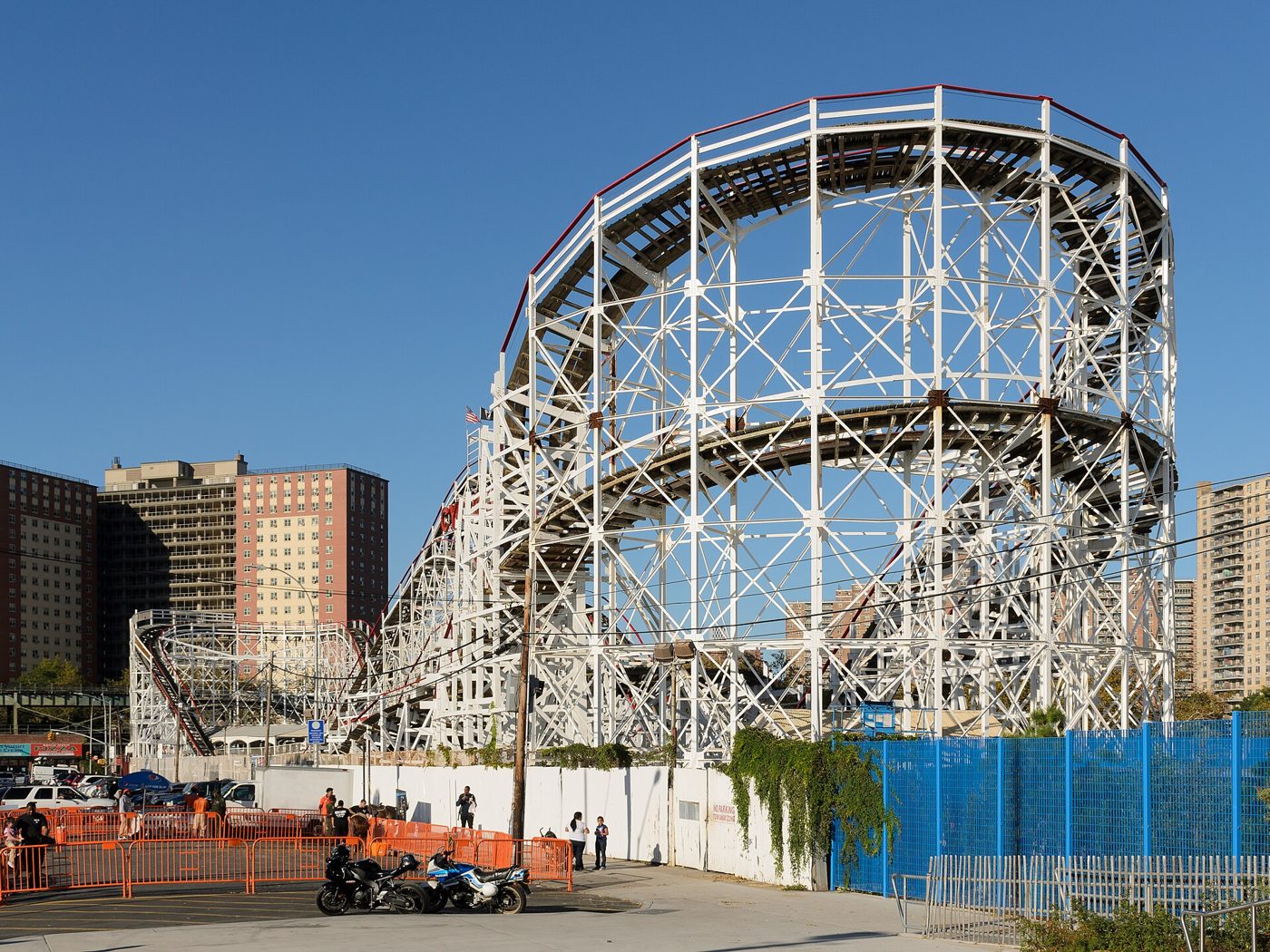
The Cyclone roller coaster, Coney Island, September 2016. Photograph by King of Hearts, via Wikimedia Commons. CC BY-SA 4.0.
Coney Island is in Brooklyn, not Manhattan. It is included in this series because it is one of the best-known tourist destinations in New York City, and the city's Landmarks Preservation Commission has designated two of its pieces: the Cyclone roller coaster in 1988 and the Riegelmann Boardwalk in 2018. This article follows those two landmarks and the nickel hot dog stand that grew up between them.
How did Coney Island become an amusement district?
The Landmarks Preservation Commission's 1988 report on the Cyclone gives a short history of the place. It says Henry Hudson docked off the coast in 1609, that Lady Deborah Moody and forty followers settled Gravesend, the area north of Coney Island, in 1643, and that she bought the island from the Canarsie Indians in 1654. A shell road reached the island in 1824, steamer service from New York began in 1847, and by the 1860s about a half dozen small hotels had opened. In the 1870s several railroad companies began service from Brooklyn, and Olmsted's Ocean Parkway gave carriages a route.
The commission says the island changed after a movement led by George C. Tilyou brought the idea of the enclosed amusement park to American recreation. In 1895 Captain Paul Boyton opened Sea Lion Park, which charged admission at the gate. Over the next decade the three most famous enclosed parks opened: Steeplechase Park, Luna Park and Dreamland. The report says a typical summer Sunday in 1900 drew about 100,000 people. Around 1920 the newly completed subway lines brought lower-income visitors for a nickel, and by 1925 an average Sunday afternoon drew a million. The report says the heyday ended after World War II, and that fire damage, the automobile and a Housing Authority plan to replace summer cottages with towers all hurt the area.
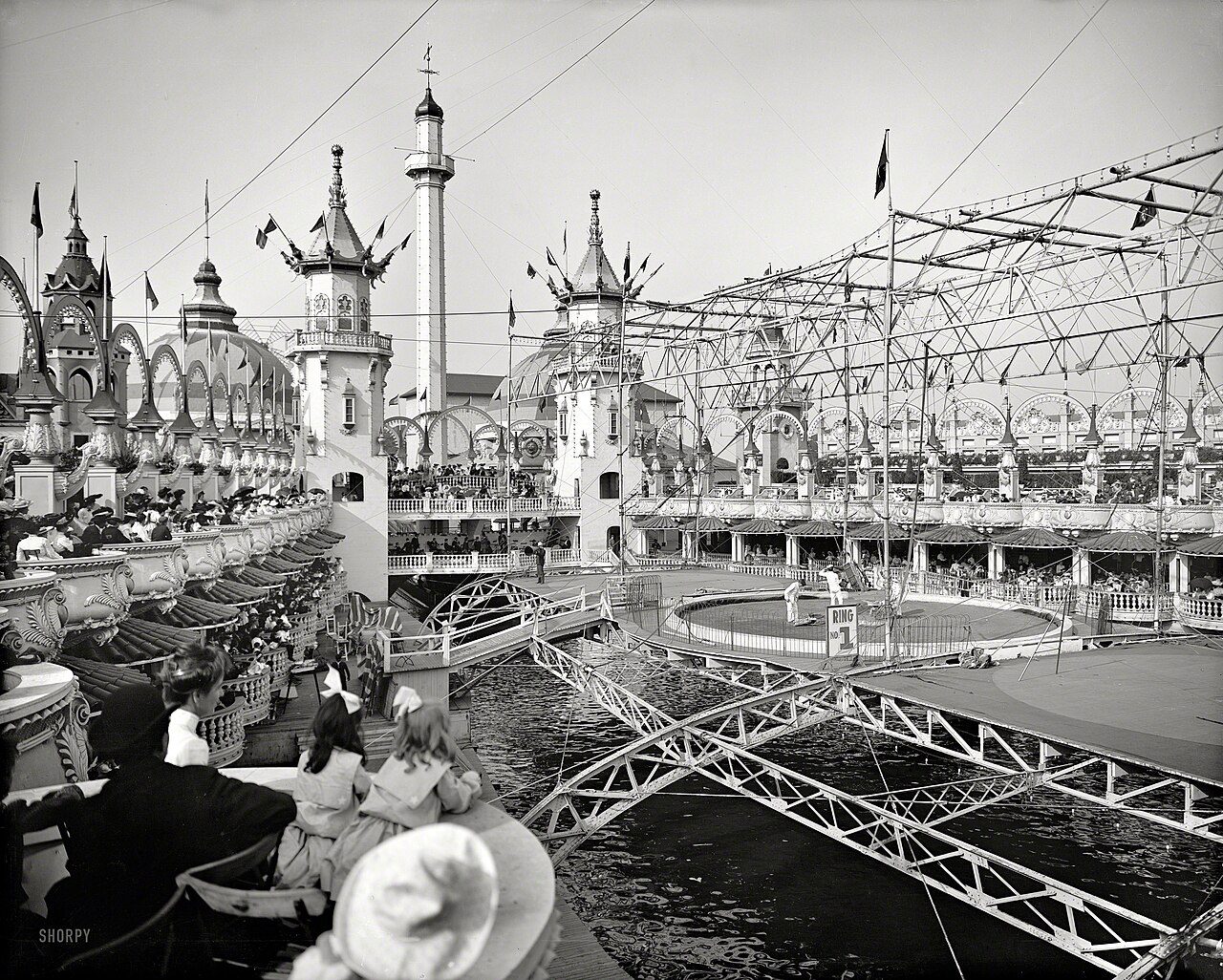
Luna Park, Coney Island, about 1905. Detroit Publishing Company, via Wikimedia Commons. Public domain.
Who built the Cyclone?
The Cyclone was designed by engineer Vernon Keenan and built by the amusement ride inventor Harry C. Baker for Jack and Irving Rosenthal. The Landmarks Preservation Commission report says it opened on June 26, 1927, at 834 Surf Avenue at West 10th Street. The steel was installed by the National Bridge Company of New York, the lumber came from Cross, Austin and Ireland of Long Island City, and the signs were made by Menheimer and Weiss. The commission designated it a landmark on July 12, 1988.
The commission says the Cyclone is a wood-track coaster of the twister type, reinforced with steel at the center and at each curved end, with six fan turns and nine drops. It says the Cyclone is irreplaceable, because the New York City building code prohibits building timber-supported roller coasters, and that only about eighty-five wood-track coasters survived out of the more than 1,500 built in the United States. At the time, it was the only roller coaster still operating at Coney Island, one of only two to survive out of nearly two dozen built there. The report quotes Charles Lindbergh, who rode it two years after crossing the Atlantic: "A ride on Cyclone is a greater thrill than flying an airplane at top speed."
How fast and how steep is it?
The two official sources disagree on the numbers, so here are both. The Landmarks Preservation Commission says the first plunge is about ninety feet, twenty-two degrees off the perpendicular, that trains reach 68 miles an hour, and that the ride covers 3,000 feet of track, with each train made of three linked cars carrying eight passengers each. NYC Parks says the ride covers 2,640 feet of track in a minute and fifty seconds, carries 24 passengers, reaches 60 miles an hour, and has a biggest drop of 85 feet at a descent angle of 58.6 degrees. The commission's report is from 1988 and Parks' text is on a historic sign posted at the site. Neither source explains the gap, so this article does not choose one.
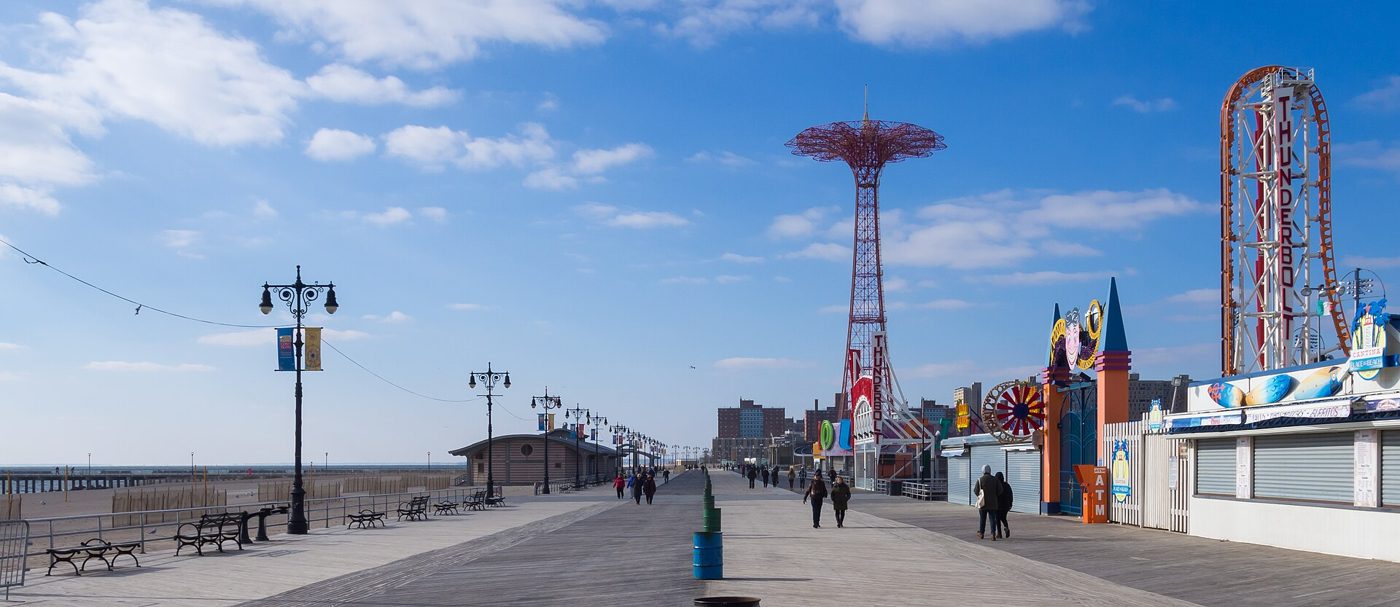
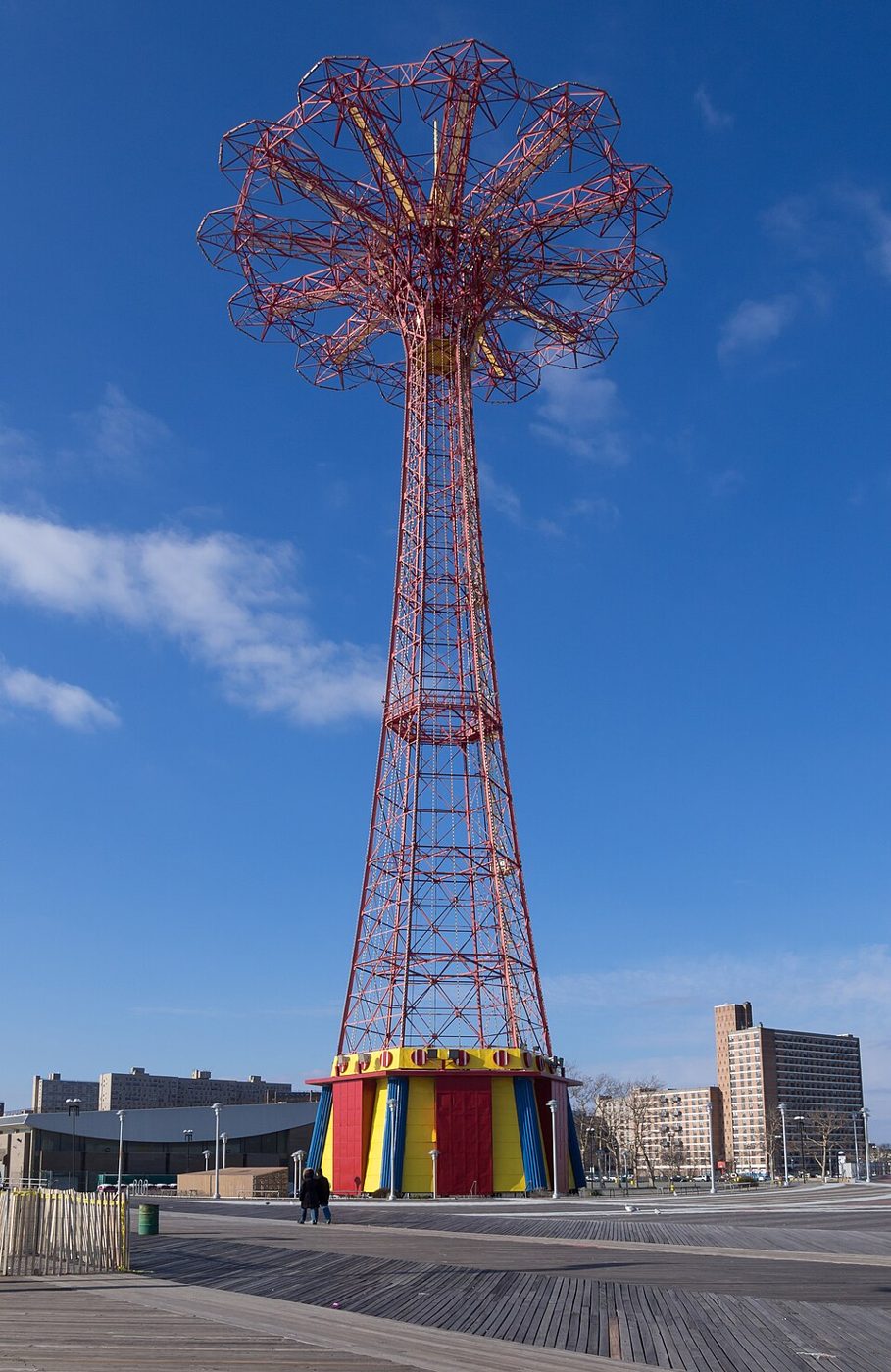
The Riegelmann Boardwalk at Coney Island, looking west toward the Parachute Jump. Photograph by Rhododendrites, via Wikimedia Commons. CC BY-SA 4.0.
Why is the Cyclone still there?
NYC Parks tells the rescue story. It says the city bought the land and the ride from owner Silvio Pinto in 1971 but leased the ride back to him for years. In 1975 Dewey Albert's Astroland amusement park won the bid to operate it. During this period the ride was nearly demolished because of the economic decline of Coney Island's amusement industry, and the nearby New York Aquarium tried to get the site through a federal grant to expand with a trout stream, a freshwater swamp and a saltwater estuary. In 1978 Parks Commissioner Gordon J. Davis wrote a letter asking that the grant be cancelled. Parks says this saved the Cyclone from demolition. It became a New York City landmark in 1988 and was listed on the New York State Register of Historic Places in 1991. Astroland closed in 2008 because a new lease deal could not be reached.
In 2010, the New York Post reported Mayor Michael Bloomberg announcing a ten-year lease with Central Amusement International for 6.2 acres of city land at Coney Island, for $100,000 a year. The pages read for this article do not say who operates the Cyclone today.
What is the Riegelmann Boardwalk?
The Landmarks Preservation Commission designated the Coney Island (Riegelmann) Boardwalk a scenic landmark on May 15, 2018. It says the 2.7-mile boardwalk runs from West 37th Street in Coney Island to Brighton 15th Street in Brighton Beach and has given people of all economic and social backgrounds free access to the beach since 1923. It is named for Brooklyn Borough President Edward J. Riegelmann, who played a leading role in creating it. The commission says the engineer Philip P. Farley planned and designed it as an elevated deck on reinforced concrete piles and girders, 80 feet wide and 9,500 feet long in its first section, between Ocean Parkway and West 37th Street.
The report says the boardwalk opened in May 1923, with Mayor John F. Hyland calling it the "happiest day of his life" and Riegelmann saying "poor people will no longer have to stand with their faces pressed against wire fences looking at the ocean." Two years later it was extended 4,000 feet east to Coney Island Avenue, and under Parks Commissioner Robert Moses in 1941 another 1,500 feet to Brighton 15th Street. In 1940 the busiest section, between Ocean Parkway and Stillwell Avenue, was straightened and moved inland. The commission says the planking has been replaced over the years and that recycled plastic lumber was used in some sections, including in 2013.
The report also explains why the beach is public. It says the Kings County Supreme Court ruled in 1913 that at low tide the beach was owned by the state and belonged to the public, which required removing fences and barriers, and that the state legislature voted in 1921 to transfer the land to New York City.
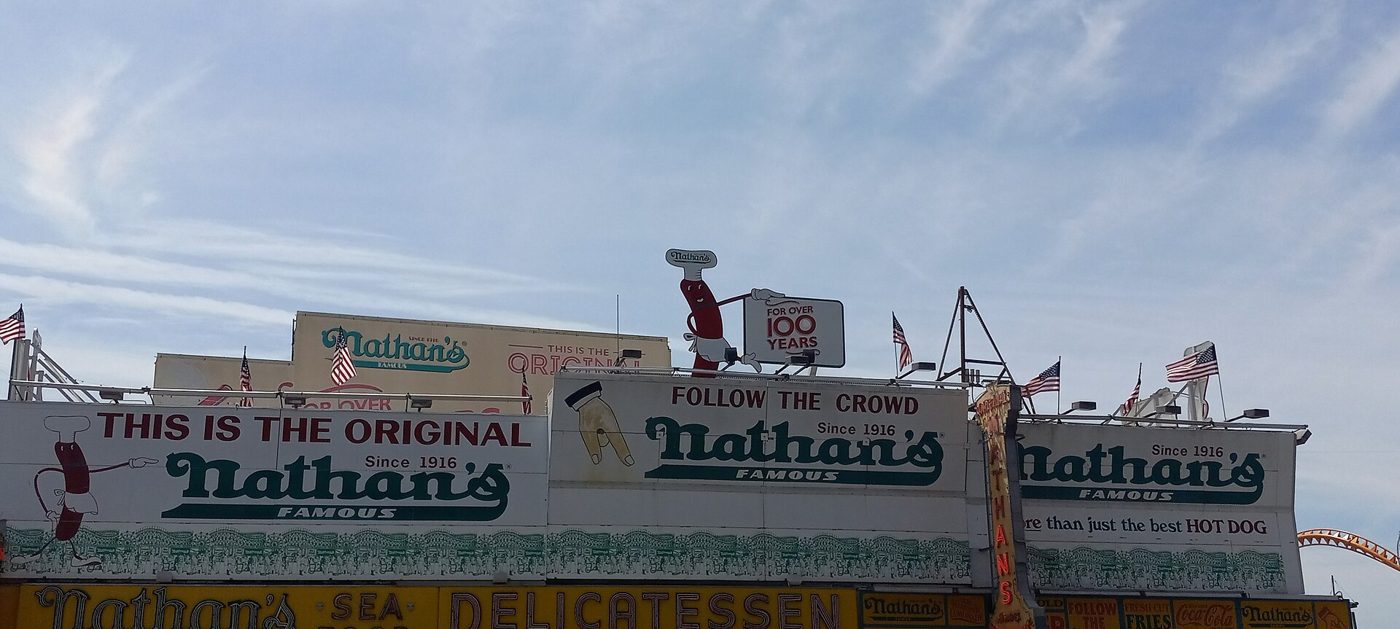
Nathan's Famous on Surf Avenue, Coney Island. Photograph by Kidfly182, via Wikimedia Commons. CC BY 4.0.
Where did Nathan's hot dogs start?
Nathan's Famous says Nathan Handwerker started his nickel hot dog stand on Coney Island in 1916 with a $300 loan and his wife's secret recipe. The Landmarks Preservation Commission's Cyclone report independently says Nathan's Famous began selling hot dogs for a nickel in 1916, and calls it the best-known of the cheap food stands that replaced elegant eating places after Prohibition began. The company's history page says that, as the legend goes, four immigrants held the first hot dog eating contest at the Coney Island stand to settle an argument over who was the most patriotic. It says President Roosevelt served Nathan's hot dogs to the King and Queen of England, and that millions around the world now tune in to see how many can be eaten in 10 minutes. The company lists its original restaurant at 1310 Surf Avenue in Brooklyn.
Who owns Coney Island's landmarks today?
The sources read for this article describe the public parts clearly and the private parts less clearly. The boardwalk is a public promenade. The Landmarks Preservation Commission says the state transferred the land to New York City in 1921, and NYC Parks lists the boardwalk and beach in its Coney Island Beach and Boardwalk page. NYC Parks says the city bought the Cyclone and its land in 1971. The pages do not say who holds title to the other rides, parks and restaurants. Nathan's Famous describes itself as a company with its original restaurant at 1310 Surf Avenue. Because the sources do not use the word "owns" for those, this article does not either.
Where can you eat or drink at Coney Island?
Add a short Dining section.
- Nathan's Famous, original restaurant at 1310 Surf Avenue (the company lists it). Visit Brooklyn says the stand was established in 1916 by Nathan Handwerker. Hours not taken from official sources, so none given.
Hours and status were read from the official pages listed below on October 13, 2026. They change, so confirm before visiting.
Sources
- NYC Landmarks Preservation Commission, The Cyclone designation report (LP-1636), July 12, 1988
- NYC Parks, The Cyclone Highlights
- NYC Landmarks Preservation Commission, Coney Island (Riegelmann) Boardwalk designation report (LP-2583), May 15, 2018
- NYC Landmarks Preservation Commission, press release, Coney Island Boardwalk becomes a designated landmark, May 15, 2018
- Nathan's Famous, Our History
- Nathan's Famous, Locations
- NYC Parks, Coney Island and Brighton Beach
- New York Post, Coney Island to add new amusement park with 19 new rides, February 16, 2010
- Visit Brooklyn: Nathan's (checked October 13, 2026)
Visiting Coney Island
- Location: The Cyclone is at 834 Surf Avenue at West 10th Street in Brooklyn, according to the Landmarks Preservation Commission's 1988 report. The boardwalk runs from West 37th Street to Brighton 15th Street. NYC Parks lists Coney Island Beach and Boardwalk, with a phone number of 718-946-1350.
- Boardwalk: NYC Parks says the boardwalk is closed from 1:00 am to 5:00 am. It is a free public promenade.
- Beach: NYC Parks says beaches are open from Memorial Day weekend through the Sunday after Labor Day, with lifeguards on duty daily from 10:00 am to 6:00 pm, and that swimming is prohibited when lifeguards are not on duty and in closed sections.
- Nathan's Famous: The company lists its original restaurant at 1310 Surf Avenue, Brooklyn, NY 11224. Its hours were not on the pages read, so check before you go.
- Cyclone: Ride hours and prices were not on the official pages read for this article. Check with the park that operates the ride before you go.
Checked against NYC Parks Coney Island and Brighton Beach page and Nathan's Famous locations page. Confirm hours and ticket rules there.