The Oculus: The $4 Billion Bird That Rose Over Ground Zero
From the outside, it looks like a dove, or a dinosaur skeleton, or a white bird caught mid-flap, depending on who is describing it. Santiago Calatrava's World Trade Center Transportation Hub, known everywhere as the Oculus, opened on March 3, 2016, at a final cost of roughly $4 billion, close to double its first estimate and years behind schedule, making it one of the most expensive train stations ever built. It is the main hall of a PATH rapid-transit station that links New Jersey to Lower Manhattan, a shopping mall, and the site of a September 11 tribute that uses only the sun. New Yorkers spent years mocking it; then they started walking through it. This is how a station that opened under the elevated Hudson Terminal in 1909 ended up with wings.
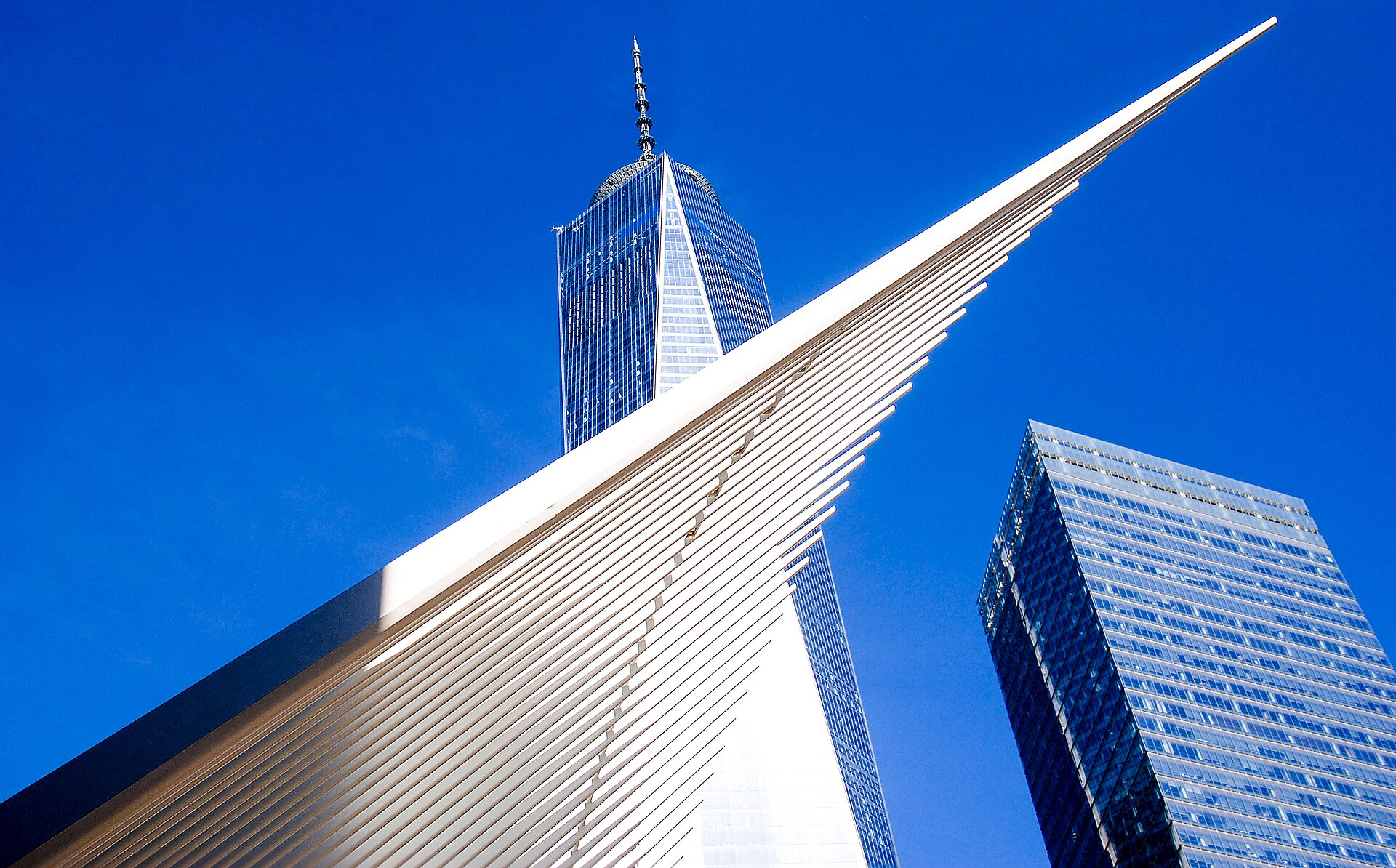
The Oculus from the World Trade Center plaza, with One World Trade Center behind it. Photo by Ron Cogswell, April 2016, via Wikimedia Commons. Creative Commons Attribution 2.0.
What stood here before the Oculus?
Trains under the Hudson are older than the World Trade Center itself. The Hudson and Manhattan Railroad opened its downtown terminal in 1909: two 22-story office towers above a grand underground station, built on a prime Lower Manhattan block. The complex, called Hudson Terminal, was demolished in the early 1970s to make way for the World Trade Center, and a new PATH station opened with the twin towers on July 6, 1971, at a cost of $35 million. About 85,000 passengers a day used it when it opened, though by 2001 that had thinned to roughly 25,000. The station was buried and destroyed on September 11, 2001, when the towers came down. It had survived worse than most people remember: in the 1993 World Trade Center bombing, part of its ceiling collapsed and trapped dozens of people, and the Port Authority had trains running again within a week. PATH service from New Jersey resumed on November 23, 2003, through a temporary station designed by the Port Authority's chief architect, Robert Davidson, which cost $323 million and became the first rebuilt part of the trade center site to reopen. A permanent station was always the plan; the question was who would design it and what it would become.
What happened to the Wedge of Light?
The Oculus exists because a plaza did not. Daniel Libeskind's 2003 Memory Foundations master plan for the rebuilt site imagined only a modest underground station, with the block left open as a plaza arranged as a "Wedge of Light": lines laid out so that each September, sunlight would strike the tower footprints at 8:46 a.m. and 10:28 a.m., the moments the first plane hit the North Tower and the tower fell. In early 2004 the Port Authority modified the plan, deciding the site needed a major above-ground station intended to rival Penn Station and Grand Central, and commissioned Calatrava to design it. Libeskind's wedge was never built, but its idea survived inside the new building: Calatrava aligned his hall and its 330-foot skylight with the autumnal equinox sun, and the glass spine opens on or around September 11 each year for 102 minutes, the span between the first impact and the North Tower's collapse. The memorial gesture outlasted the master plan that proposed it.
How did Calatrava's design come about?
The Port Authority of New York and New Jersey hired Santiago Calatrava in January 2004 to design what it then described as a $2 billion transportation hub. Calatrava, the Spanish architect known for skeletal white bridges and terminals, presented the building as a bird released from a child's hand. The design put a monumental above-ground pavilion over the platforms: a steel-and-glass hall some 350 feet long, with ribs arcing upward to a central ridge that splits open as a skylight. Work on the permanent station's infrastructure began in 2008, and the project kept growing. Construction delays, the logistics of digging around an active subway line, and repeated design changes pushed the budget far beyond the early number. By December 2014 the New York Times reported the cost approaching $4 billion, nearly twice the 2004 estimate, and Engineering News-Record headlined the 2016 opening with the same $4 billion figure. The hub's mezzanine and first sections opened to the public on March 3, 2016.
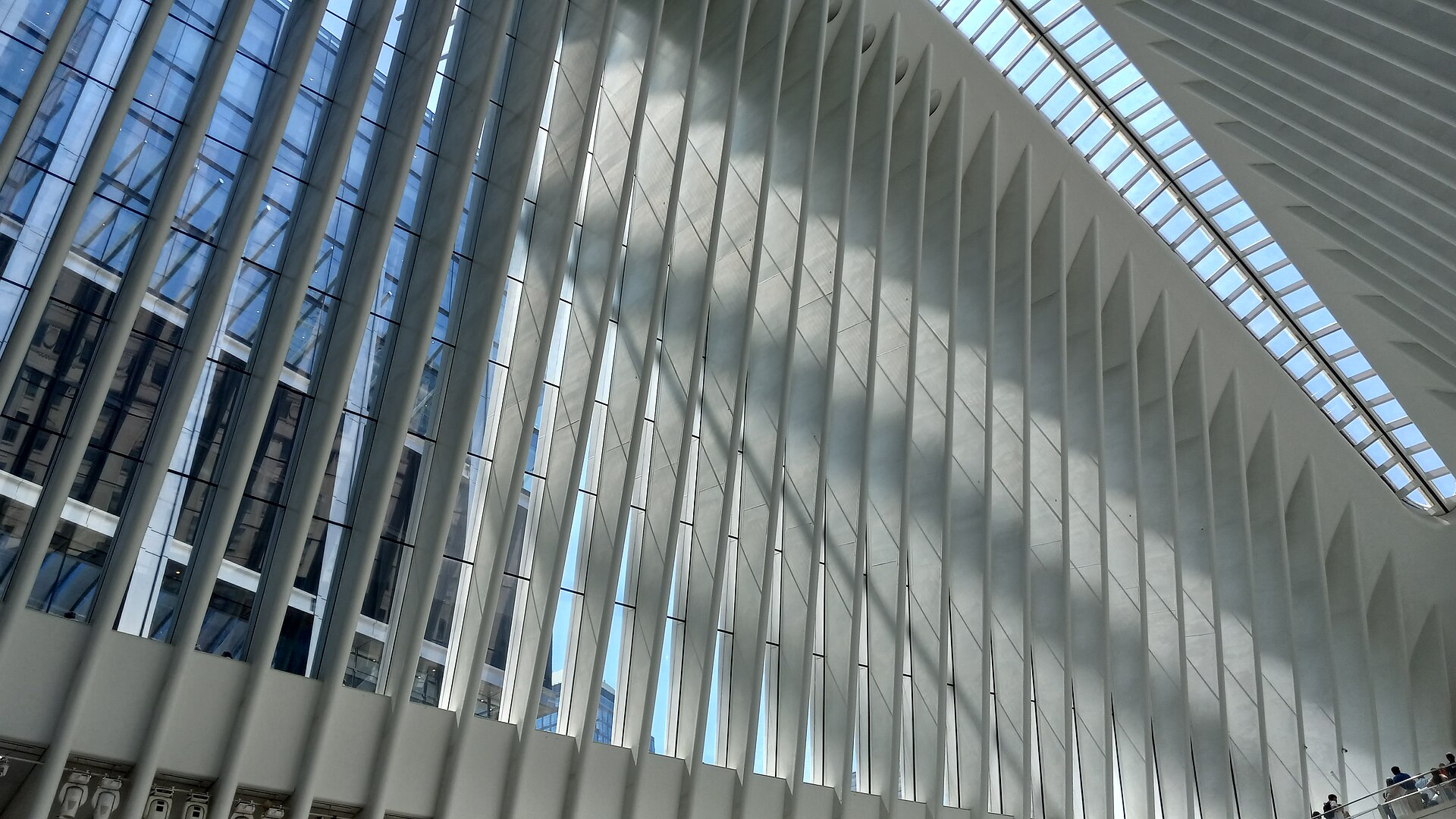
Inside the Oculus: the ribbed hall and the linear skylight that opens each September 11. Photo by Kidfly182, via Wikimedia Commons. Creative Commons Attribution 4.0.
Why does the skylight open every September 11?
The building's most deliberate feature is its spine. The ridge of the Oculus splits apart into a retractable skylight, and it is opened each year on September 11 for roughly 102 minutes, matching the span between the first plane's impact and the collapse of the North Tower. The axis of the hall aligns with the sun's position at that time of year, so on a clear morning the shaft of light falls straight down the length of the building and onto the floor. Calatrava described the gesture as letting the sun move through the station as a memorial; on an ordinary day the skylight stays shut, which makes the annual opening all the more noticed. It is the rare piece of infrastructure designed so that its most important hour happens when it is not carrying anyone.
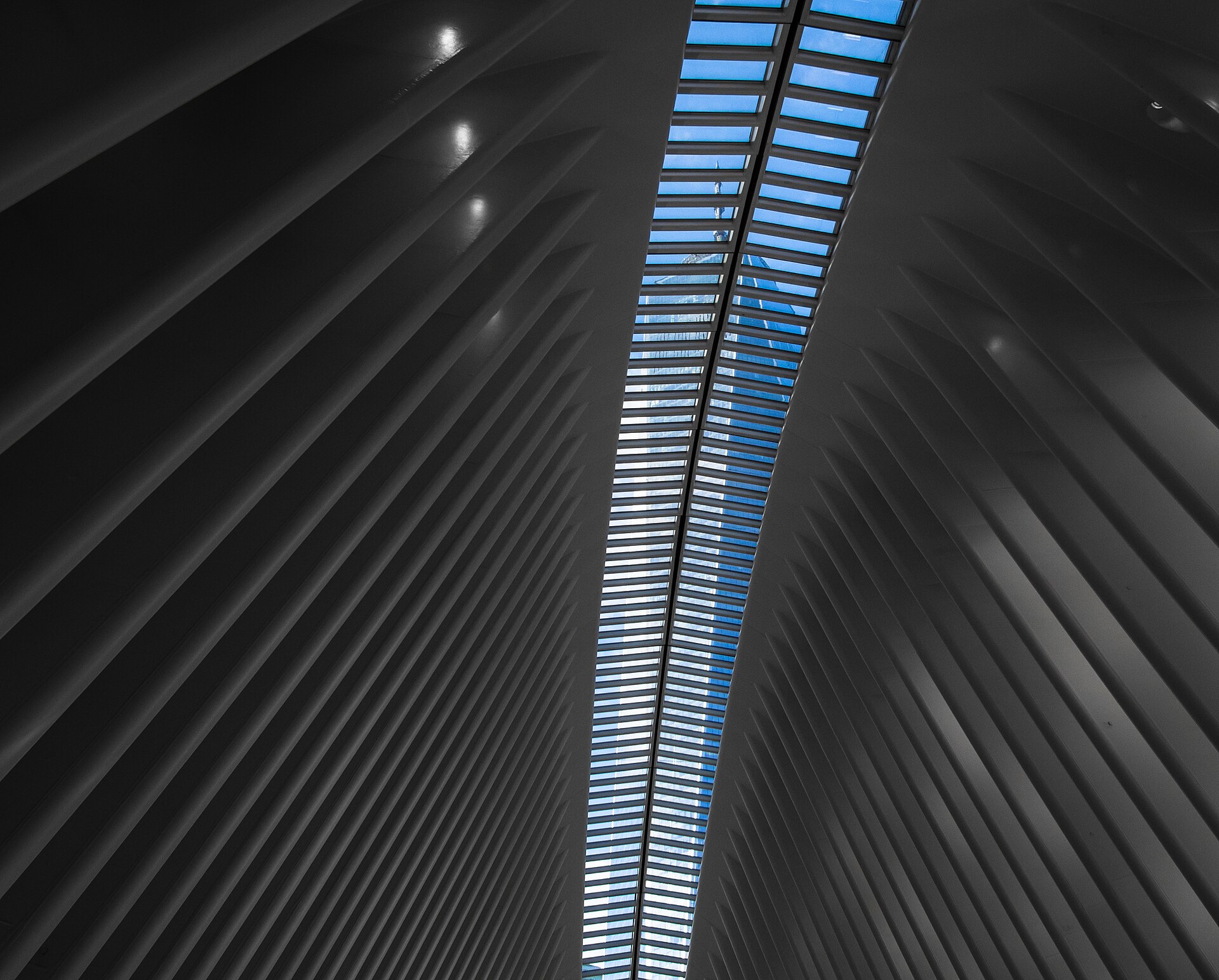
One World Trade Center framed by the Oculus skylight. Photo by Rhododendrites, via Wikimedia Commons. Creative Commons Attribution-Share Alike 4.0.
What else is in the building?
The Oculus is also a mall. Westfield World Trade Center, about 365,000 square feet of retail threaded through the hall and the underground concourses, opened on August 16, 2016, five months after the station itself. The complex connects east to Fulton Center and west, through the marble-floored West Concourse, to Brookfield Place on the Hudson; that western passage, a 600-foot pedestrian underpass beneath the West Side Highway, opened in October 2013 as a $225 million project of its own, which reporters promptly described as the most expensive passageway in the world. Its northern wall carries stores; its southern wall stays blank out of respect for the September 11 Memorial and Museum across the way. The station is now among the busiest rail hubs in the metropolitan region, serving PATH trains to Hoboken and Newark, with subway lines a short walk away. Whether it is a white elephant or Lower Manhattan's new front room remains a genuine argument, but the weekday crowds under its ribs are real.
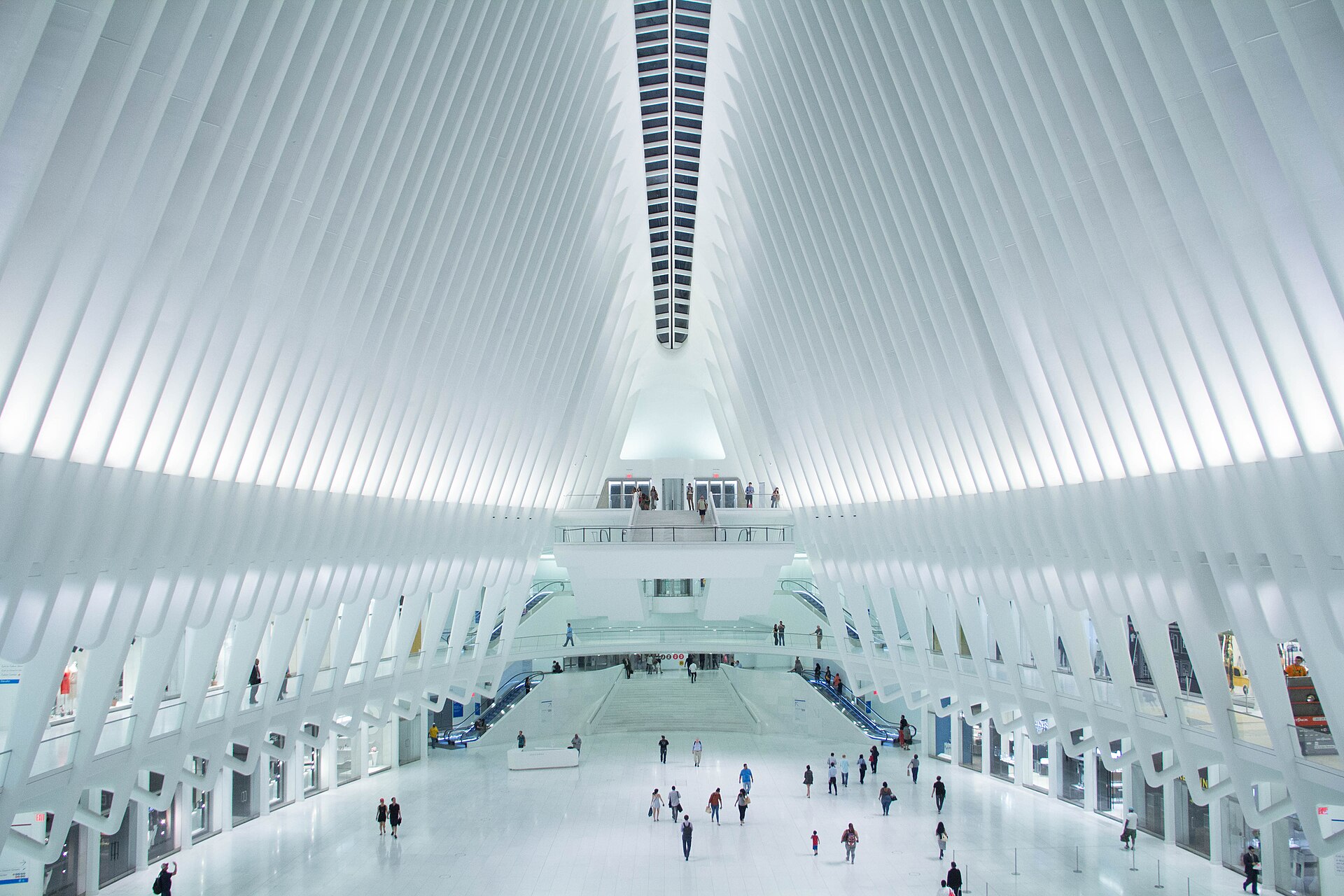
Inside the Oculus in August 2016, the year it opened. Photo by Anthony Quintano, via Wikimedia Commons. Creative Commons Attribution 2.0.
How did New York receive it?
Reviews split cleanly between the building and the bill. Critics praised the design, the play of light under the ribs and the drama of the hall, while the cost and the delays made it a byword for boondoggle; the phrase "world's most expensive train station" attached itself to the project years before it opened. The station underneath opened in stages around the construction: Platform A began service in February 2014 and Platform B in May 2015, with the remaining two platforms following in September 2016, five tracks and four platforms sitting four floors below street level. Calatrava had originally wanted more: the roof was designed so its wings could open mechanically for light and ventilation, a feature scaled back as costs climbed, though the skylight can still be opened manually. What nobody disputes is the foot traffic. On weekdays the hall fills with commuters cutting between PATH, the subway lines and the offices around the site, and it now ranks as the fifth-busiest transportation hub in the New York metropolitan area. The bird may have cost too much, but New York uses it.
Who owns and runs the Oculus?
The Port Authority of New York and New Jersey owns and operates the building. The bi-state agency built the original World Trade Center, rebuilt the PATH station after 2001, and commissioned Calatrava's design. Westfield, now part of Unibail-Rodamco-Westfield, leases and manages the retail space under a long-term agreement with the Port Authority. PATH trains, the station's reason for existing, are also run by the Port Authority.
Where can you eat or drink at the Oculus?
Right inside it. The Westfield World Trade Center directory, read on October 25, 2026, lists dining options that include Eataly NYC Downtown, the Italian food hall with restaurants, counters and a market; Épicerie Boulud; Blue Bottle Coffee; Joe & The Juice; and Shake Shack, among others, most clustered on the hall's upper levels and along the concourses. One block west, Brookfield Place's dining options sit at the end of the West Concourse. Hours vary by tenant, so check the directory page for current listings before planning around a specific spot.
Sources
- Wikipedia, World Trade Center station (PATH)
- The New York Times, "Leisurely Arrival at Ground Zero, for a $4 Billion Train Station" (2014)
- Engineering News-Record, "World Trade Center Train Station Opens With $4-Billion Price Tag"
- Westfield World Trade Center, Food & Drink directory
Visiting the Oculus
- Address: The World Trade Center site, Church Street between Fulton and Dey Streets, Lower Manhattan. The main entrance faces the 9/11 Memorial plaza.
- Getting there: PATH trains from Hoboken and Newark run into the station itself. The 1 train stops at WTC Cortlandt, the R and W at Cortlandt Street, the A, C and E at Chambers Street and World Trade Center, and the 2, 3, 4, 5, J and Z connect through the link to Fulton Center.
- Cost: The hall, the concourses and the mall are free to enter; only PATH fares apply to the platforms.
- Don't miss: Stand in the center of the hall and look straight up at the skylight; the ribs frame a sliver of sky and One World Trade Center. If you are in New York on September 11, the skylight opens for about 102 minutes that morning. The West Concourse leads through the Winter Garden at Brookfield Place to the Hudson River esplanade.
Station, shopping and transit details above were read on the official directory and transit pages on October 25, 2026.