The 9/11 Memorial & Museum: Reflecting Absence in the Twin Towers' Footprints
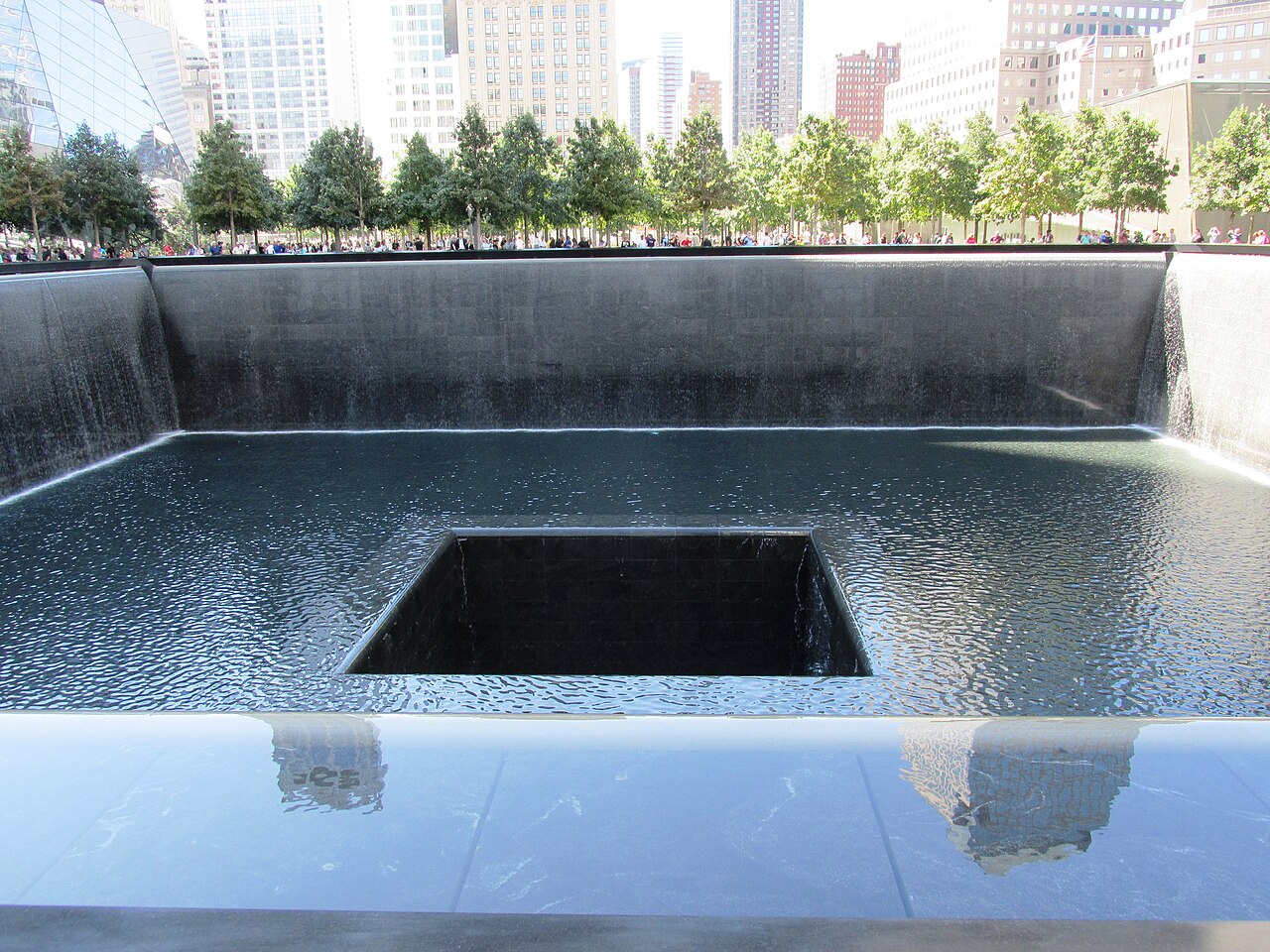
A reflecting pool at the 9/11 Memorial. Photograph by brewbooks, via Wikimedia Commons. CC BY-SA 2.0.
The 9/11 Memorial occupies eight of the sixteen acres of the World Trade Center complex in Lower Manhattan. Two waterfall pools sit in the footprints of the Twin Towers, ringed by bronze parapets carrying 2,983 names, and a museum descends to the site's bedrock. The memorial opened in 2011 and the museum in 2014. This article covers how the design was chosen, what is there, and who runs it, drawn mostly from the institution's own pages and its 2026 institutional backgrounder.
How was the memorial design chosen?
In April 2003 the Lower Manhattan Development Corporation, set up to oversee the revitalization of downtown after the attacks, launched an international competition for the memorial's design. The memorial's About page says the competition was open to any adult regardless of nationality or professional accreditation, and that it yielded 5,201 submissions from 63 countries, judged by a 13-person jury. An LMDC press release from July 2003 had already called it the largest design competition in history; that release gives the tally as 5,200 submissions from 62 nations and 49 states, slightly different from the memorial's current figures, which this article uses.
In January 2004 the jury chose "Reflecting Absence," submitted by architect Michael Arad and landscape architect Peter Walker. Their design placed twin waterfall pools in the tower footprints, edged with bronze parapets listing the names of the victims of the 2001 attacks and the 1993 World Trade Center bombing, within a plaza of roughly 400 swamp white oak trees.
What is "Reflecting Absence"?
The two pools are each nearly an acre in size and sit in the footprints of the North and South Towers. The memorial says their waterfalls are the largest manmade waterfalls in North America, each dropping 30 feet into a square basin, then falling another 20 feet into a smaller central void that, in Arad's words, can never be filled. The pools represent, he has said, "absence made visible."
The 2,983 names on the bronze parapets cover the 2,977 people killed on September 11, 2001 at the World Trade Center, the Pentagon and aboard Flight 93, and the six people killed in the February 26, 1993 bombing. Names are grouped by where victims were: the North Pool lists those killed in the North Tower, on Flight 11 and in 1993, while the South Pool lists first responders and those killed in the South Tower, on the other flights and at the Pentagon. Within those groups the memorial uses "meaningful adjacencies," placing friends, colleagues, flight crews and responder units together, and next of kin could request that specific names sit side by side.
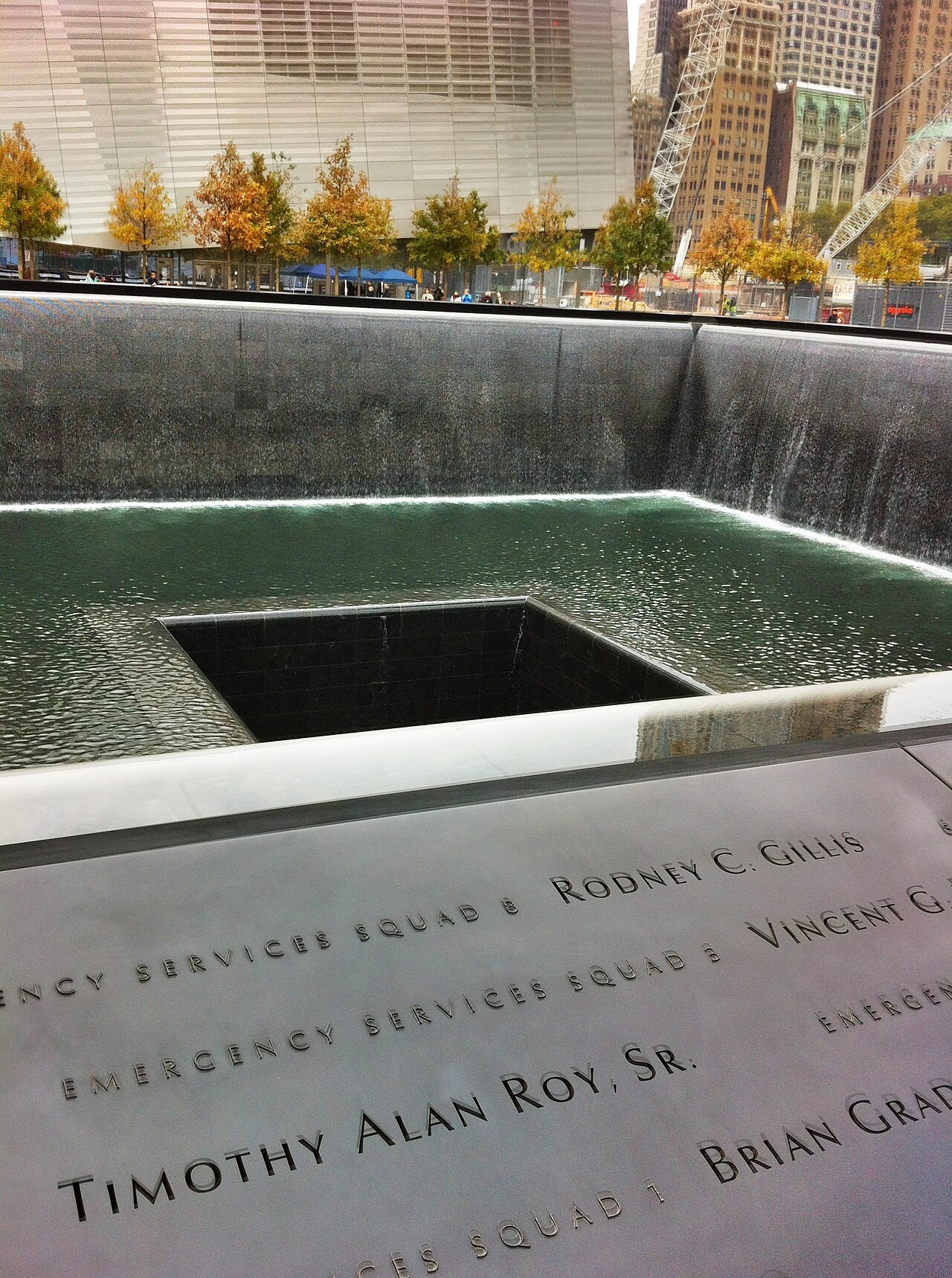
A pool corner with names on the parapet. Photograph by David Brooks, via Wikimedia Commons. CC BY 2.0.
What grows on the plaza?
Swamp white oaks, a species native to the areas of all three 9/11 crash sites: New York, Arlington, Virginia and Somerset County, Pennsylvania. The memorial's About page says roughly 400 of them; the institution's September 2026 backgrounder counts 413, so the official figures differ slightly. One tree is different: a Callery pear found badly damaged at Ground Zero in October 2001, nursed back to health by the city's Parks Department and returned to the site in 2010. It is known as the Survivor Tree.
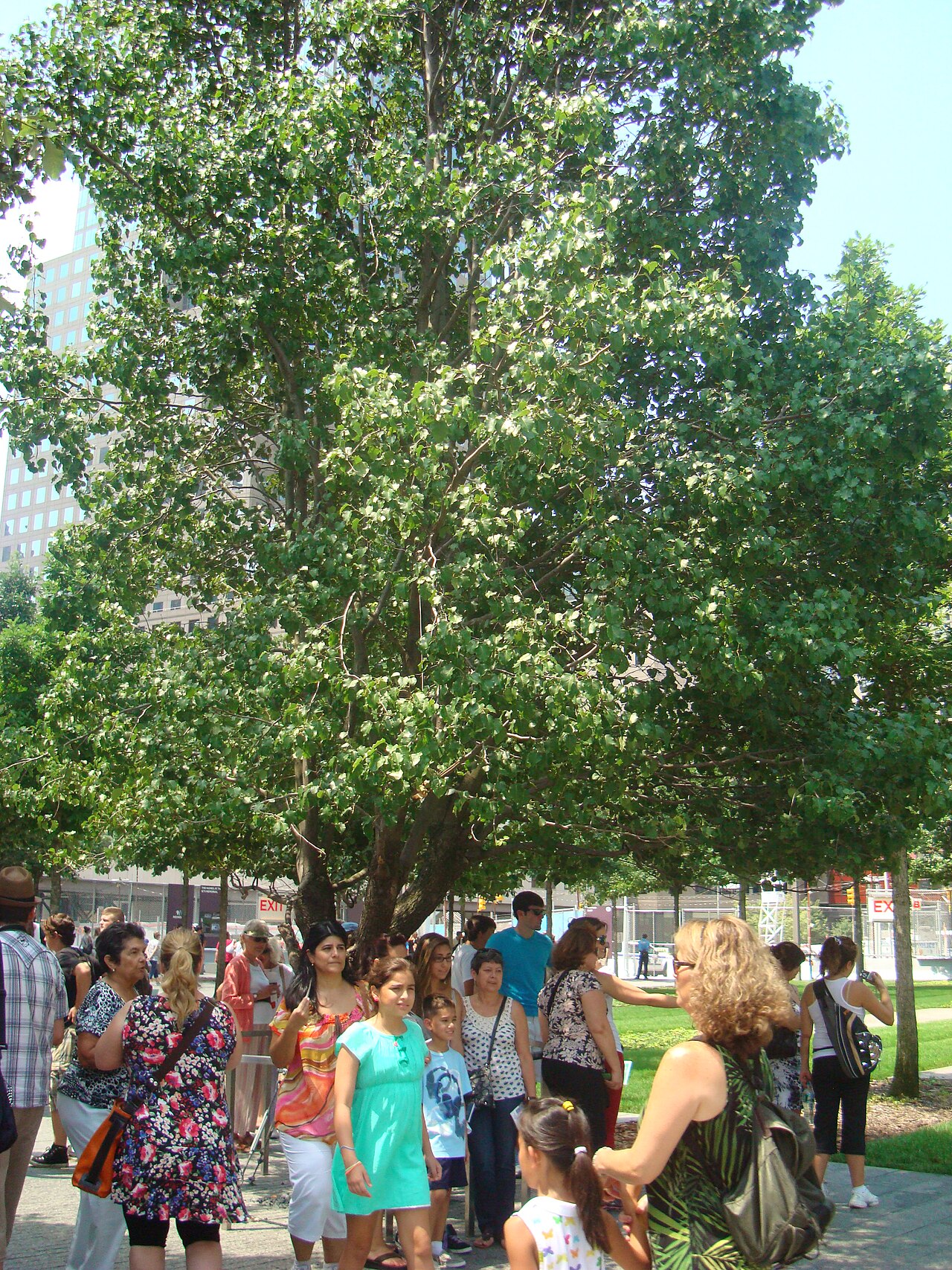
The Survivor Tree. Photograph by PumpkinSky, via Wikimedia Commons. CC BY-SA 3.0.
In the plaza's southwestern quadrant is the 9/11 Memorial Glade, honoring responders, recovery workers, survivors and Lower Manhattan residents, students and workers who are sick or have died from toxin exposure after the attacks. A pathway there is flanked by six stone monoliths inlaid with remnant World Trade Center steel. The Glade opened on May 30, 2019, the anniversary of the official end of the recovery period; the memorial's About page calls that the 17th anniversary while the 2026 backgrounder calls it the 18th, so the institution's own pages disagree on the count.
When did the memorial open?
The memorial was dedicated on September 11, 2011, the tenth anniversary of the attacks, in a ceremony for victims' families, and it opened to the public on September 12, 2011. The backgrounder says more than 100 million visitors have since come, including 11.6 million to the plaza in 2025 alone.
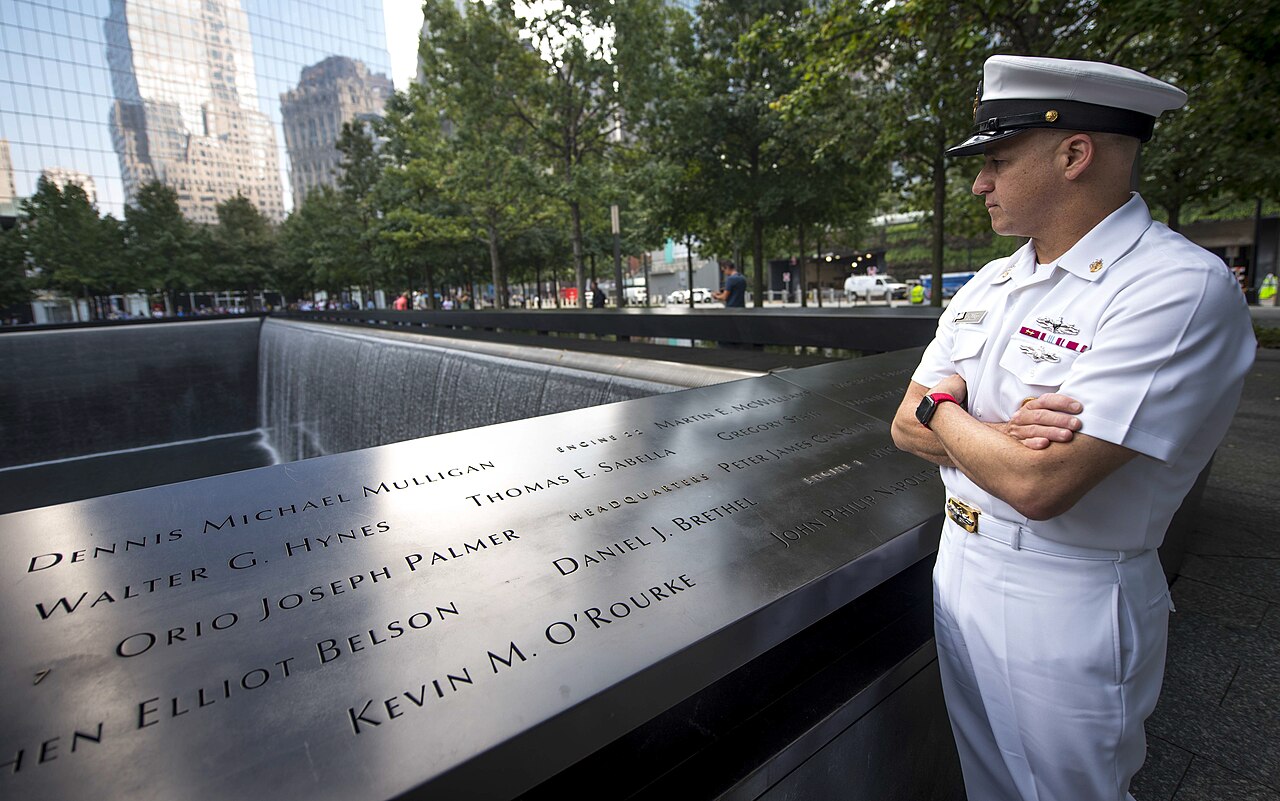
Paying respects at the names parapet. U.S. Navy photo by Mass Communication Specialist 1st Class Sarah Villegas, via Wikimedia Commons. Public domain.
What is in the museum?
The 9/11 Memorial Museum was dedicated on May 15, 2014, in a ceremony led by President Barack Obama and 9/11 Memorial chairman Michael R. Bloomberg, and it opened to the public on May 21, 2014. The institution says the museum has since welcomed 28 million visitors from all 50 states and more than 190 countries; an earlier version of its About page said more than 175 countries, so the count has grown. The museum holds 110,000 square feet of exhibition space, and its collection includes more than 82,000 physical and digital artifacts.
Visitors enter through an above-ground pavilion designed by the Norwegian firm Snøhetta. Two 80-foot steel tridents, once part of the Twin Towers' facade, stand in its glass atrium. Below ground, in spaces designed by Davis Brody Bond, a ramp descends past views into the cavity of the original complex. At the end of the ramp lies the Survivors' Stairs, the Vesey Street staircase that gave hundreds of people a way out on 9/11 and that was saved during the federal review of the site's historic assets. The site itself was found eligible for the National Register of Historic Places in February 2004, well inside the usual 50-year rule, as "exceptionally significant."
At bedrock sit two monumental spaces. Memorial Hall, between the tower footprints, holds artist Tom Joyce's quotation forged from recovered steel, "No day shall erase you from the memory of time," set against Spencer Finch's "Trying to Remember the Color of the Sky on That September Morning," made of 2,983 individual blue panels. Foundation Hall, beside the North Tower footprint, is backed by a surviving section of the slurry wall, the concrete retaining wall that held back the Hudson River when the site was excavated in the mid-1960s and that stayed intact through the collapse. At its center stands the Last Column, the 36-foot final piece of steel removed from Ground Zero on May 30, 2002, covered by recovery workers with inscriptions and mementos. The historical exhibition sits in the North Tower footprint and the memorial exhibition, In Memoriam, in the South Tower footprint. The backgrounder also notes that a repository for the remains of unidentified victims sits at bedrock, operated independently by the city's Office of Chief Medical Examiner and separate from the public museum space.
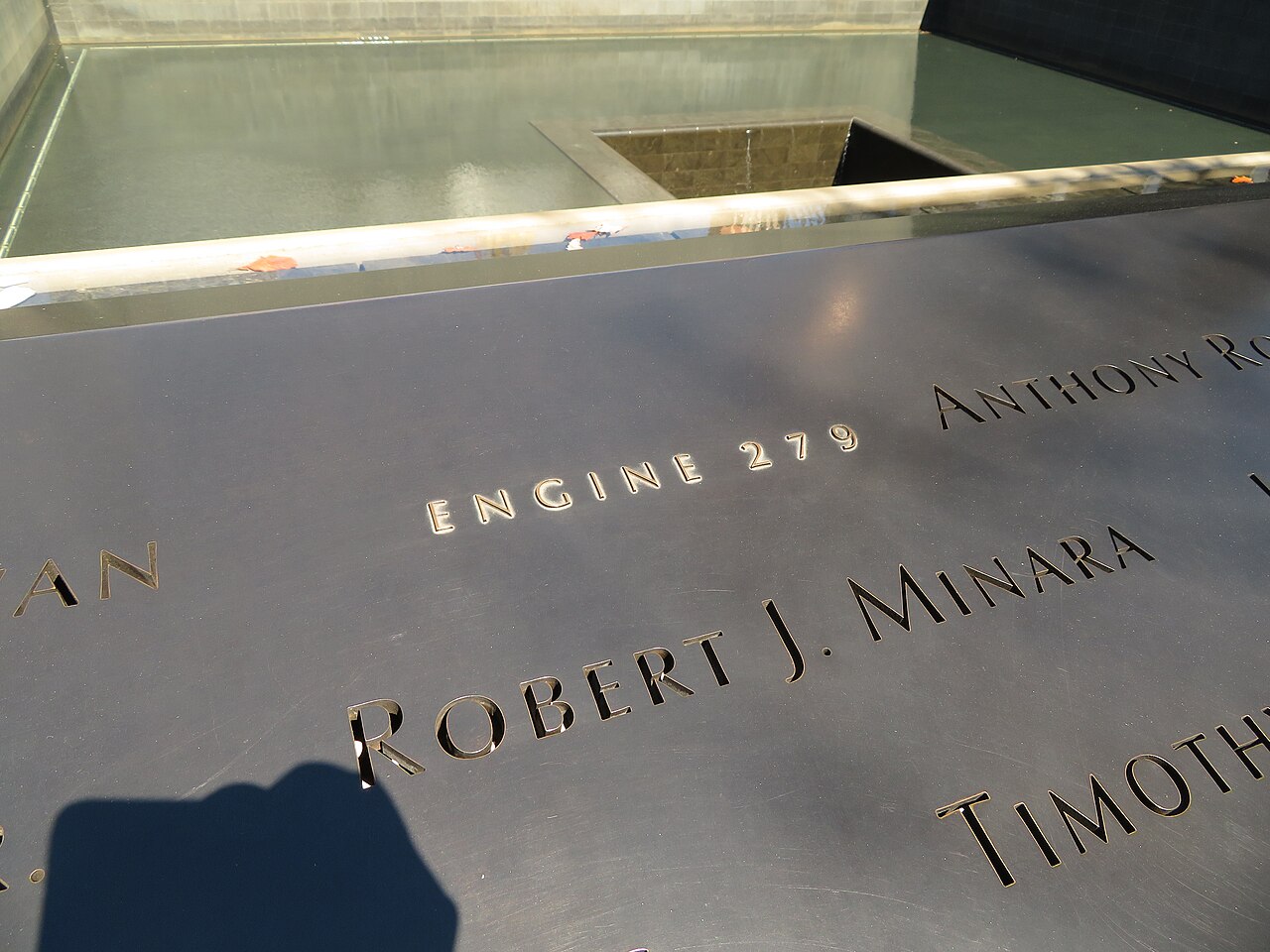
Names grouped by unit on the parapet. Photograph by Ken Lund, via Wikimedia Commons. CC BY-SA 2.0.
Who owns the 9/11 Memorial & Museum?
The memorial and museum are operated by the National September 11 Memorial & Museum, a nonprofit. Its 2026 backgrounder names Michael R. Bloomberg as chairman and Elizabeth L. Hillman as president and CEO, and says ten family members of victims serve on its board of trustees alongside others from the 9/11 community. The institution's own blog notes that the Port Authority of New York and New Jersey oversees the entire 16-acre World Trade Center, eight acres of which are occupied by the memorial and the museum.
Where can you eat or drink at the 9/11 Memorial & Museum?
The museum runs the Museum Café, on the atrium terrace. The institution's café page lists hours of 9 a.m. to 6 p.m. and describes it as a light-filled spot for rest and refreshments, noting that café purchases and donations help sustain the 9/11 Memorial & Museum. There is no dining out on the memorial plaza itself, which the institution asks visitors to treat as a place of quiet reflection.
Sources
- National September 11 Memorial & Museum, About the Memorial
- National September 11 Memorial & Museum, About the Museum
- National September 11 Memorial & Museum, Visit
- National September 11 Memorial & Museum, Institutional Backgrounder, September 2026
- Lower Manhattan Development Corporation, final submission count press release, July 17, 2003
- National September 11 Memorial & Museum, Looking Back on 100 Years of Port Authority History
- National September 11 Memorial & Museum, Museum Café (checked October 17, 2026)
Visiting the 9/11 Memorial & Museum
- Address: 180 Greenwich Street, New York, NY 10007, on the World Trade Center site.
- Memorial hours: The memorial is free and open daily, 8 a.m. to 8 p.m., per the institution's Visit page.
- Museum hours: The museum is open Wednesday to Monday and select Tuesdays, 9 a.m. to 7 p.m., with last entry at 5:30 p.m. Advance ticket purchase is required.
- Guides: Museum audio guides are available in nine languages including ASL; a free memorial audio guide is offered through Bloomberg Connects.
- Time: The institution suggests planning at least 45 to 90 minutes for the museum.
Checked against the 9/11 Memorial & Museum visit page on October 17, 2026. Confirm hours and ticket rules there before visiting.