The Woolworth Building: A Five-and-Dime Fortune Becomes a Skyscraper
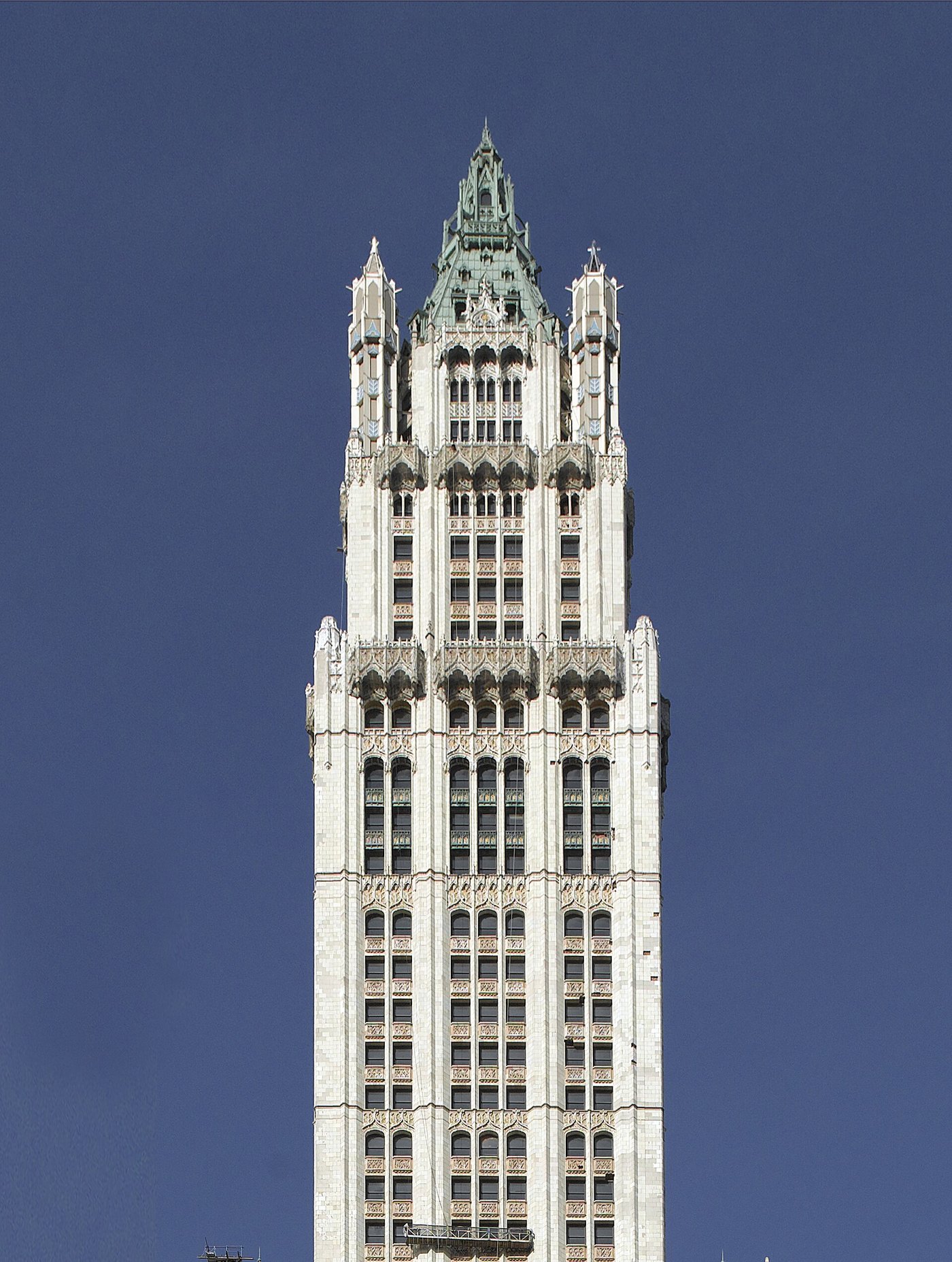
The Woolworth Building's tower in 2009. Photograph by Carol M. Highsmith. Library of Congress, Prints & Photographs Division. Public domain.
Frank W. Woolworth built his fortune a nickel and a dime at a time. Born in 1852 on a farm in Rodman, New York, he opened his first successful five-cent store in Lancaster, Pennsylvania, in June 1879. By 1910 his chain had merged with several competitors, and he was ready for a headquarters in Manhattan that would match the size of the business.
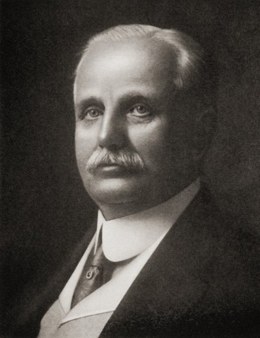
The project began more modestly than the result suggests. According to the New York City Landmarks Preservation Commission, Woolworth first planned a standard office building of twelve to sixteen stories at the corner of Broadway and Park Place. It was also meant to house the Irving National Bank. Its president, Lewis Pierson, was a friend of Woolworth's, and Woolworth offered to buy the stock needed to complete a bank merger if the bank would move its headquarters into his building. The bank agreed, and Woolworth hired the architect Cass Gilbert.
The height then kept climbing. The design was raised to twenty stories to top the Pulitzer Building across City Hall Park. By September 1910 it called for a forty-story tower of about 550 feet. Two months later, Gilbert's notes record Woolworth asking how the tower compared with the 612-foot Singer Building a few blocks south and telling him to raise it to 620 feet. The Metropolitan Life tower on Madison Square was then the tallest building in the world, and Woolworth decided to go higher still. He later explained that businessmen in Europe kept asking him about the Singer tower. "I decided to erect a building that would advertise the Woolworth five and ten cent stores all over the world," he said in 1913.
The finished building rises sixty stories and 792 feet above Broadway. Woolworth paid for it in cash - $13.5 million, according to the National Park Service. The engineering was as ambitious as the height. Builders sank caissons through soil, mud and water to bedrock, averaging about 110 feet deep, and braced the tower against the wind with portal frames like those used on bridges.
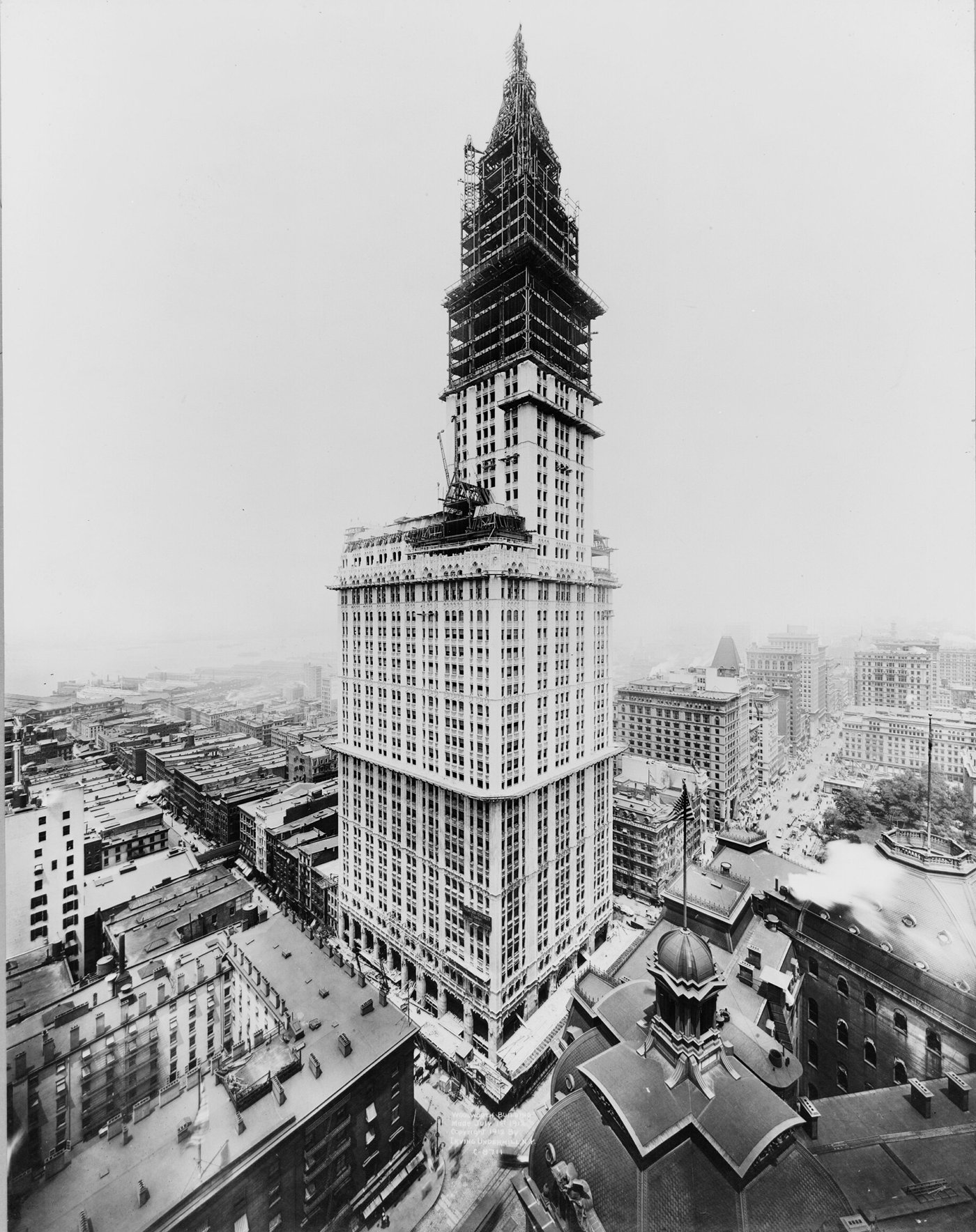
The Woolworth Building under construction, July 1, 1912. Photograph by Irving Underhill. Library of Congress, Prints & Photographs Division. No known restrictions on publication.
Gilbert clad the steel frame in terra cotta and dressed it in Gothic detail. His choice was often misunderstood. The Landmarks Preservation Commission explains that he used Gothic forms to express the upward movement of a tall tower, not to imitate a church. At the opening, the Rev. S. Parkes Cadman christened the building the "Cathedral of Commerce," a name that stuck even though it irritated the architect.
That opening came on the night of April 24, 1913. Woolworth hosted a dinner for about 900 guests in Gilbert's honor. At the signal, President Woodrow Wilson pressed a button at the White House, and lights came on across the building, from the sub-basement to the top of the tower. It was the tallest building in the world and held that title until 1930. In 1915 the Panama-Pacific Exposition gave it a gold medal as the "most beautiful building in all the world erected to commerce."
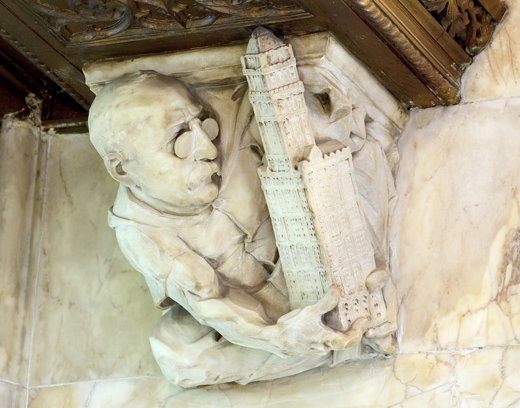
The lobby is one of the finest in the city. The National Park Service describes walls of veined marble from the Greek island of Skyros, a vaulted ceiling of glass mosaic, and murals titled "Commerce" and "Labor." Tucked under the beams are small carved caricatures of the men behind the project. Gilbert holds a model of the building. The engineer Gunvald Aus measures a girder. Woolworth counts his nickels and dimes.
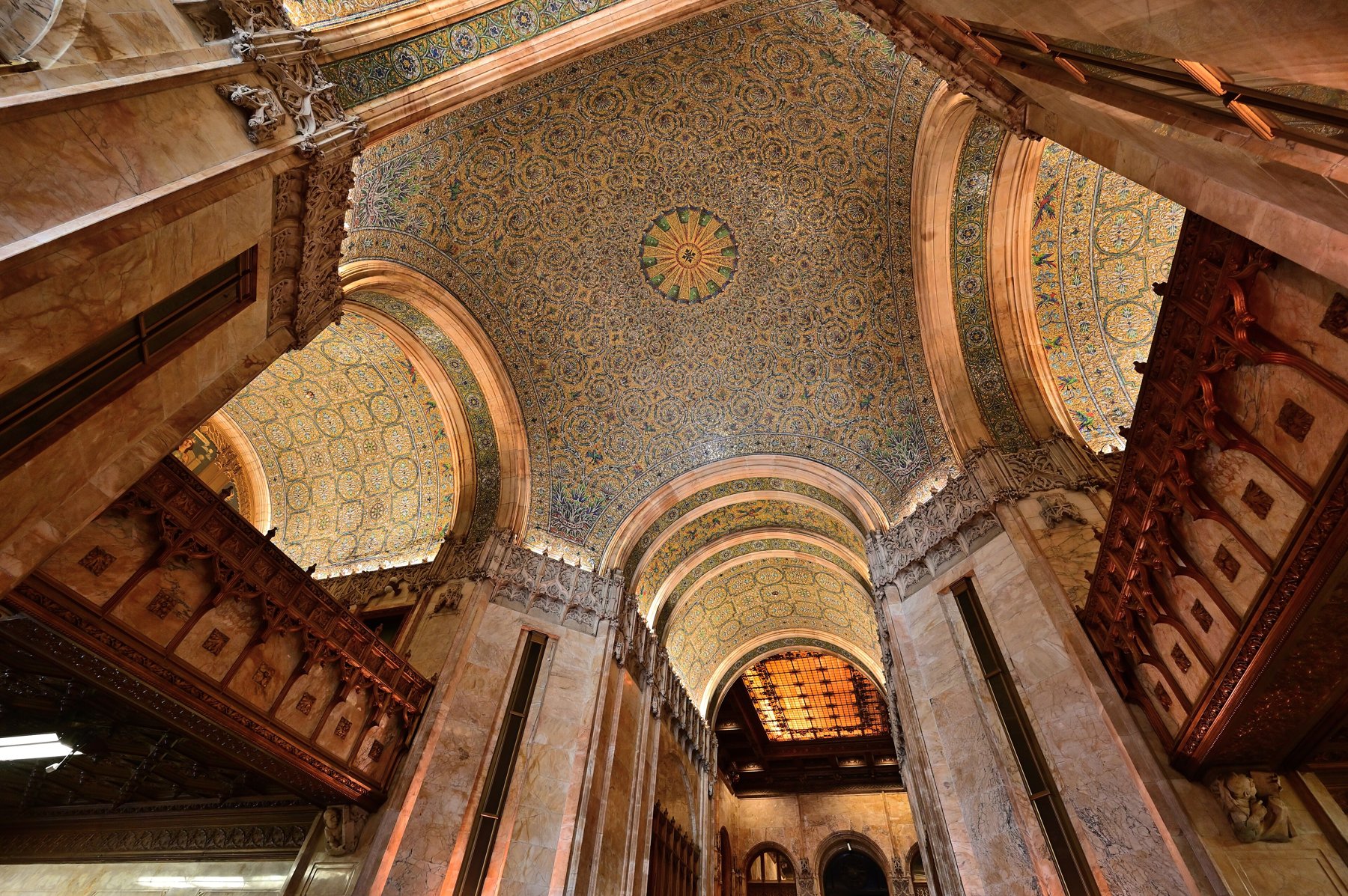
The Woolworth Building lobby in 2019. Photograph by Stefan Kemmerling, via Wikimedia Commons. CC BY-SA 4.0.
Who owns the Woolworth Building today?
The F. W. Woolworth Company still owned the building when the National Park Service documented it as a National Historic Landmark. Today it is split in two. The Witkoff Group and Cammeby's International own the commercial portion at 233 Broadway. In 2012 they sold the upper part of the building to Alchemy Properties, which converted it into condominiums, as Commercial Observer has reported. The lower floors remain offices and shops.
New York City designated both the exterior and the first-floor lobby as landmarks on April 12, 1983. More than a century after Wilson flipped the lights on, the Woolworth Building remains what its owner wanted: an advertisement in stone and terra cotta, now for Lower Manhattan as much as for the five-and-dime.
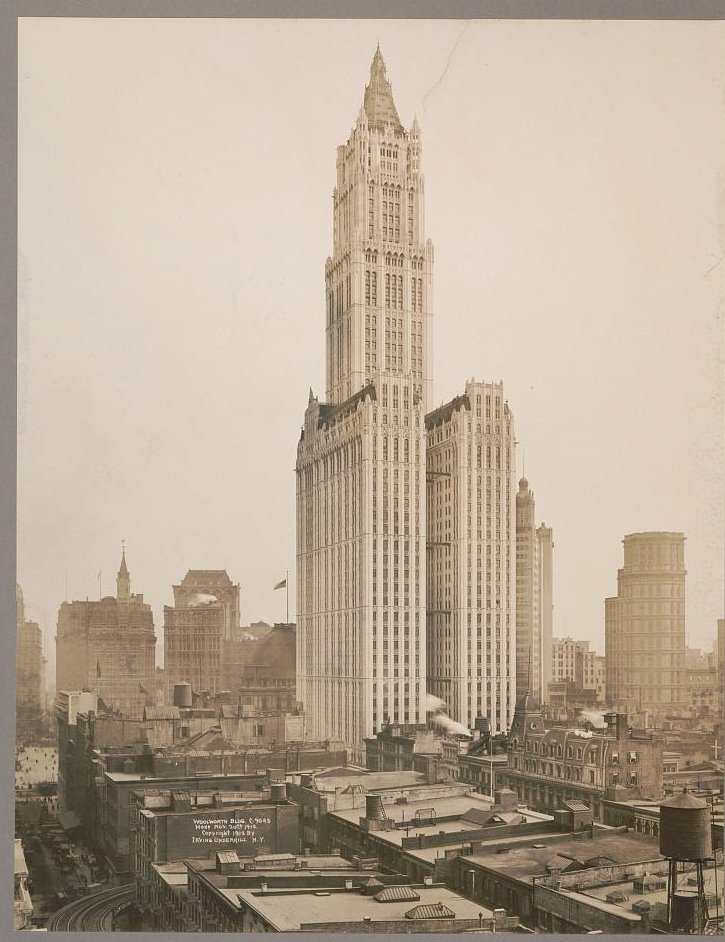
The Woolworth Building, ca. 1912. Library of Congress, Prints & Photographs Division. No known restrictions on publication.
Sources
- NYC Landmarks Preservation Commission, Woolworth Building designation report (1983)
- NYC Landmarks Preservation Commission, Woolworth Building lobby interior designation report (1983)
- National Park Service, National Historic Landmark documentation
- Commercial Observer, Goody's lease at the Woolworth Building (2025)
- Library of Congress, historic Woolworth Building photograph
- Library of Congress, Irving Underhill construction photograph (1912)
- Wikimedia Commons, Woolworth Building lobby by Stefan Kemmerling (CC BY-SA 4.0)
- Library of Congress, Carol M. Highsmith photograph of the Cass Gilbert carving (2009)
- Library of Congress, Carol M. Highsmith photograph (2009)
- Wikimedia Commons, portrait of Frank W. Woolworth (public domain)

