Lincoln Center: The Neighborhood That Came Down for a Performing Arts Campus
Lincoln Center sits on land that was a crowded Upper West Side neighborhood in the 1950s. The campus that replaced it opened in stages, with the first concert in September 1962 and the last major building in 1969, and its construction was part of a slum-clearance program that displaced thousands of families. Both parts of that story are documented, and this article tries to give them equal weight.
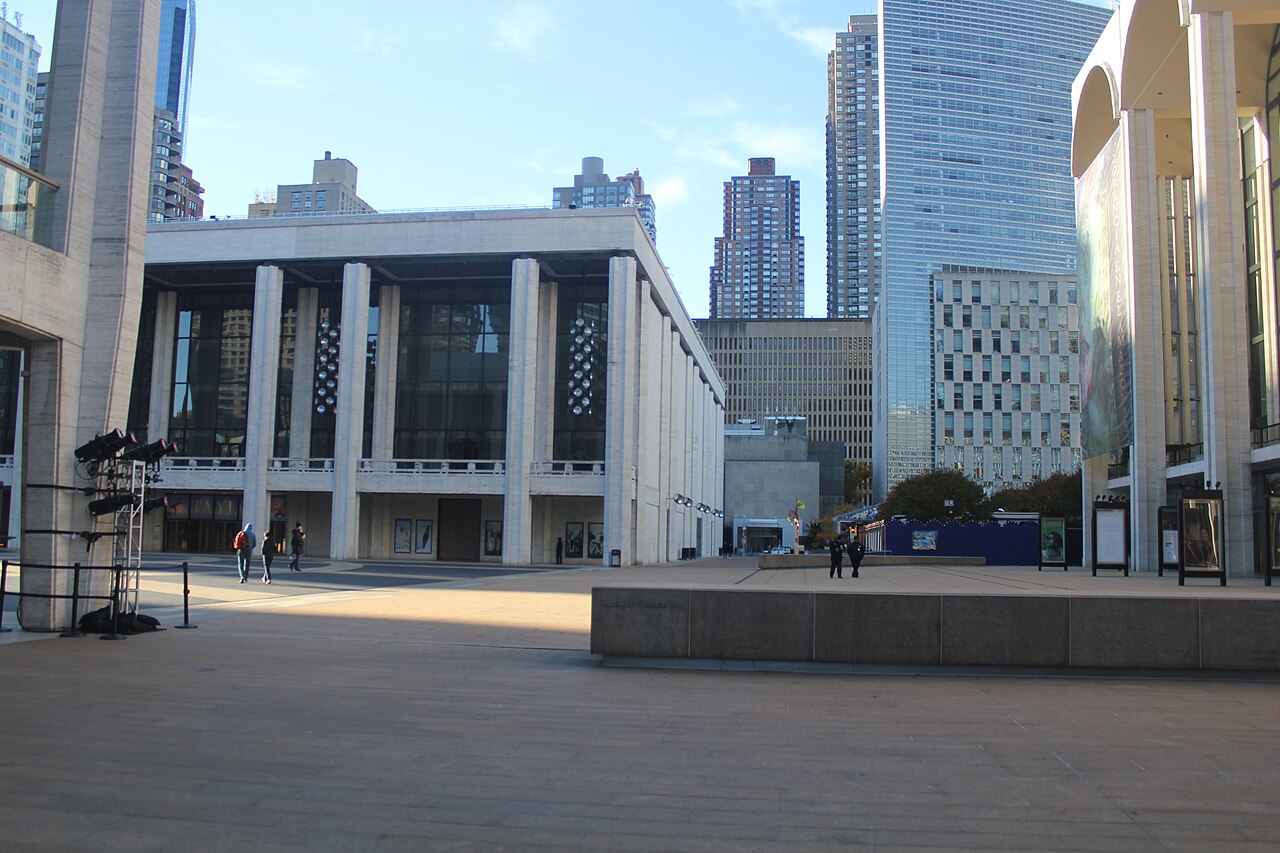
David Geffen Hall (far left), the David H. Koch Theater (left) and the Metropolitan Opera House (right) at Lincoln Center, November 2023. Photograph by Epicgenius, via Wikimedia Commons. CC BY-SA 4.0.
What was here before Lincoln Center?
The New York Times says the neighborhood, called Lincoln Square, was a vibrant one. It was where James P. Johnson introduced the Charleston, the dance craze of the 1920s, and where Thelonious Monk perfected his bebop style. It was also very crowded, with as many as 5,000 people living on a single block. NPR's 2022 report says the neighborhood was known as San Juan Hill and was mostly a community of Black and Puerto Rican residents in the 1950s. It had nurtured jazz musicians including the saxophonist Benny Carter, who grew up there, and the pianist Herbie Nichols, who was born there. Duke Ellington and Rex Stewart co-wrote a tune in tribute to it.
How did the land get cleared?
By the 1950s, Lincoln Center's own history says, the Metropolitan Opera and the New York Philharmonic, two of the country's oldest performing arts organizations, were looking for new homes. At the same time Robert Moses was leading the Lincoln Square Urban Renewal Project. The Lincoln Square Development Plan, drawn by Harrison & Abramovitz and approved on October 31, 1956, treated the performing arts center as one element among many changes to the area.
The Times describes Lincoln Center as the crown-jewel project of the Mayor's Committee on Slum Clearance, overseen by Moses. The plan leveled 18 city blocks and also included educational, commercial and residential buildings. The Times says it displaced more than 7,000 low-income families and 800 businesses, and that few if any of the 4,400 new housing units were meant for the earlier residents, who were almost all Black and Hispanic. It adds that the relocation help the committee promised never materialized. NPR reports the same figures, more than 7,000 families and some 800 businesses, and says Moses's aim included a midtown campus for Fordham University alongside Lincoln Center.
Moses defended the clearance in a 1977 interview with the public television station WNET. NPR quotes him calling the area "the worst slum in New York" and saying "we cleared it out." NPR also notes that there is no record of Moses living on any of those streets, despite his claim in the interview that he had, citing Robert Caro's biography, The Power Broker. Yarimar Bonilla, director of the Center for Puerto Rican Studies at Hunter College, told NPR that Moses used medical language about slums as cancers to be removed. The 2021 film version of West Side Story opens on rubble and a sign about slum clearance, which NPR connects to this neighborhood.
When did construction start?
President Dwight D. Eisenhower broke ground on May 14, 1959, at Broadway and West 64th Street. Lincoln Center's history lists Borough President Hulan Jack, Mayor Robert Wagner, John D. Rockefeller 3rd and Lieutenant Governor Malcolm Wilson at the ceremony. The Times headline that week put the project's cost at $75 million. Lincoln Center says the campus transformed 16.3 acres of the Upper West Side. Eisenhower said at the ceremony that it would be a place for "a true interchange of fruits of national cultures."
How were the buildings finished?
Philharmonic Hall, designed by Max Abramovitz, rose first. Leonard Bernstein led the New York Philharmonic in the first concert on September 23, 1962, which included the world premiere of Aaron Copland's Connotations. The hall was later called Avery Fisher Hall and is now David Geffen Hall.
The New York State Theater, by Philip Johnson, opened on April 23, 1964, built for the New York City Ballet. George Balanchine called it a jewel box. The New York City Opera performed there until 2011, and it is now the David H. Koch Theater. Lincoln Center's third building, by Eero Saarinen, opened on October 21, 1965. It holds the Vivian Beaumont Theater at plaza level, the Mitzi E. Newhouse Theater at street level and the New York Public Library for the Performing Arts. The Repertory Theater of Lincoln Center opened the Beaumont with a revival of Georg Buchner's Danton's Death, with James Earl Jones and Stacy Keach. A third theater, the Claire Tow, was added to the roof in 2012.
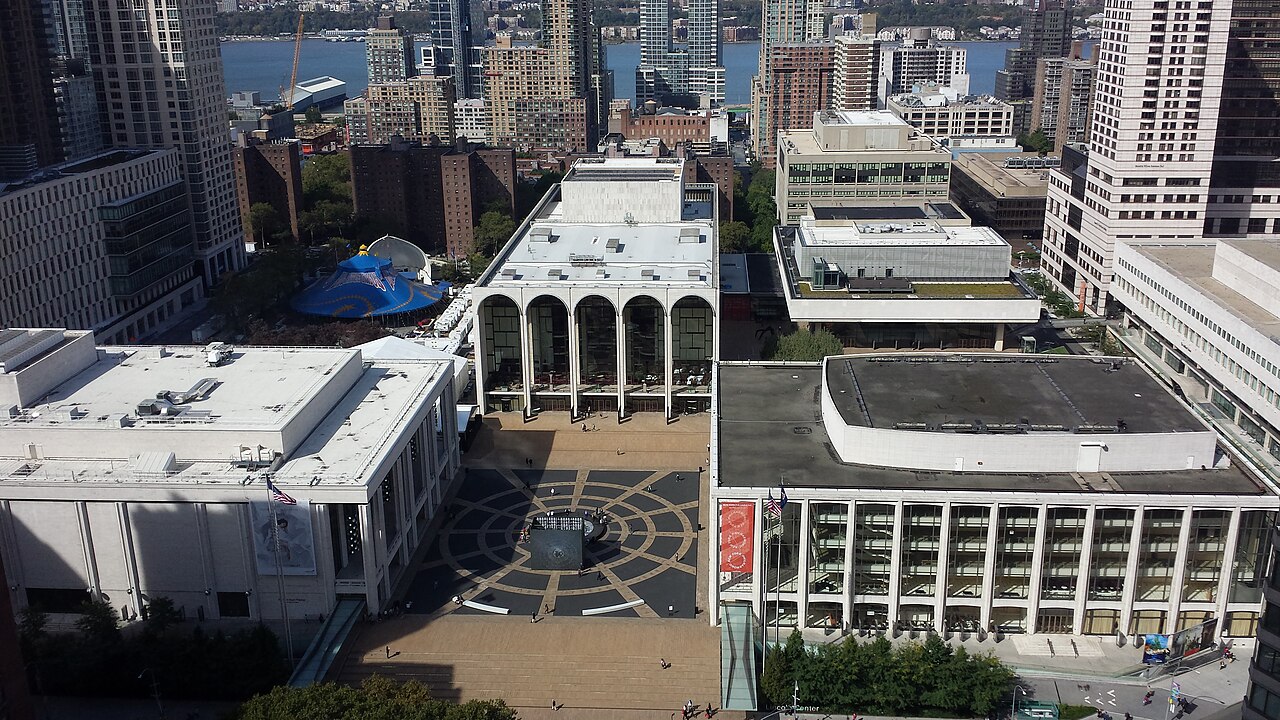
Lincoln Center's plaza seen from above, with the arches of the Metropolitan Opera House at the far end. Photograph by Ostarrichi, via Wikimedia Commons. CC BY-SA 4.0.
The Metropolitan Opera House, with its tall arches, was finished in 1966. Lincoln Center says it came from chief architect Wallace Harrison's forty-third design, is about one and a half football fields long and has five stages. Marc Chagall unveiled his two murals there on September 8, 1966, and the house officially opened on September 16, 1966, with the world premiere of Samuel Barber's Antony and Cleopatra, in which Leontyne Price sang Cleopatra. The last parts of the campus to be completed were Alice Tully Hall, which opened on September 11, 1969, as the first major hall in the city designed for chamber music, and The Juilliard School, which opened to students on October 26, 1969.
Sculpture filled the plazas. Lincoln Center's history shows Henry Moore's Reclining Figure, placed in the reflecting pool in 1965, and Alexander Calder's Le Guichet in front of the library building. The Times sums up the timeline this way: Lincoln Center officially opened in 1962, and the rest of the surrounding construction was finished by 1969.
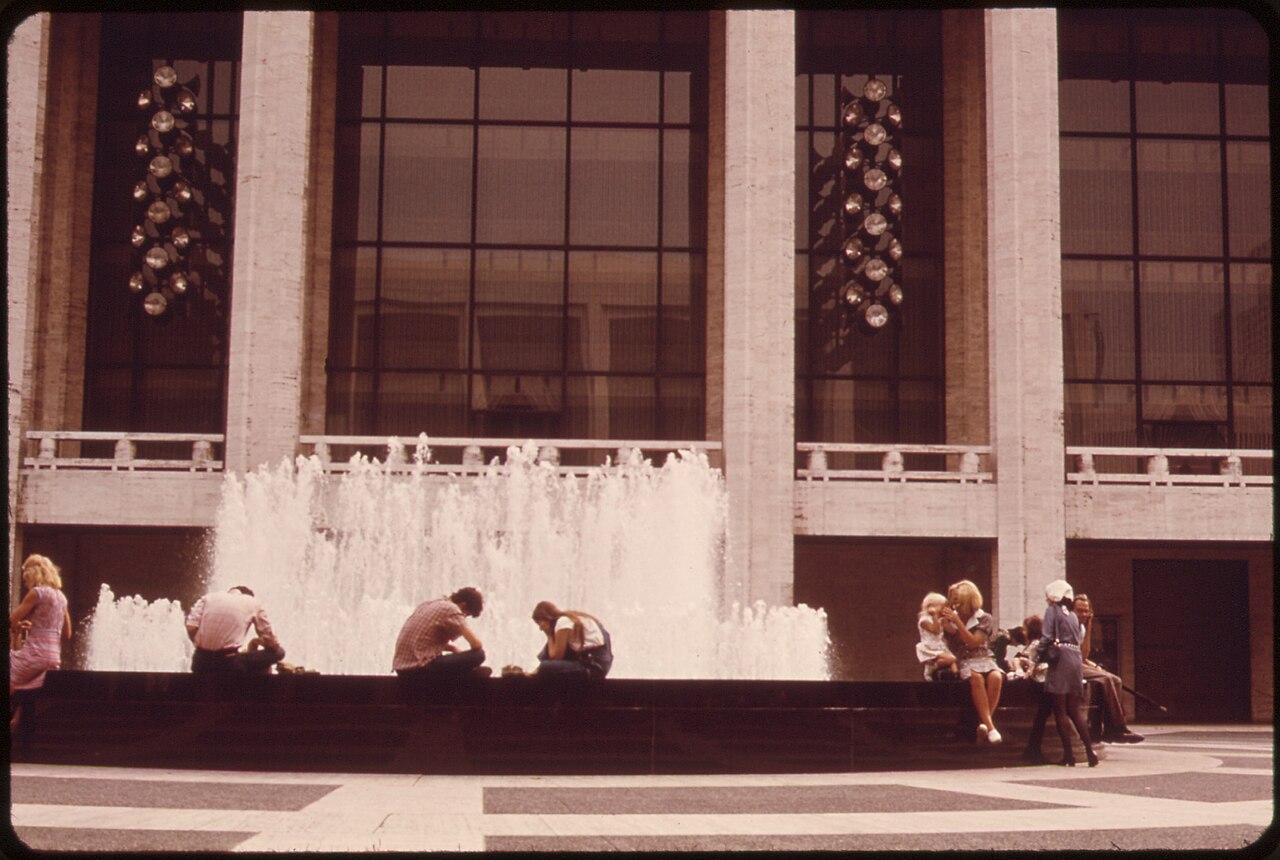
The fountain plaza at Lincoln Center in August 1973. Photograph by Suzanne Szasz, National Archives, via Wikimedia Commons. Public domain.
What is the Revson Fountain?
Josie Robertson Plaza is the gateway to the campus at Columbus Avenue and West 64th Street, with David Geffen Hall, the David H. Koch Theater and the Metropolitan Opera House facing it. Lincoln Center says the Revson Fountain at its center appeared in the films Moonstruck, Ghostbusters and Black Swan and puts on choreographed water shows every day, with spurts up to 40 feet high.
What has changed since the 1960s?
The biggest rebuild is David Geffen Hall. The New York Philharmonic describes the 2,200-seat hall as totally renovated for better acoustics, with seating that puts performers and audience closer together. NPR's October 2022 report calls it newly renovated, and Lincoln Center says the redesign aimed at public space, with thousands of square feet open to passersby every day. The same NPR report covers a new piece of music premiered by the Philharmonic to acknowledge San Juan Hill, and NPR's photo captions refer to a project called San Juan Hill: A New York Story. I did not verify the exact reopening date of the renovated hall from an official page, so it is not given here.
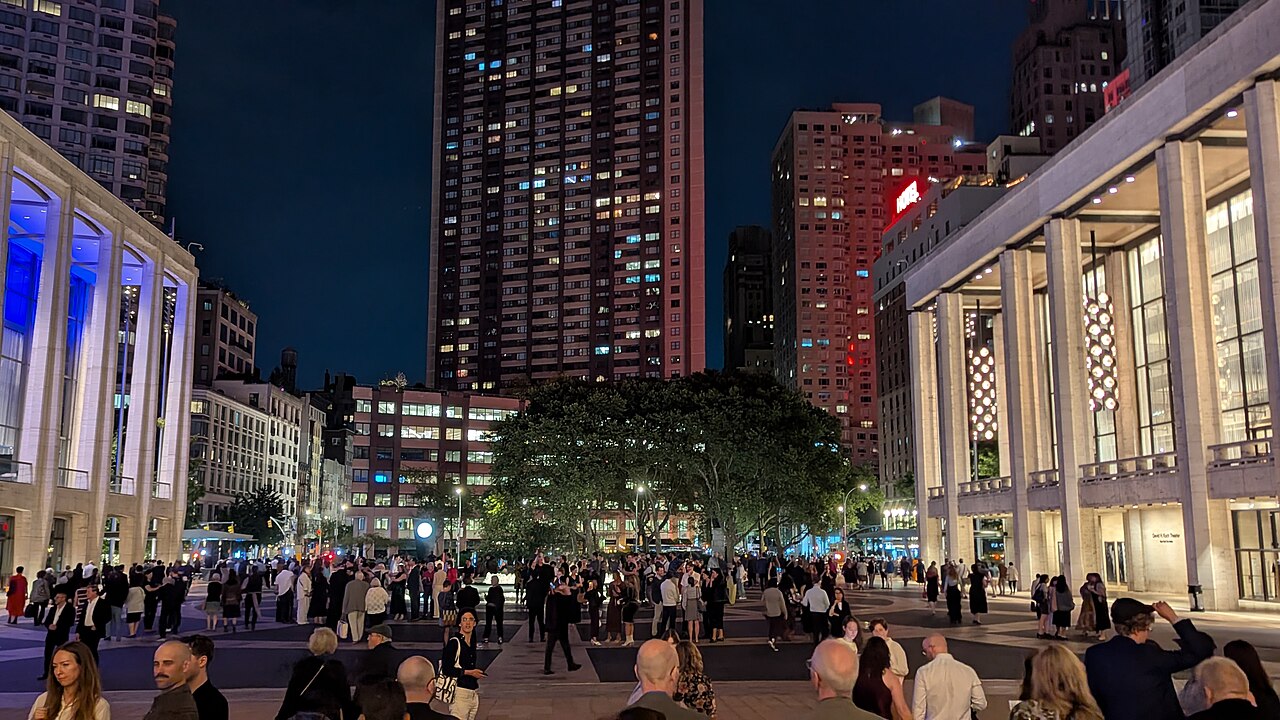
The plaza at night. Photograph by Eden, Janine and Jim, via Wikimedia Commons. CC BY 4.0.
Who runs Lincoln Center?
Lincoln Center's own history says that more than 6 million people visit each year and names 11 resident organizations: The Chamber Music Society of Lincoln Center, The Film Society of Lincoln Center, Jazz at Lincoln Center, The Juilliard School, Lincoln Center Theater, The Metropolitan Opera, New York City Ballet, New York Philharmonic, The New York Public Library for the Performing Arts, School of American Ballet, and Lincoln Center for the Performing Arts itself. That visitor count is from the organization's own page and is not independently verified. I did not find a source that states who legally owns the land and buildings, so this article does not say.
Where can you eat or drink at Lincoln Center?
Lincoln Center Theater's restaurant page lists places in and around the campus. For light, quick options with no reservations, it names The Independent Cafe at 61 West 62nd Street inside the Lincoln Center Atrium, Cafe Paradiso at 144 West 65th Street inside the Elinor Bunin Munroe Film Center, Le Pain Quotidien at 60 West 65th Street, Migrant Kitchen at 157 Columbus Avenue and two Starbucks locations, at 1889 Broadway and 141 Amsterdam Avenue.
For full dining, where it recommends reservations, the list includes Cafe Fiorello at 1900 Broadway, (212) 595-5330; Tatiana by Kwame Onwuachi at 10 Lincoln Center Plaza, inside David Geffen Hall; Lincoln at 142 West 65th Street, (212) 359-6500; P.J. Clarke's and Rosa Mexicano, both on West 63rd Street; Shun Lee West at 43 West 65th Street; and Marea at 240 Central Park South. Lincoln Center Theater also says drinks and snacks are sold at a concessions bar in each of its lobbies. Restaurants change, so confirm hours and bookings with each one. Listings and hours here were read on the official pages on October 19, 2026.
Sources
- Lincoln Center for the Performing Arts, The Construction of Lincoln Center for the Performing Arts (1959-69), Google Arts & Culture
- The New York Times, How Lincoln Center Was Built (It Wasn't Pretty), December 21, 2017
- NPR, Revisiting San Juan Hill, the neighborhood destroyed to make way for Lincoln Center, October 7, 2022
- Lincoln Center, Josie Robertson Plaza
- Lincoln Center, David Rubenstein Atrium
- New York Philharmonic, David Geffen Hall
- Lincoln Center Theater, Restaurants
Visiting Lincoln Center
- Address: Lincoln Center lists 10 Lincoln Center Plaza, New York, NY 10023, with Josie Robertson Plaza at Columbus Avenue and West 64th Street as the gateway to the campus.
- Public spaces: Lincoln Center says the David Rubenstein Atrium is open daily to the public and that thousands of square feet of public space in David Geffen Hall are open daily. The plaza and its fountain are outdoors.
- Performances: Tickets and hours depend on the resident organization and the event. Check Lincoln Center and each organization for current schedules and prices.
Facts above come from Lincoln Center pages. I did not find a single official page that lists opening hours for the whole campus, so none are given here.