Carnegie Hall: The Concert Hall New York Almost Tore Down
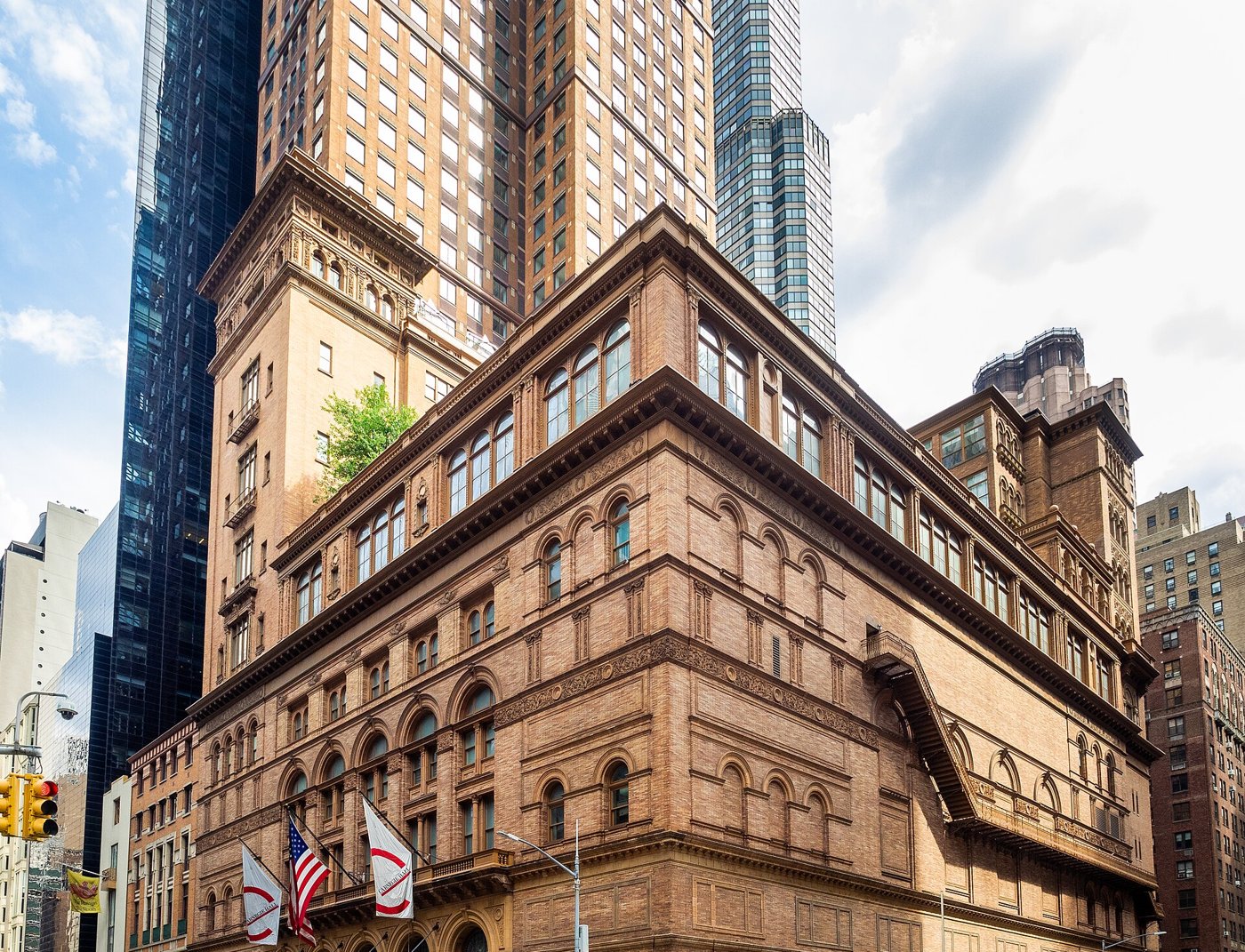
Carnegie Hall in 2019. Photograph by Ajay Suresh, via Wikimedia Commons. CC BY 2.0.
Carnegie Hall began with a conversation at sea. In the spring of 1887, the industrialist Andrew Carnegie and his new wife, Louise Whitfield, sailed from New York for their honeymoon in Scotland. Also on board was Walter Damrosch, then 25, who conducted both the Symphony Society and the Oratorio Society of New York. According to Carnegie Hall's own history, the couple invited him to visit them in Scotland, and there Damrosch described his hope for a new concert hall in New York. Carnegie said he was interested in paying for it.
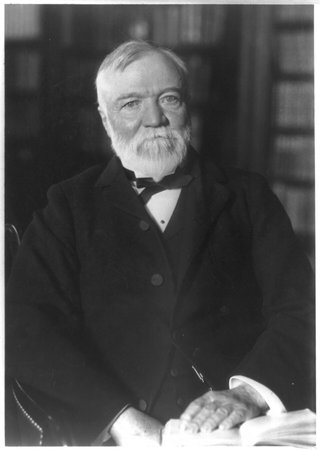
Back home, Carnegie formed the Music Hall Company of New York, bought land along Seventh Avenue between 56th and 57th Streets, and hired the architect William Burnet Tuthill. Tuthill was a capable cellist and served on the board of the Oratorio Society. The National Park Service notes that Dankmar Adler assisted him on the acoustics. On May 13, 1890, Louise Carnegie set the cornerstone with a trowel that Tiffany & Co. later plated in silver. "It is built to stand for ages," her husband said at the ceremony.
The building's style is restrained. The Landmarks Preservation Commission describes it as a modified Italian Renaissance design in reddish brown Roman brick, with bandcourses, arches and pilasters in terra cotta. The music inside mattered more. The hall opened on May 5, 1891, with a five-day festival. Damrosch led the Symphony Society in "America" and Beethoven's Leonore Overture No. 3, and the Russian composer Pyotr Ilyich Tchaikovsky came to the podium to conduct his own Marche solennelle. Seats cost $1 to $2.
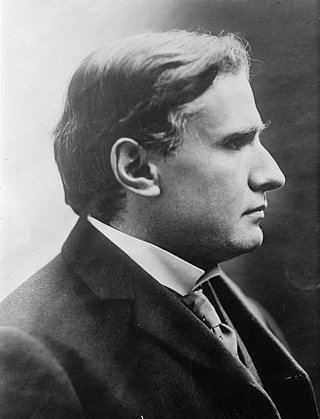
It opened as the Music Hall. The board of the Music Hall Company later persuaded Carnegie to let them use his name. Dvorak's "New World" Symphony was first heard there in December 1893, and the Philharmonic played its concerts in the hall from 1892 until 1962, according to the Landmarks Preservation Commission.
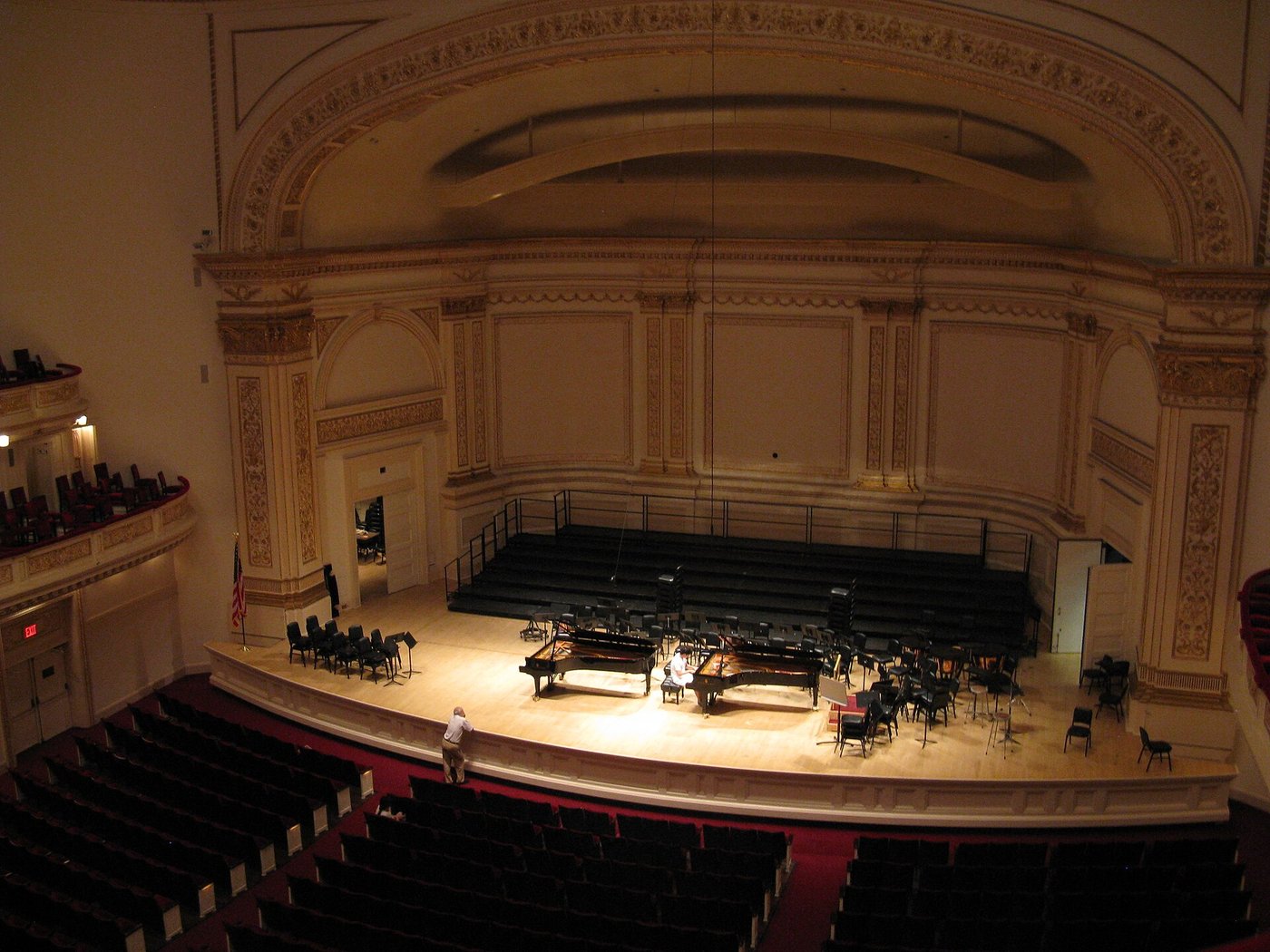
The main hall, now the Isaac Stern Auditorium / Ronald O. Perelman Stage, in 2012. Photograph by Yair Haklai, via Wikimedia Commons. CC BY-SA 4.0.
The threat came slowly. After Andrew Carnegie died in 1919, Louise Carnegie kept majority ownership for six more years. In February 1925 she sold the building to the developer Robert Simon Sr., on the condition that it stand until a "more suitable concert hall" was built. That condition became dangerous in the 1950s, when plans for Lincoln Center gave the Philharmonic a new home. Losing the orchestra meant losing more than 115 days of rent a year. The developer Louis J. Glickman unveiled plans for a red skyscraper on the site, and although that deal fell apart, a committee trying to buy the hall had raised less than $25,000 of the $5 million it needed.
The rescue was led by a violinist. In December 1959, after playing twelve times in four days at Carnegie Hall, Isaac Stern told the philanthropist Jacob Kaplan how sad he was that those might be his last performances there. Kaplan agreed to fund a new campaign if Stern would lead it. Stern gathered civic leaders at his home on January 10, 1960, and pressed for a change in state law that let the city buy buildings of special historical or aesthetic value. On June 10, 1960, the city's Board of Estimate approved the purchase for $5 million. Robert Simon Jr., who had inherited the building, cut the price by $250,000 as a contribution.
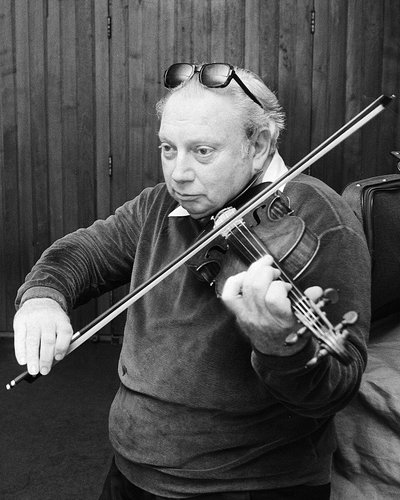
The hall reopened on September 26, 1960, freshly painted, its exterior steam-cleaned for the first time in 40 years. It was designated a National Historic Landmark on November 6, 1964, and a New York City landmark on June 20, 1967. In 2006 the main hall was renamed the Isaac Stern Auditorium / Ronald O. Perelman Stage, and in September 2003 Zankel Hall opened in the lower level, where the original recital hall had been.
Who owns Carnegie Hall today?
The City of New York owns the building. Carnegie Hall itself is a nonprofit corporation whose trustees operate the concert hall under a lease with the city that dates to the 1960 purchase, as the hall and the New York City Comptroller both describe. The city also helps support its operations through the Department of Cultural Affairs.
More than 130 years after Louise Carnegie set the cornerstone, the hall still stands at Seventh Avenue and 57th Street, and her husband's prediction that it would "stand for ages" has held, largely because a musician refused to let it go.
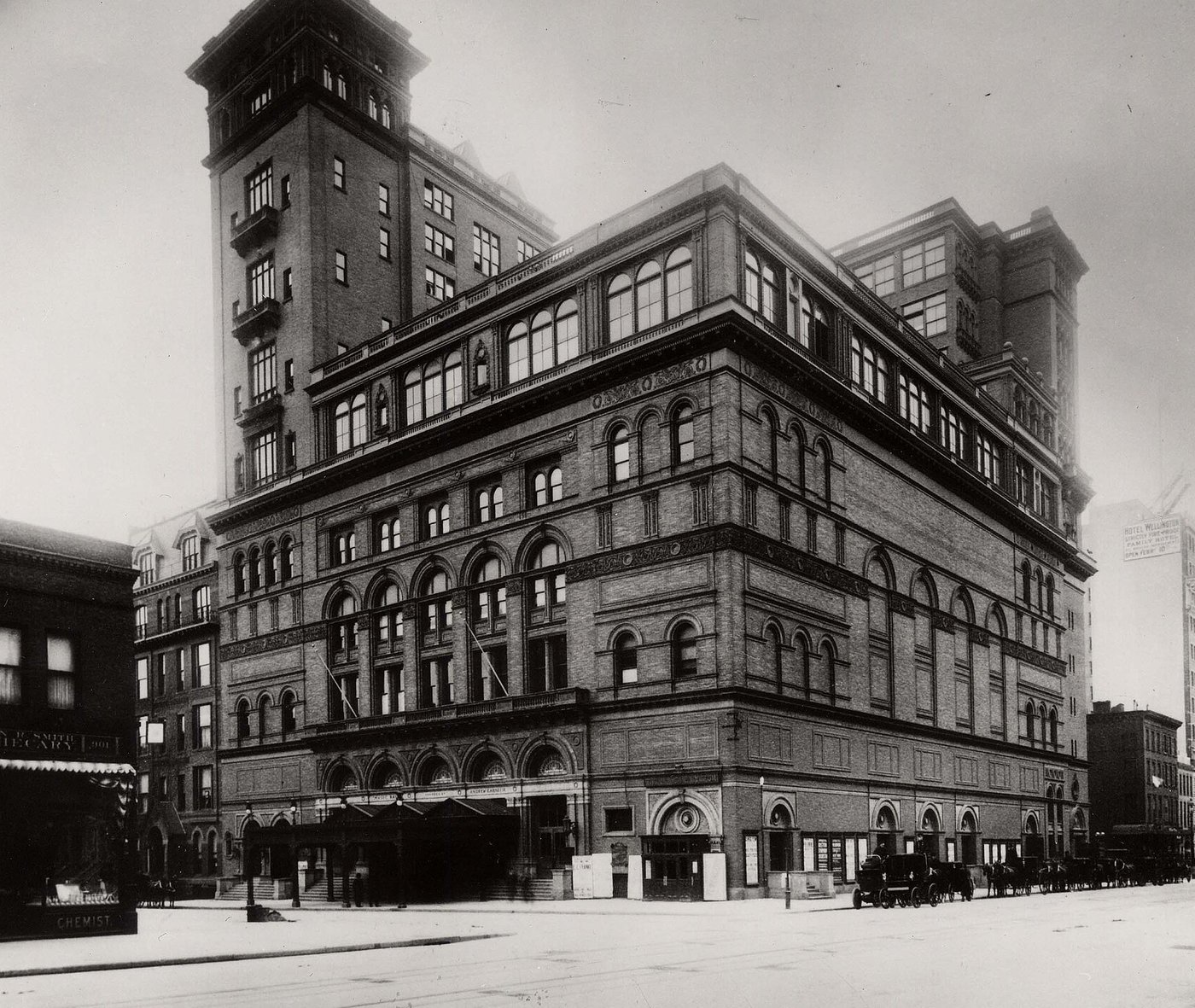
Carnegie Hall, looking south on Seventh Avenue, 1899. Carnegie Hall Archives, via Wikimedia Commons. No known copyright restrictions.
Sources
- NYC Landmarks Preservation Commission, Carnegie Hall designation report (1967)
- National Park Service, National Historic Landmark documentation
- Carnegie Hall, "Carnegie Hall: Then and Now" (2018)
- Carnegie Hall, "The Campaign to Save Carnegie Hall" (2021)
- Carnegie Hall, history timeline
- Carnegie Hall, public support
- New York City Comptroller, audit of the Carnegie Hall Corporation's city lease
- Wikimedia Commons, Carnegie Hall by Ajay Suresh (CC BY 2.0)
- Library of Congress, Frances Benjamin Johnston portrait of Andrew Carnegie (1905)
- Wikimedia Commons, Bain News Service portrait of Walter Damrosch (public domain)
- Wikimedia Commons, Isaac Stern Auditorium by Yair Haklai (CC BY-SA 4.0)
- Wikimedia Commons, Isaac Stern by Rob Bogaerts for Anefo (CC BY-SA 3.0 NL)
- Wikimedia Commons, Carnegie Hall exterior, 1899 (Carnegie Hall Archives)
.jpg)


