Brooklyn Botanic Garden: A Century of Cherries, Bonsai and a McKim, Mead & White Landmark
Every spring, tens of thousands of New Yorkers file into Crown Heights to stand under a tunnel of pink blossoms at the Brooklyn Botanic Garden. The cherry festival feels timeless, but the garden is a planned institution with a precise birthday, May 13, 1911, and a pedigree that runs through the Brooklyn Institute of Arts and Sciences, the Olmsted Brothers and McKim, Mead & White. Its 52 acres hold one of the first Japanese gardens in the United States, a bonsai collection that began with a 32-tree gift in 1925, a rose garden closing in on its centennial, and a laboratory building that is itself a designated New York City landmark. Here is how the garden grew, and who owns it today.
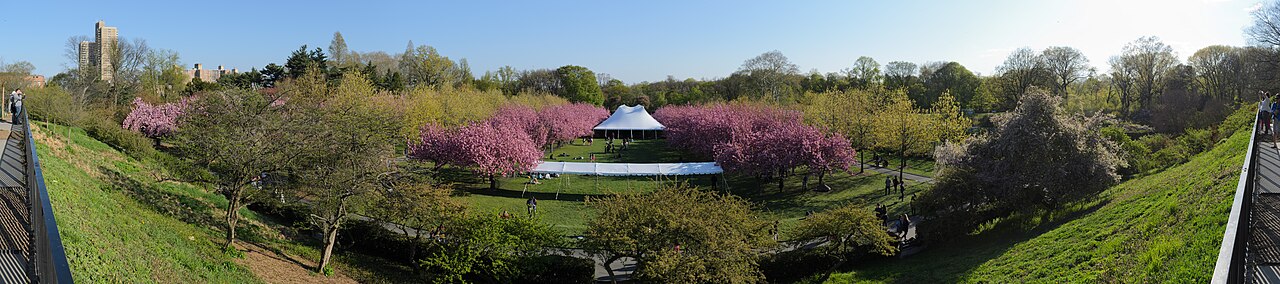
The Cherry Esplanade in bloom. Photograph by King of Hearts, via Wikimedia Commons. CC BY-SA 3.0.
How did the garden get its land?
The garden was a Progressive Era project, built to hold on to green space as Brooklyn filled in with pavement. In 1897, New York State legislation reserved 39 acres for a botanic garden on the triangle behind the Brooklyn Institute of Arts and Sciences, the museum complex on Eastern Parkway. The site had been set aside in the Olmsted Brothers' plans for the Prospect Park area as a place for large institutional buildings, and it sat between the park, the museum and the new parkway. A push from Alfred Tredway White, a Brooklyn philanthropist who had offered money for a scientific botanic garden as early as 1905, helped turn the reservation into an institution, and a 1909 agreement between the City of New York and the Brooklyn Institute made it official.
The Brooklyn Botanic Garden was founded in 1910, with the botanist Charles Stuart Gager as its first director and the Olmsted Brothers firm laying out the original site plan. When it opened on May 13, 1911, its first display garden was the Native Flora Garden, a systematic collection of local wildflowers arranged by plant family. The next year brought the appointment of Harold Caparn as landscape architect, who would shape the grounds for three decades, and 1914 brought the Children's Garden, a one-acre teaching plot that was among the first programs of its kind anywhere, where city children grew their own vegetables.
What was built in the first fifteen years?
The garden's signature spaces arrived quickly. In 1915 the Japanese Hill-and-Pond Garden was completed to designs by Takeo Shiota, one of the first public Japanese gardens in the United States, with its orange-red torii rising from the pond. The Rock Garden followed in 1916, built from boulders unearthed on the site itself. Then, in 1917, the garden dedicated its Laboratory Building and Conservatory, today the Administration Building and the Palm House. The laboratory was designed by William Kendall of McKim, Mead & White in a Tuscan Revival style, a Greek-cross plan with a central cupola in concrete, brick, stucco and terra cotta, modeled on the small churches of Lombardy. It originally held research laboratories, a photographic darkroom and an assembly room, and it is important enough to be included in the firm's own monograph; the Landmarks Preservation Commission designated it an individual city landmark on March 13, 2007, calling it a significant example of the firm's late work.
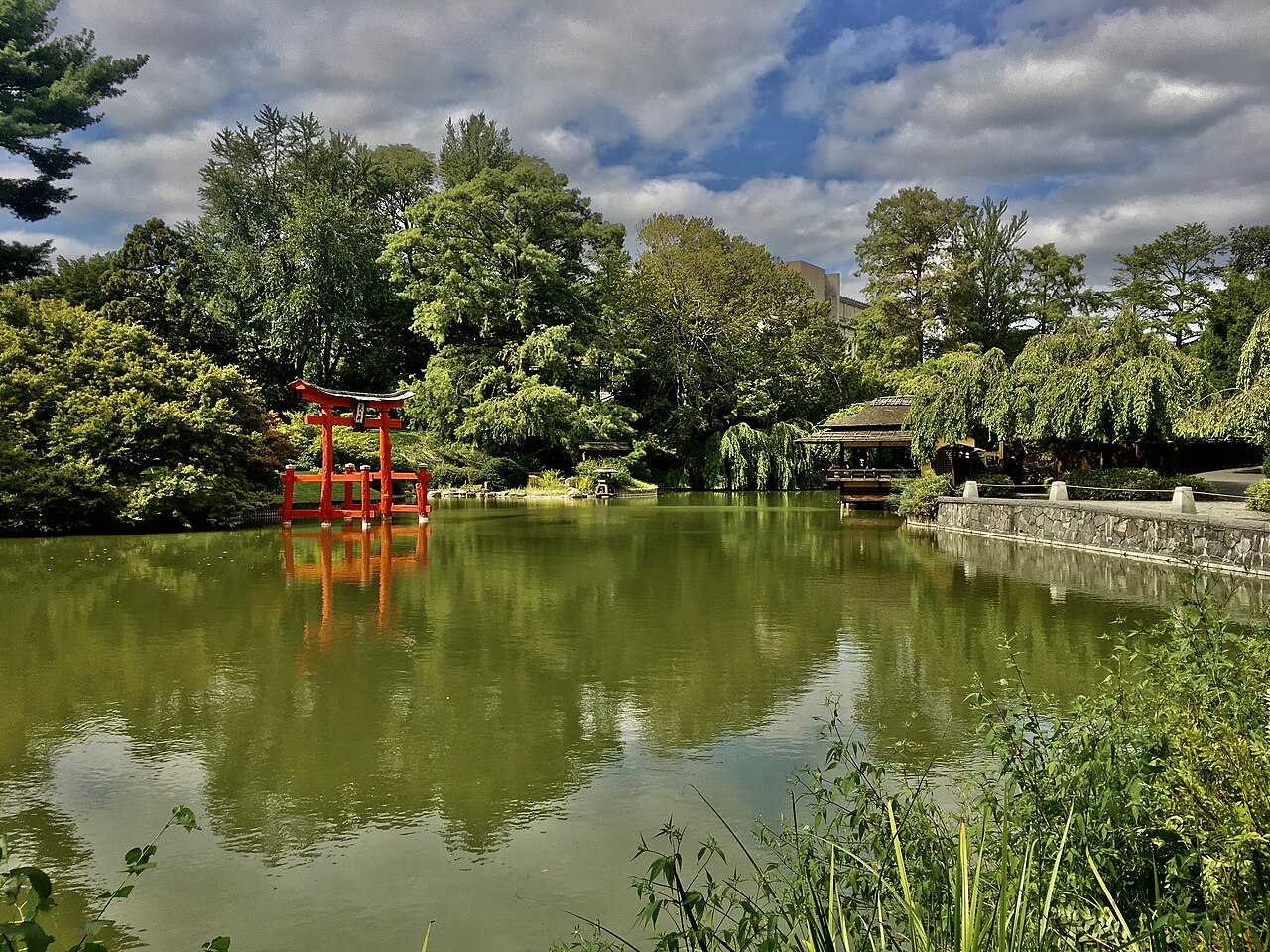
The torii in the Japanese Hill-and-Pond Garden, completed in 1915. Photograph by Andre Carrotflower, via Wikimedia Commons. CC BY-SA 4.0.
The 1920s filled in the collection. The Lily Pool Terrace and the first Cherry Walk were dedicated in 1921. The bonsai collection began in 1925 with a gift of 32 trees from the plantsman Ernest F. Coe, making it one of the oldest in the country, and it gained its own curator when Frank Okamura joined the staff in 1947. The Shakespeare Garden opened in 1925 as a gift of Henry C. Folger, and the Cranford Rose Garden was dedicated in 1928. The magnolias on Magnolia Plaza arrived in 1933, the Rose Arc Pool in 1936, and the Osborne Garden in 1939. In 1941, rows of 'Kanzan' cherry trees were planted to form the Cherry Esplanade, the allée that now anchors the city's cherry-blossom season.
How did the garden become famous for cherries?
The Esplanade's 'Kanzan' trees were a 1941 gift of the garden's Auxiliary, and they joined a cherry collection that already included the 1921 Cherry Walk. In 1980 the city of Tokyo gave the garden a 500-year-old stone Shogun lantern, which now stands in the Japanese Hill-and-Pond Garden, and in 1982 the garden held its first Sakura Matsuri, the cherry-blossom festival that has grown into one of Brooklyn's largest annual events. The breeding program left a permanent mark on the plant world too: in 1977 the garden received a patent for Magnolia 'Elizabeth', the first yellow magnolia, developed at BBG. The garden's café is named for it.
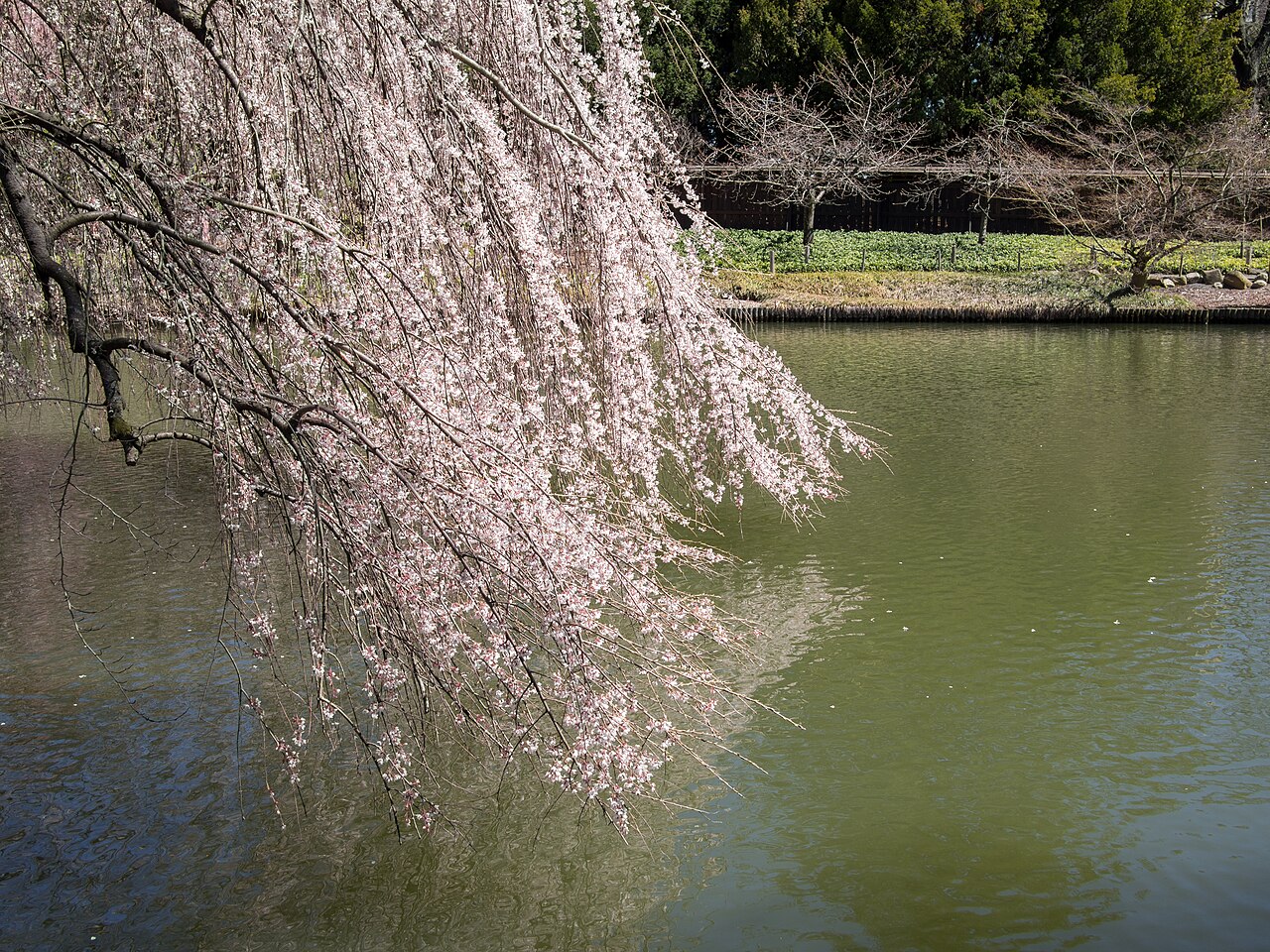
A weeping cherry over the pond in the Japanese Hill-and-Pond Garden. Photograph by Rhododendrites, via Wikimedia Commons. CC BY-SA 4.0.
What changed in the modern era?
The postwar decades added science and teaching. The Fragrance Garden, designed by landscape architect Alice R. Ireys for visitors with limited vision, opened in 1955. The Steinhardt Conservatory, the glasshouse complex that holds the bonsai museum and the tropical and desert pavilions, was completed in 1988. The new century brought a building campaign: a new Eastern Parkway entrance by Polshek Partnership Architects in 2005, the LEED Gold Steinberg Visitor Center by Weiss/Manfredi in 2012 with its living roof, a Native Flora Garden expansion in 2013, a new Discovery Garden for children by Michael Van Valkenburgh Associates in 2015, the Shelby White and Leon Levy Water Garden in 2016, the Robert W. Wilson Overlook in 2019 and the Elizabeth Scholtz Woodland Garden in 2020. The 2018 Water Conservation Project tied the Japanese garden, Belle's Brook and the Water Garden into one recirculating system, sharply cutting the garden's freshwater use. In 2014 the garden received the National Medal for Museum and Library Service, the country's highest honor for such institutions.
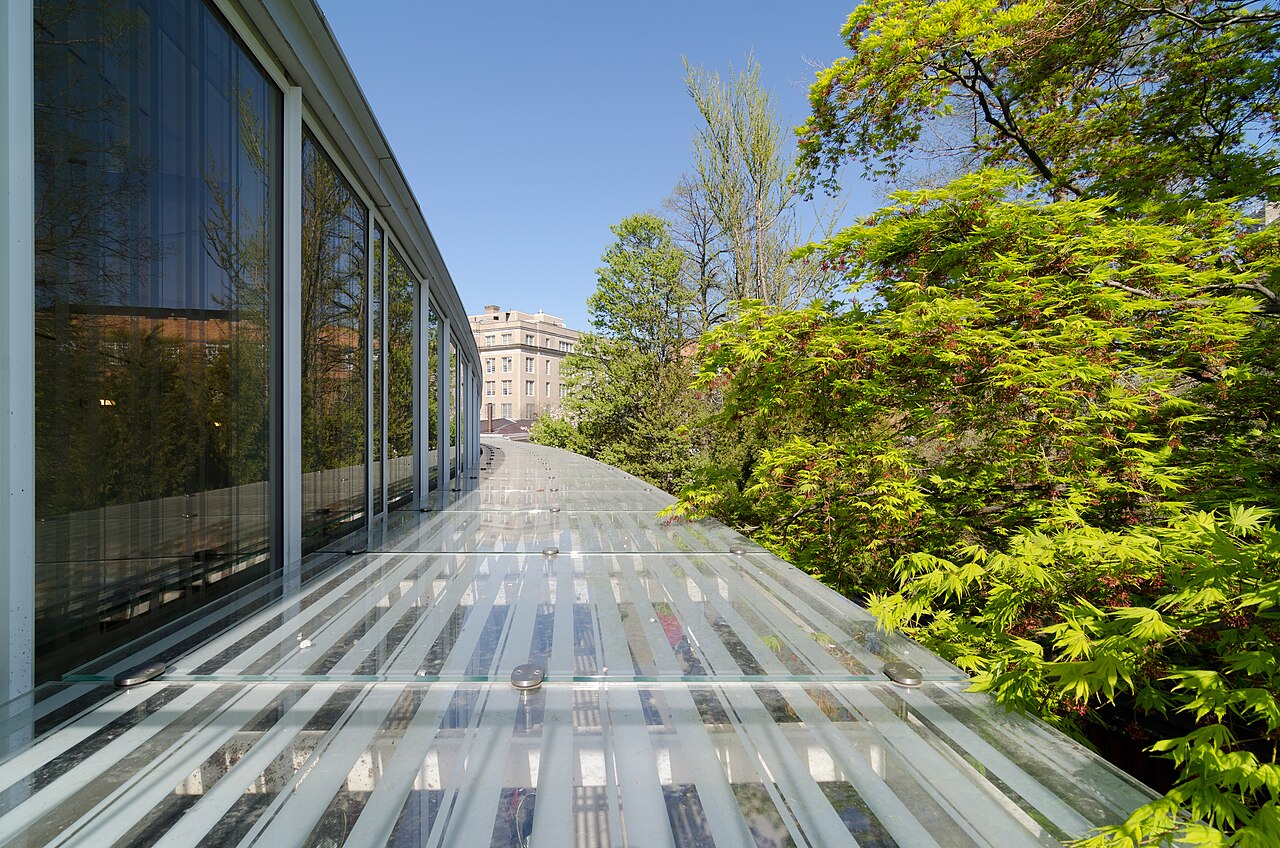
The deck above the Steinberg Visitor Center, opened in 2012. Photograph by King of Hearts, via Wikimedia Commons. CC BY-SA 3.0.
Who owns the Brooklyn Botanic Garden today?
The garden is a public-private partnership of the classic New York kind. The operator is Brooklyn Botanic Garden, a 501(c)(3) nonprofit corporation, which employs the horticulturists, runs the programs and sets the calendar. The land, in the garden's own words, is "property owned in part by the City of New York," and its operation is funded in part through the New York City Department of Cultural Affairs. That arrangement makes BBG a member of the Cultural Institutions Group, the city's formal partnership with the nonprofit museums and gardens that occupy city-owned property, the same structure that supports the Bronx's New York Botanical Garden and the Brooklyn Museum next door. So the honest answer is that the city owns much of the ground, and the nonprofit owns the mission and the operation.
Where can you eat or drink at the Brooklyn Botanic Garden?
The garden's dining is named for its own breeding work. Yellow Magnolia Café, honoring the yellow magnolia cultivar patented at BBG, is the full-service restaurant serving modern American food with a focus on local sourcing. The outdoor Yellow Magnolia Canteen sells pizza, salads, sandwiches and snacks, and a Coffee Bar in the Atrium handles drinks and light bites; in winter, a pop-up Coffeehouse takes over the café space. The garden lists all of these, with current hours and menus, on the dining page of bbg.org.
Sources
- Brooklyn Botanic Garden, A Brief History of BBG
- NYC Landmarks Preservation Commission, Laboratory Administration Building, Brooklyn Botanic Garden (LP-2214), March 13, 2007
- Brooklyn Botanic Garden, Funders and Public Support
- Brooklyn Botanic Garden, Dining at the Garden
- NYC Department of Cultural Affairs, Cultural Institutions Group
- Brooklyn Botanic Garden, Plan Your Visit
Visiting the Brooklyn Botanic Garden
- Address: Entrances at 150 Eastern Parkway, 455 Flatbush Avenue and 990 Washington Avenue, Brooklyn, NY 11225.
- Hours: The garden is open Tuesday through Sunday, closed Mondays; hours shift with the season and are posted on bbg.org's visit page.
- Tickets: Admission is ticketed; the garden recommends buying in advance online, and winter weekday admission has traditionally been pay-what-you-wish.
- Food: Yellow Magnolia Café for full-service dining, the outdoor Canteen and the Atrium Coffee Bar for quick stops.
Facts above were read on the official pages on October 31, 2026. Hours, ticket rules and café openings change, so confirm on bbg.org before you go.