The Bronx Zoo: How a Gilded Age Society Built America's Wildest Classroom
The Bronx Zoo opened on November 8, 1899, and half a million people came in the first year. It was a private club's idea planted on public ground: a group of wealthy and scientifically minded New Yorkers chartered a zoological society, talked the city out of 261 acres of Bronx Park, raised money from Carnegie and Vanderbilt, and hired the architects of the Cathedral of St. John the Divine to design animal houses like Beaux-Arts palaces. More than 125 years later the same society, renamed the Wildlife Conservation Society, still runs the place, and its oldest quadrangle is a designated New York City landmark.
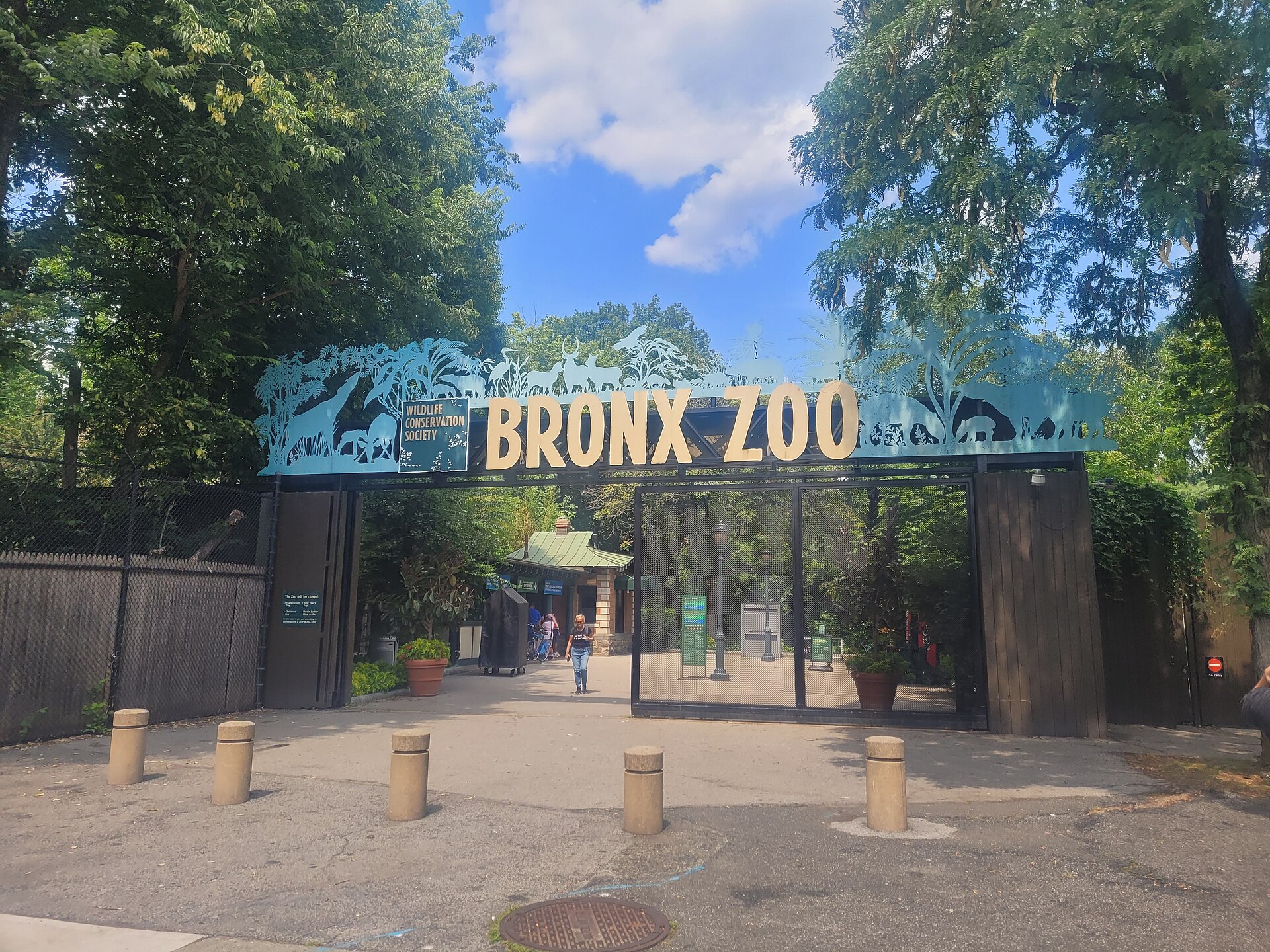
The zoo's Asia Gate entrance in August 2026. Photograph by SnowFire, via Wikimedia Commons. CC BY 4.0.
Who founded the Bronx Zoo?
The Wildlife Conservation Society's own archive says the organization was chartered by New York State on April 26, 1895, as the New York Zoological Society, with a mandate to advance wildlife conservation, promote the study of zoology and create a first-class zoological park. Among its founders were Andrew H. Green, the planner of Central Park, Henry Fairfield Osborn and Madison Grant, and Theodore Roosevelt was among the prominent New Yorkers involved in its creation. The society took the name Wildlife Conservation Society in 1993.
To build the zoo the society picked William T. Hornaday, a taxidermist and zoologist who had helped found the National Zoo in Washington. Appointed the zoo's first director in April 1896, Hornaday recommended about 261 acres in the southern half of Bronx Park, near East Fordham Road and straddling the Bronx River, close to elevated trains and full of unspoiled, varied topography. In March 1897 the Commissioners of the Sinking Fund of the City of New York resolved to allot that South Bronx Park land to the society, which assumed control of the grounds on July 1, 1898.
How was the zoo paid for and built?
As a partnership, unusual for its day. Hornaday later described the financing as a "perfectly harmonious joint effort" between a powerful philanthropic organization and the taxpayers of New York: the city issued stock to pay for improvements and upkeep of the grounds, while the society provided equipment, animals and management. The Landmarks Preservation Commission's designation report records that over the year before opening, the society raised $250,000 in donations from contributors including Andrew Carnegie, Cornelius Vanderbilt II, Jacob Schiff and William C. Whitney to stock the exhibits.
The society's first annual report, dated March 15, 1897, set three objectives, quoted in the landmarks report: to establish a free zoological park "with North American and exotic animals, for the benefit and enjoyment of the general public, the zoologist, the sportsman and every lover of nature;" to encourage an interest in animal life among all classes of people; and to cooperate with similar organizations in preserving the native animals of North America against what it called their "wanton destruction." The free-admission ambition did not survive later financing realities, but the public-education mission it states still organizes the place.
The New York Zoological Park opened to the public on November 8, 1899, with wooden structures and outdoor pens, and it was an immediate success. The landmarks report counts 525,000 visitors in the first year, with as many as 20,000 on a single day; by 1909 annual attendance had reached four million, and Hornaday ranked the zoo among the city's top institutions for public betterment.
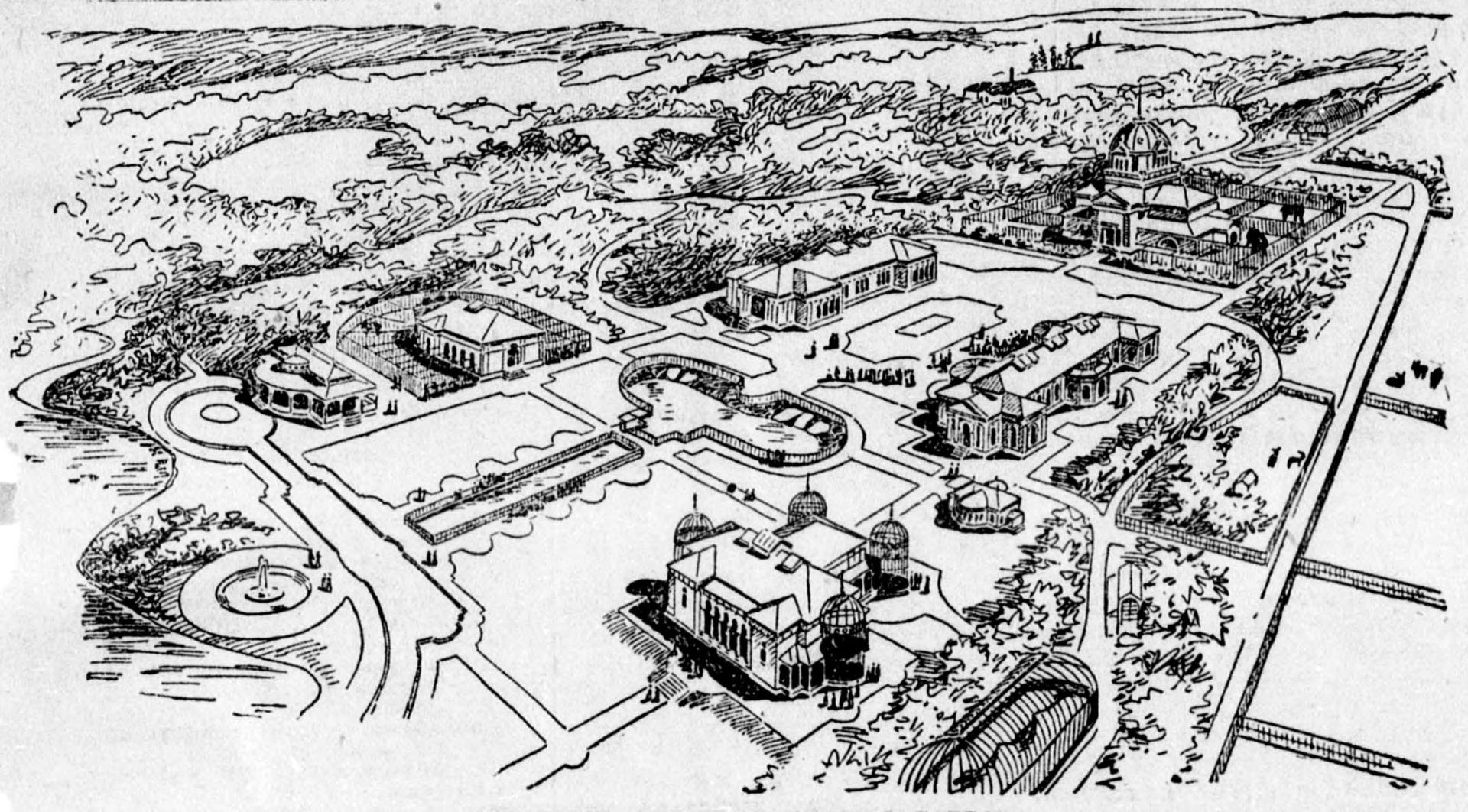
An 1898 bird's-eye view of the planned zoological park, published before opening day. Via Wikimedia Commons. Public domain.
What is Astor Court?
The architectural heart of the original zoo. With a master plan by Heins and La Farge, the firm behind the Cathedral of St. John the Divine, and landscaping by Harold A. Caparn, the zoo's designers laid out a symmetrical raised court modeled on the "Court of Honor" at the 1893 Chicago World's Fair, terminating in a monumental domed Elephant House. Five of the court's buildings, the Primates' House, Lion House, Large Bird House, Elephant House and Administration Building, went up between 1899 and 1910 in brick and limestone, four of them wrapped in large, realistically modeled stone and terra-cotta animal sculptures by Eli Harvey, Charles R. Knight and Alexander Phimister Proctor, commissioned to illustrate the animals housed inside each one. A sixth building, the National Collection of Heads and Horns, followed in 1922 to a design by Henry D. Whitfield.
The court, then called Baird Court and now Astor Court, was designated a New York City landmark on June 20, 2000, including its six buildings, its terraces and stairs and the central sea lion pool. The old Elephant House survives as Zoo Center, and the landmark report notes the classical ensemble stands as a monument to the zoo's founders.
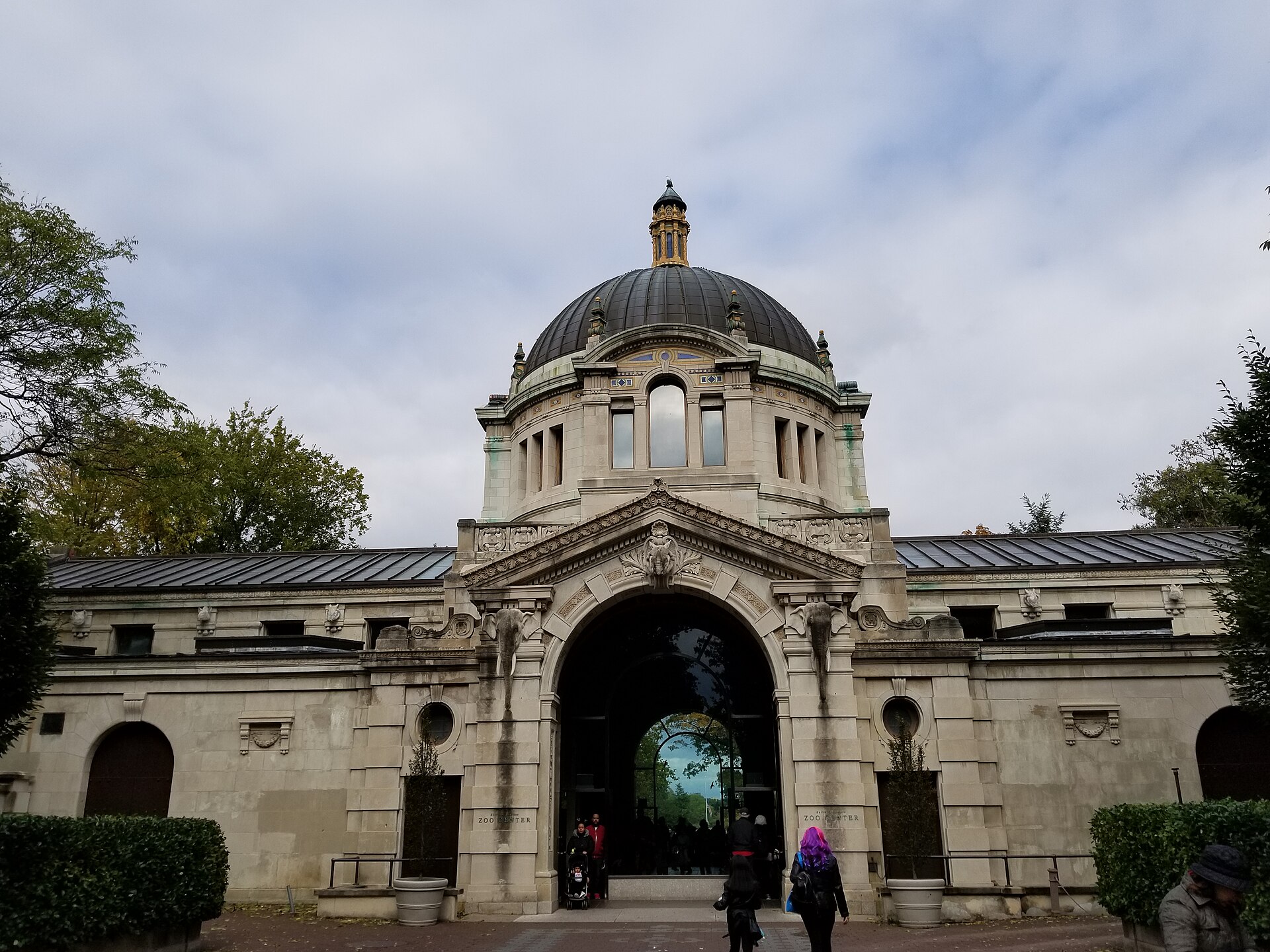
Zoo Center, the former Elephant House of 1899 to 1910, with its carved elephant heads. Photograph by Antigng, via Wikimedia Commons. CC BY-SA 4.0.
Who made the bronze gates?
Paul Manship, the sculptor later famous for the Prometheus figure at Rockefeller Center. The landmarks commission's 1967 report says Manship began work on the Rainey Memorial Gates in 1926 and spent five years expanding the design from a wrought-iron project into a full sculptural treatment in bronze; the casting, done in Belgium, took two more. The gates' plant and animal motifs, modeled in profile so they read equally well from both sides, culminate in a seated lion framed by tree limbs that seem to turn into birds' wings. Bronze screens link the gates to granite gatekeepers' lodges, each roofed by a single 26-ton slab of granite.
The gates were a gift from Grace Rainey Rogers in memory of her brother Paul Rainey, a big-game hunter and zoo patron whose expeditions had enriched the collection with polar bears, walrus and musk oxen before he died at sea in 1923 on his way to Africa. Dedicated in June 1934, the gates were declared unrivaled in this country as a work of art by the Zoological Society's president at the ceremony, and the Landmarks Preservation Commission designated them a city landmark on January 11, 1967, two years after the landmarks law took effect.
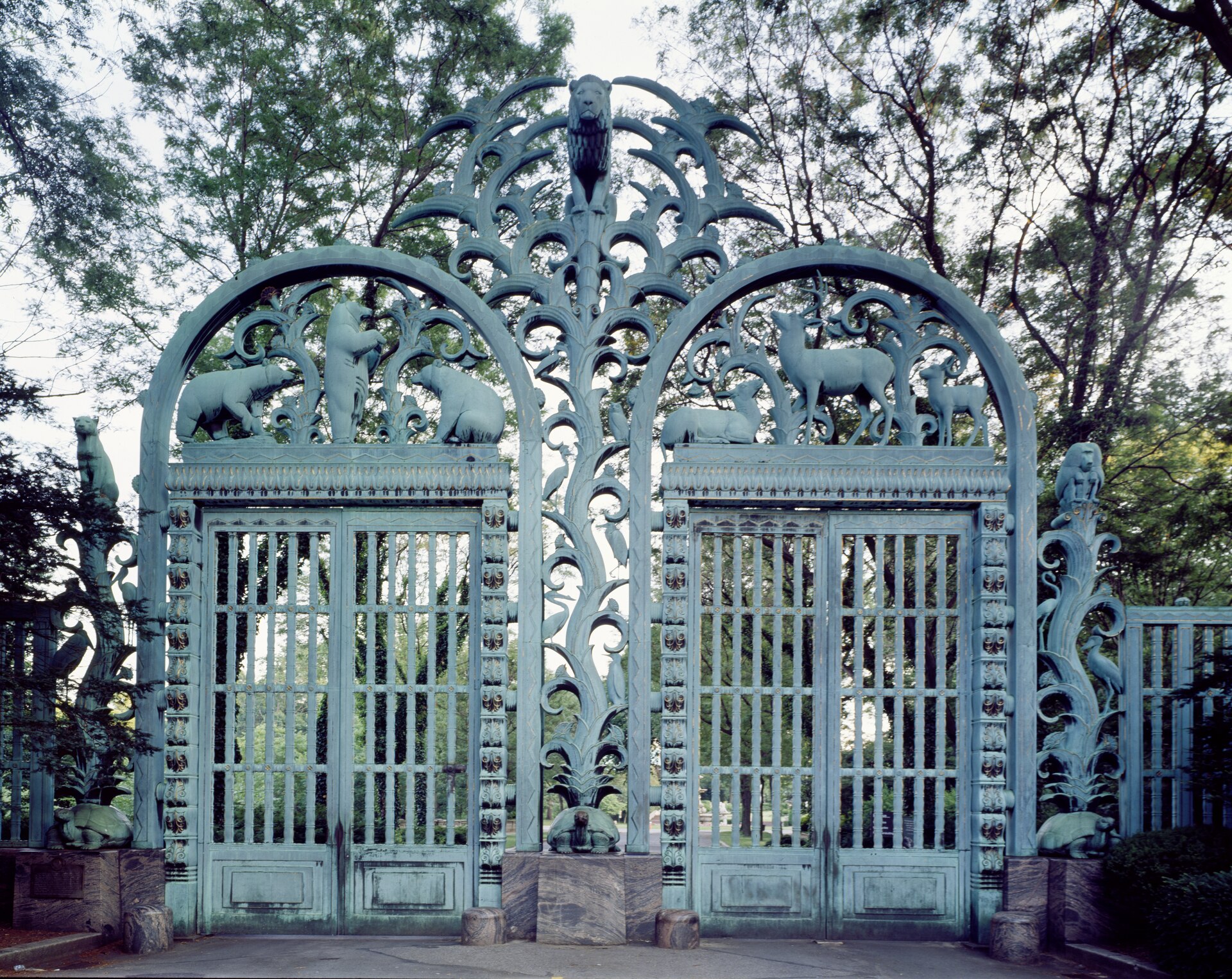
The Rainey Memorial Gates of 1934. Photograph by Carol M. Highsmith, Library of Congress, via Wikimedia Commons. Public domain.
What about the zoo's harder history and its conservation work?
The society's archive is unusually direct about both. For its 125th anniversary the Wildlife Conservation Society acknowledged its historical role in promoting racial injustice, including the display of Ota Benga, a Congolese man, in the zoo's Monkey House for several days in September 1906, and the eugenics-based ideals of founders Madison Grant and Henry Fairfield Osborn. That history is part of Astor Court's history, and the society now publishes the archival record of it.
The conservation record runs the other way. Hornaday's surveys publicized the decline of American birds and mammals; in 1905 society leaders co-founded the American Bison Society, and the Bronx Zoo sent 15 bison to the Wichita Reserve in 1907 as part of the campaign that brought the species back from the edge. William Beebe, the zoo's first curator of birds, built a Department of Tropical Research from 1916 and made record-setting dives in the bathysphere off Bermuda in 1934. The zoo pioneered naturalistic exhibits like the World of Birds and Wild Asia in the 1960s and 1970s, and the city later turned its three smaller zoos over to the society: the redesigned Central Park Zoo opened in 1988, followed by the Queens Zoo in 1992 and the Prospect Park Zoo in 1993.
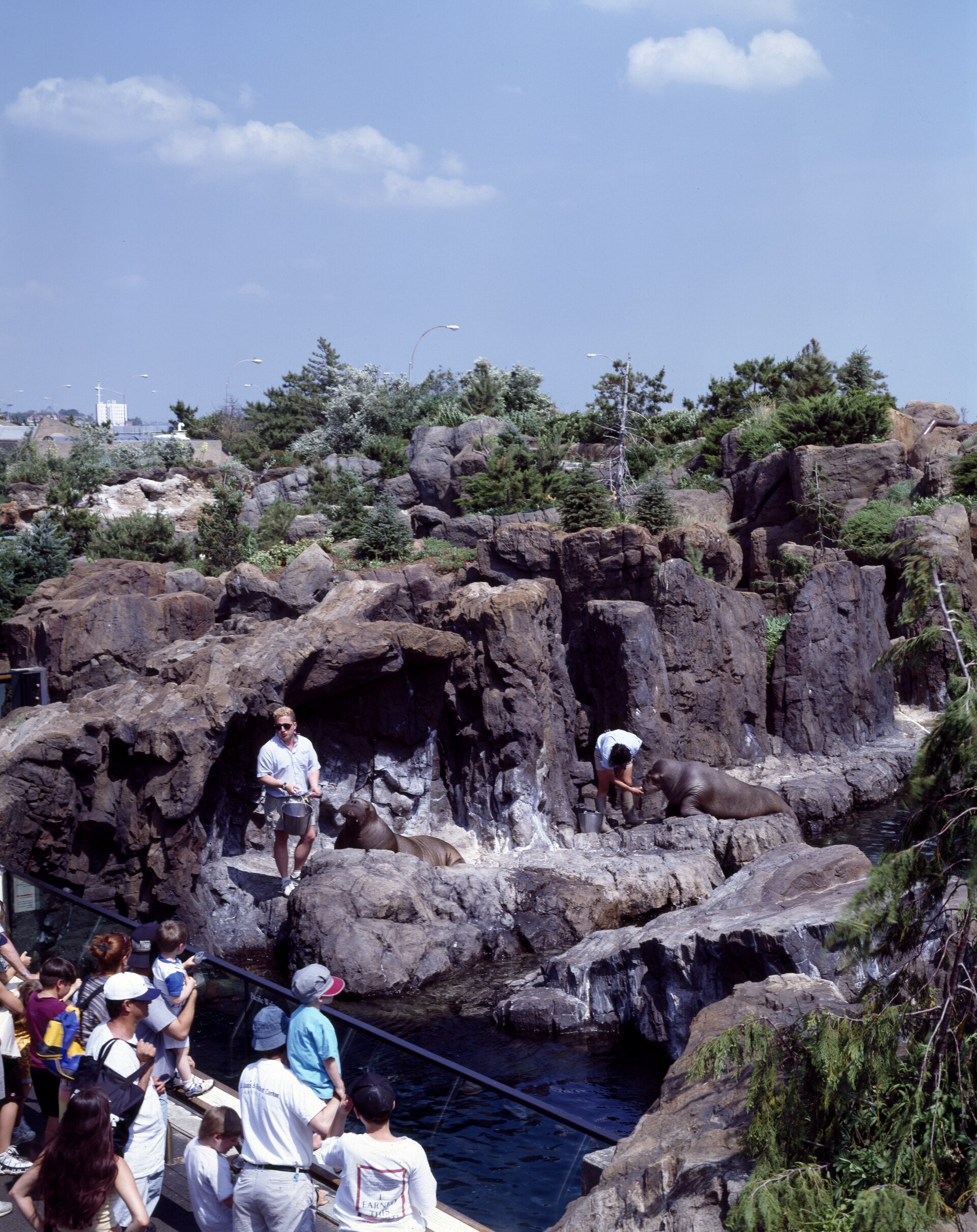
Feeding the sea lions at the Bronx Zoo. Photograph by Carol M. Highsmith, Library of Congress, via Wikimedia Commons. Public domain.
Who owns the Bronx Zoo today?
The land is the city's; the zoo is the society's to run. The 1897 allotment gave the New York Zoological Society the use of 261 acres of Bronx Park, which remains city parkland, and the society's own history describes the deal: the city provided the land and some funding for buildings and operating costs, while the society raised most of the money for construction and operations from private donors and chose the scientific and administrative staff. That arrangement continues today under the society's current name, the Wildlife Conservation Society, which also operates the Central Park, Queens and Prospect Park zoos and the New York Aquarium. The Bronx Zoo is not one of the city's Cultural Institutions Group members on city-owned property; its city relationship runs through the older parkland allotment and funding agreements rather than the CIG structure.
Where can you eat or drink at the Bronx Zoo?
The zoo's own dining page names the Dancing Crane Café as its main restaurant, open year-round with hot and cold dishes, snacks and beverages, in a 17,500-square-foot space with indoor and outdoor seating. Seasonal stands operate around the park in the warmer months. Outside the gates, the Fordham Road and Little Italy stretches of the Bronx are a short walk away, but this article lists only the dining named on the zoo's official pages, which were read on October 27, 2026; hours and open stands change with the season, so check the dining page before you go.
Sources
- Wildlife Conservation Society Archives, WCS History
- NYC Landmarks Preservation Commission, Baird (now Astor) Court designation report, LP-1888, June 20, 2000
- NYC Landmarks Preservation Commission, Rainey Memorial Gates designation report, LP-0108, January 11, 1967
- Bronx Zoo, Tickets and hours
- Bronx Zoo, Dining
Visiting the Bronx Zoo
- Address: The zoo lists its headquarters at 2300 Southern Boulevard, Bronx, NY 10460, with entrances on Southern Boulevard and at the Asia Gate and Bronx River gate.
- Hours: From April 2 to October 31, 2026, the zoo lists Monday to Friday, 10 a.m. to 5 p.m., and weekends and federal holidays, 10 a.m. to 5:30 p.m.; from November 1, 2026 through March 2027, daily 10 a.m. to 4:30 p.m. Last entry is 45 minutes before closing. The zoo is closed Thanksgiving Day, Christmas Day, New Year's Day and Martin Luther King Jr. Day.
- Admission: Date-specific tickets use flex pricing, listed as starting at $28.95 for adults, $26.95 for seniors and $20.95 for children 3 to 12, with children 2 and under free; winter prices are lower. Members do not need tickets for regular daytime visits.
- Parking: Listed at $22 per car for all-day parking, and the zoo warns that lots fill on peak days.
Facts above come from the zoo's pages listed in Sources. Hours, prices and seasonal attractions change, so confirm on bronxzoo.com before you go.