The American Museum of Natural History: Eighteen Buildings Built Over Sixty Years
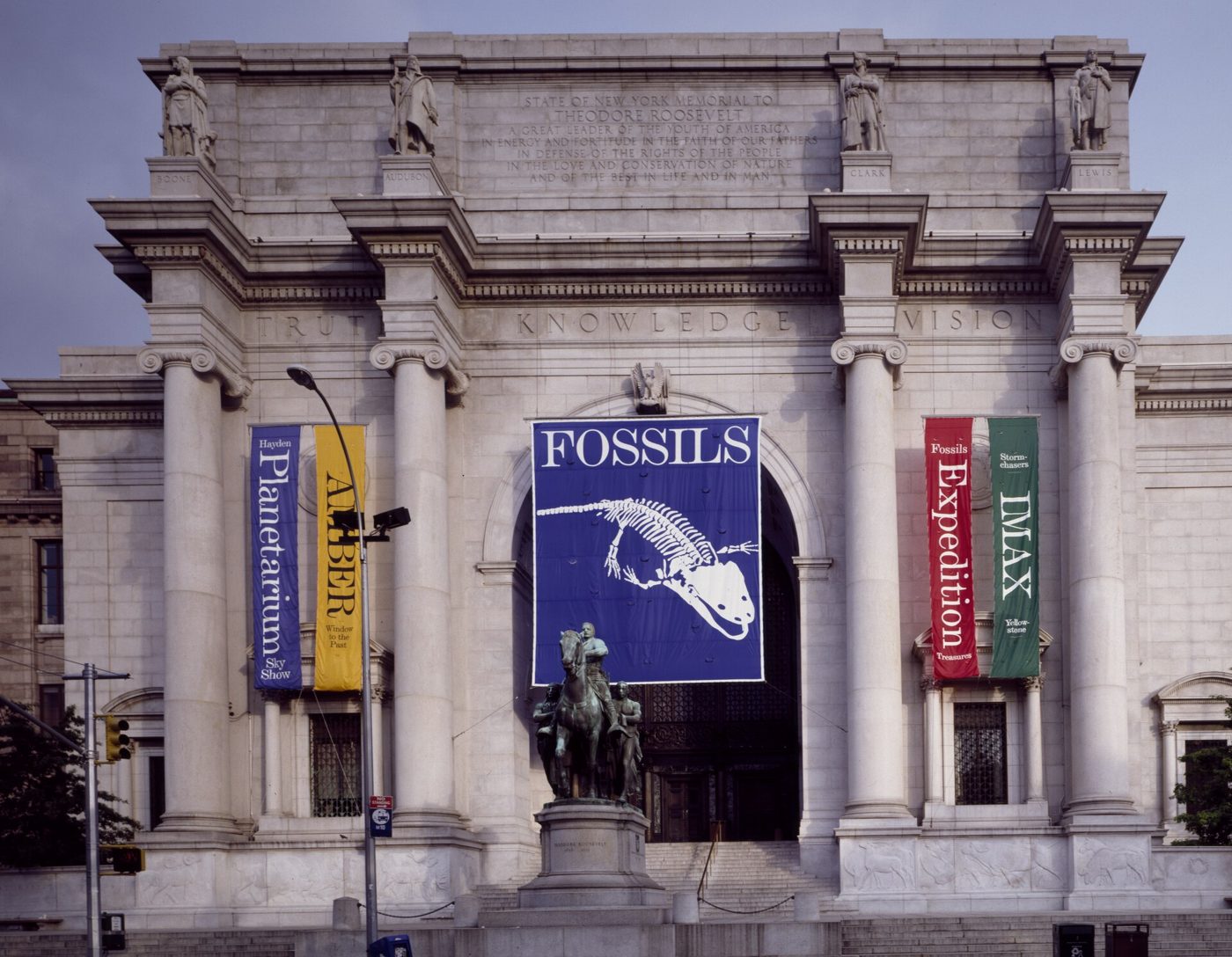
The Central Park West entrance to the American Museum of Natural History. Photograph by Carol M. Highsmith, Library of Congress, via Wikimedia Commons. Public domain.
The American Museum of Natural History is not one building. The Landmarks Preservation Commission describes eighteen interconnected units on one of the most spacious sites in the city, built over nearly a century in several architectural styles. The oldest part, a Victorian Gothic building by Vaux & Mould, is now hidden behind the center of the West 77th Street front. The commission designated the museum on August 24, 1967.
How did the museum begin?
The museum says Albert Smith Bickmore, a one-time student of the Harvard zoologist Louis Agassiz, won support for a natural history museum from William E. Dodge Jr., Theodore Roosevelt Sr., Joseph Choate and J. Pierpont Morgan. Governor John Thompson Hoffman signed the Act of Incorporation on April 6, 1869. The first exhibits went on view in 1871 in the Central Park Arsenal, on the east side of the park, the museum's original home.
Why did it move across the park?
The museum says it quickly outgrew the Arsenal. In 1872 it secured Manhattan Square, a block of land between West 77th and 81st Streets across from Central Park. President Ulysses S. Grant laid the cornerstone of the first building in 1874, and President Rutherford B. Hayes presided at the public opening in 1877. The commission dates the south central wing from 1874 to 1877 and calls it a five-story red brick and stone building in the Victorian Gothic style.
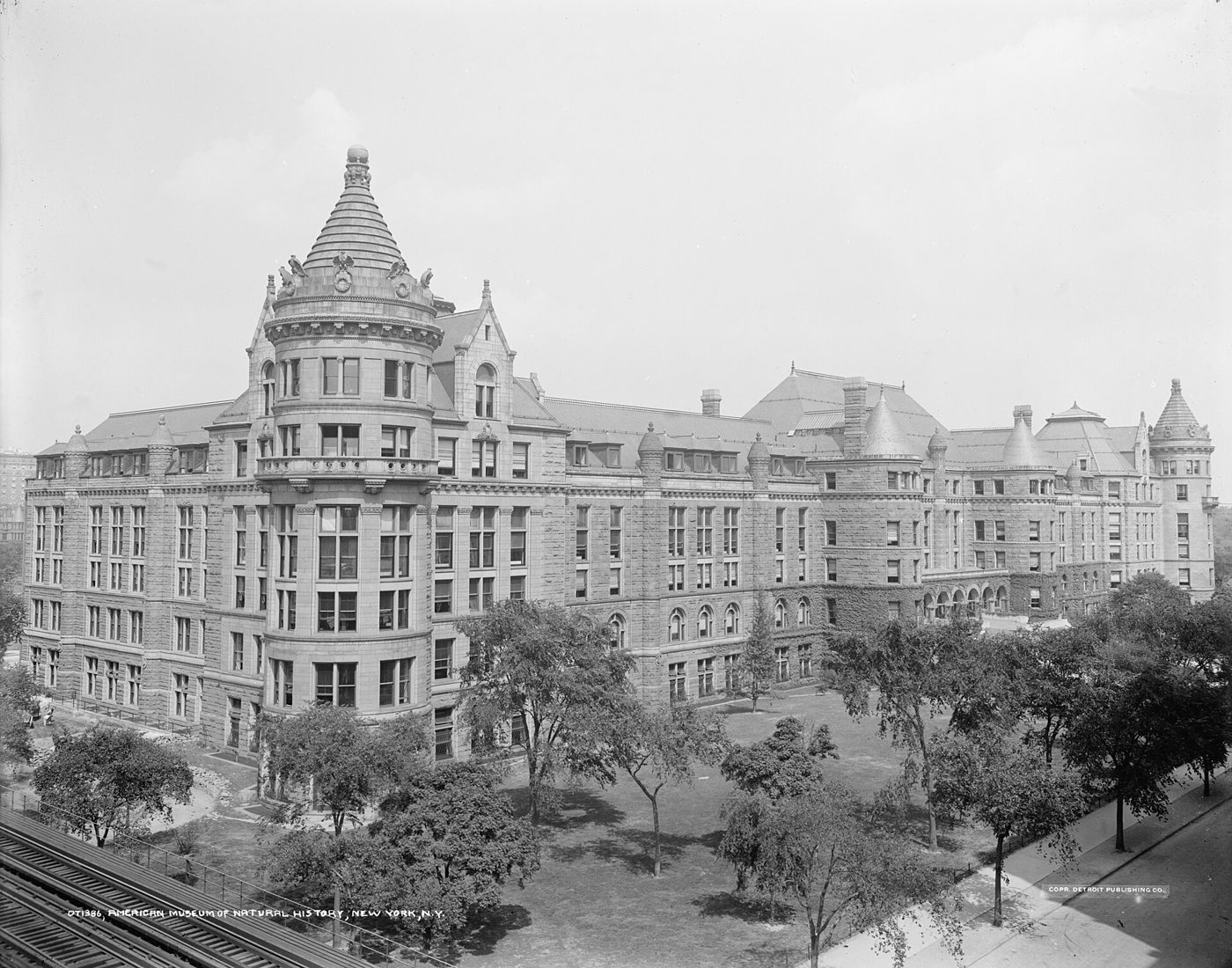
The museum building in an early photograph from about 1900 to 1910. Detroit Publishing Co., Library of Congress, via Wikimedia Commons. Public domain.
What does the West 77th Street front look like?
The commission says Cady, Berg & See designed the central unit on 77th Street, completed in 1891, in the Romanesque Revival style, along with similar east and west wings added from 1894 to 1900. It calls the completed front the most impressive example of Romanesque Revival architecture in New York City. The facade is five stories of smooth and rock-faced Vermont pink granite under steep red slate roofs. Two stairways rise to a platform on either side of a giant segmental arch that was once the carriage entrance. A seven-bay arcaded porch with a balustrade runs along the platform, ending in towers with a conical slate roof at the west and a pyramidal one at the east. Carved eagles on wreaths sit at the base of the roofs. The commission says the 77th Street section was extended north along Columbus Avenue in 1906, in the same style.
Who designed the Central Park West entrance?
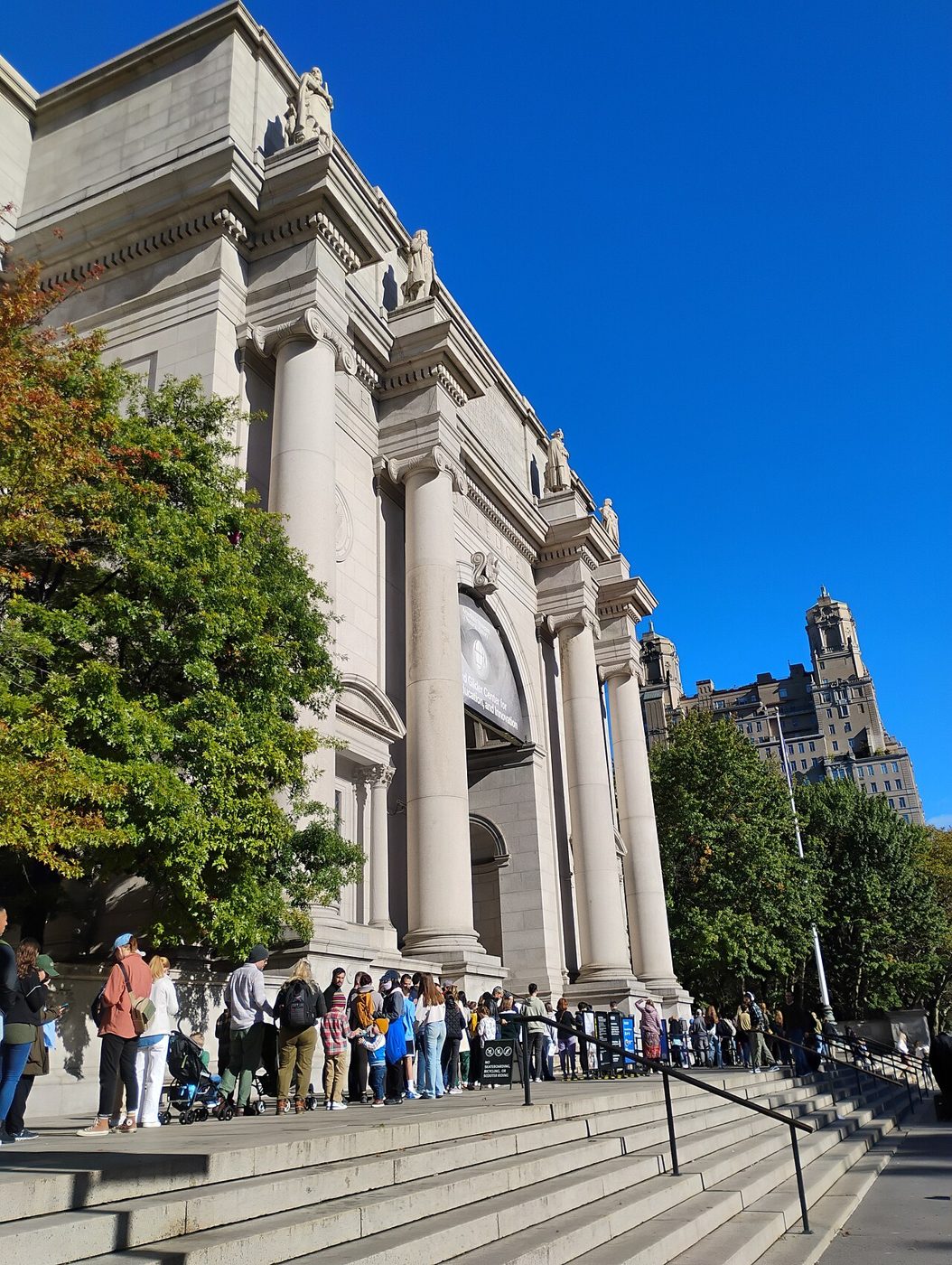
For the Central Park West side, Trowbridge & Livingston started a wing to the north in 1922 in gray granite and the classic style. That change let John Russell Pope build his winning competition design for the central unit facing the park, the Theodore Roosevelt Memorial. The commission describes it as an expression of the Roman triumphal arch, carried out in a warm shade of limestone by Trowbridge & Livingston. Franklin Delano Roosevelt, then Governor of New York, laid the cornerstone in 1931. A broad flight of stairs leads up to the arch and its bronze doors. Ionic columns stand on either side, and the pedestals are decorated with carved bas reliefs of animals. In front, a high pedestal carries James E. Fraser's equestrian statue of Theodore Roosevelt.
The commission says Hayden Planetarium, designed by Trowbridge & Livingston, was finished in 1935. The museum's own timeline also dates the planetarium to 1935 but says Theodore Roosevelt Memorial Hall and the Theodore Roosevelt Rotunda opened in 1936, a year later than the commission's completion date of 1935 for the memorial. The commission designated the rotunda an interior landmark in 1975, according to the museum.
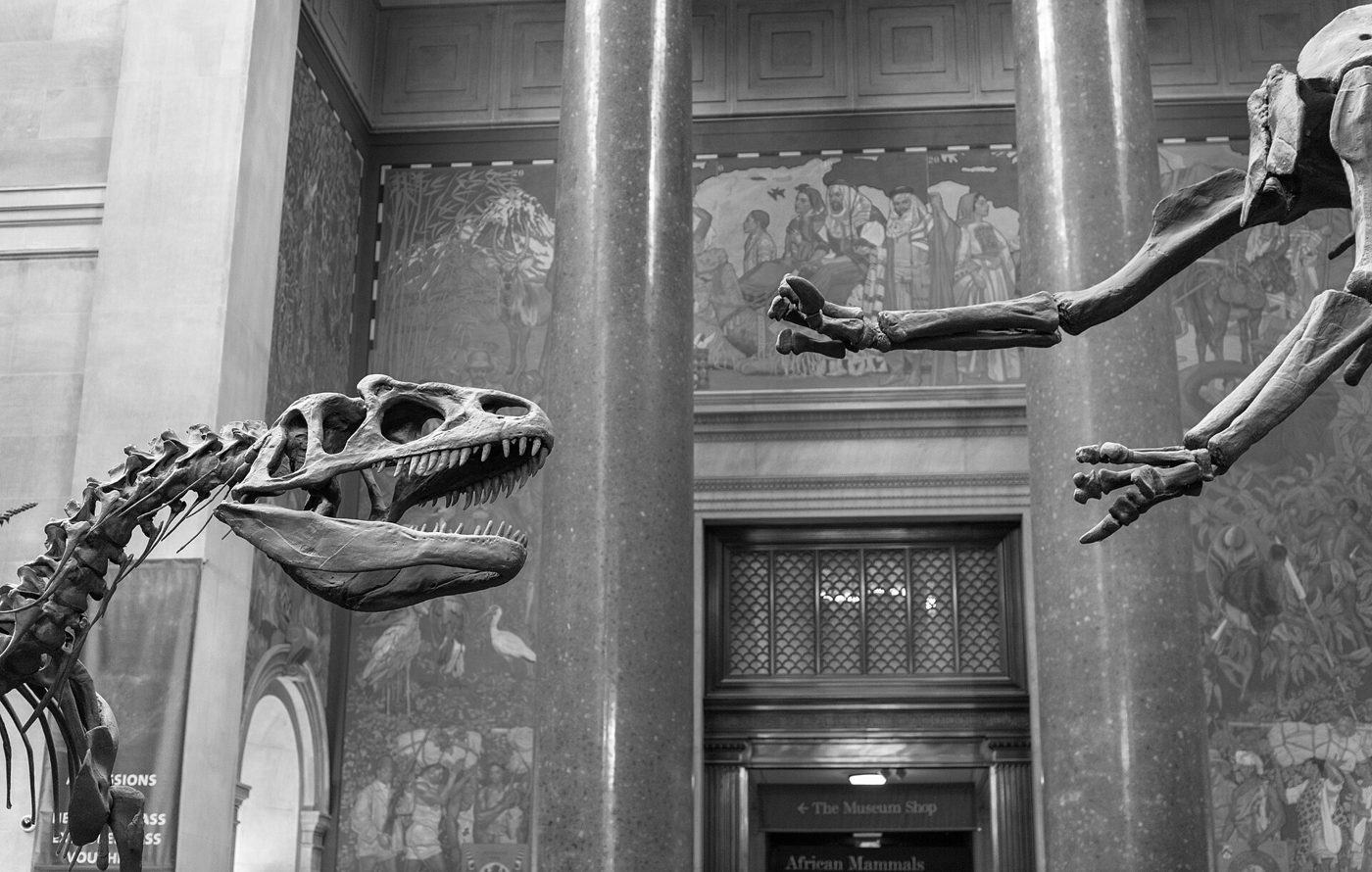
Dinosaur skeletons inside the museum. Photograph by Giorgio Galeotti, via Wikimedia Commons. CC BY 4.0.
What did its expeditions bring back?
The museum says that from 1880 to 1930, under President Morris K. Jesup, it ran a golden age of exploration, with expeditions that explored Siberia, Outer Mongolia, the Gobi and the Congo. Franz Boas organized the Jesup North Pacific Expedition from 1897 to 1902, and Margaret Mead worked in the Department of Anthropology from 1926 until her death in 1978. In 1922 Roy Chapman Andrews led the Central Asiatic Expeditions through the Gobi, and the museum says they found some of the richest dinosaur fossil sites in the world. The South Asiatic Hall, the first major hall of mammal habitat dioramas, opened in 1930. The Hall of Ocean Life opened in 1933 and in 1969 gained a 94-foot model of a blue whale. In 1991 a five-story Barosaurus cast was installed in the Roosevelt Rotunda, which the museum calls the world's highest freestanding dinosaur display.
By 1967 the commission counted nearly three million visitors a year, more than 2,300 habitat groups and exhibits in fifty-eight halls and alcoves, and a library of 175,000 volumes.
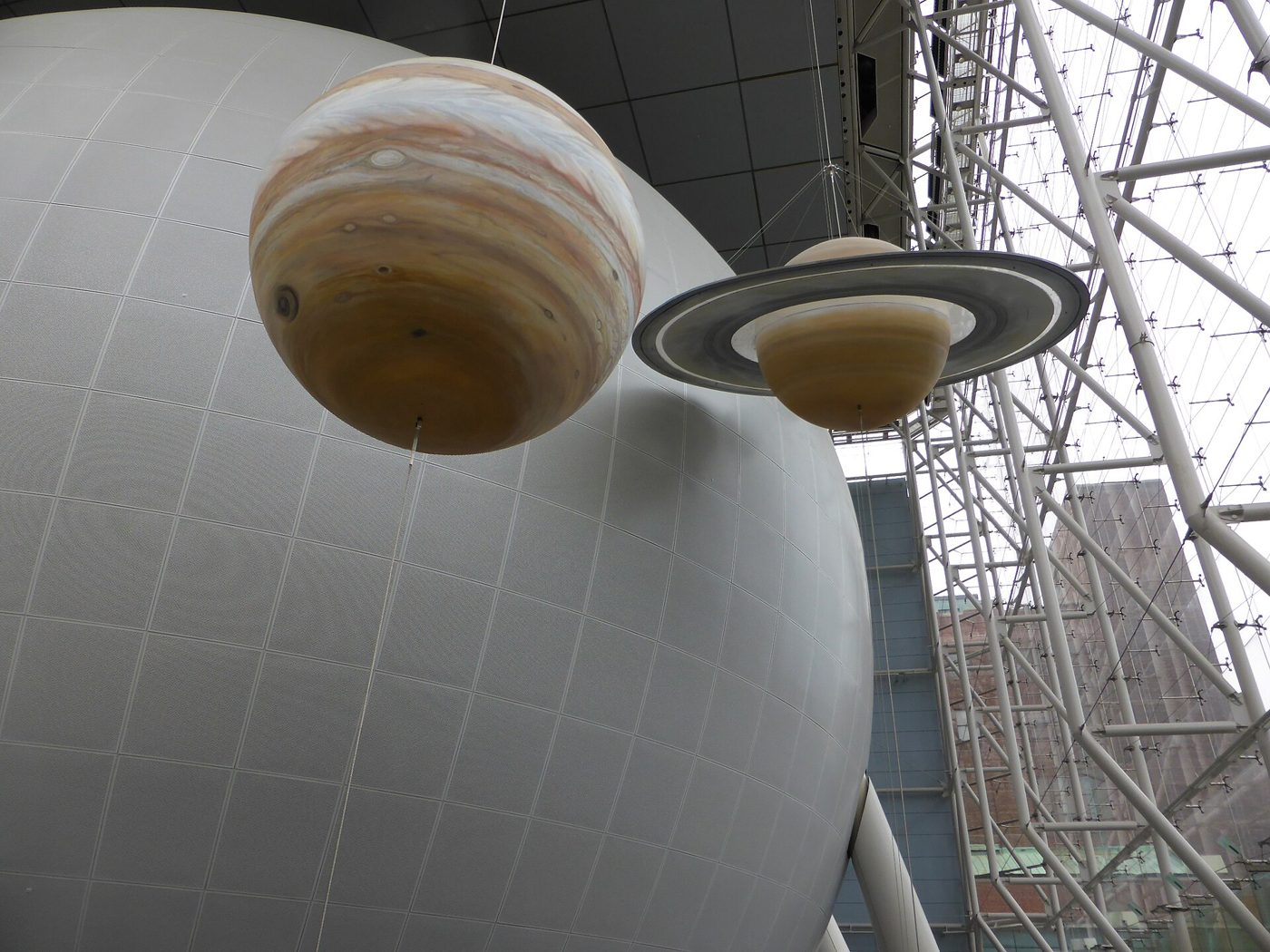
The Hayden Sphere in the Rose Center for Earth and Space. Photograph by MartinThoma, via Wikimedia Commons. CC0.
What is the Rose Center?
The museum says the Gottesman Hall of Planet Earth was the first part of the Rose Center for Earth and Space to open, in 1999, and that the whole Rose Center opened to the public in 2000 with a new Hayden Planetarium and a Zeiss Star Projector, Mark IX. The Judy and Josh Weston Pavilion added an entrance on Columbus Avenue in 2001. In 2006 the museum opened the Richard Gilder Graduate School, which it says made it the first American museum granted authority to award its own Ph.D. degree. The museum also says it sits within Lenapehoking, the ancestral land of the Lenape.
Who owns the American Museum of Natural History today?
The City of New York owns the museum's main buildings and land. The museum's audited financial statements for fiscal 2025 say they are occupied under an original lease from 1877, rent-free while used for charter purposes. The statements add that the Planetarium Authority holds title to the Rose Center and its land. The museum says its campus covers 18 acres.
Sources
- NYC Landmarks Preservation Commission, American Museum of Natural History designation report, 1967
- American Museum of Natural History, About the Museum and history timeline
- American Museum of Natural History, consolidated financial statements, fiscal years 2025 and 2024
- American Museum of Natural History, Plan Your Visit
- American Museum of Natural History, Accessibility
Visiting the American Museum of Natural History
- Address: 200 Central Park West.
- Hours: The museum lists daily hours of 10 am to 5:30 pm. It is closed Thanksgiving and December 25.
- Admission: The museum says admission is pay what you wish for New York State residents with ID.
- Subway: The museum names the 1, 2 and 3 at 72nd Street as the closest accessible subway. The B and C at 81st Street-Museum of Natural History has stairs only.
- Accessible entrance: The Rose Center entrance at 54 West 81st Street.
Checked against the museum's Plan Your Visit page and its accessibility page. Confirm hours and ticket rules there.