Why Is the Gershwin Theatre the Biggest on Broadway? From Uris Theatre to Wicked
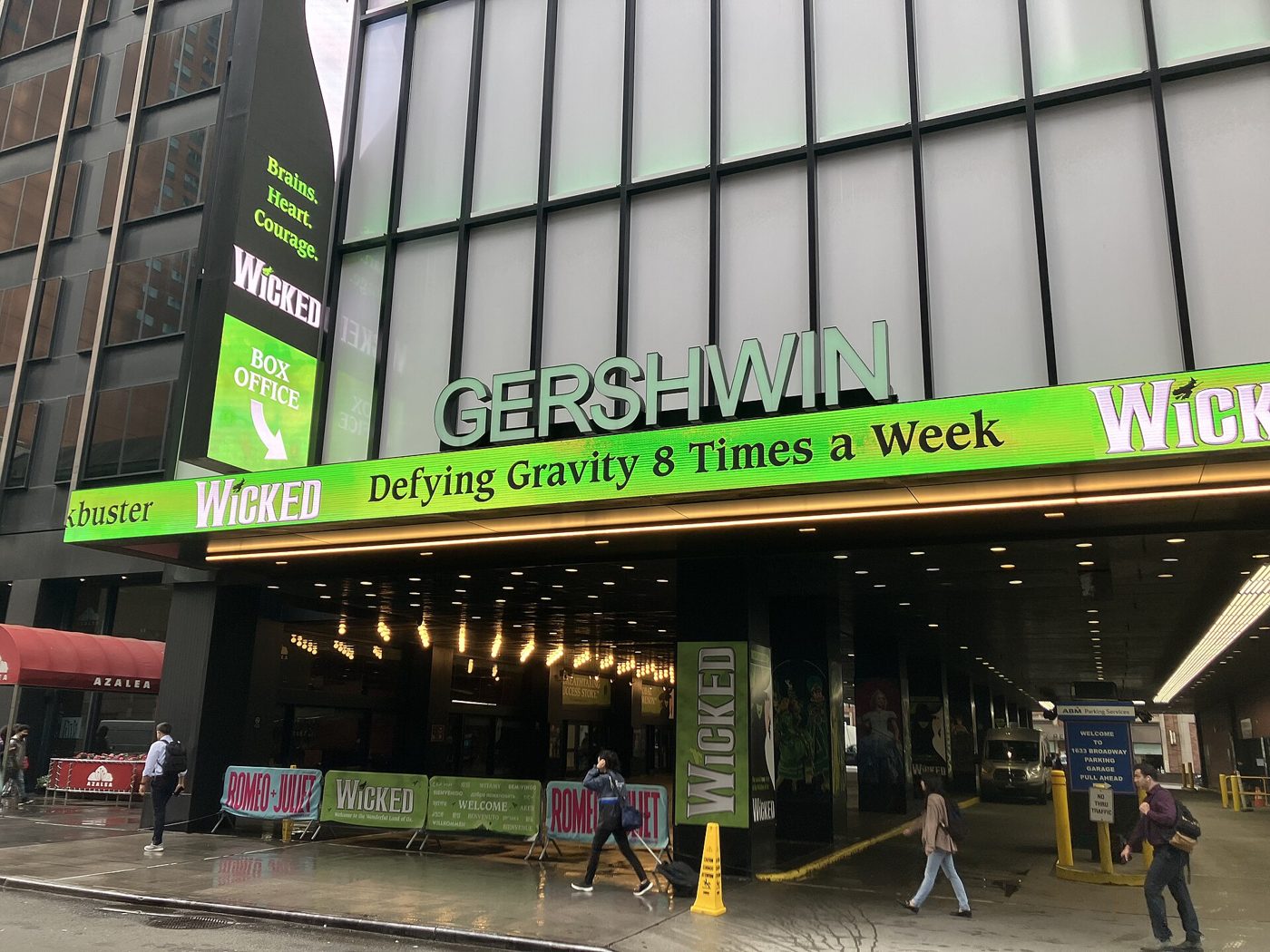
The Gershwin Theatre entrance on West 51st Street during the long run of Wicked, September 2024. Photograph by DaHuzyBru, via Wikimedia Commons. CC BY-SA 4.0.
Why is the Gershwin Theatre the biggest theater on Broadway?
Because it was built big and has stayed that way. The Gershwin, at 222 West 51st Street, seats 1,933 according to the Internet Broadway Database (IBDB), Theatre Development Fund (TDF) and Playbill's venue write-up. TDF says flatly that it has the highest seating capacity of any Broadway theatre. The numbers are not perfectly uniform. Playbill's own fact box for the venue lists 1,926 seats, and two ticket-information sites round it to 1,900. All of them agree on the ranking. The reason is that the house was designed in the late 1960s as a large musical theater on the lower levels of a new office tower, rather than squeezed into a lot between older neighbors the way most Broadway houses were.
The IBDB entry puts it this way: when it opened on November 28, 1972, the Uris Theatre was the first legitimate Broadway theatre built since 1928. Other sources give a different cutoff. Classic New York History says the last Broadway theater before it was the Mark Hellinger, built in 1930, and a third site names the Earl Carroll as built in 1931. This article uses IBDB's 1928 date because it is the Broadway database's own entry, and notes that the sources differ. Every version makes the same point: for more than four decades, almost no one had built a new Broadway playhouse.
What stood on the site before the theater?
The Capitol Theatre. The Capitol was a movie palace at Broadway and 51st Street, opened on October 24, 1919, according to the Performing Arts Archive. Cinema Treasures lists the architects as Thomas W. Lamb and John J. McNamara and gives it 5,230 seats, which is far larger than any Broadway stage house. Loew's took the Capitol over and made it a flagship, and it hosted many premieres of films from Loew's studio, MGM, per Classic New York History.
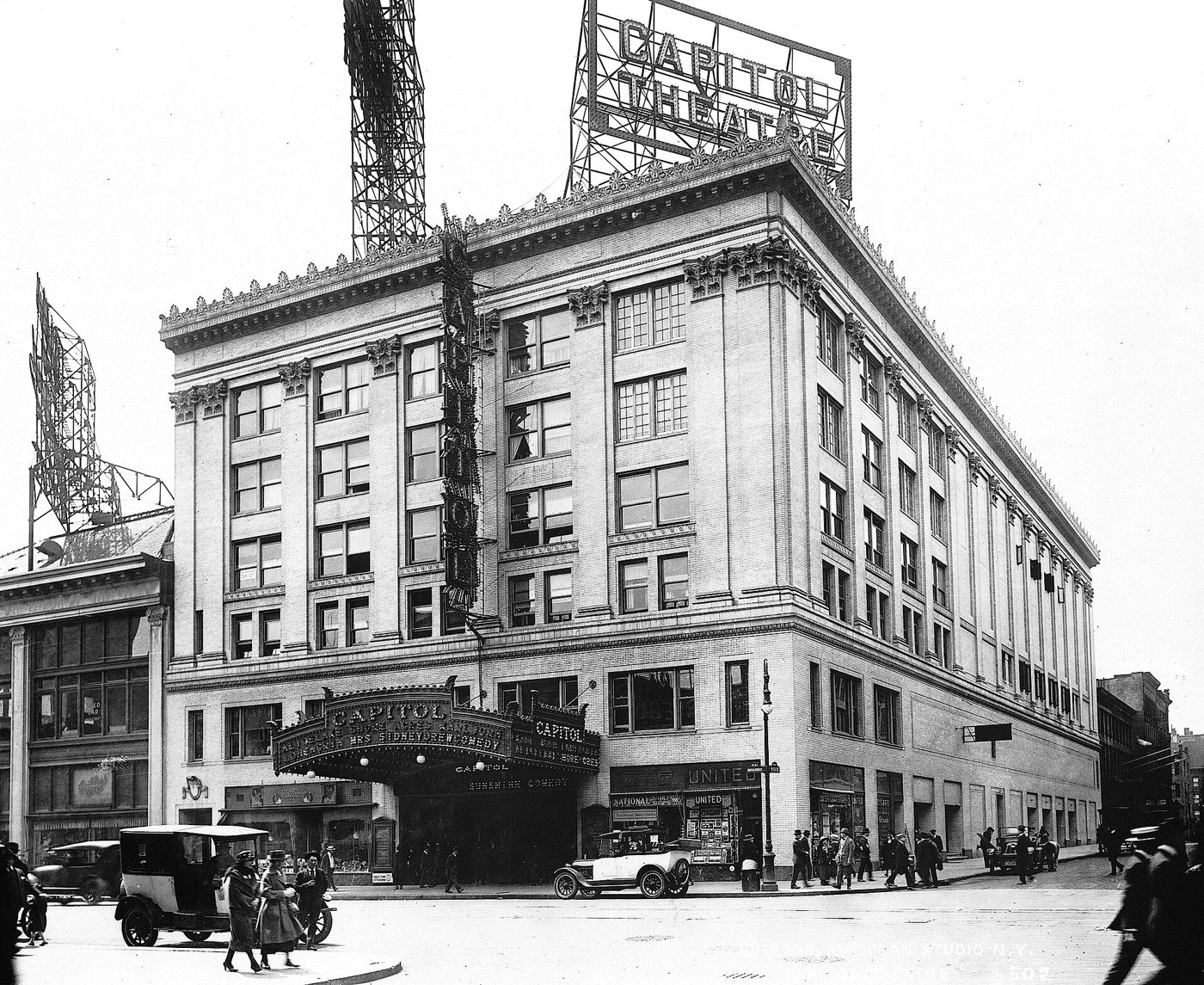
The Capitol Theatre at Broadway and 51st Street, about 1920. Public domain, via Wikimedia Commons.
Classic New York History says the Capitol was not a true predecessor of the Gershwin, since it showed films rather than plays. TDF describes the new theater as built "on the site of the historical Capitol Theatre." Both statements are accurate. The site is the same. The use was different.
By the late 1960s the Capitol was one of the last big movie palaces in the area. In September 1967 the Uris Buildings Corporation leased the site to put up an office building and a Broadway theater, per Classic New York History. The theater was the unusual part. Getting permission to put a legitimate house in a tower involved talks with the City Planning Commission. The same source says six parties supported the plan and the Shubert Organization opposed it, and that the developers changed the scheme so the building would hold two theaters instead of one. The Capitol closed in September 1968. The tower opened in 1971.
Who designed it and how did it open?
Ralph Alswang designed the theater. TDF identifies Alswang as a set designer and describes the design as Art Nouveau in style. TDF puts the cost of the whole office complex at an estimated $12.5 million. The theater was named the Uris Theatre after the Uris brothers who developed the building. Playbill's archived notes on the theater say Gerald Oestreicher took a 30-year lease on it. Classic New York History says the Uris family got the Nederlander Organization to operate it. The Nederlanders are still its operator in current references. IBDB points readers to the Nederlander website for its history.
The first show was Via Galactica, a space musical starring Raul Julia. It closed after seven performances. TDF and Classic New York History both say it was the first Broadway show to lose a million dollars. From 1974 to 1976, TDF says, the house served as a concert hall for limited engagements by pop and jazz performers. The Desert Song lasted 15 performances in 1973, per Classic New York History. Seesaw, the same year, ran 296.
When did it become the Gershwin?
On June 5, 1983, during the Tony Awards broadcast. IBDB and Playbill both record the date. The new name honored the composer George Gershwin and his brother, the lyricist Ira Gershwin. Classic New York History adds that the theater hosted the memorial for Ira Gershwin a couple of months after the rename. This article could not find a second source for that, so treat it as a single-source detail.
The 1980s and 1990s were uneven. The 1970s had two long runs, according to Classic New York History: The King and I in 1977 with 719 performances and Sweeney Todd in 1979 with 755. Starlight Express arrived in 1987 and required the theater to be renovated for its skating set. The Playbill notes also mention Fiddler on the Roof starring Topol in 1990 and Meet Me in St. Louis the same year. The Red Shoes opened on December 16, 1993 and closed on December 19, 1993, according to IBDB's production list. Classic New York History says it ran three days and lost $8 million. Those two accounts differ by a day, which depends on whether you count the opening or closing day, and the article cannot settle that from the sources.
IBDB's list of productions also shows Show Boat (1994 to 1997), 1776 (1997 to 1998), On the Town (1998 to 1999), Peter Pan (1999), Riverdance (March 2000 to August 2001) and Oklahoma! (March 2002 to February 2003). Classic New York History gives Riverdance 605 performances and Oklahoma! 388.
Why is Wicked at the Gershwin?
Wicked has played the Gershwin since it opened there on October 30, 2003, per IBDB, with first previews on October 8, 2003. IBDB lists 8,811 performances as of June 7, 2026. Playbill's venue page lists a larger count, 8,947, so the figure depends on the date of each source. The show's own site calls it the fourth longest-running show in Broadway history, and Playbill reported that it reached that ranking in April 2023.
Classic New York History says the creators of Wicked were reluctant to book the Gershwin because of its reputation for short-lived shows, and that the theater's size turned out to suit the show. This is a single secondary source and it is an account of other people's thinking, so it is stated here as what that source says. What the record does show is simple. A show that could fill nearly 1,900 seats eight times a week found the one Broadway house that could hold it.
What is inside?
The lobby holds a Theatre Hall of Fame. IBDB calls it the Theatre Hall of Fame and says it is housed in a special oval room in the lobby. TDF calls it the American Theatre Hall of Fame. This article uses the name each source gives. The theater shares the building with a smaller Broadway house, the Circle in the Square, which Playbill says opened in 1972 as the Gershwin's sister theater.
The Gershwin is one of the Nederlander Organization's Broadway theaters, per BroadwayWorld. The Playbill page lists the stage door to the right of the theater on 51st Street, marked "Gershwin Stage Door." TDF says the theater has both elevators and escalators to every floor and that the lobby is wheelchair accessible.
Where can you eat or drink at the Gershwin Theatre?
Inside the theater, yes. The official Wicked FAQ says the Gershwin offers snacks and drinks from 45 minutes before the show and during intermission, with bars on the front orchestra and mezzanine levels. It suggests pre-ordering intermission drinks at the bar before the show. No food or drink is allowed into the auditorium, and everything must be consumed in the lobbies. Outside food is not allowed in the building. Playbill's venue page says concessions are on the second and fourth floors. This is a theater concession, not a restaurant, and the Gershwin has no public restaurant of its own that this article could confirm. Offerings and hours can change with the production, so check the Wicked FAQ before you go.
Who owns the Gershwin Theatre today?
The theater sits inside the office building at 1633 Broadway. Classic New York History says Paramount Group bought a majority stake in the building in 1976 and renamed it Paramount Plaza in 1980. The Nederlander Organization operates the theater, according to BroadwayWorld and others. This article did not find a current official statement of who holds title to the theater space, so it does not name an owner. It can only say who operates it. Note that no New York City landmark designation for the Gershwin was confirmed in the sources checked.
Sources
- Internet Broadway Database, Gershwin Theatre
- Theatre Development Fund, Gershwin Theatre
- Playbill, George Gershwin Theatre venue page
- Gershwin Theatre website (archived 2017), About, text used with permission by Playbill
- Wicked the Musical, official FAQs (concessions)
- Wicked the Musical, The Story of Wicked
- Internet Broadway Database, Wicked (original Broadway production)
- Playbill, Wicked Celebrates 20 Years on Broadway
- Classic New York History, History of the Gershwin Theatre
- Cinema Treasures, Capitol Theatre, 1645 Broadway
- Performing Arts Archive, Capitol Theatre
- BroadwayWorld, Gershwin Theatre
- Broadway League, Wicked (running time and dates)
Visiting the Gershwin Theatre
- Address: 222 West 51st Street, New York, NY 10019 (TDF).
- Getting there: TDF lists the N, R and Q to 49th Street and the 1, C and E to 50th Street, and the M7, M20, M50 and M104 buses.
- Entrance: TDF says to enter through the arcade between 50th and 51st Streets.
- Accessibility: TDF lists wheelchair seating in the rear orchestra and mezzanine, elevators and escalators, and free assistive listening headsets with a photo ID deposit.
- Running time: broadway.org lists Wicked at 2 hours 45 minutes with one intermission. Check the official Wicked site for current performance times.
Checked against official Wicked FAQ and TDF Gershwin page. Confirm hours and ticket rules there.