Who Is Buried in Green-Wood Cemetery? A Composer, a Boss and a Butcher
Green-Wood Cemetery is where New York keeps its dead, and a good share of its history. Founded in 1838 on 478 acres of Brooklyn hills, it was one of America's first rural cemeteries, a landscaped alternative to the crowded churchyard that became so popular it helped inspire Central Park and Prospect Park. Its 580,000 permanent residents include Leonard Bernstein, Boss Tweed, Jean-Michel Basquiat and two men from New York's underworld: Bill the Butcher, the nativist gang leader, and Joey Gallo, the mobster shot on his birthday. A Revolutionary War battle was fought across its grounds, and its Gothic gate is a New York City landmark.
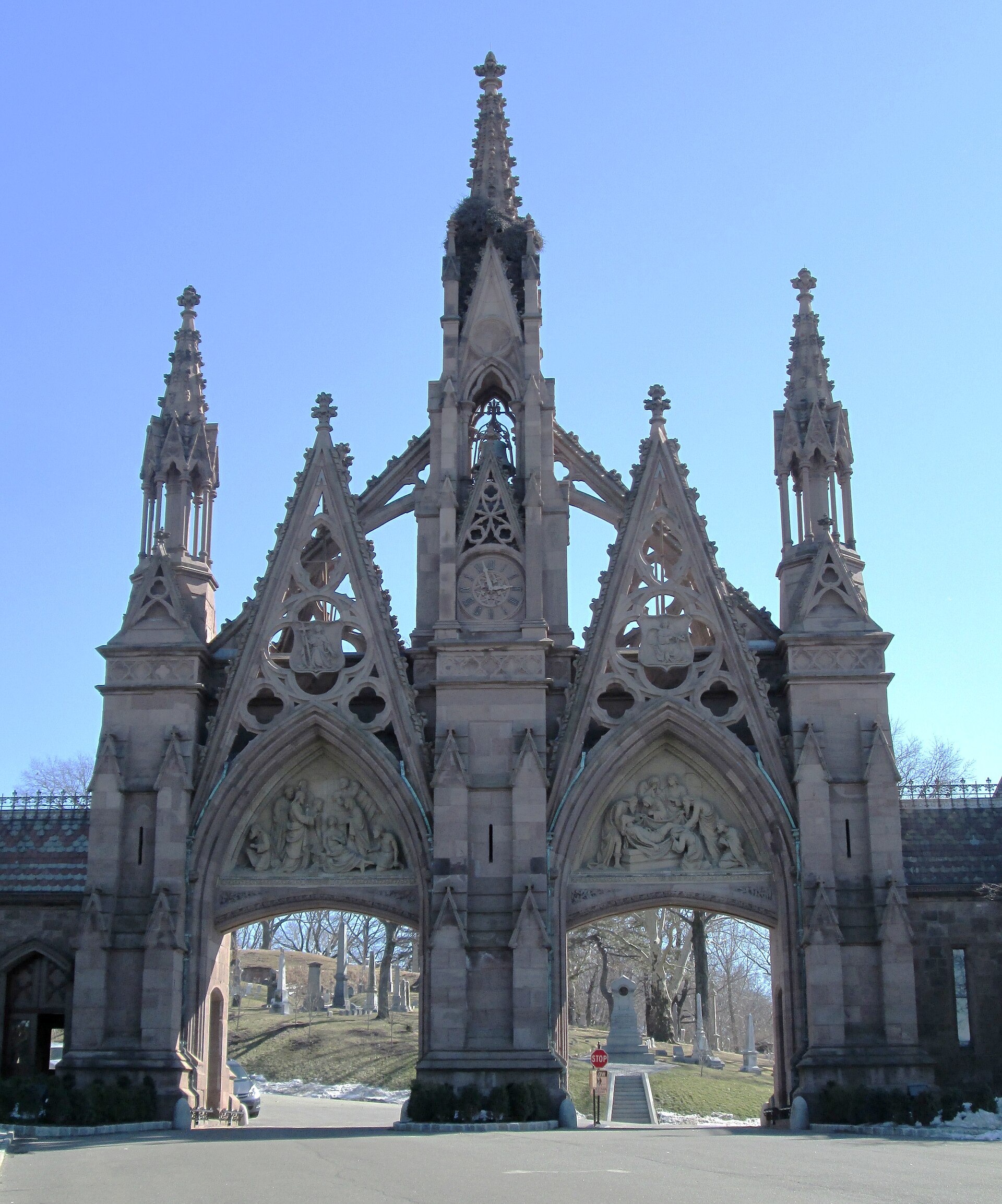
The main gate at Fifth Avenue and 25th Street, completed in 1865. Photograph by Beyond My Ken, via Wikimedia Commons. CC BY-SA 4.0.
How did Green-Wood begin?
By the 1830s, New York had a burial problem. The cemetery's own archives explain that churchyards were terribly overcrowded, regulations were few, and the situation threatened the city's water supply and its people. In late 1837 a committee formed to find land for a large rural burial ground and settled on a tract in Gowanus, Brooklyn, chosen for its beauty and its availability. In 1838 the New York State Senate passed an act of incorporation, and Green-Wood became a corporation.
The model was Mount Auburn Cemetery in Cambridge, Massachusetts, the first of the "rural" cemeteries, where a landscaped setting rather than a churchyard would receive the dead. Green-Wood followed within the decade. The Landmarks Preservation Commission calls it the fourth rural cemetery in the United States, with a landscape influenced by the English garden movement championed by Andrew Jackson Downing. Henry Pierrepont and Major David Bates Douglass directed the early planning and laid out the grounds: hills, valleys and glacial ponds laced with paths, planted with trees, and filled over time with one of the largest outdoor collections of nineteenth- and twentieth-century statuary and mausoleums in the country.
It worked beyond anyone's expectations. Green-Wood's own history page says that by the early 1860s the cemetery drew 500,000 visitors a year, second only to Niagara Falls as the nation's greatest tourist attraction. Families came for carriage rides, outings and sculpture. The Landmarks Preservation Commission, writing about Prospect Park, notes that before Brooklyn had a real park, Green-Wood was the prime recreational space for thousands of city dwellers. The cemetery says its popularity helped inspire the creation of New York's public parks, Central Park and Prospect Park among them.
What happened here during the Revolution?
The ground itself is a battlefield. On August 27, 1776, the Battle of Long Island, the first major battle between Washington's Continental Army and the British after the Declaration of Independence, was fought across what are now the cemetery's grounds. Green-Wood describes itself as a Revolutionary War historic site for exactly that reason, and as a registered member of the Audubon Cooperative Sanctuary System, a magnet for history buffs and bird watchers on the same 478 acres.
The high ground is Battle Hill. There, on August 27, 1920, the 144th anniversary of the battle, the cemetery dedicated the Altar to Liberty, a monument topped by a bronze statue of Minerva, the Roman goddess of battle. According to the Smithsonian's inventory of American sculpture, Minerva raises her left hand to salute the Statue of Liberty across the harbor while her right hand places a wreath on the altar. One of the monument's bronze plaques carries a poem by Sarah Day, a student who won a writing contest held in honor of the battle.
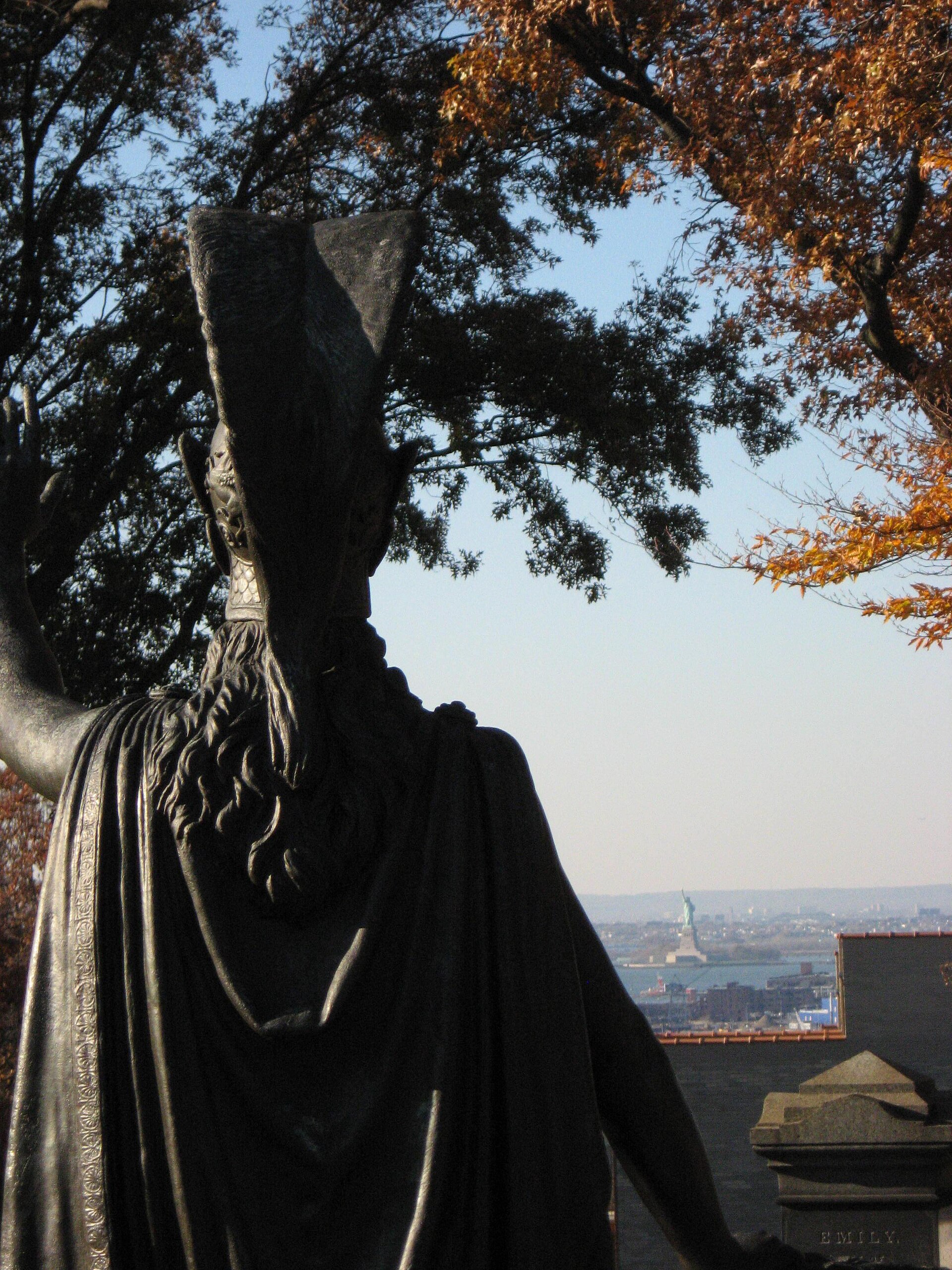
Minerva salutes the Statue of Liberty across New York Harbor from Battle Hill. Photograph by Russell Bittner, via Wikimedia Commons. CC BY-SA 3.0.
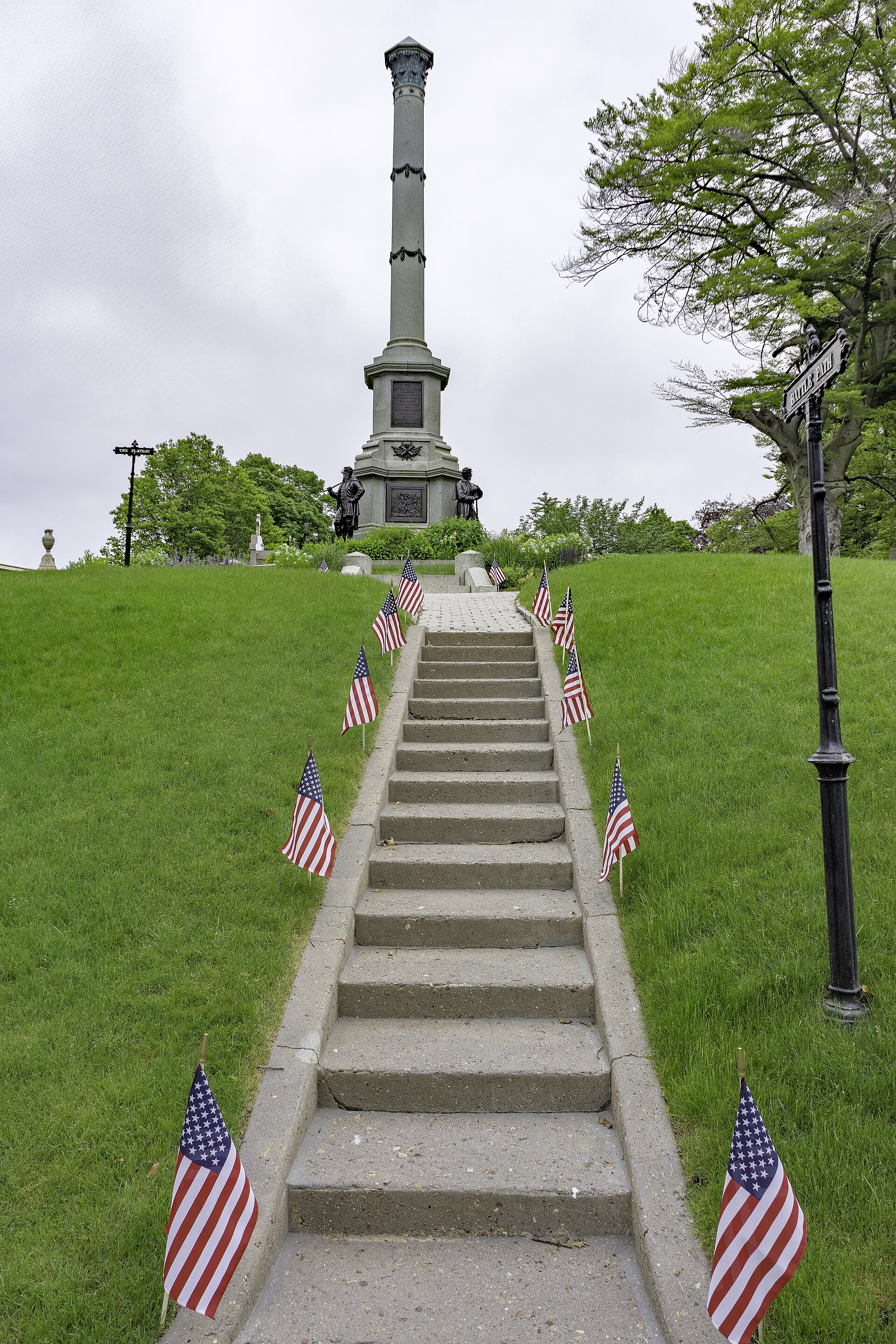
The steps of Battle Hill, part of the 1776 battlefield. Photograph by BarryBrooklynNY, via Wikimedia Commons. CC BY-SA 4.0.
Who is buried at Green-Wood?
About 580,000 people, by the cemetery's own count, which makes Green-Wood larger in population than every American city in its founding year except the one next door. The institution's history page names the famous ones plainly: Leonard Bernstein, Boss Tweed, Charles Ebbets, Jean-Michel Basquiat, Louis Comfort Tiffany and Horace Greeley, plus, in its words, numerous Civil War generals, baseball legends, politicians, artists, entertainers and inventors. Around them lie the families that built Brooklyn, including the Pierreponts, Roosevelts, Jeromes and Schermerhorns, and hundreds of thousands of less famous New Yorkers.
The cemetery likes to note the saying that one of every seven Americans can trace family roots back to Brooklyn. Until 1898, when it joined New York City, Brooklyn was the fourth most populated city in the United States, and generations of its immigrants ended up in its largest cemetery. Green-Wood's archives, which hold lot records, burial orders, death certificates and family correspondence going back to 1838, describe themselves as a genealogical record that exists nowhere else.
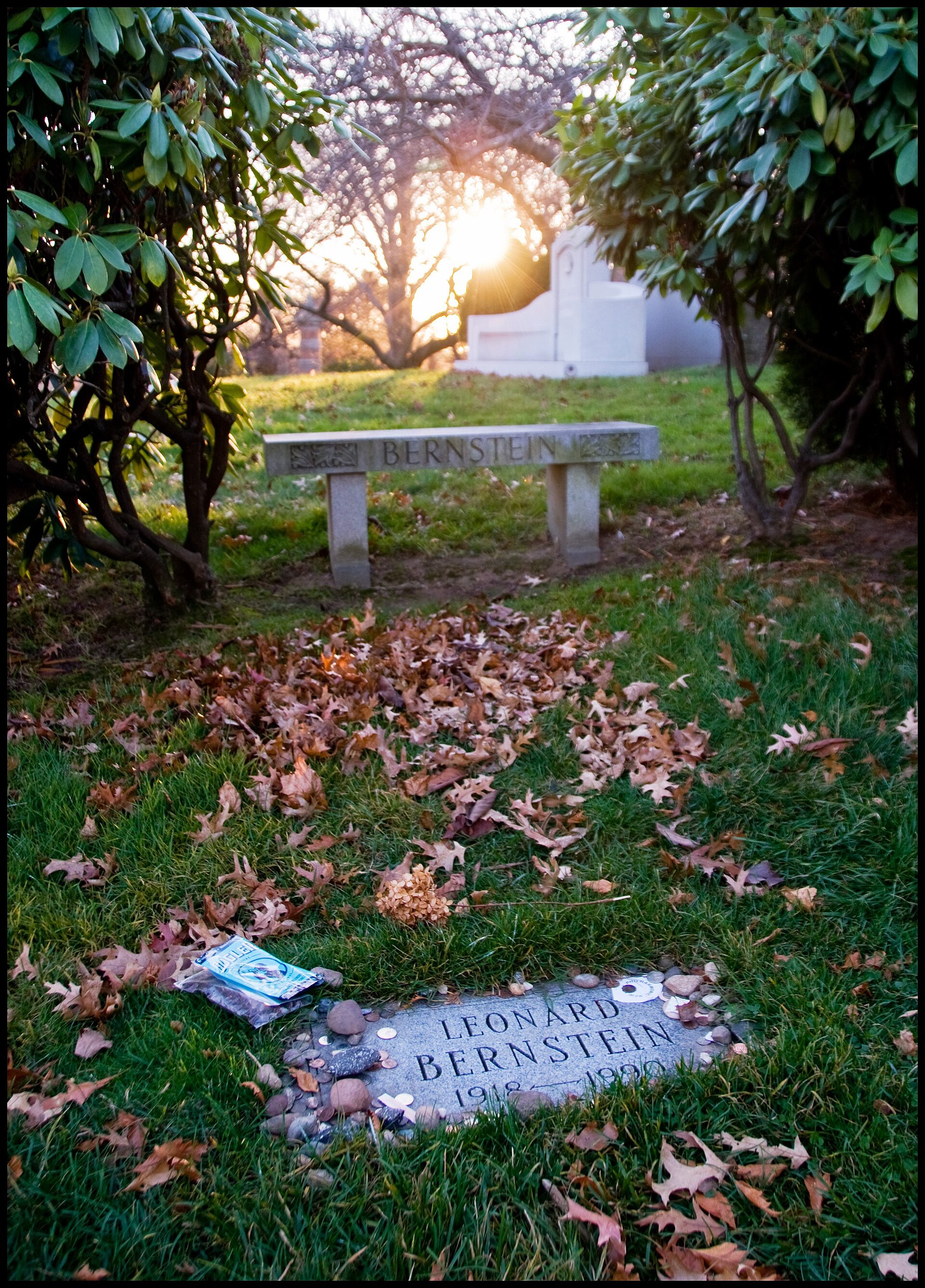
Leonard Bernstein's grave at Green-Wood. Photograph by Tony, via Wikimedia Commons. CC BY 2.0.
What did New York landmark at Green-Wood?
Start at the front door. The main gate at Fifth Avenue and 25th Street, begun in 1861 and completed in 1865, was designed by Richard M. Upjohn and Son. The Landmarks Preservation Commission designated it a New York City landmark on April 19, 1966, calling it one of the outstanding monuments of the late Gothic Revival: two principal gates flanking a Flamboyant Gothic clock tower, with the cemetery office on one side and a chapel and reception room on the other, and sculptured bas reliefs set into the pointed arches.
Two more pieces followed half a century later. On April 12, 2016, the Commission designated the Fort Hamilton Parkway Entrance, built from 1876 to 1877 to a design by Richard Mitchell Upjohn, and the Green-Wood Cemetery Chapel, built from 1911 to 1913 and designed by Warren and Wetmore. The Commission called both excellent examples of Gothic Revival design that continue the tradition of the main gate. And on September 27, 2006, the United States Department of the Interior designated the whole cemetery a National Historic Landmark, recognizing its national significance in art, architecture, landscaping and history.
Gangsters and Organized Crime
Green-Wood holds two men from opposite ends of New York's gangster century. The older one is William Poole, better known as Bill the Butcher. Poole led the Bowery Boys, the bare-knuckle nativist gang of the 1850s, working as a butcher by day and as a political enforcer for the anti-immigrant Know-Nothing movement. In February 1855 he was shot in a Manhattan bar by a rival; he died days later. His funeral procession to Green-Wood drew a record crowd, with thousands lining lower Broadway. His grave went unmarked for nearly 150 years, until 2003, when the cemetery installed a headstone bearing his last words, "Good-bye boys, I die a true American," and had a bugler play taps. The man himself was more than a movie villain. Forgotten New York's account of his grave describes him as over six feet tall and two hundred pounds, a butcher by profession as well as avocation, and the standout brawler even among the Bowery Boys. Five thousand men marched in his funeral procession, behind a half-dozen brass bands, and Herbert Asbury's classic gang history records that Broadway playwrights rushed the dying words into their scripts, so the hero could drape himself in the flag and cry them out. When the new headstone went up in 2003, the New York Post reported, the cemetery's president Richard Moylan said the taps were not for Poole alone but for all those who lost their lives in the riots of his era, and the cemetery's historian noted that he was called the Butcher not only for the cleaver. Martin Scorsese's "Gangs of New York" turned Poole into Bill Cutting, the film's gang boss.
The newer one is Joe Gallo. The Red Hook gangster, known as Crazy Joe, fought an underdog war against the Profaci crime family between 1961 and 1963, at one point holed up with his ramshackle crew in a Columbia Waterfront District home. On April 7, 1972, Gallo celebrated his 43rd birthday at Umberto's restaurant in Little Italy; before the dinner was over, he was shot and killed. Green-Wood's own pages mark the date of his death, and Brooklyn Paper counts him among the cemetery's famous residents; his grave is in Section 12, a few hills away from the Butcher.
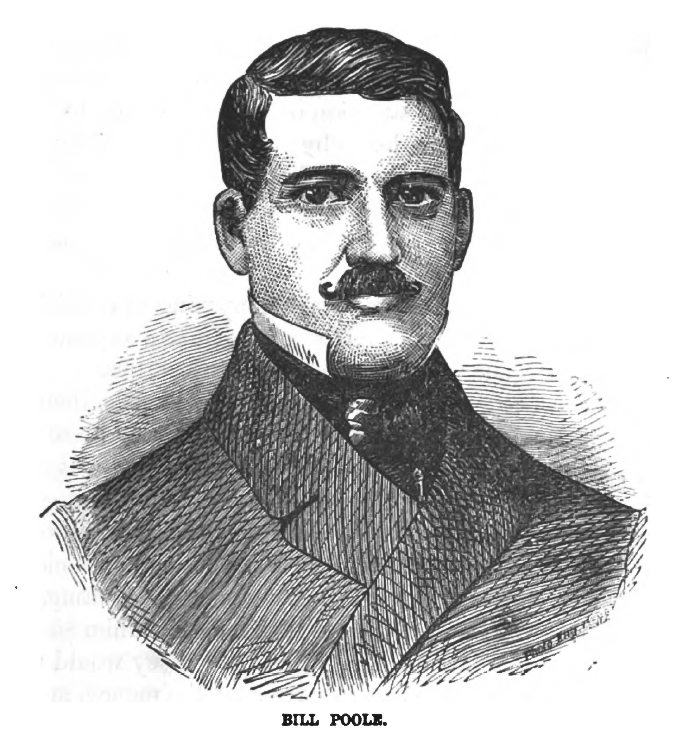
Bill Poole, the Bowery Boys leader buried at Green-Wood in 1855. Engraving: public domain, via Wikimedia Commons.
Who owns Green-Wood Cemetery today?
The same institution that opened it. The Green-Wood Cemetery, the corporation created by the 1838 act of incorporation, still owns and operates the grounds; its website describes it as a nonprofit and notes 187 years of memorialization. This article did not examine deeds or tax records, because the official pages answer the question directly: the cemetery is not part of a city agency or a private chain, and its address, phone number and visitor rules are published under its own name.
Sources
- The Green-Wood Cemetery, Our Story
- The Green-Wood Cemetery, Green-Wood's History and Archives
- The Green-Wood Cemetery archives, Founding Documents, 1837-1899
- NYC Landmarks Preservation Commission, Green-Wood Cemetery Gates designation report (LP-0149), April 19, 1966
- NYC Landmarks Preservation Commission, Fort Hamilton Parkway Entrance and Green-Wood Cemetery Chapel designation report (LP-1233), April 12, 2016
- Smithsonian American Art Museum, Inventories of American Painting and Sculpture, Minerva and Altar to Liberty
- The Green-Wood Cemetery, April 7: Joey Gallo
- New York Post, 'Bill the Butcher' Fil-laid to Rest, February 14, 2003
- Brooklyn Paper, Meet five famous Green-Wood Cemetery residents killed by gunfire
- Forgotten New York, Bill the Butcher's Grave
- The Green-Wood Cemetery, Plan a Visit
Visiting Green-Wood Cemetery
- Address: The cemetery lists its address as 500 25th Street, Brooklyn, NY 11232. The Main Entrance is at Fifth Avenue and 25th Street.
- Hours and admission: Green-Wood says admission is always free, and the Main Entrance is open every day from 7 a.m. to 7 p.m. The Green-House, its new visitor building on 25th Street, is open Thursday to Monday, 7 a.m. to 7 p.m.
- Getting there: The cemetery suggests the R train to the 25th Street station, then one block east and uphill to the Main Entrance. It also offers free parking inside, on the right-hand side of the road only.
- Tours and rules: Self-guided walks are free, with maps at the entrances and a free mobile guide; the cemetery also runs public programs and private tours. Its phone number is (718) 768-7300.
Facts above were read on the official pages on October 29, 2026. Hours and programs change, so confirm on green-wood.com before you go.