Who Is Buried in Grant's Tomb? The Monument New York Built for a President
The classic riddle has a trick answer: technically, nobody is buried in Grant's Tomb. Ulysses S. Grant and his wife Julia rest in red granite sarcophagi above ground, in a crypt you look down into from the main floor. The monument holding them, officially the General Grant National Memorial, stands in the median of Riverside Drive at West 122nd Street in Morningside Heights, and it remains the largest mausoleum in North America. It is a national memorial, a National Register property, and a New York City landmark inside and out, and it took New York twelve years, two design competitions and what was then the largest public fundraising campaign in the world to build it.
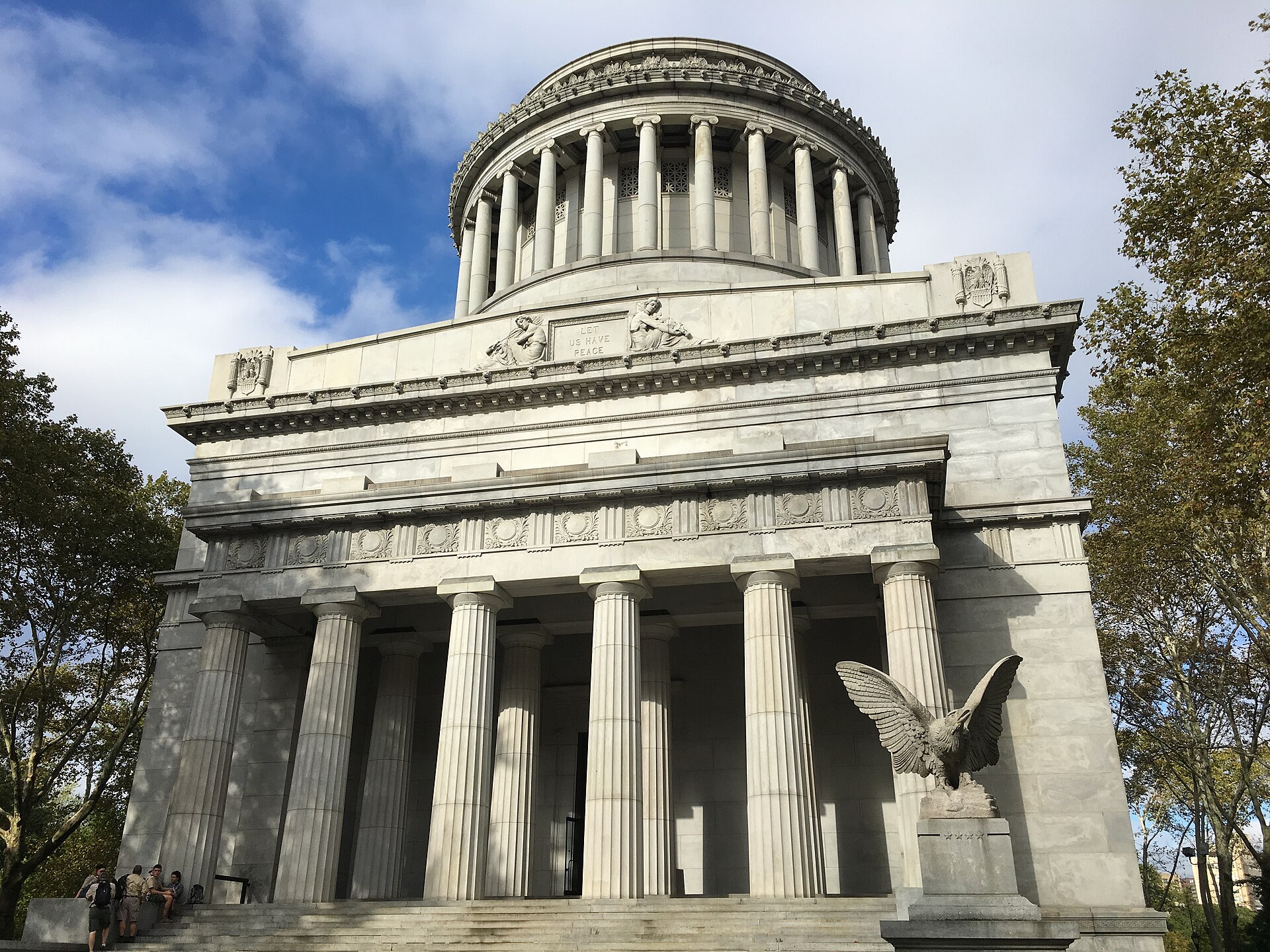
The General Grant National Memorial on Riverside Drive. Photo by Ccnyc123, via Wikimedia Commons. Creative Commons Attribution-Share Alike 4.0.
Why is a president buried in New York?
Grant was an Ohioan by birth and an Illinoisan by adoption, and he won the Civil War far from Manhattan. But he spent his final years in New York, and when he died of throat cancer at age 63 on July 23, 1885, days after finishing the memoirs he wrote to rescue his family from bankruptcy, the city moved fast. On the day he died, Mayor William Russell Grace telegrammed Julia Dent Grant to offer New York as the burial place for both husband and wife. Grant's own will had named St. Louis, Galena or New York City as possibilities, and Julia chose New York, in part because military cemeteries such as West Point would not have allowed her to be interred beside him. City officials first picked Central Park; the family found the proposed plots too small for two graves, and the public objected. Attention shifted to an undeveloped bluff in Riverside Park above the Hudson, and on July 28 the city settled on the Riverside site. His empty casket had already drawn 15,000 mourners in a single day.
How was the tomb designed and paid for?
The Grant Monument Association, formed within days of his death, raised $100,000 in its first three months, then almost stalled, adding only $55,000 over the next five years while out-of-state newspapers argued the monument belonged in Washington. The first design competition in 1889 drew 65 entries and ended in embarrassment: the judges refused to recommend any of the five winning plans, and the press mocked them. A second, invitation-only competition in 1890, with a $500,000 cost cap, brought in five architects, including Carrère and Hastings, and on September 9 the association chose John Hemenway Duncan. Duncan said he wanted "a monumental structure that should be unmistakably a tomb of military character," modeled on the ancient Mausoleum at Halicarnassus: a square granite base ringed by colonnades, a cylindrical drum, and a stepped dome. Fundraising was revived in 1892 by a citywide campaign that drew in 185 committees; when President Benjamin Harrison laid the cornerstone on April 27, 1892, the fund had passed $202,000, and by early 1893 it held $600,000 from more than 90,000 donors, the largest fundraiser the world had seen to that point. Strikes, stained granite and a bad water table slowed the work, and the initial plan for one shared sarcophagus was changed to two before the end. The tomb was completed on April 27, 1897, what would have been Grant's 75th birthday.
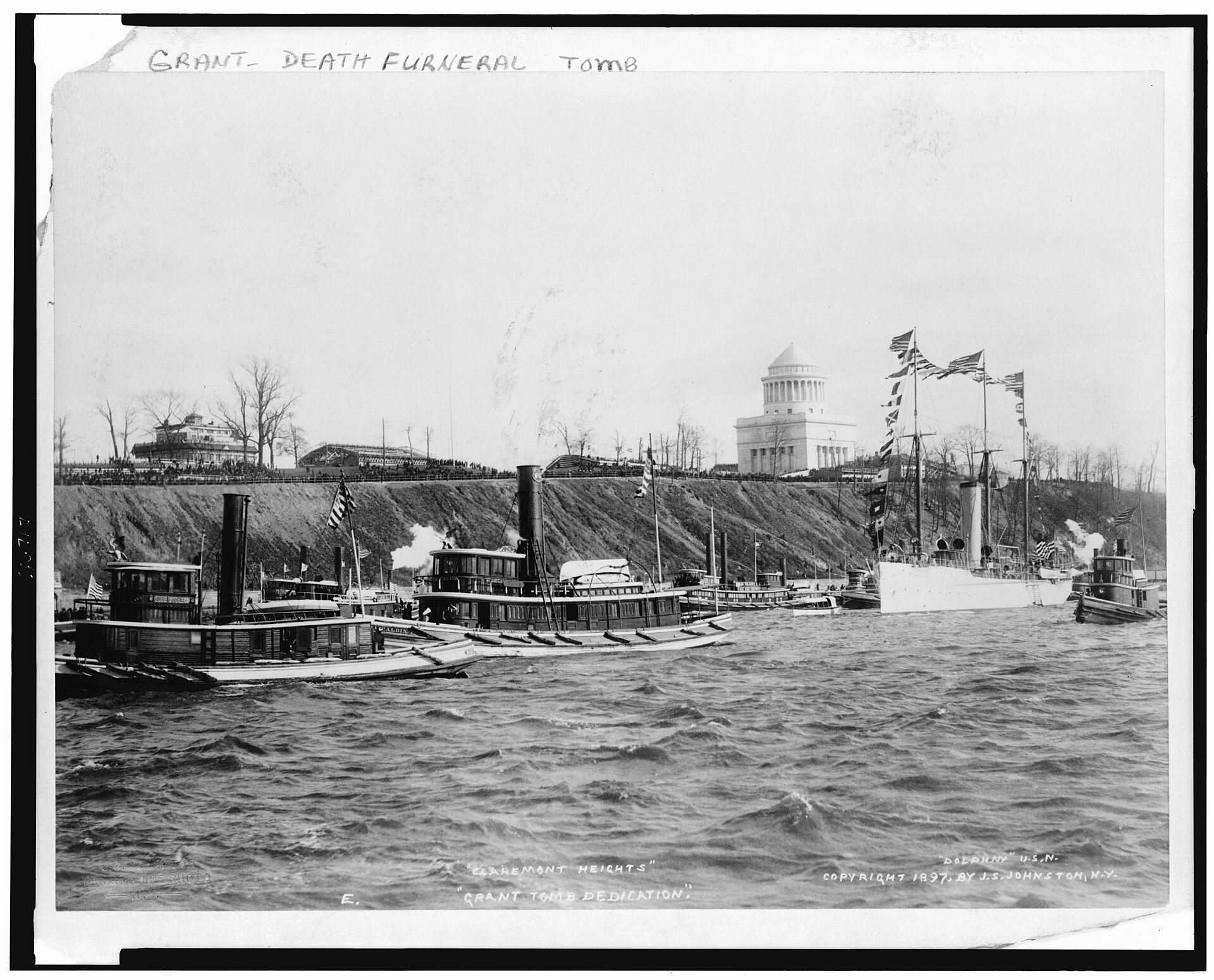
Dedication day, April 27, 1897: the finished tomb on the Riverside bluff, seen from the Hudson with naval vessels below. Photograph by J.S. Johnston, via the Library of Congress and Wikimedia Commons. Public domain.
What happened on dedication day?
New York threw itself one of the great civic days in its history. The state legislature made April 27, 1897 a holiday in the city-area counties. Grant's remains had been placed in his sarcophagus ten days earlier, and two days before the ceremony an estimated 200,000 people filed through the finished monument. Despite foul weather, roughly one million spectators turned out, and more than 50,000 marchers paraded six miles up from Madison Square Park. The next day, ten to fifteen thousand people filed through the building. In its first eight months the tomb drew 560,000 visitors, and for years it outdrew the Statue of Liberty, peaking around 600,000 visitors in 1906. Julia died on December 14, 1902, and was placed in the matching sarcophagus the following week.
What is inside the monument?
The main level is laid out as a Greek cross, with four barrel-vaulted exhibition spaces off a domed center. Below, in a sunken crypt ringed by a balustrade, sit the twin sarcophagi of red Wisconsin granite. Around the crypt stand busts of five Union generals, designed by William Mues and Jeno Juszko as a WPA Federal Art Project in the late 1930s. That decade brought the building's most thorough makeover: WPA laborers relaid marble floors, renovated the roof, and installed two battle-map murals by Dean Fausett, while two eagle statues salvaged from the old New York City Post Office went up outside and Louis Comfort Tiffany's earlier purple window glass was swapped for amber. The whole project, finished by 450 WPA workers in January 1939, cost either $300,000 or $450,000 depending on the account, with the monument association paying about $90,000 of it.
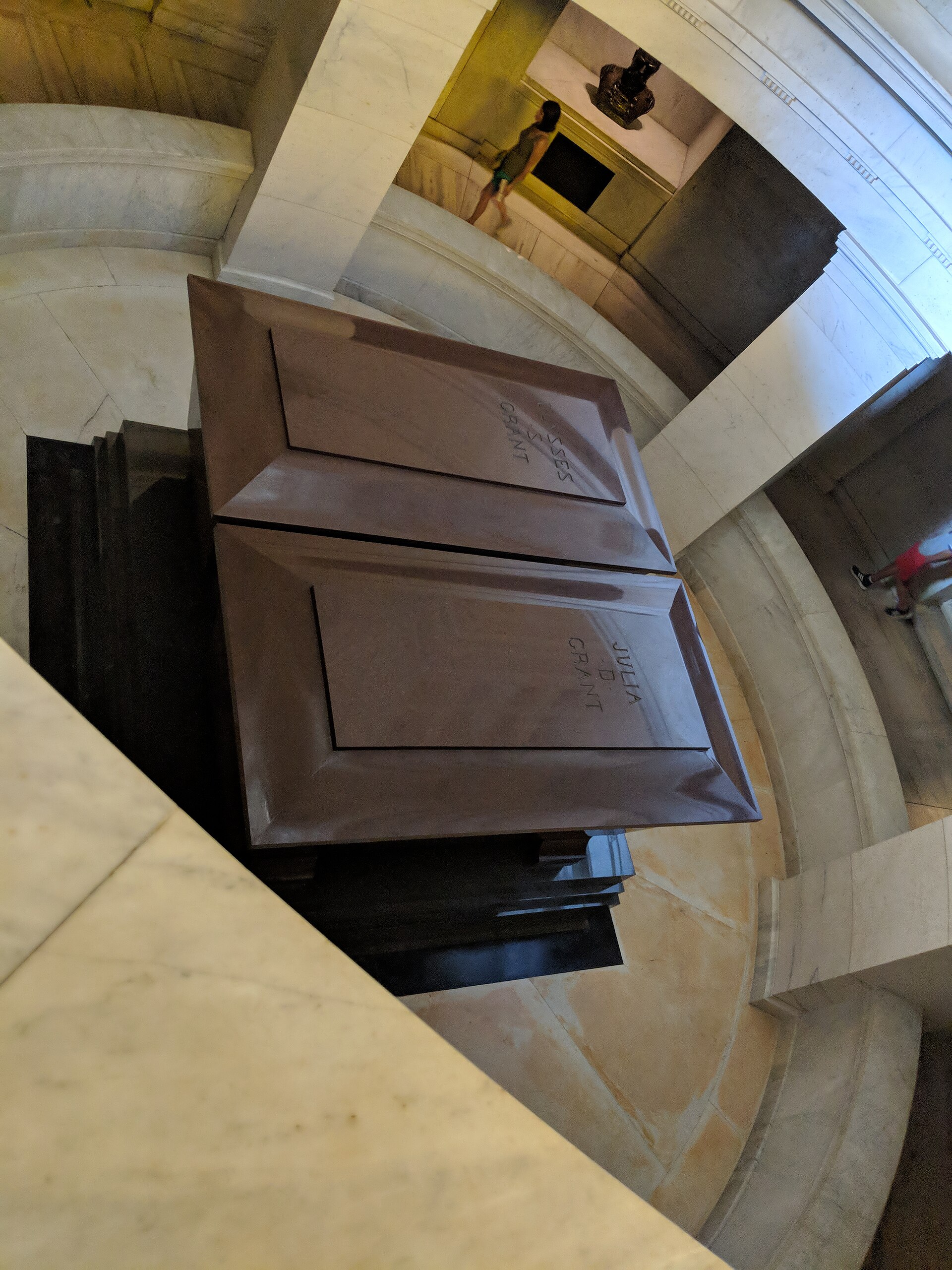
The sarcophagi of Ulysses and Julia Grant in the crypt, the trick behind the riddle: the Grants are entombed above ground, not buried. Photo by Kalfatovic, via Wikimedia Commons. Creative Commons Attribution-Share Alike 4.0.
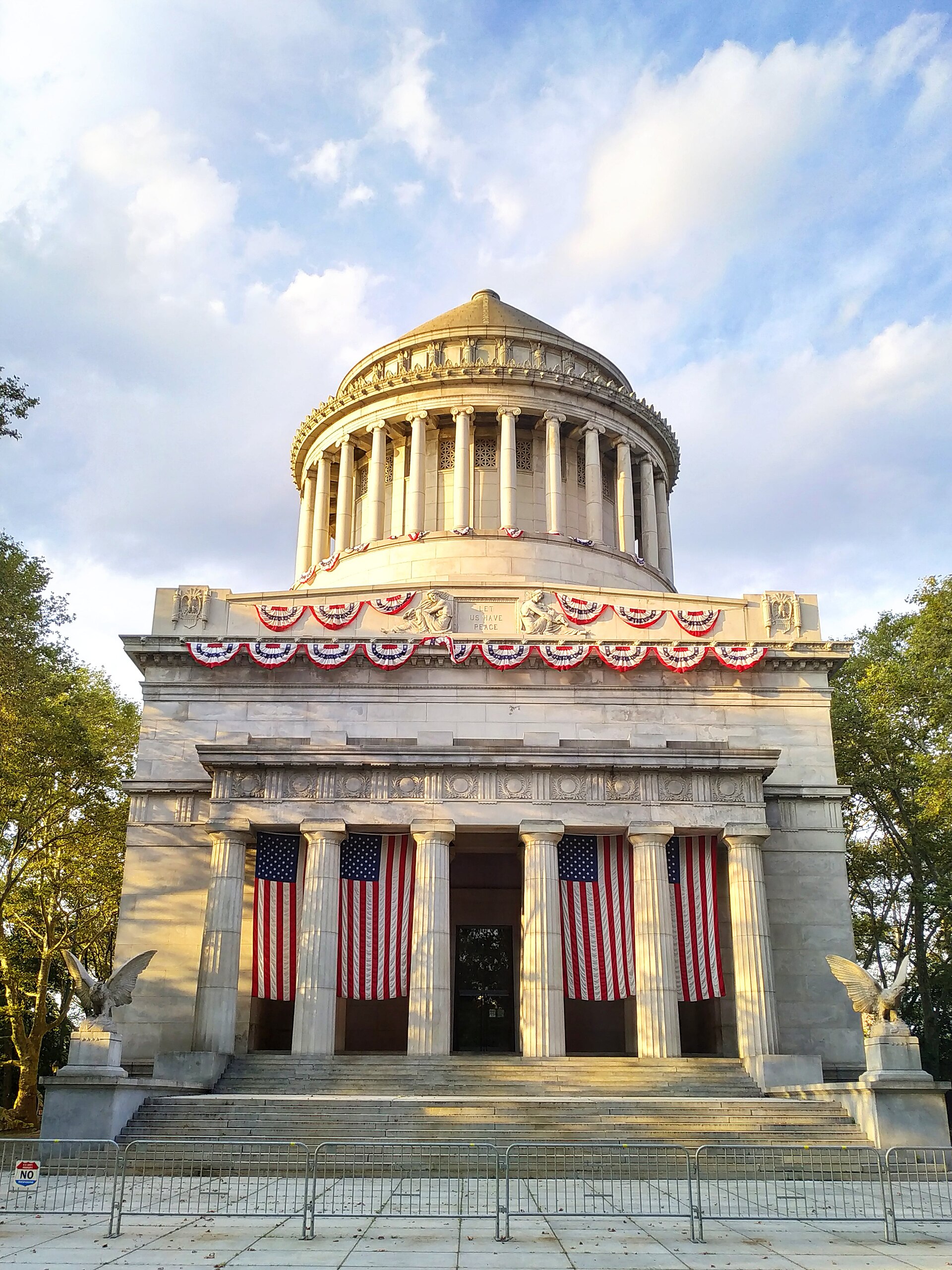
The memorial from Riverside Park, a block west. Photo by Shoobydooba, via Wikimedia Commons. Creative Commons Attribution-Share Alike 4.0.
How did the tomb fall apart, and who saved it?
How bad did the decline get?
The numbers track the neglect. The memorial drew about 300,000 visitors a year in the mid-1960s, roughly 120,000 when it was added to the National Register of Historic Places in 1966, 95,300 by the end of that decade, and just over 35,000 in 1979, its low point. Through the 1970s and 1980s the building was vandalized regularly; the eagle statues outside were damaged so often that the Park Service kept spare beaks in stock for replacements. By the 1980s the entire staff was two janitors and one person handing out pamphlets, guided tours were gone, the upper level was closed for lack of staff, and funding cuts forced Sunday closures starting in 1986. Preservationists estimated 40,000 visitors a year in 1993, even as the agency claimed 100,000. Newspapers described the monument as a frequent site of drug use and muggings, and the Washington Post found that many tourists no longer knew whose tomb it was. The pressure that finally worked was legal and political at once: in March 1994 the Illinois General Assembly voted to ask that the tomb be restored or the Grants' remains moved to Illinois, a month before Scaturro and Deitz filed their suit, while Ohio politicians pushed their own claim and bills to fund a restoration moved through Congress. The Park Service first requested $850,000; a House plan offering up to $375,000 was attacked by Scaturro and Deitz as insufficient before the full $1.8 million was appropriated. During the work, the agency tried to disassemble the mosaic-tile Rolling Bench around the plaza, the 1970s artwork by Pedro Silva built with neighborhood volunteers, and kept it only after protests.
The federal government took the monument over in the late 1950s: Congress approved the transfer, President Eisenhower signed it in August 1958, and the National Park Service assumed operations on May 1, 1959, renaming it the General Grant National Memorial. The association formally dissolved in 1965, spending its last $9,095.50 on a model of the equestrian statue that had been planned and canceled repeatedly since the 1920s and was never built. By the 1970s the tomb was in deep trouble: graffiti that cost $11,000 a year to remove, muggings, a leaking roof, Sunday closures after 1986, and visitation that bottomed out near 35,000 in 1979. The city designated the facade and interior a landmark in 1975, but the decline continued into the 1990s, when a photo of the wrong person reportedly hung in place of a stolen picture of Grant. The rescue came from a volunteer. Frank Scaturro, a Columbia student and volunteer ranger, spent two years sending the Park Service weekly memos, then issued a 325-page whistleblower report in 1993 and was fired for it; Grant's descendants called him a hero. Illinois, Ohio and Congress all floated taking the remains away, and Scaturro and Grant descendant Ulysses Grant Deitz sued the agency. Under that pressure, $1.8 million was appropriated, the facade was cleaned, the roof replaced, exhibits rebuilt, and the memorial was rededicated on April 27, 1997, its centennial. Visitation has recovered since; the Park Service recorded 63,152 visitors in 2025.
Who owns and runs Grant's Tomb?
The United States government. The National Park Service has operated the memorial since 1959, and the site is federal land ceded by the city. The agency staffs the visitor center, maintains the building, and sets the opening hours. The reborn Grant Monument Association that Scaturro established advocates for the memorial but plays no role in running it.
Where can you eat or drink at Grant's Tomb?
Nothing is sold inside the memorial; food and drink are not permitted near the sarcophagi. The monument sits in a residential university neighborhood, and the nearest options are a few blocks south around Broadway and Amsterdam Avenue: Community Food & Juice, the farm-to-table spot near 113th and Broadway; Tom's Restaurant at Broadway and 112th, the diner whose facade played Monk's in Seinfeld; the Hungarian Pastry Shop on Amsterdam near 111th, a decades-old Columbia institution; and New Absolute Bagels on Broadway near 108th, the bagel shop long known as Absolute Bagels before its 2026 name change. Neighborhood listings here were read on the official shop sites and local reporting on October 25, 2026.
Sources
- National Park Service, General Grant National Memorial
- National Park Service, Operating Hours & Seasons
- Wikipedia, General Grant National Memorial
- The Hungarian Pastry Shop
- Community Food & Juice
Visiting Grant's Tomb
- Address: Riverside Drive at West 122nd Street, Morningside Heights, Manhattan. The 1 train stops at 116th Street-Columbia University and at 125th Street, and Riverside Park is a block west.
- Hours: As read on the National Park Service page on October 25, 2026: the mausoleum, the visitor center and overlook pavilion, and the main plaza are open Wednesday through Sunday, 10 a.m. to 4 p.m. The memorial is closed Mondays and Tuesdays, with separate federal-holiday exceptions listed by the Park Service.
- Admission: Free; this is a national memorial with no ticketed entry.
- Don't miss: The view down into the crypt and its twin sarcophagi, the WPA-era battle murals, the Union generals' busts, the salvaged post office eagles outside, and the mosaic-tile Rolling Bench that curves around the plaza, a 1970s artwork the Park Service tried to remove and kept after protests.
Hours and visitor facts above come from the National Park Service pages for the memorial, read on October 25, 2026.