The Morgan Library & Museum: J.P. Morgan's Marble Masterpiece on Madison Avenue
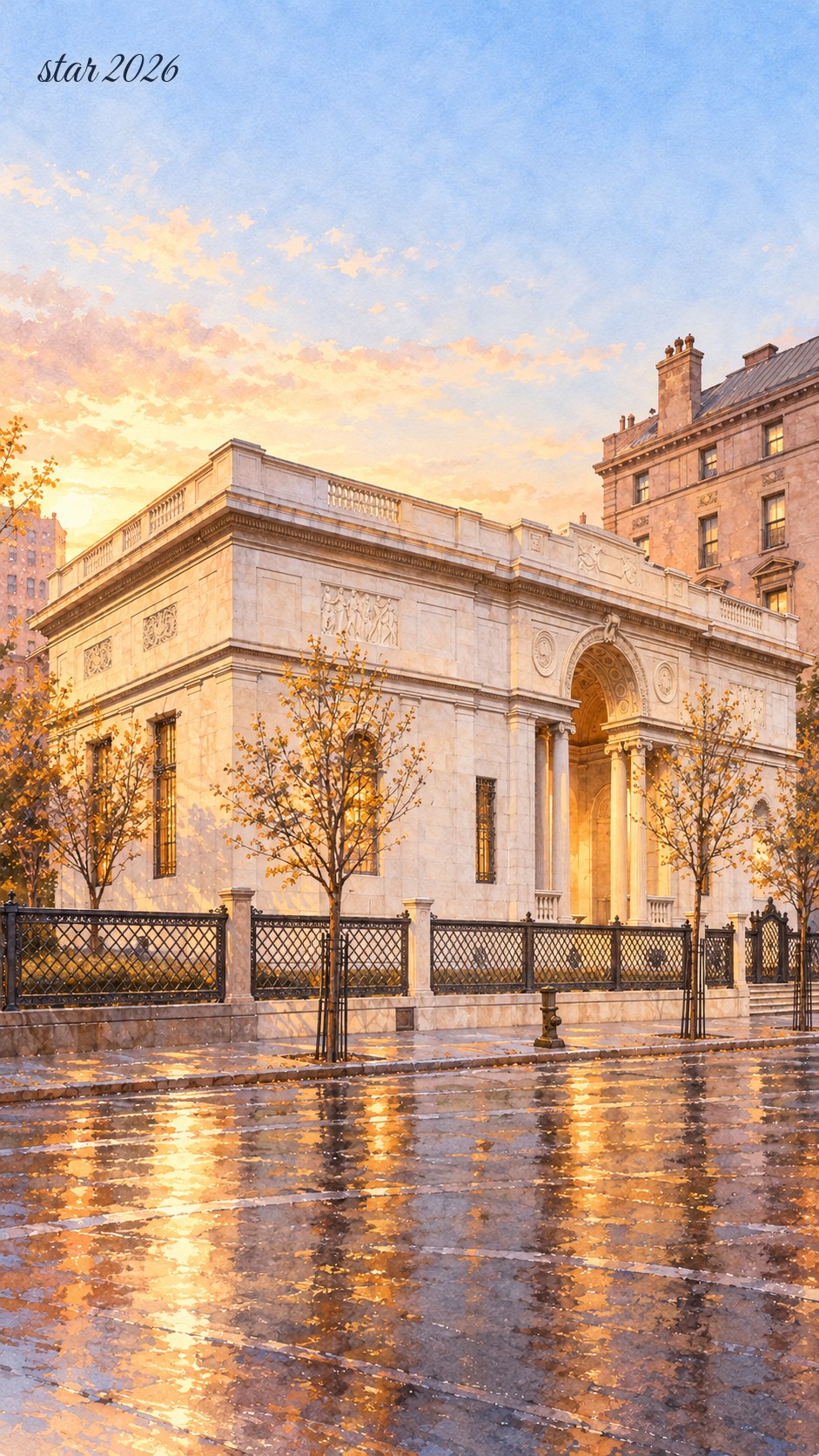
An original watercolor illustration of the Morgan Library & Museum, painted from a public-domain historical photograph - a stylized illustration, not a photograph. Signed star 2026.
A block from the noise of Midtown, where Madison Avenue meets 36th Street, stands a small marble palace that one of the most powerful bankers in America built for his books. The financier J. Pierpont Morgan spent a fortune collecting rare manuscripts, drawings and art, and in 1903 he commissioned Charles Follen McKim to give the collection a home worthy of it. The result, completed in 1906, is a building the Landmarks Preservation Commission has called McKim's masterpiece. Morgan's son opened the library to the public in 1924, and the campus has kept growing ever since, most dramatically in 2006, when Renzo Piano threaded new steel-and-glass pavilions between the old marble ones. Here is how the Morgan came to be, and who owns it today.
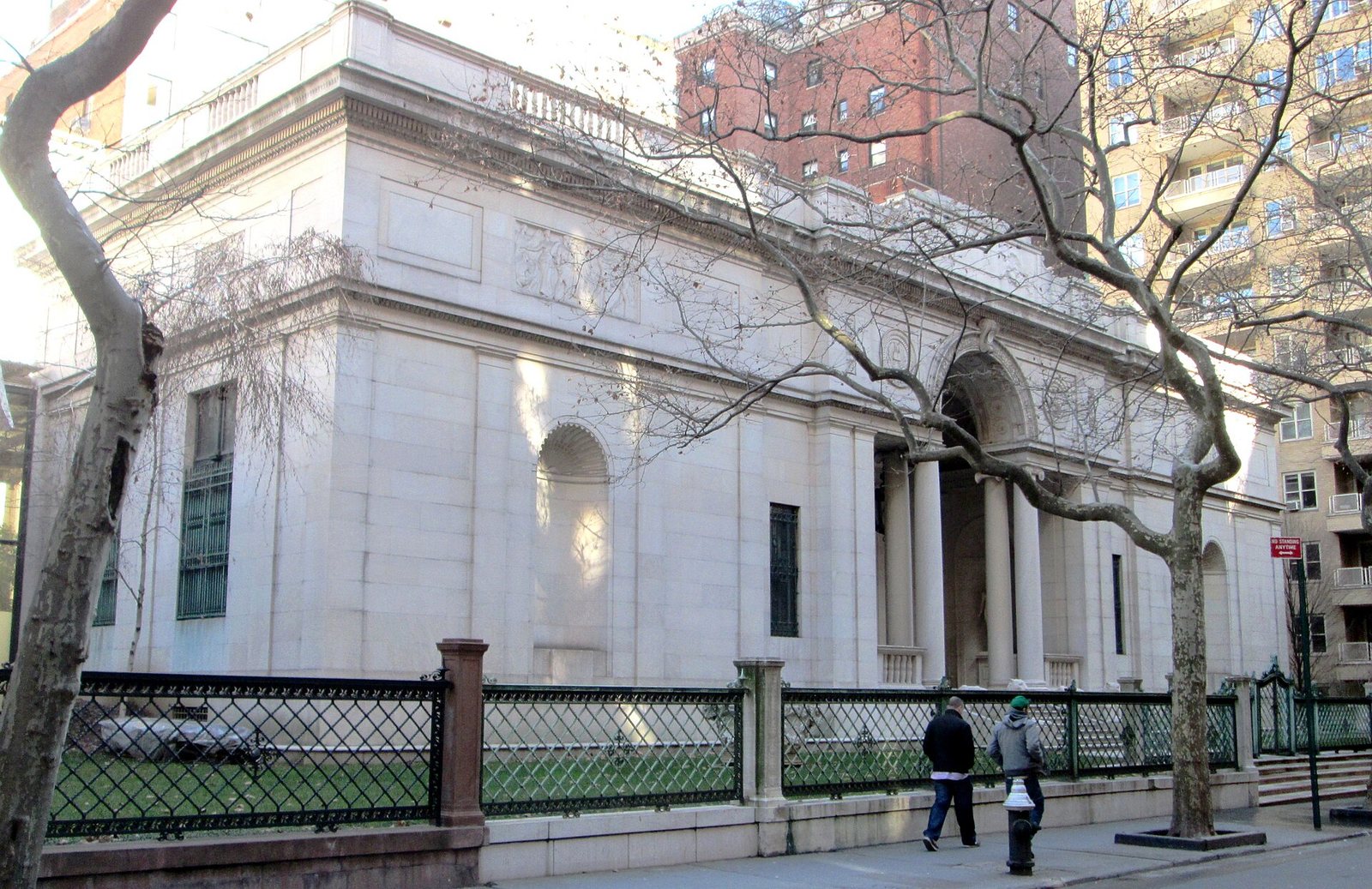
Charles Follen McKim's 1906 library building on East 36th Street. Photograph by Beyond My Ken, via Wikimedia Commons. CC BY-SA 4.0.
Why did J.P. Morgan build a library?
John Pierpont Morgan, born in 1837 into two old New England families, was an internationally known banker and financier, and by the turn of the twentieth century he was collecting on a scale that outgrew his brownstone at the corner of Madison Avenue and 36th Street. Medieval and Renaissance manuscripts, early printed books, drawings, paintings and sculpture filled the house, and Morgan decided the collection needed a building of its own. He commissioned McKim, Mead & White in 1903, and Charles Follen McKim took the project personally. The library was completed in 1906 in the Italian Renaissance style, slightly raised above the sidewalk behind a lawn, a fine fence and entrance gates, so that it reads as a small Renaissance palazzo dropped into Murray Hill.
The commission produced what many consider the firm's most refined work. Designating the building's exterior on May 17, 1966, in one of the earliest actions under the city's new landmarks law, the Landmarks Preservation Commission wrote that the original library is "considered Charles Follen McKim's masterpiece," and praised its central Palladian motif and its calm, beautifully detailed marble facades. The commission also noted that the library appears in publications far more often than the later Annex, simply because it is the more striking building of the two.
Who was J.P. Morgan?
John Pierpont Morgan (1837-1913) was born into two old New England families: his father, Junius Spencer Morgan, was an international banker and a London partner of George Peabody & Co., and his mother, Juliet Pierpont, was the daughter of the Reverend John Pierpont, a poet, reformer and abolitionist preacher. Educated in Vevey, Switzerland, and at the University of Göttingen, Morgan entered his father's firm, came to New York as the American representative of George Peabody & Co., and had his own banking house by 1864. When his firm became J.P. Morgan & Co. in 1895 it was one of the most powerful banking houses in the world; Morgan reorganized much of the nation's railroad system after the panic of 1893, and in 1901 he organized the United States Steel Corporation, then the largest corporation in the world.
His collecting began modestly, with autographs, and he did not buy extensively until after his father's death in 1890. Aided and stimulated by his nephew Junius S. Morgan, a connoisseur of books, prints and manuscripts, the collection then grew very rapidly into the library that needed a building.
What makes the interiors landmarks too?
McKim built the walls of the principal rooms from Tennessee marble blocks laid with dry joints, fitted together without mortar, a feat of masonry the landmarks commission singled out when it made the entrance hall, East Room and West Room one of its early interior-landmark designations on March 23, 1982. The painter Henry Siddons Mowbray covered ceilings and lunettes with Renaissance-inspired murals. Mowbray, born in Alexandria, Egypt, in 1858 to British parents and raised in Massachusetts, studied in Paris under Léon Bonnat and became one of the leading American muralists of his day; he received the Morgan contract on May 12, 1904, and modeled his entrance-hall program on Raphael's ceiling in the Vatican's Stanza della Segnatura and on the Villa Madama in Rome, choosing themes that allude to the collection itself, from Arthurian romance to the Divine Comedy. and the lions flanking the entrance steps were modeled by Edward Clark Potter, who went on to create the famous lions of the New York Public Library. The commission's interior report describes the library as evoking the turn-of-the-century ideal of the unity of the arts, and calls the collection it houses one of the foremost of its kind, unsurpassed in the Western Hemisphere and comparable in diversity and quality to major European collections.
Opening off the entrance hall, with its marble benches and freestanding marble columns carrying alabaster lamps, the East Room is the showpiece: triple tiers of wooden bookcases behind grilled doors line the walls, with projecting balconies for the upper tiers, a massive Italian Renaissance fireplace hung above with a sixteenth-century Flemish tapestry, and a groin-vaulted ceiling whose eighteen lunettes alternate female muses with portraits of civilization's leaders, from Caxton and Dante to Michelangelo. Mowbray studded the spandrels with zodiac signs, and curator William Voelkle's research showed they were not generic: the Aries and Gemini signs over the entrance coincide with the dates of Morgan's birth and his marriage to Frances Louise Tracy. The West Room, designed as Morgan's own study, has been called by the architectural historian Wayne Andrews "one of the great achievements of American interior decoration."
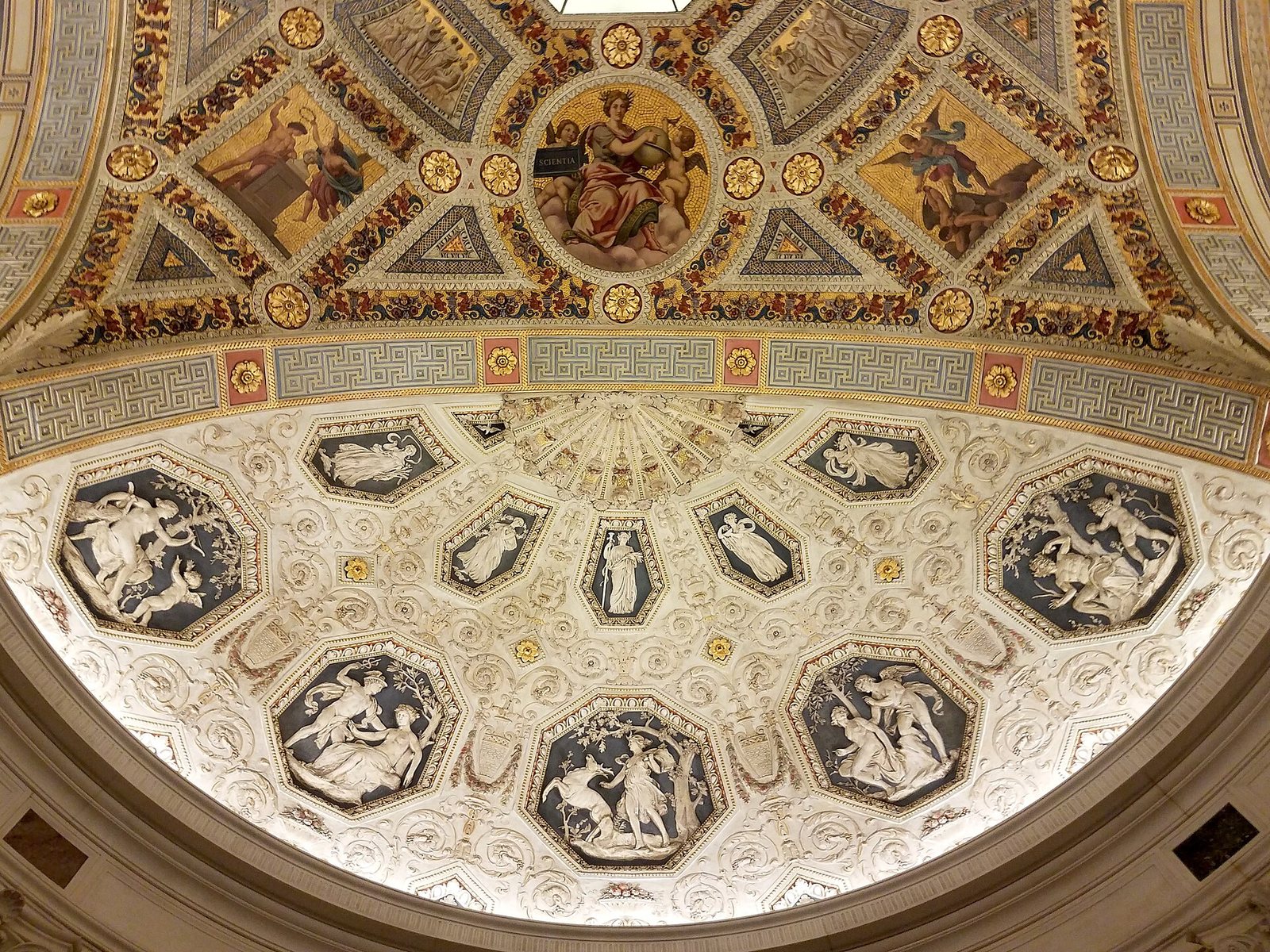
The rotunda ceiling, part of the landmark interior. Photograph by Francis Helminski, via Wikimedia Commons. Public domain.
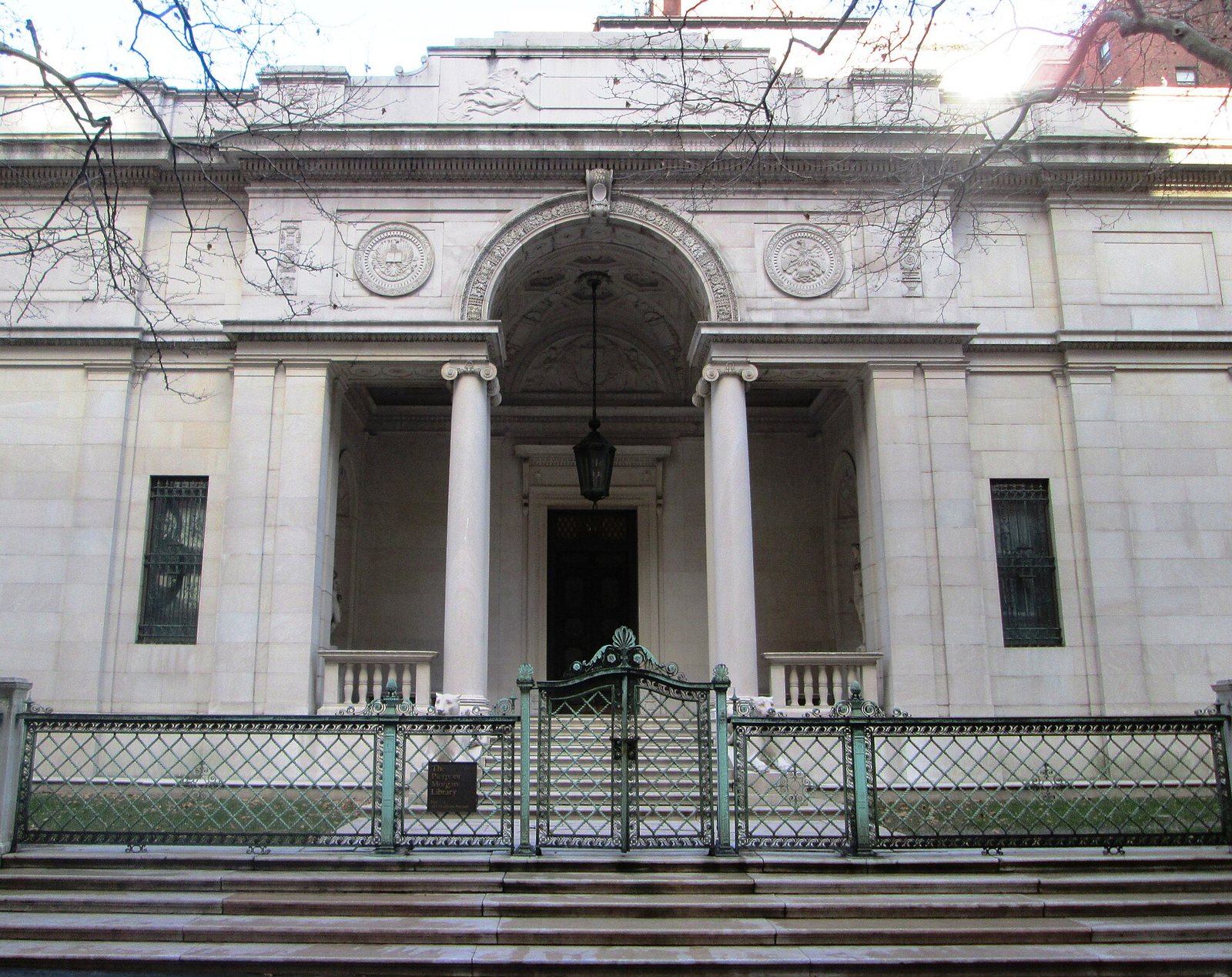
The entrance front of the 1906 library. Photograph by Beyond My Ken, via Wikimedia Commons. CC BY-SA 4.0.
How did a private library become a public museum?
Morgan died in 1913, leaving the library and its collection to his son. In 1924, J.P. Morgan Jr. opened the collection to the public as a memorial to his father, transforming the private library into a public institution, a role it has kept for a century since. As the library grew to include more manuscripts and drawings, space ran short, and twenty-two years after the original building rose, in 1928, the Annex was completed next door, on the site of the elder Morgan's demolished residence, designed by Benjamin Wister Morris in a Florentine Renaissance manner that harmonized with McKim's building without copying any of its detail, a piece of architectural manners the landmarks commission praised as accomplished "with rare perception." Though connected at the rear, the two buildings still read from the street as separate palazzi.
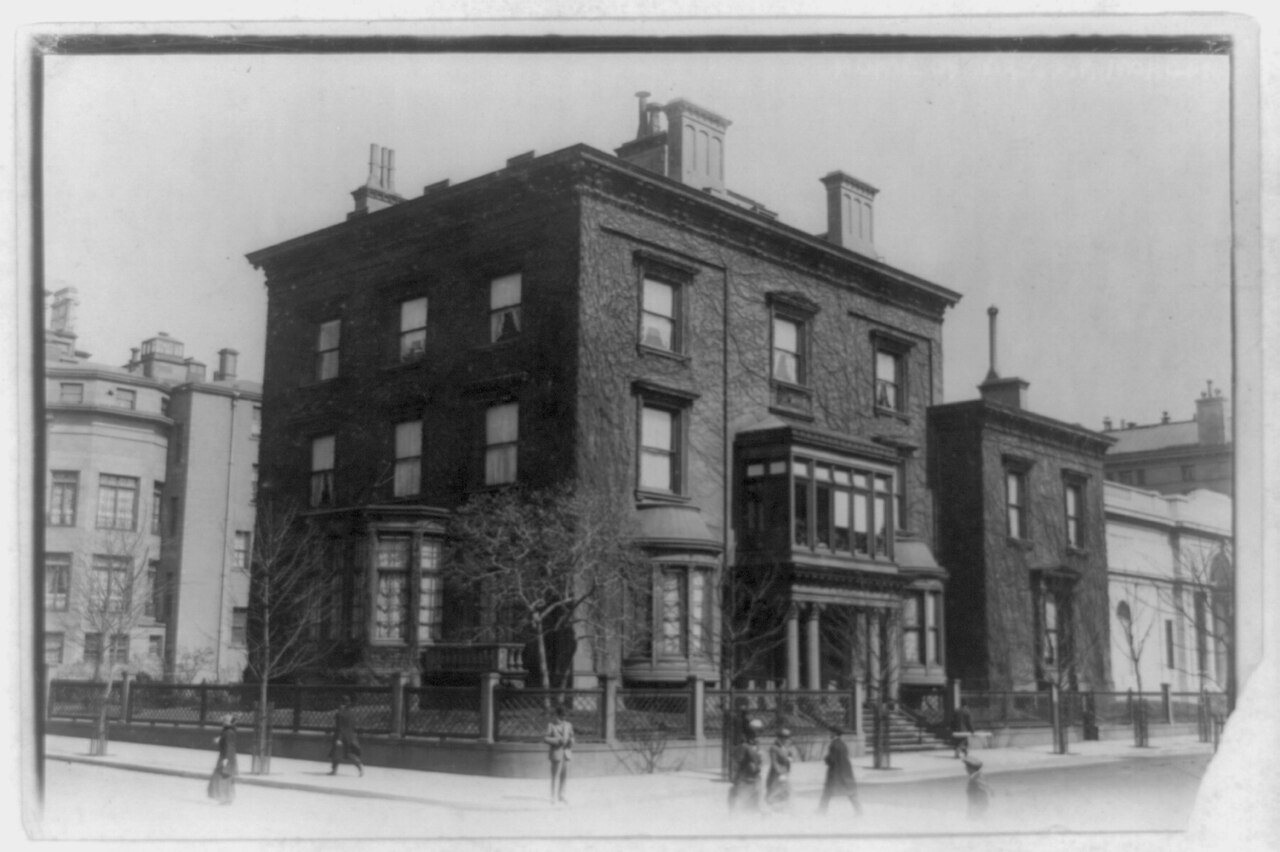
The elder Morgan's residence at 219 Madison Avenue, later replaced by the 1928 Annex. Photograph by the Bain News Service, via Wikimedia Commons. Public domain.
The campus kept growing around them. In 1988 the institution acquired the Morgan House, the mid-nineteenth-century brownstone at Madison Avenue and 37th Street that had been J.P. Morgan Jr.'s home. In 1991, Voorsanger & Associates added the Garden Court, a glass-roofed court joining the buildings. Then, in 2006, the Renzo Piano Building Workshop expansion gave the museum a new Madison Avenue entrance, new galleries and a soaring central court, tying the historic structures into a single complex. A restoration of McKim's landmark interiors followed in 2010.
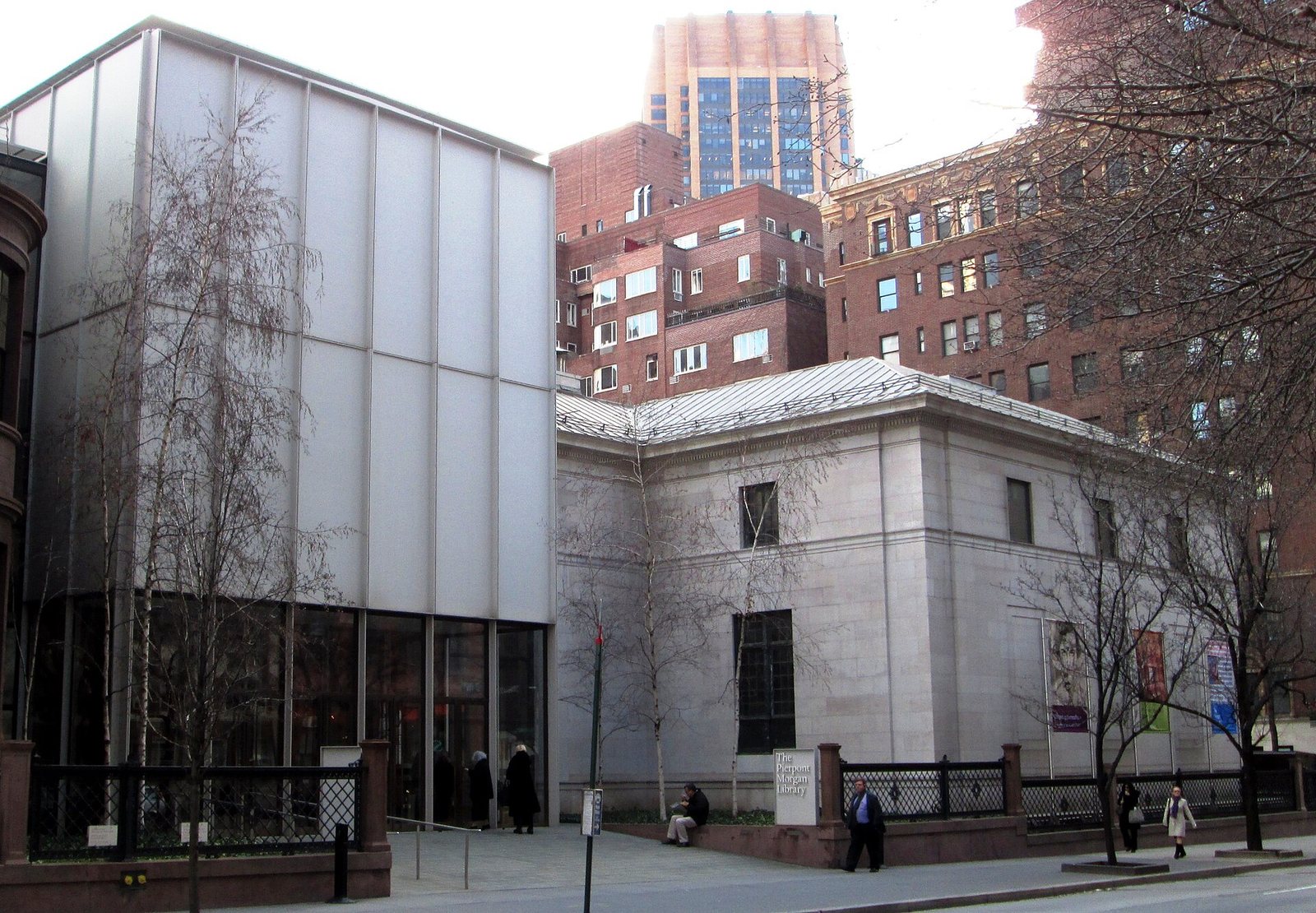
Renzo Piano's 2006 pavilions beside the 1928 Annex. Photograph by Beyond My Ken, via Wikimedia Commons. CC BY-SA 4.0.
What is the Morgan today?
The institution that grew out of one man's library is now part museum and part research library, in the landmarks commission's words "a lasting legacy of the taste and judgment of J. Pierpont Morgan and his successors." It describes itself as an independent research library, and it mounts exhibitions drawn from and inspired by the collection Morgan assembled, in galleries that range from McKim's landmark rooms to Renzo Piano's glass pavilions. Scholars still come to work with the manuscripts and rare books, and the public still enters, as it has since 1924, through the gates on 36th Street.
Who owns the Morgan Library & Museum today?
Unlike the big museums that occupy city-owned buildings, the Morgan answers simply: it belongs to itself. The Morgan Library & Museum is an independent research library and museum, a private nonprofit institution that owns its landmark complex and the collection inside it, governed by its own board and supported by admissions, memberships and donations rather than by City Hall. It has been a public institution since 1924, but it has never been a city agency, and the Madison Avenue campus remains private property in private nonprofit hands.
Where can you eat or drink at the Morgan?
The museum operates the Morgan Café for visitors, with seasonal menus, coffee and light meals; current offerings and hours are listed on the Morgan's visit page.
Sources
- NYC Landmarks Preservation Commission, The Pierpont Morgan Library and Annex (LP-0239), May 17, 1966
- NYC Landmarks Preservation Commission, Pierpont Morgan Library, First Floor Interior (LP-1119), March 23, 1982
- The Morgan Library & Museum, Architecture
- The Morgan Library & Museum, The Morgan House
- Encyclopaedia Britannica, Pierpont Morgan Library
- The Morgan Library & Museum, Plan Your Visit
Visiting the Morgan Library & Museum
- Address: 225 Madison Avenue, at 36th Street, Manhattan.
- Hours: Tuesday through Thursday and weekends, 10:30 a.m. to 5 p.m.; Fridays until 8 p.m.; closed Mondays.
- Tickets: Admission is charged, with discounts for seniors and students and free entry for children under 12; current prices are on the visit page.
- Food: The Morgan Café inside the museum.
Facts above were read on the official pages on November 2, 2026. Hours, ticket rules and café openings change, so confirm on themorgan.org before you go.