Jefferson Market Courthouse: The Village Gem That Became a Library
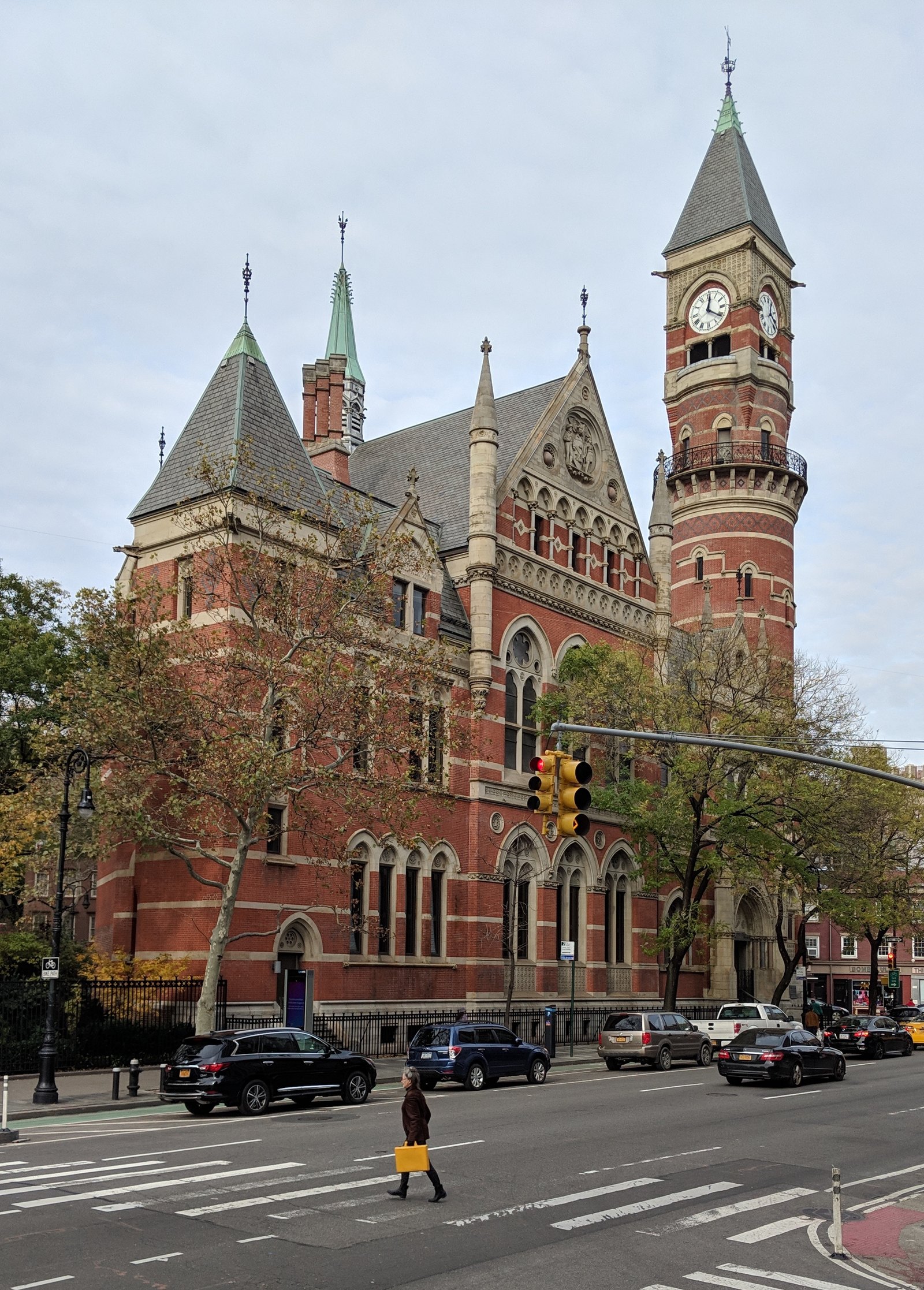
The former Jefferson Market Courthouse, now the Jefferson Market Library, in 2018. Photograph by M. M. Dwyer, via Wikimedia Commons. CC BY-SA 4.0.
The wedge of land where Sixth Avenue meets Greenwich Avenue and West 10th Street has served Greenwich Village for nearly two centuries. A market opened there in 1833, named for Thomas Jefferson, with food sheds, a police court, a volunteer firehouse and a jail. A tall wooden fire lookout tower stood over the sheds, and court sessions were held in rooms above the market.
Replacing all of that took a scandal first. The idea of a new courthouse on the site began in Albany as one of the many pork-barrel bills of the Tweed political machine, the National Park Service recounts. By the autumn of 1873 some $150,000 had been appropriated and spent, and the city had only a rotting pile of building materials to show for it. New commissioners appointed in 1874 took the advice of Andrew Green, the city comptroller, threw out the old scheme and hired a new architect.
The commission went to the firm of Vaux and Withers, but Calvert Vaux was busy with the American Museum of Natural History and the Metropolitan Museum of Art, so the design fell to his partner, the English-born Frederick Clarke Withers. The courthouse, the fire and bell tower at the corner, and a five-story prison behind a high wall on Greenwich Avenue went up between 1874 and 1877, at a cost of rather less than $360,000, not counting the architects' fees. Market buildings designed by Hogan and Hogan followed in 1883.
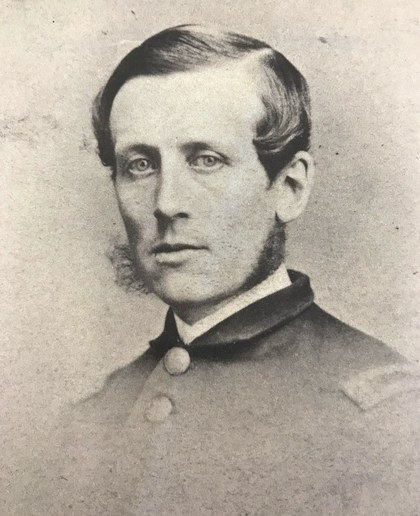
Withers worked in the High Victorian Gothic manner, in what the Park Service calls the "Venetian" or "Ruskinian" style: red Philadelphia brick laid in Flemish bond, trimmed with granite and with stone from Berlin, Ohio, under a picturesque jumble of gables, mansards and pyramidal roofs. The carving, directed by William Simon, crowds the entrance portal and the gables; the tympanum over the main window shows the trial scene from Shakespeare's Merchant of Venice, and the state seal fills the main gable. At the foot of the bell tower sits a fountain carved with a weary traveler and a pelican. A lookout in the tower, reached by its own spiral stair, stood 98 feet above the sidewalk, high enough to watch for fires over every roof in the neighborhood.
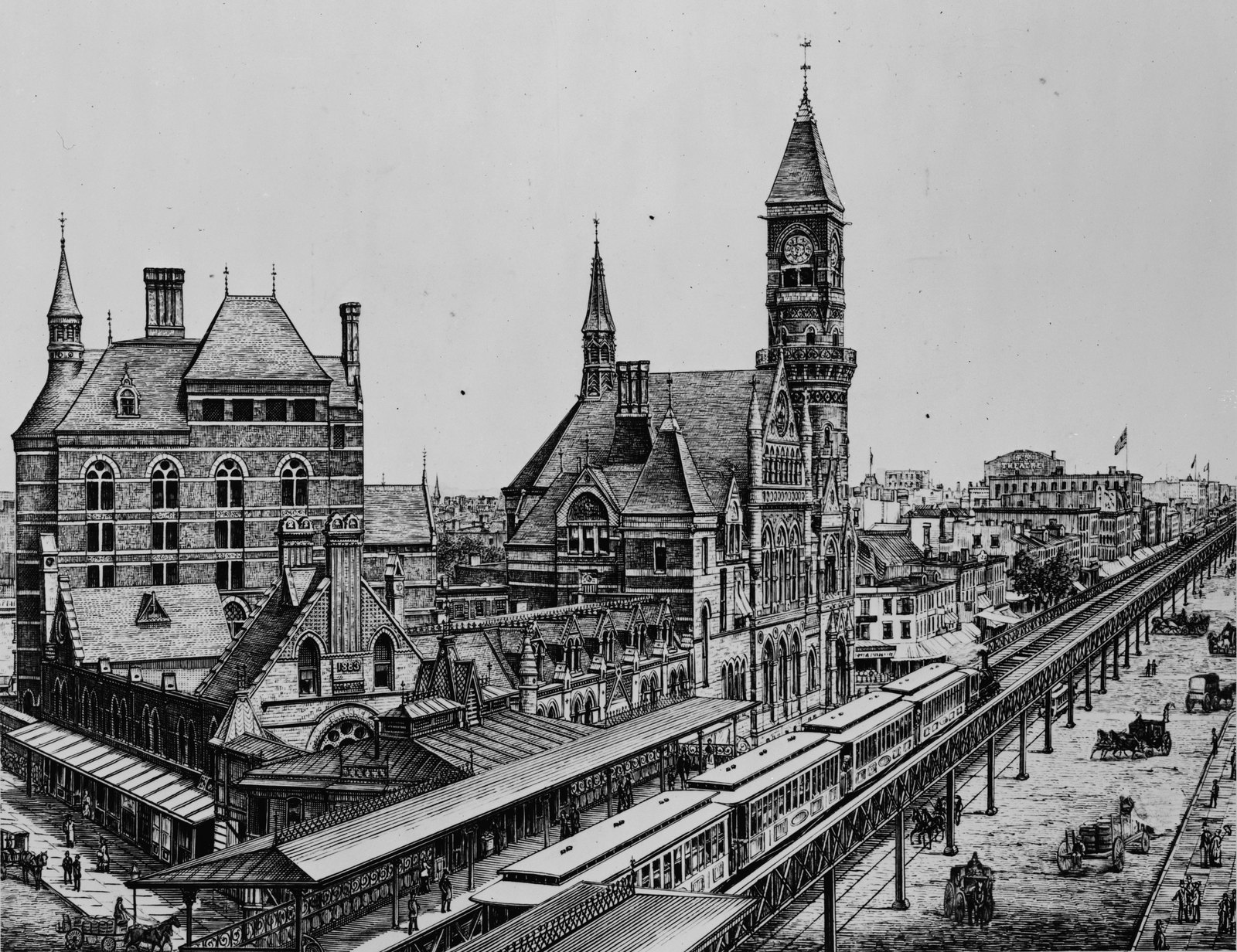
The courthouse looking north along Sixth Avenue, about 1880. Historic American Buildings Survey photocopy, courtesy of the New-York Historical Society. Library of Congress. Public domain.
The Village approved of the result. In 1885, when the readers of American Architect and Building News voted on the best ten buildings in the country, they placed the Jefferson Market Courthouse fifth, ahead of every other New York building but two. The courthouse did heavy duty, too: the Third Judicial District covered the city's entertainment district, and the building held a police court on the ground floor, a civil court above, and cells for prisoners on their way to trial.
The complex around it changed with the neighborhood. In 1931 the old prison was replaced by the eleven-story Women's House of Detention, which towered over the courthouse; neighbors remembered inmates shouting from its windows to friends on the street below. By 1945 the court itself had left, and by 1959, in the words of the New York Public Library, the building was home only to pigeons and rats. The city planned to knock it down and put up an apartment building.
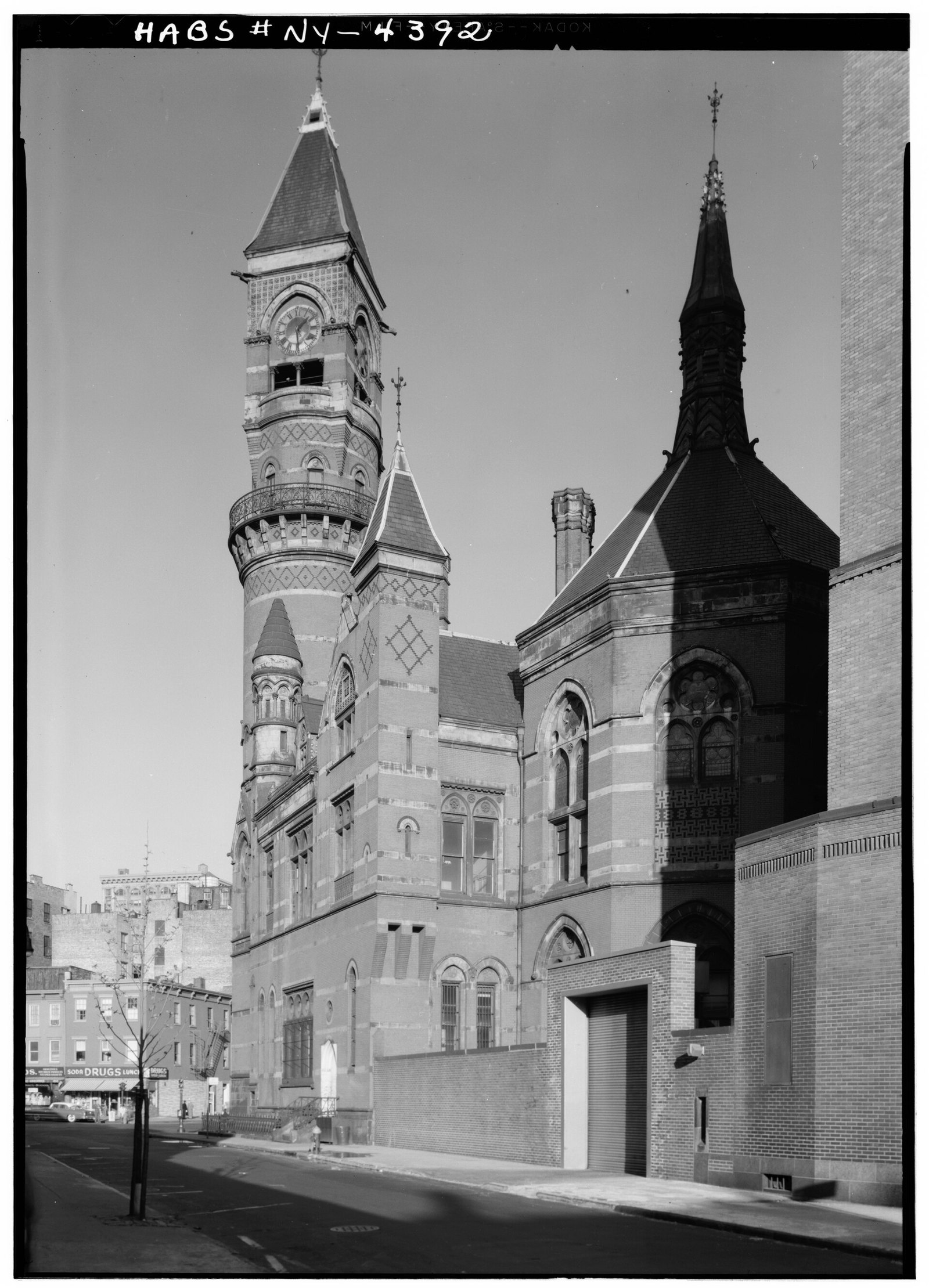
The courthouse in 1960, near its lowest point. Photograph by Cervin Robinson for the Historic American Buildings Survey. Library of Congress. Public domain.
The neighbors had other ideas. Villagers led by Margot Gayle and Philip Wittenberg, with supporters including Lewis Mumford, the poet E. E. Cummings, who lived across the street in Patchin Place, and the actor Maurice Evans, rallied to save the building. One committee of neighbors took as its first goal simply getting the tower clock running again; the clock was electrified in 1961. That same year Mayor Robert F. Wagner announced that the courthouse would be preserved and converted into a public library. The architect Giorgio Cavaglieri, who had adapted the Astor Library into the Public Theater, cleaned the brick, cut new windows and fitted a modern library inside the Victorian shell. Construction began in 1965, and the Jefferson Market Branch of the New York Public Library formally opened on November 27, 1967 - the old police court becoming the Children's Room, the civil court the Adult Reading Room. Among its first visitors was the poet Marianne Moore, who pronounced the renovation very pleasing.
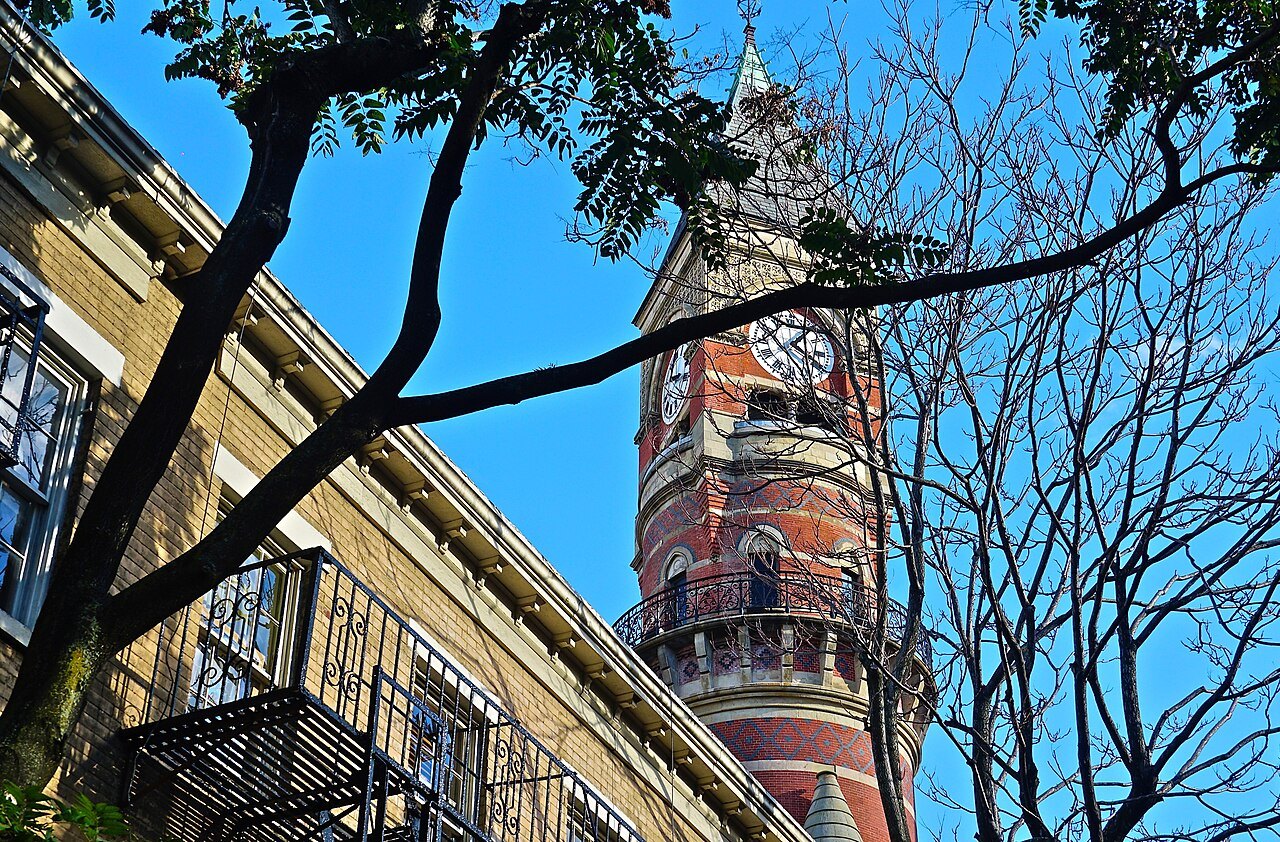
The clock tower from Patchin Place, E. E. Cummings’s old street, in 2018. Photograph by Jntman5621, via Wikimedia Commons. CC BY-SA 4.0.
Who owns Jefferson Market Courthouse today?
The City of New York does, as it has since the courthouse was built; the National Park Service's landmark nomination lists the city as the owner. The New York Public Library runs the branch inside. The building was placed on the National Register of Historic Places in 1972 and made a National Historic Landmark in 1977, and it stands within the Greenwich Village Historic District, created in 1969. The Women's House of Detention next door did not survive the neighbors' campaign against it: the prison was demolished, and in the spring of 1975 the first flowers bloomed in Jefferson Market Garden on its site.
Of Withers's picturesque group - courthouse, tower, prison and market - only the courthouse remains. It has outlasted the Tweed machine, the night court, the pigeons and the wreckers, and it still does public business at the same corner, only quieter now.
Sources
- National Park Service, National Historic Landmark nomination (Third Judicial District Courthouse)
- The New York Public Library, "A History of the Jefferson Market Library"
- The New York Public Library, About the Jefferson Market Library
- Jefferson Market Garden, About Us
- Jefferson Market Garden, "America’s Fifth Most Beautiful Building in 1885"
- Wikimedia Commons, the courthouse by M. M. Dwyer (CC BY-SA 4.0)
- Wikimedia Commons, portrait of Frederick Clarke Withers (CC BY-SA 4.0)
- Library of Congress, HABS photocopy of the courthouse, c. 1880
- Library of Congress, HABS photograph by Cervin Robinson (1960)
- Wikimedia Commons, clock tower from Patchin Place by Jntman5621 (CC BY-SA 4.0)


