Is the Unisphere the Largest Globe in the World?
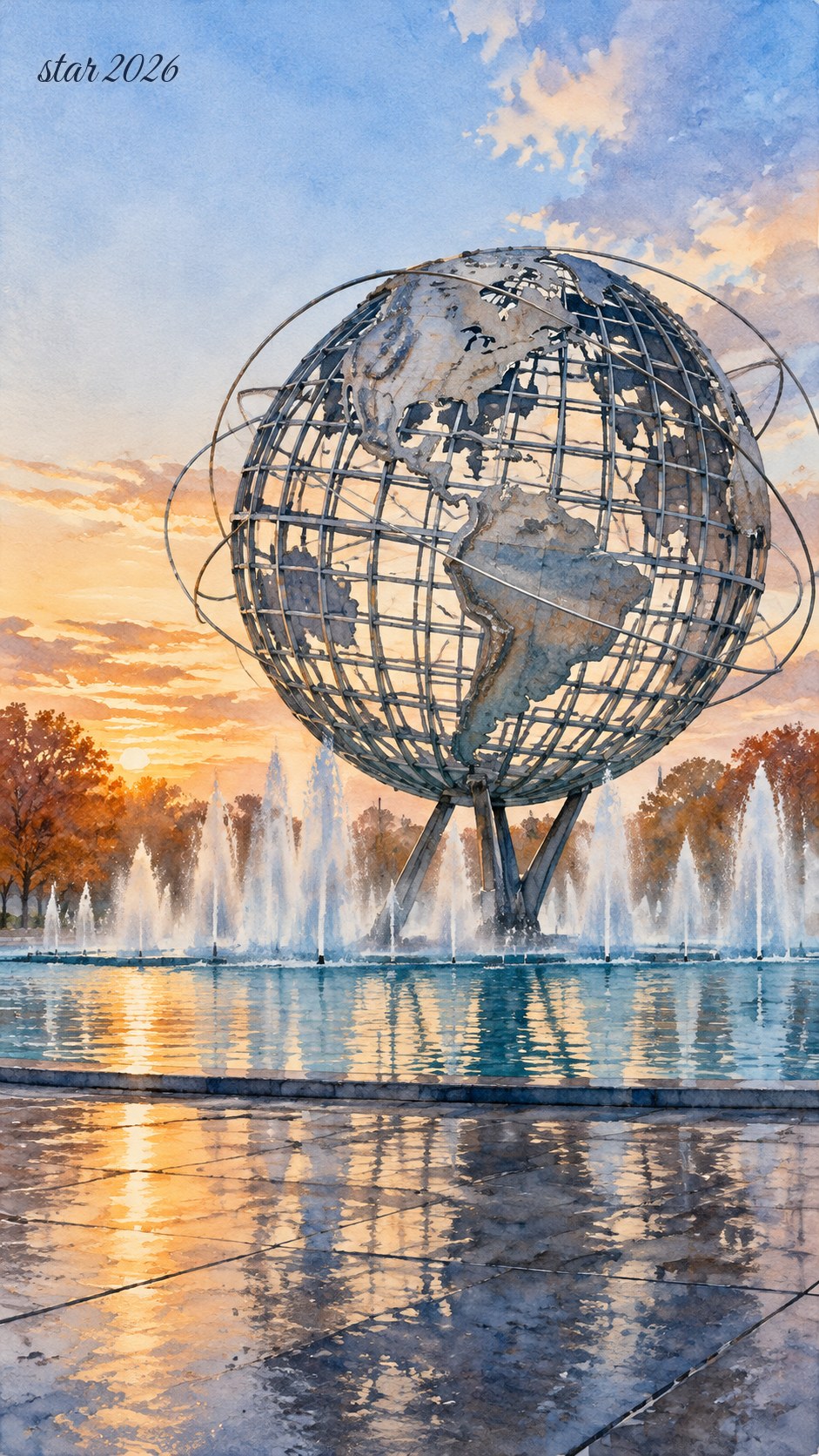
An original watercolor illustration of the Unisphere - a stylized illustration, not a photograph. Signed star 2026.
Ask the question and the answer takes a little untangling: the Unisphere in Flushing Meadows Corona Park, Queens, is a stationary openwork representation of the Earth in stainless steel, 120 feet across, and it does not turn. The hard numbers behind its scale come from its Landmarks Preservation Commission designation report: the sphere stands 140 feet high, measures 120 feet in diameter and weighs 700,000 pounds, assembled from more than 500 major structural pieces of stainless steel. It was built as the centerpiece and visual logo of the 1964-65 New York World's Fair, it has never moved, and it has outlasted almost everything else its fair built. Here is how a Queens dumping ground ended up with the fair's surviving icon, how its size compares with the globe that holds the official record, and who owns the Unisphere today.
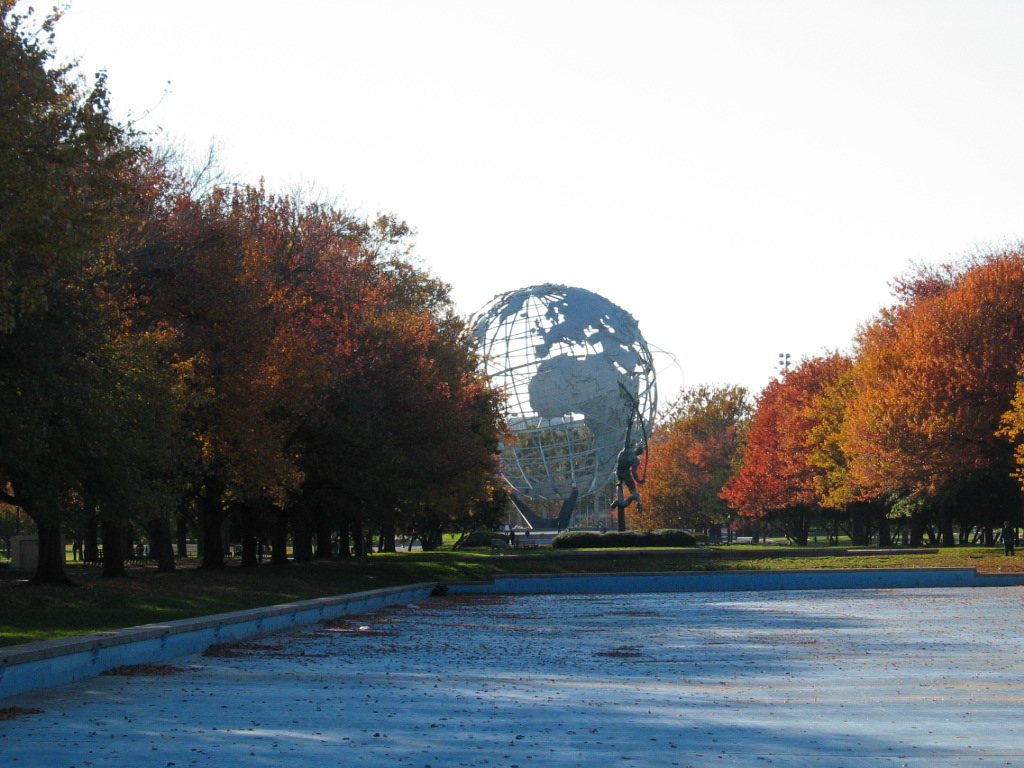
The Unisphere in Flushing Meadows Corona Park. Photograph by GK tramrunner229, via Wikimedia Commons. CC BY-SA 3.0.
How did a dumping ground become fairgrounds?
For decades, the marshland along Flushing Creek was the Corona Dump, where the city unloaded ashes, street sweepings and excavated material, a mountain of refuse in the middle of Queens. In the 1930s, parks commissioner Robert Moses chose the dump as the site of the 1939-40 New York World's Fair and hired Gilmore D. Clarke, one of the foremost landscape architects of the era, to plan the fairgrounds. Clarke laid out a formal plan whose major axes ended at focal points holding pavilions, fountains and sculpture, and its Theme Center was the Trylon and Perisphere, the spike and the sphere that became that fair's symbols. The 1939-40 fair, themed "Building the World of Tomorrow" and run by its president Grover A. Whalen, drew an impressive roster of foreign exhibitors and the endorsement of the Bureau International des Expositions, but attendance fell short of expectations: it grossed only 48 million dollars against expenses exceeding 67 million, and the fair corporation declared bankruptcy at the end of its second season in 1940. The partially landscaped site it left behind became the park. After the fair closed, the land became Flushing Meadows-Corona Park, at 1,255 acres one of the largest parks in the city.
When New York won a second fair for 1964 and 1965, the twenty-fifth anniversary of the first, Clarke was retained to adapt his 1939 landscape plan to the new fair, and Robert Moses, whose reputation was by then on the wane, was again appointed president of the Fair Corporation, hoping the fair's profits would finally build the park he wanted as the crowning glory of his career. The second fair was conceived as a forum for developing technology, especially space exploration, computers and nuclear energy, and in 1961 the New York World's Fair 1964-1965 Corporation announced that its theme, "Peace through understanding in a shrinking globe and in an expanding universe," would be symbolized by a large stainless steel armillary sphere called the Unisphere. The new fair placed its own symbol at the same prominent position the Trylon and Perisphere had occupied. The United States Steel Corporation handled the engineering and fabrication, met several engineering challenges along the way, and donated the finished globe to the park after the fair.
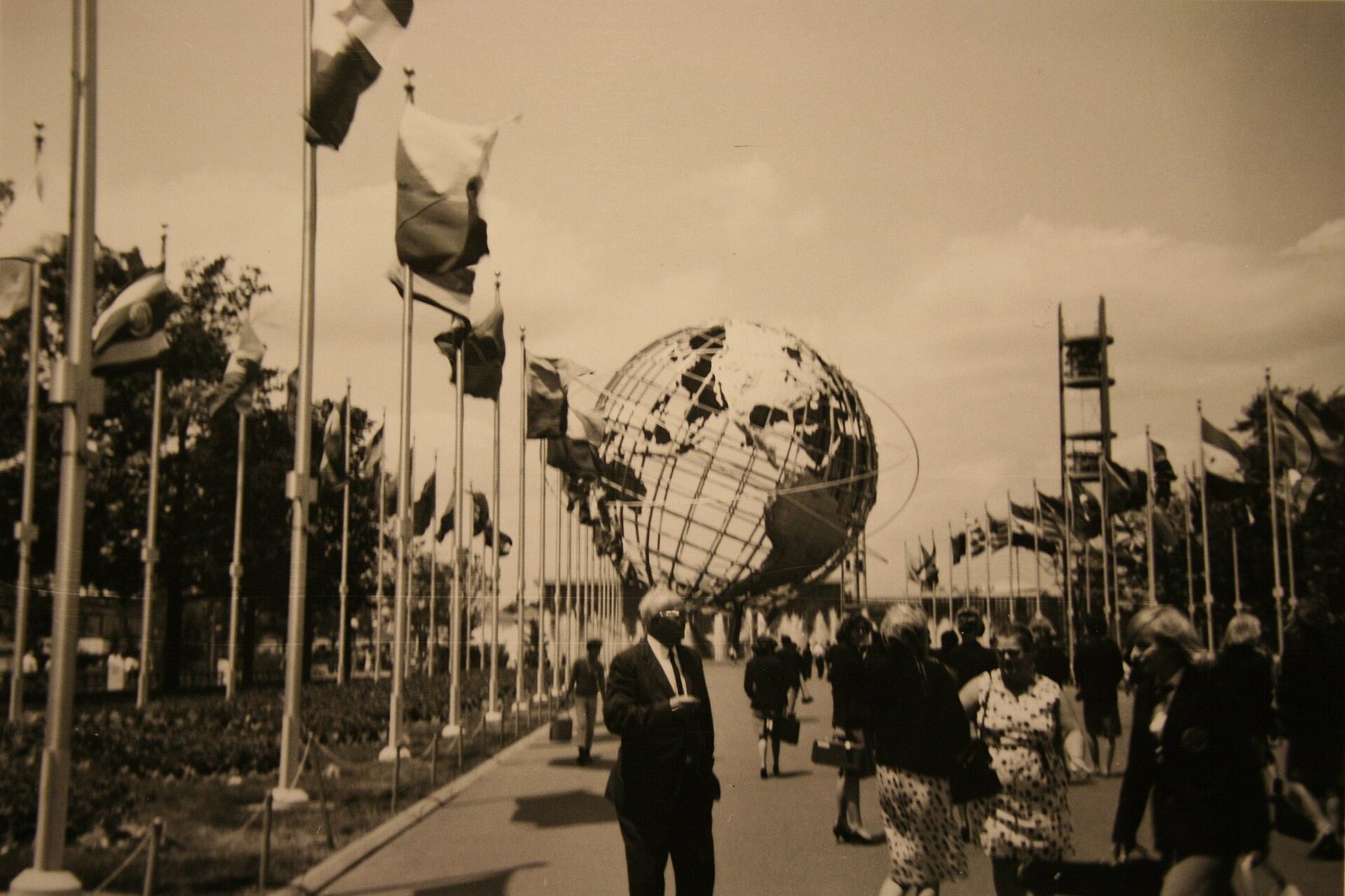
The Unisphere during the 1964-65 World's Fair. Photograph by Gary Lee Todd, via Wikimedia Commons. CC0.
Who designed and built the Unisphere?
Gilmore D. Clarke (1892-1982) was born in New York City and studied landscape architecture and civil engineering at Cornell University, graduating in 1913 before serving as an Army engineer in World War I. Through the 1920s he sat on a string of local, state and federal commissions as a landscape architect, including the Architectural Advisory Board for the United States Capitol and the New York State Council of Parks, which was headed by Robert Moses, and his work for Westchester County included Playland and the Saw Mill River Parkway. His projects for the city's park department included the Central Park Zoo, the Henry Hudson Parkway, Astoria Park in Queens, Orchard Beach in the Bronx and renovations of Bryant and City Hall Parks, and he taught landscape architecture at Cornell from 1935 to 1950, serving as Dean of Architecture for most of that time. In 1935 he co-founded the engineering and landscape firm Clarke & Rapuano, whose designers shaped many of the fair's statues and fountains, and late in his career he consulted on the construction of the United Nations Headquarters. Moses hired him to lay out both New York World's Fairs.
U.S. Steel's engineers had to make a hollow steel cage that would hold its shape and strength in the wind. They varied the sectional dimensions of the meridians and parallels so the structure stayed stable without compromising the design, and the three polished steel orbit rings are anchored to the superstructure by aircraft cable. Altogether the Unisphere contains a mile and a half of meridians, parallels and orbit rings. The 700,000-pound globe sits on an inverted tripod base of low-alloy, high-strength steel weighing 200,000 pounds, and the poured-concrete foundation incorporates the Perisphere's piling ring, left intact underground from the 1939-40 fair and reinforced with 600 additional 100-foot piles. The meridians are hollow rectangular sections, six inches wide above the equator and ten below, while the parallels are steel tubing whose diameter diminishes from ten and three-quarter inches below the equator to six inches near the North Pole. The continents are mounted on a framework of channels and angles so the structure can withstand winds above 110 miles per hour, and fitting their irregular coastlines to the sphere's curvature was a complicated task because no section was square in plane. Each orbit ring was welded together on the ground around the sphere, then lifted into place in one piece by four cranes. The effect was carefully judged: from the edge of the reflecting pool, the Unisphere appears as the Earth would look from 6,000 miles in space.
What do the numbers say?
The landmarks report reads like a spec sheet. The globe is 140 feet high and 120 feet in diameter, built from more than 500 major structural pieces, and tilted at 23.5 degrees, the normal tilt of the Earth. The circles of the armillary sphere represent the lines of latitude and longitude, and the capital cities of the world are marked by lenses that were backed by flashing lights during the fair. Three giant rings circle the globe, denoting the first manmade satellites, launched in the late 1950s. The sphere rises from a circular reflecting pool 310 feet in diameter, its bulkhead sheathed in rose-colored granite, encircled by a double ring of ninety-six fountainheads arranged in pairs, which spray twenty feet high. Four aluminum plaques donated by U.S. Steel face the park's major walkways where they converge at the globe.
One number is disputed. The City Lore Place Matters profile of the Unisphere puts its weight at 900,000 pounds, while the landmarks commission's report says 700,000. This article goes with the commission's figure, the more authoritative of the two. Either way, the superlative needs a footnote. Guinness World Records keeps a globe record, but it is for the largest revolving globe, and it belongs to Eartha, the globe built by the DeLorme map company in Yarmouth, Maine, in 1998, which surveyors measured at about 41 feet in diameter and 5,600 pounds, larger than the previous record holder, Italy's Globe of Peace. The Unisphere is a different kind of thing: stationary, and an openwork armillary sphere rather than a solid scale globe, though at 120 feet across it is nearly three times Eartha's diameter. Whether any larger globe structure stands anywhere is not a claim the record book settles, so this article does not make it; what the numbers show is the difference in category, a solid globe that turns in Maine versus a fixed cage of steel in Queens.
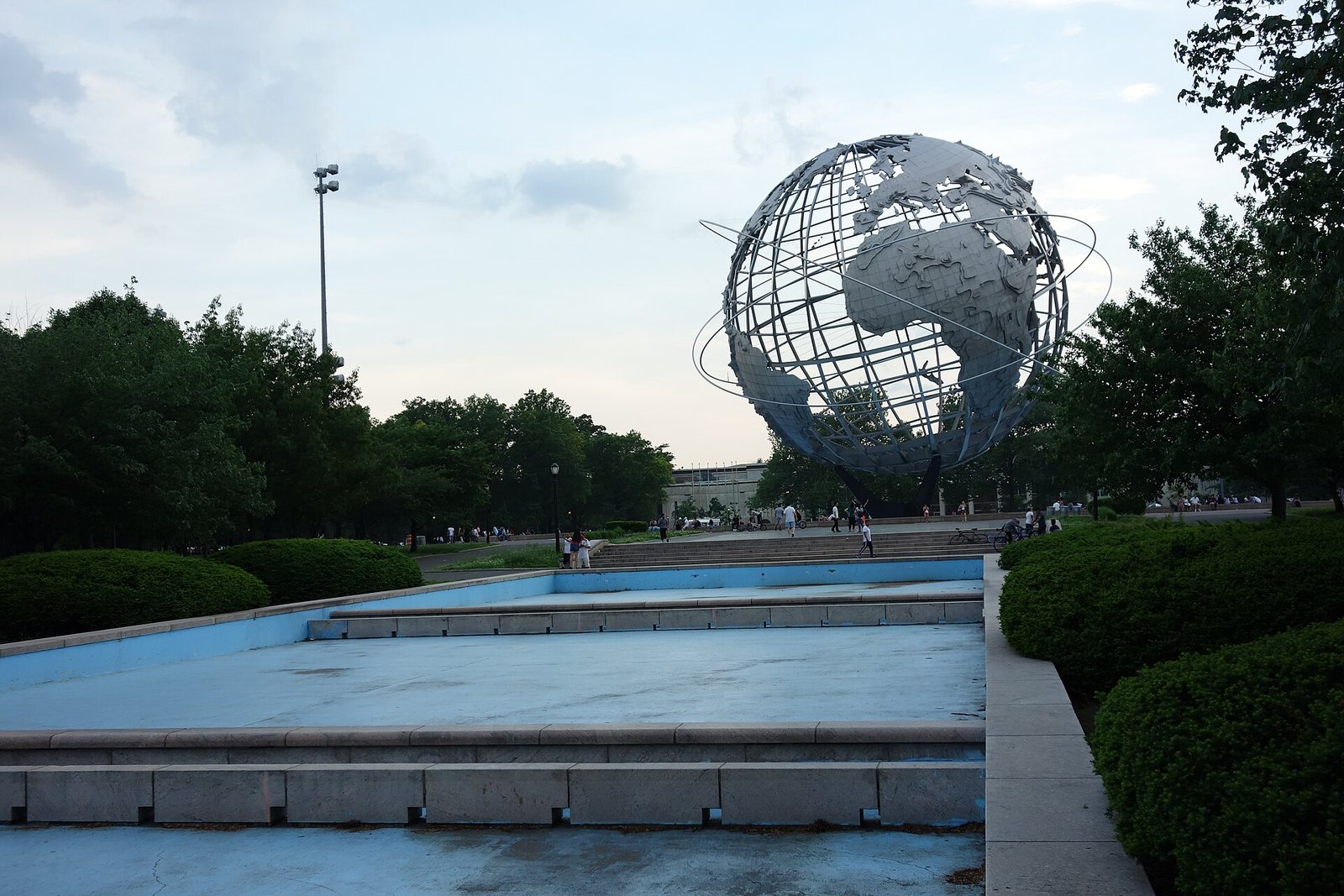
The Unisphere beyond the Fountain of the Fairs pool. Photograph by Tdorante10, via Wikimedia Commons. CC BY-SA 4.0.
What happened after the fair closed?
The 1964-65 fair ended in financial disappointment: attendance in its two seasons ran well below expectations, and at its conclusion the fair corporation had 11.6 million dollars on hand against 23 million dollars in debts. Most of the remaining money went to demolish the pavilions of bankrupt exhibitors, clean up the fair site and help restore Flushing Meadows Park, following an adaptation of Clarke's Beaux-Arts design. The Unisphere stayed exactly where Clarke had put it. Through the following decades it weathered, and in late 1993 and early 1994 the Parks Department restored the sphere, its reflecting pool and its fountains as part of a 3.6 million dollar project at the park, installing new floodlighting; the sphere itself was cleaned and stabilized. On May 16, 1995, the Landmarks Preservation Commission designated the Unisphere, together with its surrounding pool and fountains, a New York City landmark.
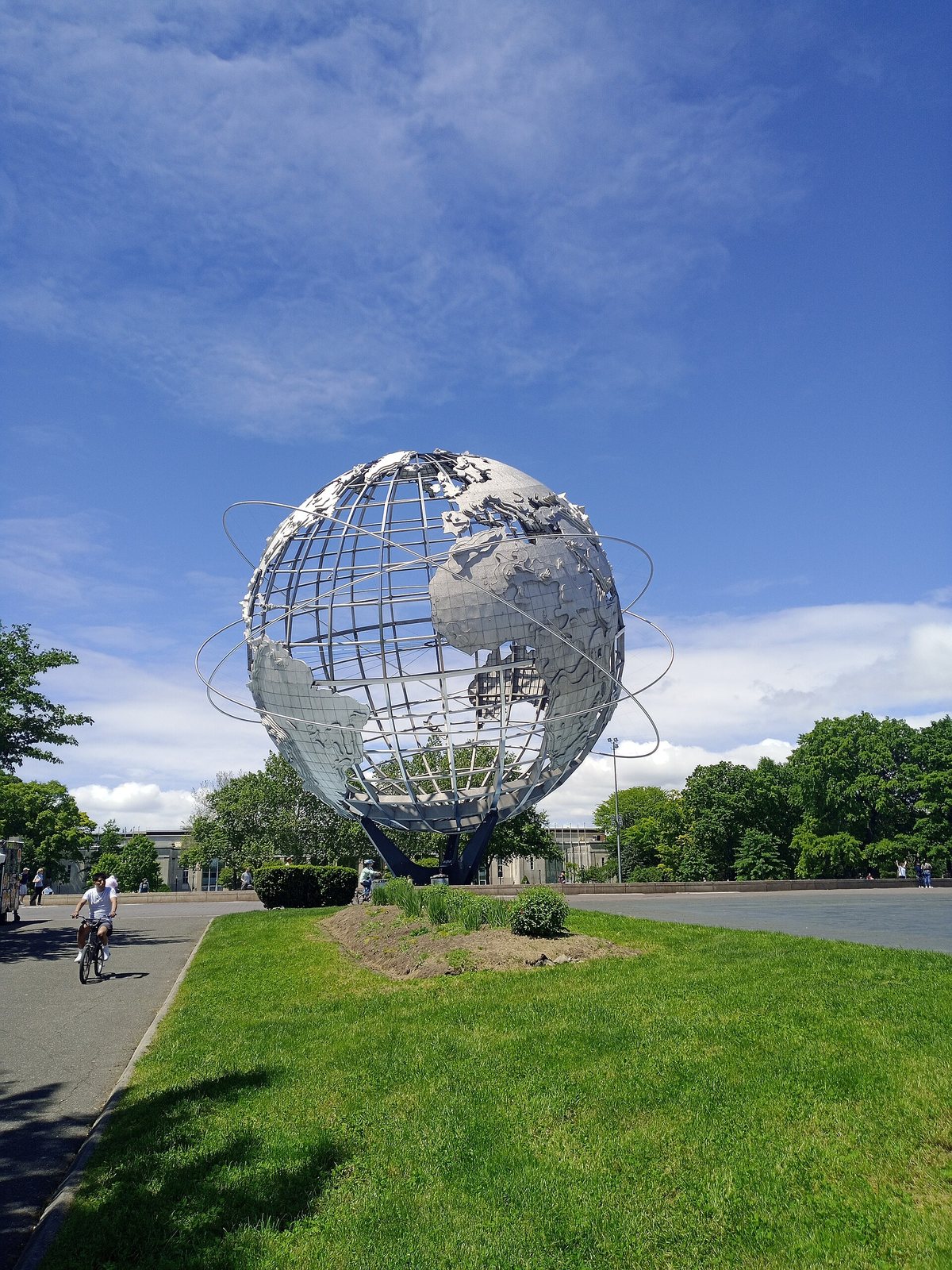
The Unisphere in spring. Photograph by Epicgenius, via Wikimedia Commons. CC BY-SA 4.0.
Who owns the Unisphere today?
The Unisphere stands in Flushing Meadows Corona Park, and like the park itself it belongs to the City of New York: U.S. Steel donated the globe to the park after the fair, and it is maintained by the New York City Department of Parks and Recreation. The landmarks commission calls it one of the most prominent structural and landscape features of the park. No ticket is needed to see it; it is public art on public land, visible from the highways that ring the park and open whenever the park is.
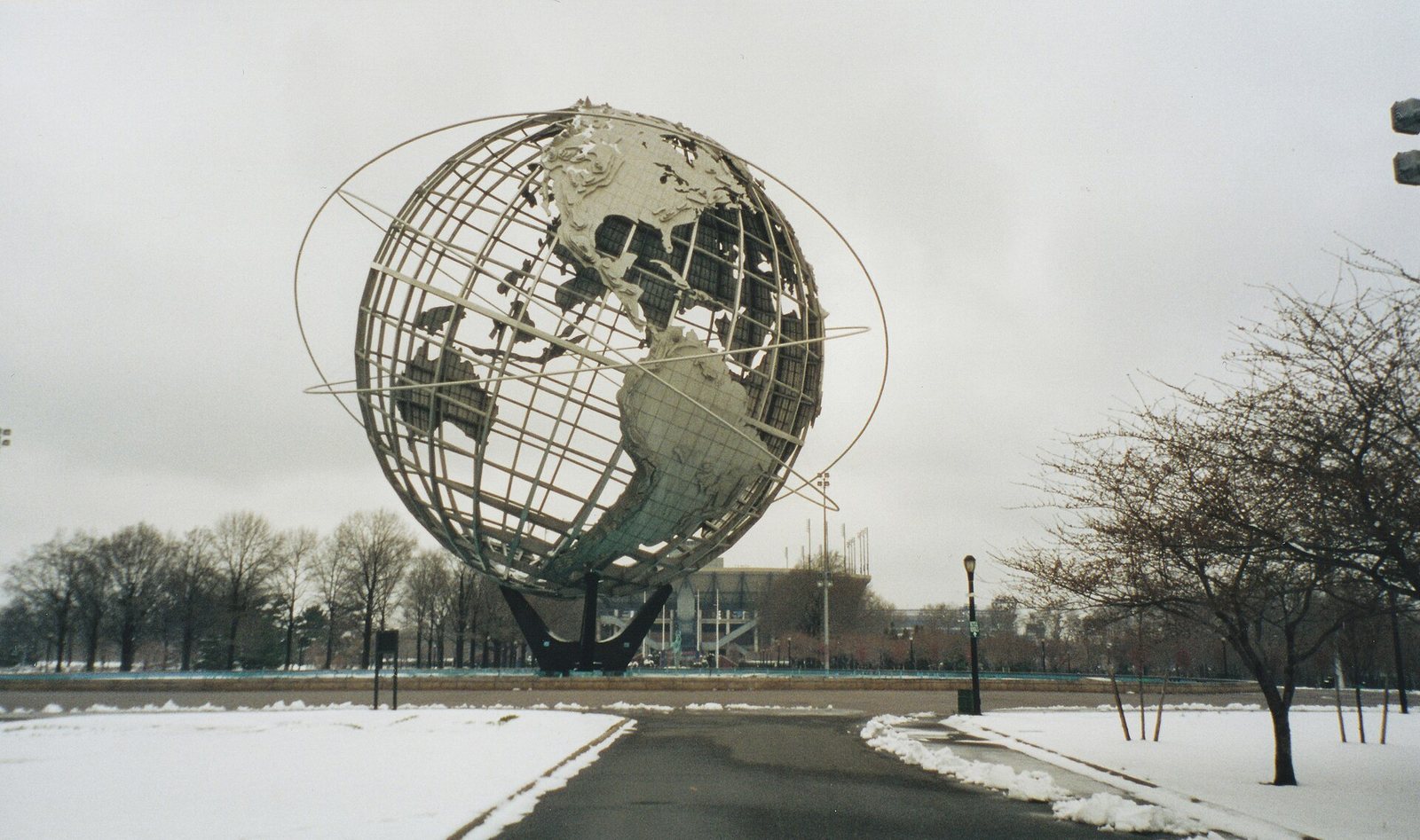
The Unisphere in winter, 2003. Photograph by Gunnar Klack, via Wikimedia Commons. CC BY-SA 4.0.
Sources
- NYC Landmarks Preservation Commission, The Unisphere (LP-1925), May 16, 1995
- City Lore, Place Matters: Unisphere
- Guinness World Records, Largest Revolving Globe (Eartha)
- Maine Office of Tourism, Eartha, the World’s Largest Globe
- NYC Parks, Flushing Meadows Corona Park
Visiting the Unisphere
- Address: Flushing Meadows Corona Park, Queens, at the heart of the park between the Long Island Expressway and the Grand Central Parkway.
- Getting there: Take the 7 train to Mets-Willets Point or 111th Street and walk into the park; the globe is hard to miss.
- Cost: Free. The Unisphere stands in the open park.
Facts above were read on the official pages on November 2, 2026. Park rules and fountain schedules change, so confirm on nycgovparks.org before you go.