The Intrepid: How a Torpedoed WWII Carrier Became Manhattan's Sea, Air and Space Museum
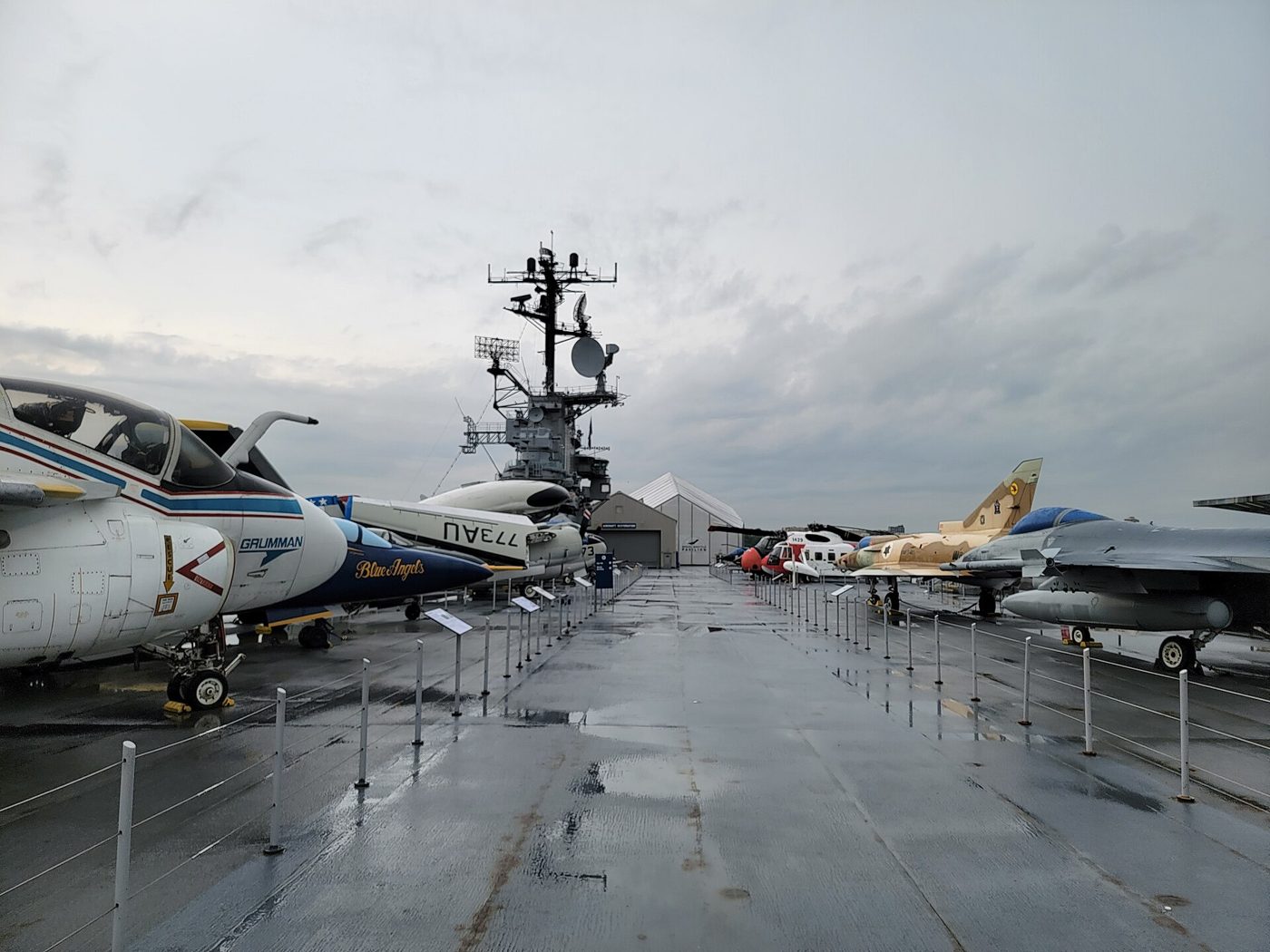
The flight deck of the Intrepid Sea, Air and Space Museum, 2022. Photograph by Fritzmann2002, via Wikimedia Commons. CC BY-SA 4.0.
The Intrepid is a World War II aircraft carrier that now sits at a pier on the Hudson River in Manhattan, with a Space Shuttle orbiter, a Concorde and a submarine within a short walk of its flight deck. It is also a ship that took a torpedo and several kamikaze hits, was recommissioned and rebuilt for the jet age, recovered two American space capsules from the sea and was nearly scrapped. The museum that saved it opened in 1982. This is how the ship got from a Virginia shipyard to Pier 86.
Who built the USS Intrepid, and what kind of ship is it?
The National Historic Landmark nomination form says USS Intrepid (CV-11) was laid down at the Newport News Shipbuilding and Drydock Company on December 1, 1941. After the outbreak of the war, work was accelerated. She was launched on April 26, 1943, and commissioned on August 16, 1943. The form calls her the third Essex-class carrier to be laid down by the United States. It describes the Essex class as a halfway design, an enlarged and improved version of the earlier Yorktown class with more antiaircraft armament, new high-pressure boilers, better underwater protection, more powerful catapults and a second armored deck at the hangar level.
The form gives these figures: 27,000 tons standard displacement and 36,000 tons at full load, 872 feet long, 148 feet wide, room for more than 90 aircraft, and a wartime crew of 3,400. Four Westinghouse turbines and eight Babcock and Wilcox boilers drove four shafts. The ship's range was 15,000 miles at 15 knots.
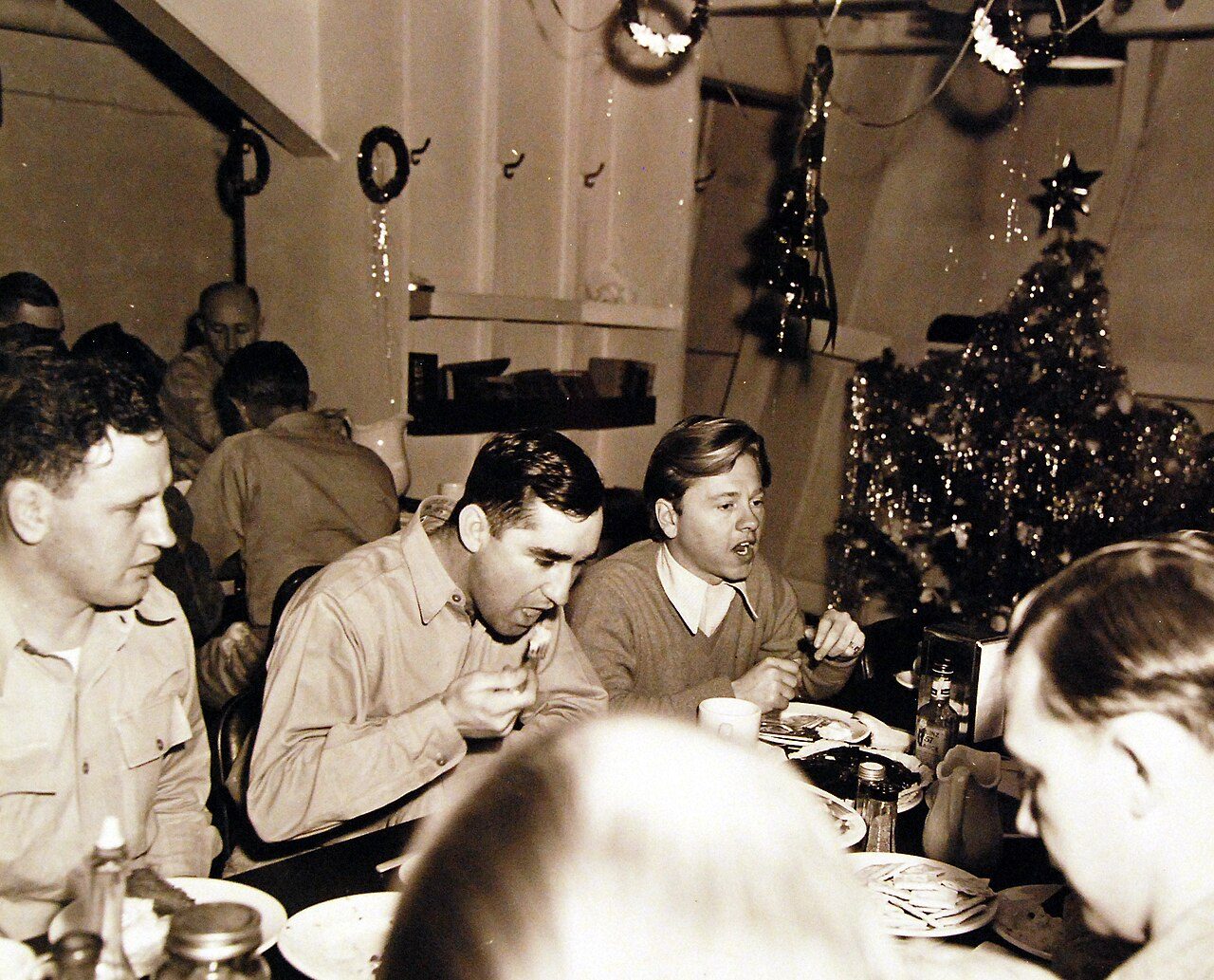
Mickey Rooney eating chow in the Chief Petty Officer Quarters aboard USS Intrepid (CV-11), photographed December 28, 1943. U.S. Navy photograph, National Archives, via the National Museum of the U.S. Navy and Wikimedia Commons. Public domain.
What did the Intrepid do in World War II?
The nomination form says the Intrepid fought against Japan for two years and was hit by enemy action on five occasions. It places her in the Battle of Leyte Gulf in 1944, says she helped sink both of Japan's superbattleships, Musashi and Yamato, and records five battle stars for her World War II service. The museum's own history says she took part in the January 1944 raid on Roi-Namur and in the October 24, 1944 strikes on the Musashi, and that she survived five kamikaze attacks and a torpedo strike.
The worst days came late in the war. The Navy and museum accounts record a kamikaze hit on October 30, 1944 that killed 10 men, two kamikazes on November 25, 1944, and another hit on April 16, 1945 that killed 8. The two sources count the damage slightly differently, one listing five hits by enemy action and the other five kamikaze attacks plus a torpedo, so this article gives both rather than a single total.
How did the carrier change after the war?
The Navy decommissioned the Intrepid in 1947 and recommissioned her in 1952. The nomination form says she was extensively modernized in 1954 to become an attack carrier able to handle jets. All heavy guns were removed, the centerline elevator was sealed, and a heavy-duty elevator was installed on the starboard side. In a later refit an angled flight deck was added on the port side. The museum says she was the first carrier to launch aircraft with American-built steam catapults, on October 13, 1954.
The Intrepid then became a recovery ship for the space program. The museum says she picked up Aurora 7, the Mercury capsule flown by Scott Carpenter, on May 24, 1962, and Gemini 3 on March 23, 1965. She deployed to Vietnam between April 1966 and February 1969, and the museum notes one fast launch of 15 aircraft in seven minutes. The Navy decommissioned her for the last time on March 15, 1974.
How was the Intrepid saved from the scrap yard?
The museum says it was founded in 1982 with the acquisition of the carrier. It is one of the Intrepid Family of Foundations, which the museum says were established by founders Zachary and Elizabeth Fisher. The museum calls the ship a National Historic Landmark, and the National Park Service nomination form lists the Intrepid Sea-Air-Space Museum, Intrepid Square, as its owner. She is berthed at Pier 86, at West 46th Street and 12th Avenue.
Why does the Navy's nomination form treat the Intrepid as important?
The form explains the ship in the context of how naval power changed. It says that after World War I the perfection of the airplane and the rise of the carrier led supporters of air power to argue that the battleship was obsolete. It says this view was strengthened by the British carrier strike on the Italian fleet at Taranto on November 11, 1940, and confirmed by the Japanese carrier strikes at Pearl Harbor and on HMS Prince of Wales and HMS Repulse. The Pacific war, it says, was fought over vast stretches of ocean with carriers as highly mobile weapons, and the Essex class formed the core of the fast carrier task forces and, after 1945, of the postwar carrier fleet. The Intrepid represents that class, which is why the form argues she belongs on the list of national landmarks.
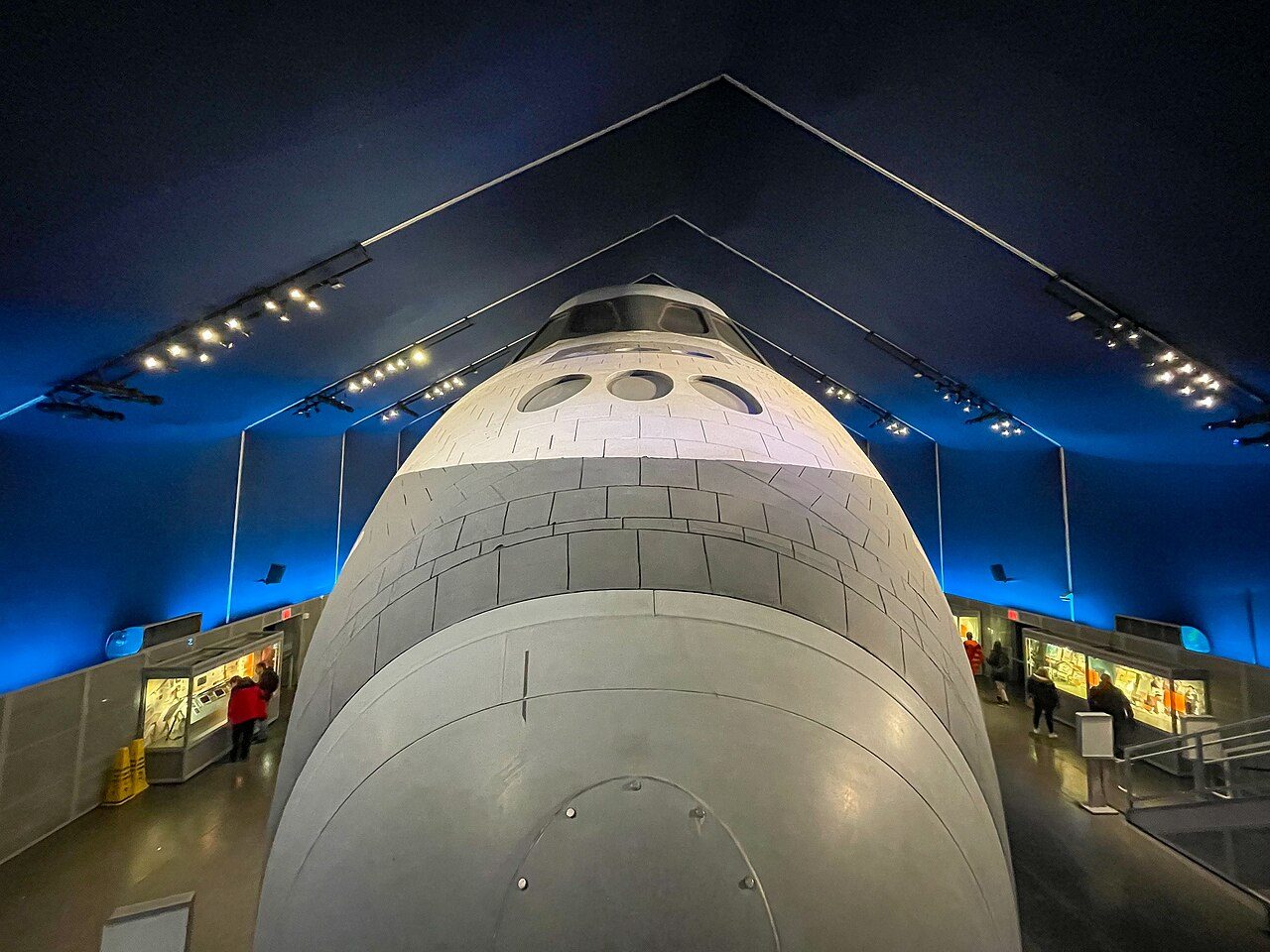
The nose of Space Shuttle Enterprise in the Space Shuttle Pavilion, 2023. Photograph by Mike Peel, via Wikimedia Commons. CC BY-SA 4.0.
What is on board besides the ship?
The museum calls Enterprise a prototype orbiter. It opened to the public on July 19, 2012, after the orbiter traveled from Washington to John F. Kennedy International Airport and then up the Hudson by barge. It sits in the Space Shuttle Pavilion. The space-flown hardware on site is a Soyuz TMA-6 capsule, which the museum also displays.
The aircraft collection spans all five branches of the U.S. armed forces. The museum's pages mention an Avenger, the A-12, a Skyray and a MiG-21 acquired from Poland in 1991. The museum calls the submarine Growler the only American nuclear missile submarine open to the public. It also calls Enterprise the world's first space shuttle.
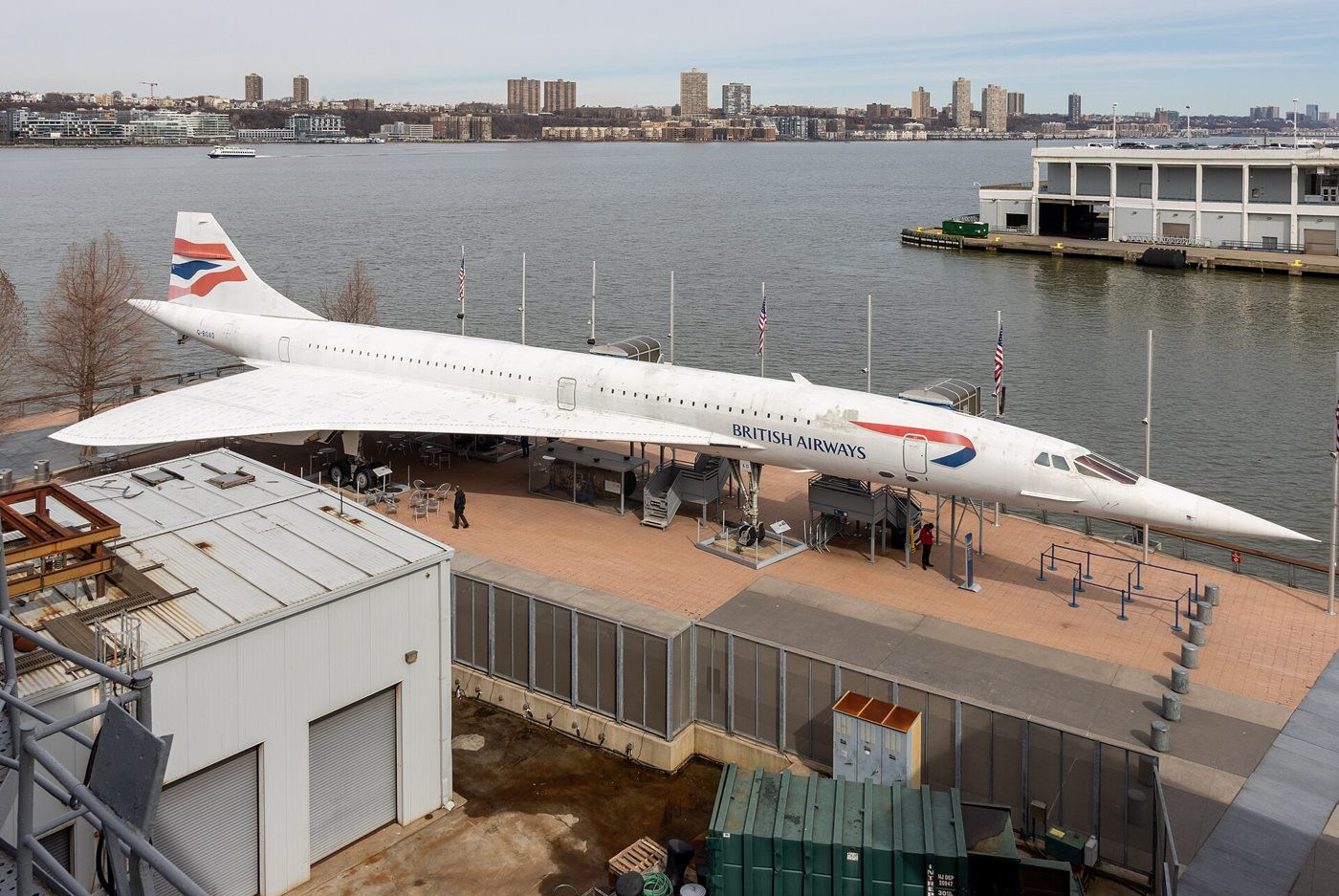
British Airways Concorde G-BOAD on the pier at the Intrepid Museum. Photograph by Mike Peel, via Wikimedia Commons. CC BY-SA 4.0.
Why is a Concorde parked next to an aircraft carrier?
The Concorde is G-BOAD. The museum says it first flew on August 25, 1976, and made the fastest Atlantic crossing, in 2 hours, 52 minutes and 59 seconds. It calls this the only British Airways Concorde on display in the Northeast. Sources disagree about how the museum came to hold it. A 2003 New York Times article said British Airways gave the aircraft to the museum, and the museum's pages read did not describe the ownership terms, so this article makes no claim either way. The museum says G-BOAD was one of only 14 Concordes ever in service. Going inside is a ticketed 20-minute Concorde Experience, offered every 30 minutes from 11:00 am, listed at $15 for adults, seniors and children 5 to 12, and $5 for museum members.
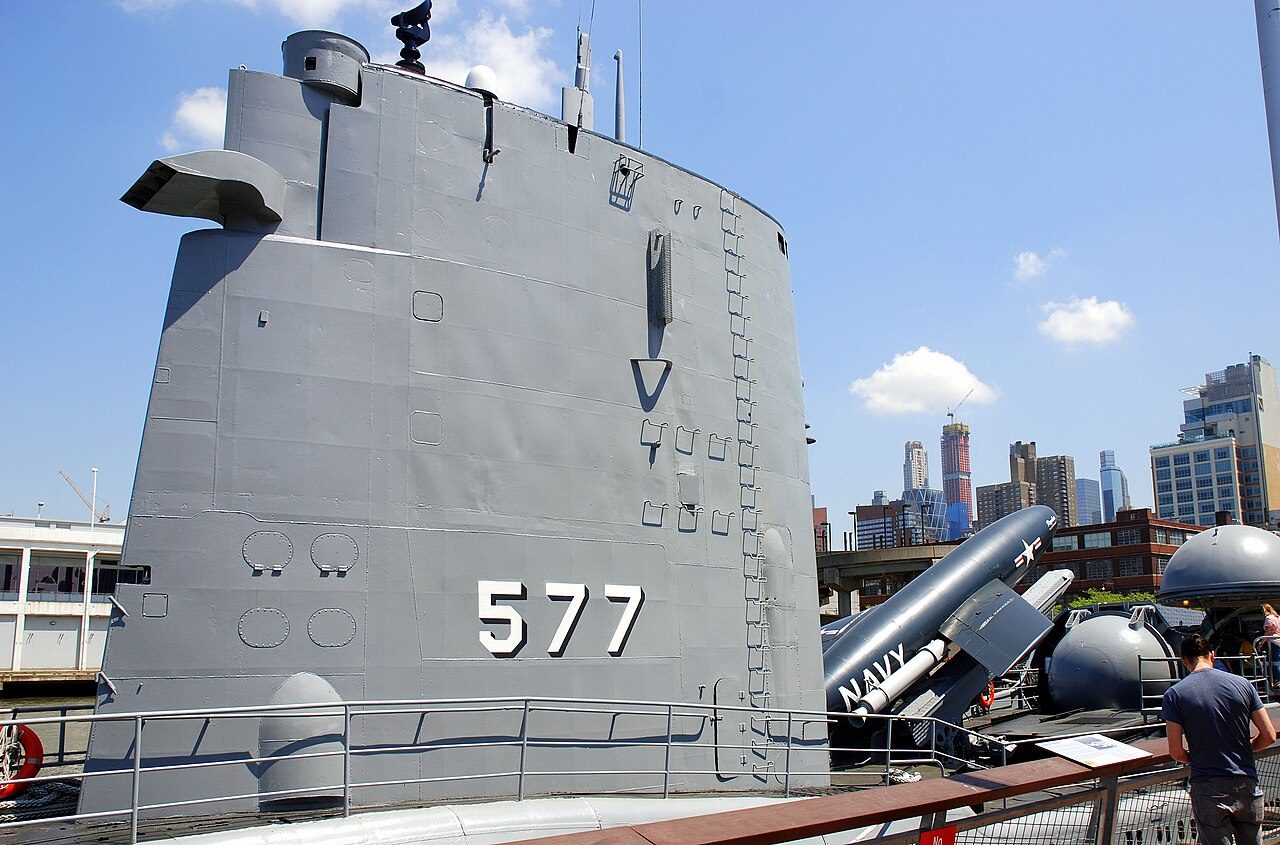
The sail of USS Growler (SSG-577) at the Intrepid Museum. Photograph by Roland Turner, via Wikimedia Commons. CC BY-SA 2.0.
Who owns the Intrepid today?
The museum describes itself as a private non-profit. The National Park Service nomination form lists the Intrepid Sea-Air-Space Museum as owner of the ship. The sources read for this article do not say who holds title to Pier 86 or the other vessels and aircraft on display, so this article makes no claim about them. The museum reports more than one million visitors a year.
Where can you eat or drink at Intrepid Sea, Air & Space Museum?
The museum lists three places to eat.
- Aviator Grill, Welcome Center, second floor, open to the general public for dine-in or takeout, opens at 10:00 am daily.
- Intrepid Marketplace, third deck (mess deck), for museum guests.
- Pier Side Cafe, seasonal outdoor dining on Pier 86.
Hours and status were read from the official pages listed below on October 13, 2026. They change, so confirm before visiting.
Sources
- Intrepid Museum, About Us
- Intrepid Museum, Aircraft Carrier Intrepid
- Naval History and Heritage Command, USS Intrepid
- National Park Service, National Historic Landmark nomination form for USS Intrepid (CV-11)
- Intrepid Museum, Space Shuttle Pavilion
- Intrepid Museum, British Airways Concorde
- Intrepid Museum, Concorde Experience tour
- Intrepid Museum, Submarine Growler
- Intrepid Museum, Visitor Information
- Intrepid Museum, Directions
- Intrepid Museum: Dining (checked October 13, 2026)
Visiting the Intrepid Museum
- Address: Pier 86, West 46th Street and 12th Avenue, New York, NY 10036, according to the museum.
- Hours: The museum's sources differ. Its Visitor Information page lists October 1 to March 31 as Monday to Sunday and holidays, 10:00 am to 5:00 pm (last entry 4:00 pm), and April 1 to September 30 as Monday to Friday 10:00 am to 5:00 pm and Saturday, Sunday and holidays 10:00 am to 6:00 pm, with last entry an hour before closing. Its Visit page lists Monday to Friday 10:00 am to 5:00 pm and Saturday, Sunday and holidays 10:00 am to 6:00 pm all year. The museum is closed on Thanksgiving and Christmas Day.
- Tickets: The museum says to buy online for the quickest entry, or at the Box Office in the Welcome Center. Everyone aged 5 and over needs a ticket. The Concorde Experience is a separate ticketed add-on.
- By subway and bus: The museum lists the A, C, E, N, Q, R, S, 1, 2, 3 and 7 trains to 42nd Street and then the M42 bus or a walk west, or the 7 train to 34th Street-Hudson Yards and a walk west and north. Crosstown buses M34, M42 and M50 stop at 12th Avenue, and the M50 stops in front of the museum.
- By ferry: The museum says NY Waterway runs a ferry from Hoboken and Weehawken, New Jersey to 39th Street and 12th Avenue, a walk from the museum.
Checked against Intrepid Museum visitor information page. Confirm hours and ticket rules there.