New York City Hall: The Oldest City Hall in America Still Doing Its Job
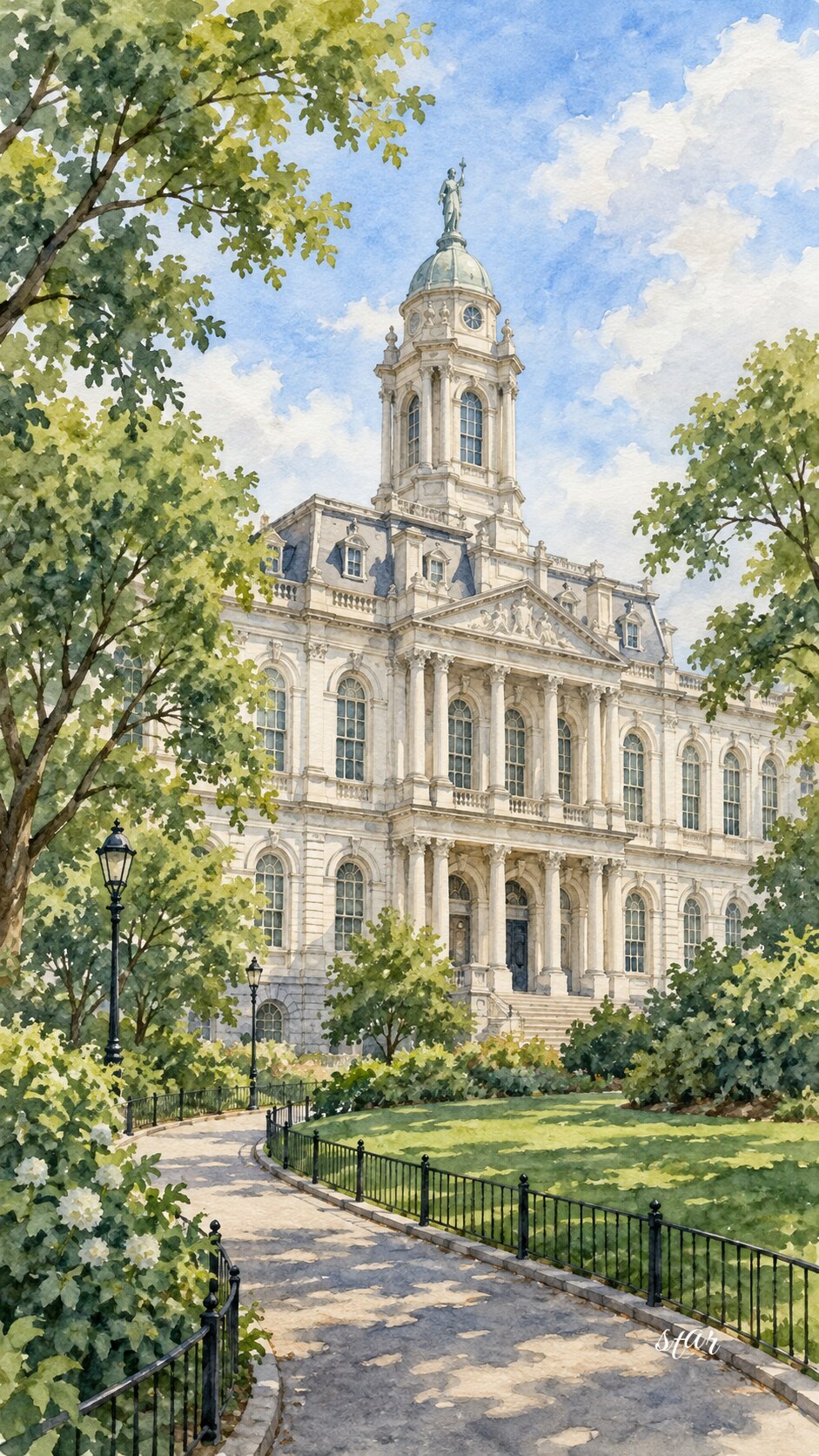
Original watercolor art illustration by Solomon Rokowsky.
New York City Hall has housed the mayor and the City Council since 1812, which makes it the oldest city hall in the United States that still houses its original governmental functions. The building that stands in City Hall Park today is essentially the one that opened more than two centuries ago, a French Renaissance Revival exterior wrapped around a Georgian Revival interior, and it is still a working seat of government rather than a museum. Presidents, kings and astronauts have walked its marble stairway, and Abraham Lincoln lay in state beneath its dome.
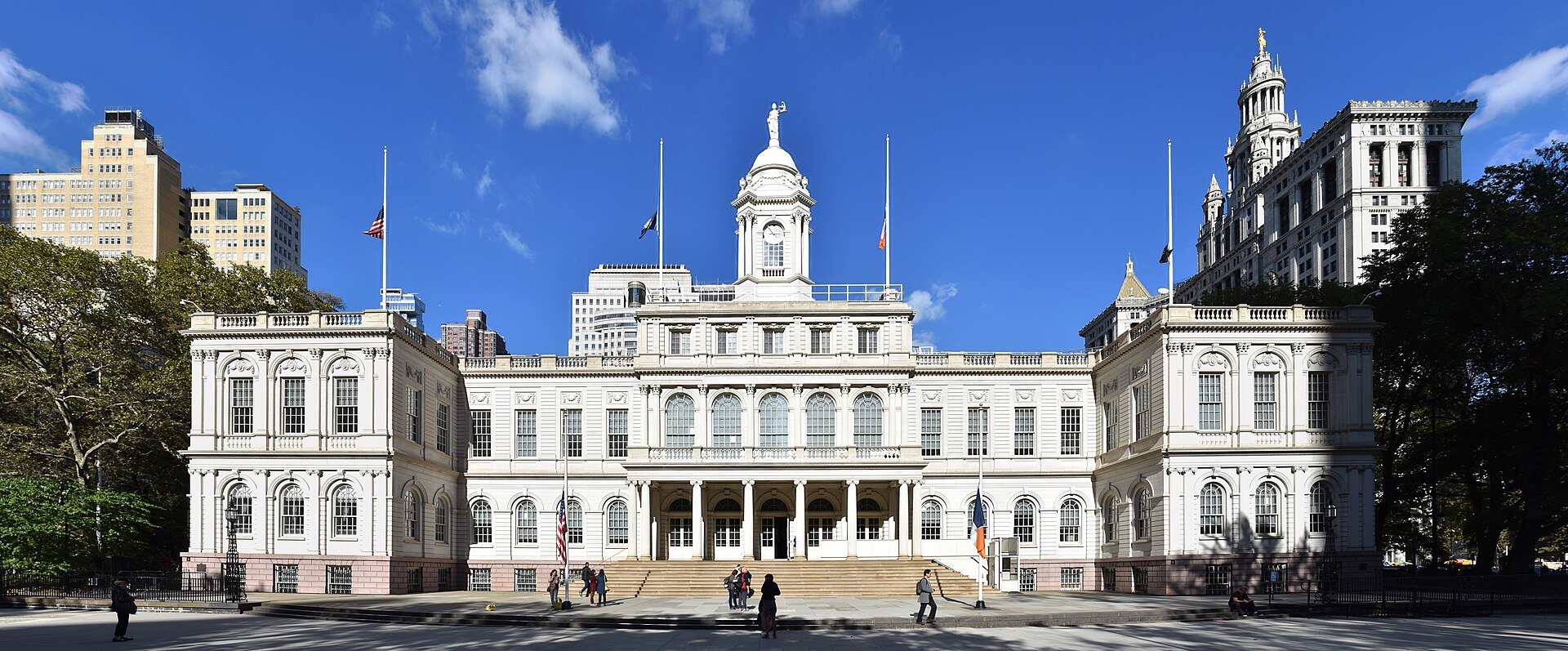
New York City Hall from City Hall Park. Photo by MusikAnimal, October 2016, via Wikimedia Commons. Creative Commons Attribution-Share Alike 4.0.
Who designed City Hall, and when was it built?
The city's government had outgrown its old home in Federal Hall on Wall Street by the turn of the nineteenth century, and in 1802 the city held a design competition for a new seat of government. The winners were an unusual pair: Joseph-Francois Mangin, a French emigre who had studied architecture in his native country before becoming a New York City surveyor in 1795, and John McComb Jr., a native New Yorker whose father had worked on the old City Hall and who went on to design Castle Clinton in Battery Park. Mangin had no known involvement with City Hall after winning the commission; McComb alone supervised every aspect of construction and controlled the architectural detailing during the long building process. McComb also reduced the size of the building and used brownstone at the rear instead of marble to lower costs, an economy that later generations would correct.
On the dates, the sources differ slightly. The city's own Public Design Commission says the building was constructed from 1803 to 1812, while the Department of Citywide Administrative Services records 1803 to 1811. Both agree on the essential fact: the building opened in 1812, and it has been altered numerous times over the years by several architects while remaining in continuous use.
The design mixes cultures the way the young city did. The exterior is French Renaissance Revival and the interior Georgian Revival, the Georgian manner more evident inside. The Public Design Commission calls it an early expression of the city's cosmopolitanism and one of the finest architectural achievements of its period.
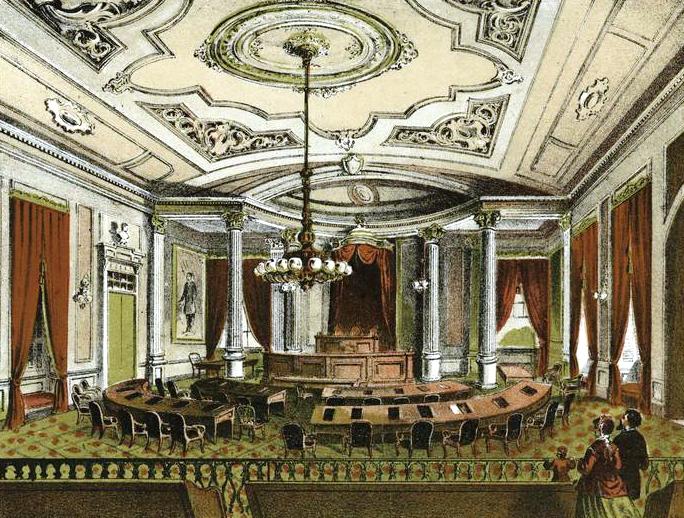
The Chamber of the Board of Councilmen in 1868, one of the rooms that has housed the city's legislature since the building opened. Engraving by W. C. Rogers & Co., via Wikimedia Commons. Public domain.
What is inside City Hall?
The ceremonial heart of the building is the rotunda, a designated interior landmark in its own right, a soaring space with a grand marble stairway rising to the second floor, where ten fluted Corinthian columns support a coffered dome; the dome was added in a 1912 restoration by Grosvenor Atterbury and John Almy Tompkins II. This is the room where New York receives the world. President-elect Abraham Lincoln was hosted in the Governor's Room in 1861, and four years later, after his assassination, Lincoln lay in state in the rotunda in 1865. Colonel Elmer Ephraim Ellsworth, the first Union officer killed in the Civil War and commander of the 11th New York Volunteer Infantry Regiment, had lain there before him.
Upstairs, the Governor's Room serves as the city's official reception room. It has hosted dignitaries including the Marquis de Lafayette and Albert Einstein, and that it houses one of the most important collections of nineteenth-century American portraiture as well as historic artifacts such as George Washington's desk. The room is part of the City Hall Portrait Collection and historic furnishings highlighted by the Public Design Commission's online exhibit, which also features the City Council Chamber.
How protected is the building?
Few buildings in the country carry as many layers of protection. City Hall was designated a National Historic Landmark on December 19, 1960, and listed on the National Register of Historic Places in 1966. Within the city's own system, the exterior was designated a New York City landmark in 1966 and the interior, specifically the rotunda, on January 17, 1976. It is also listed on the New York State Register of Historic Places.
The setting is part of the story. City Hall stands in City Hall Park in the Civic Center area of Lower Manhattan, between Broadway, Park Row and Chambers Street, about three blocks from the World Trade Center. The park itself carries deep history: The former City Hall subway station, the original southern terminal of the first New York City Subway line, curves beneath the park, and that in 1911 the park included the Manhattan terminal for cable cars running across the Brooklyn Bridge.
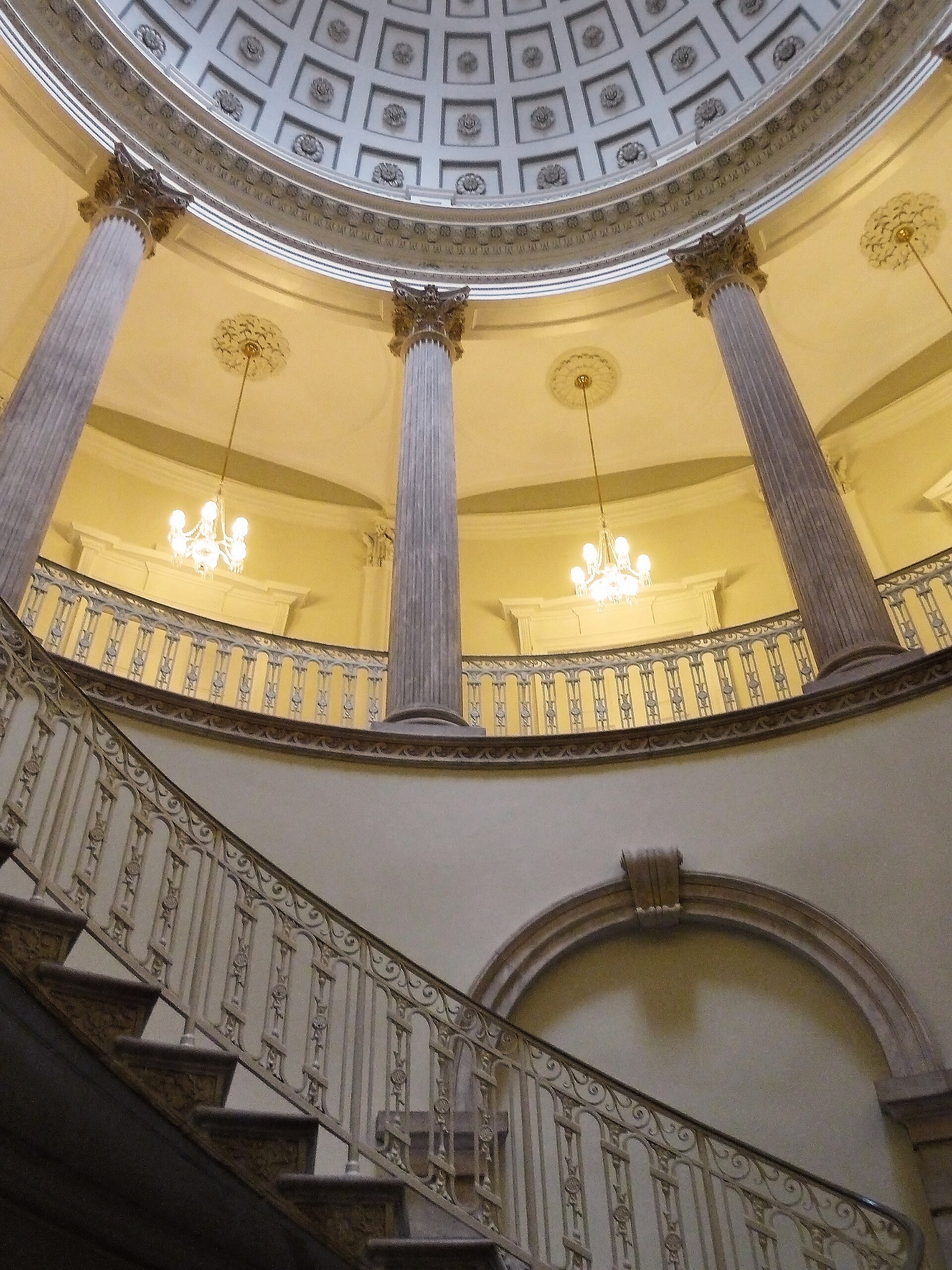
The landmarked rotunda, with the marble stairway and the coffered dome added in the 1912 restoration. Photo by MariekeSlagter, via Wikimedia Commons. Creative Commons Attribution-Share Alike 4.0.
How has the building changed over two centuries?
The exterior New Yorkers see today is not quite the one Mangin and McComb delivered. The original marble facade, quarried in Alford, Massachusetts, and complemented with brownstone on the rear elevation, deteriorated over time from pollution and pigeons. Between 1954 and 1956 the marble was replaced with Alabama limestone above a Missouri granite base, in a project led by Shreve, Lamb & Harmon, the architects of the Empire State Building. The interior has been renewed repeatedly too: the coffered dome over the rotunda dates from the 1912 restoration by Grosvenor Atterbury and John Almy Tompkins II, and a major restoration of much of the interior and exterior followed in the late 1990s, after a century without a major renovation. A restoration campaign for 47 paintings identified by the Art Commission as highest in priority has cared for the portrait collection in recent years.
The neighborhood grew up around it. City Hall stands among a cluster of civic landmarks: the Tweed Courthouse and the Surrogate's Courthouse to the north, the Manhattan Municipal Building to the northeast, the Brooklyn Bridge to the east, and the former New York Times Building, the Potter Building and the Park Row Building to the southwest. Few American buildings of its age still do the job they were built for; that the mayor and the City Council walked the same corridors this week as their predecessors did in 1812 is the building's real claim to fame.
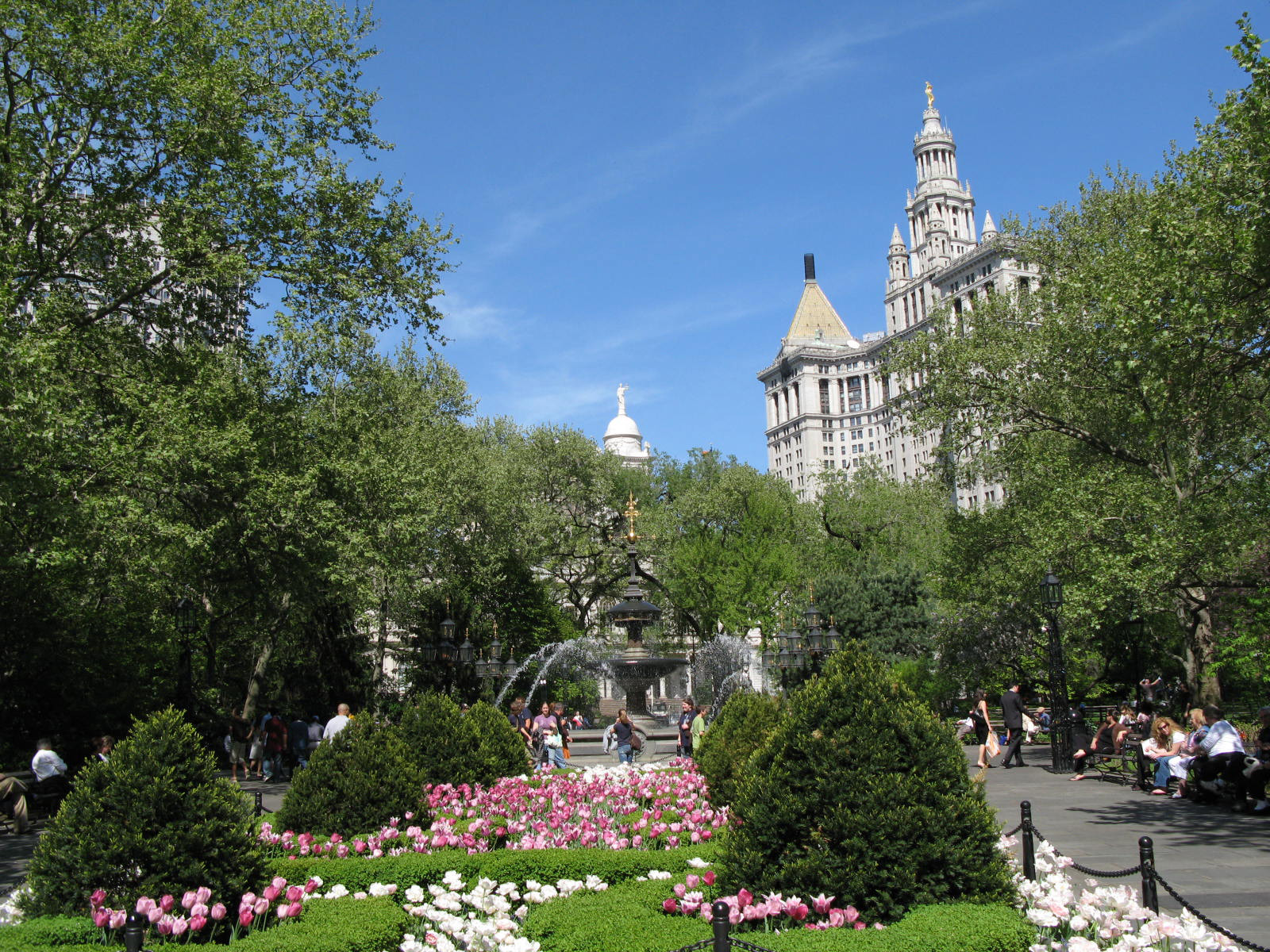
City Hall Park, the green space surrounding the building, maintained by NYC Parks. Photo by Momos, via Wikimedia Commons. Creative Commons Attribution-Share Alike 3.0.
Can you visit New York City Hall?
Yes, but only on a reserved tour. According to the Public Design Commission's official City Hall tours page, reservation tours of City Hall are offered every week, tours are limited to 20 individuals, and reservations must be made in advance. The commission lists separate group tours and individual tours, both free, and its online exhibit covers the landmarked rotunda, the City Council Chamber and the Governor's Room for anyone who cannot get a slot. Because City Hall is a working government building, there is no walk-up admission.
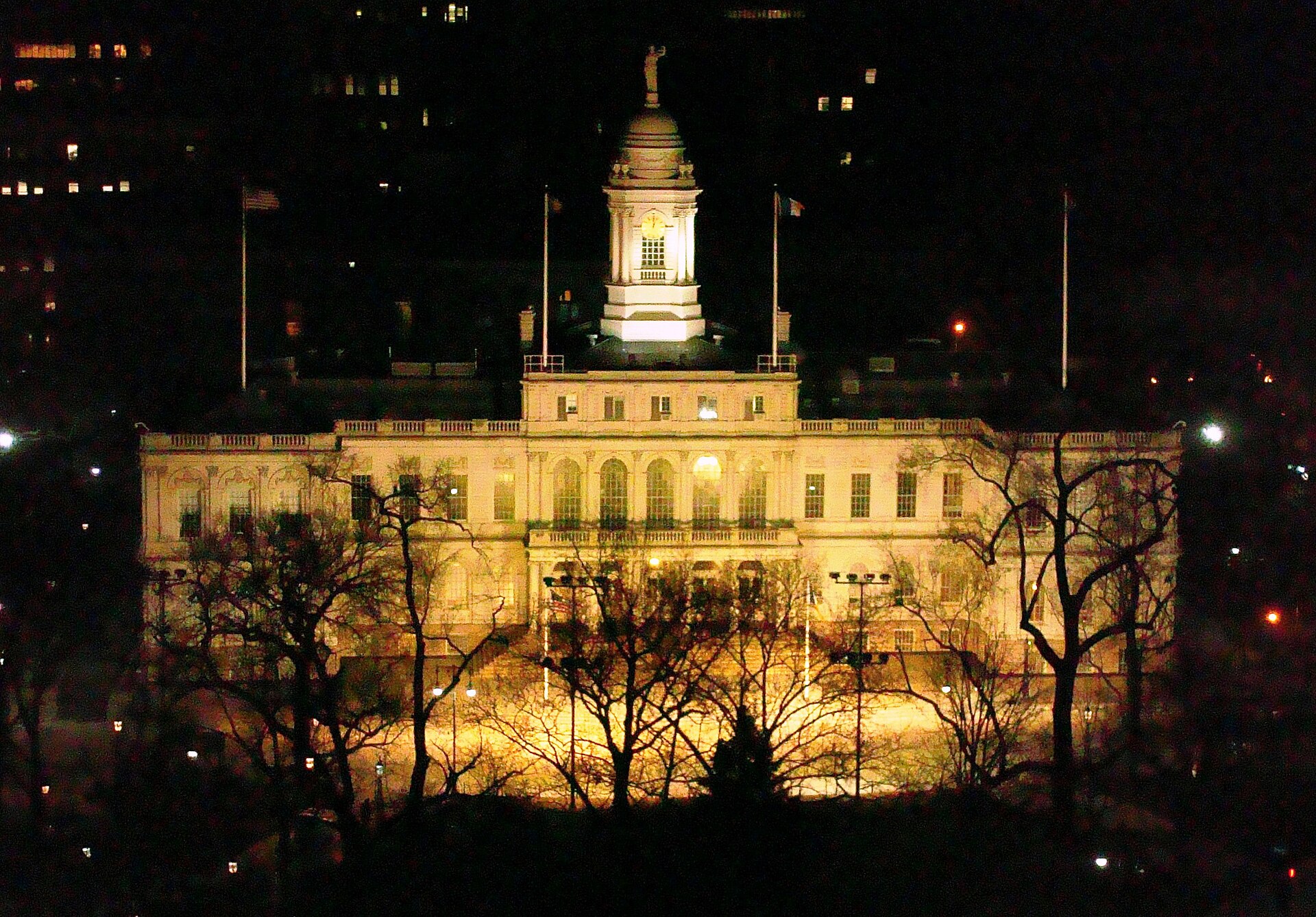
City Hall in spring. Photo by No1Manhattanite, cropped by Beyond My Ken, via Wikimedia Commons. Creative Commons Attribution-Share Alike 3.0.
Who owns City Hall today?
The City of New York. City Hall is a city-owned building in the care of the Department of Citywide Administrative Services, which lists it among the city-owned buildings it manages, operates and maintains; the agency's own page for the building records its construction dates, 1803 to 1811, and its architects, Joseph Francois Mangin and John McComb Jr. There is no private landlord and never has been: City Hall has been the seat of New York's government since it opened in 1812, and the mayor's office and the City Council chamber are still inside, which is why visiting runs through the Public Design Commission's reserved tours rather than a ticket desk.
Where can you eat or drink at City Hall?
You cannot eat or drink inside City Hall itself. It is a functioning office of the mayor and the City Council, and the official tour page lists no cafe, restaurant or concessions. The practical answer is City Hall Park, the green space surrounding the building, which NYC Parks maintains with lawns, paths and benches where visitors routinely sit with takeout from the surrounding Civic Center and Tribeca blocks. The park's official page notes its role as one of the city's oldest public spaces, so the classic move is simple: pick up food nearby and eat it on a bench in the park with City Hall as the backdrop. Listings and hours here were read on the official pages on November 3, 2026.
Sources
- NYC Department of Citywide Administrative Services, City Hall page
- NYC Public Design Commission, City Hall tours
Visiting New York City Hall
New York City Hall stands in City Hall Park between Broadway, Park Row and Chambers Street in Lower Manhattan. Free guided tours are offered weekly by the Public Design Commission, limited to 20 people, and must be reserved in advance through the commission's official page; the nearest subway stations include Brooklyn Bridge-City Hall (4, 5, 6) and City Hall (R, W). The rotunda, Governor's Room and City Council Chamber can also be seen in the commission's free online exhibit. These details were read on the official pages on November 3, 2026.