Citi Field: The Queens Ballpark Built to Look Like Brooklyn
Baseball's newest New York ballpark opened in 2009 wearing another city's clothes. Citi Field's arched brick facade copies Ebbets Field, the Brooklyn Dodgers' lost home; its green seats honor the Polo Grounds; its outfield bridge echoes the Hell Gate; and its front door is a rotunda built around a Dodger, Jackie Robinson. The ballpark that rose in Shea Stadium's old parking lot was meant to be a love letter to New York's National League past, and for its first years fans complained the letter was addressed to the wrong borough. Seventeen seasons, one All-Star Game and one World Series later, Citi Field has grown into its own address at 41 Seaver Way in Flushing, Queens, where the Mets play on land the city owns, in a stadium the team built, under a lease that runs to 2049.
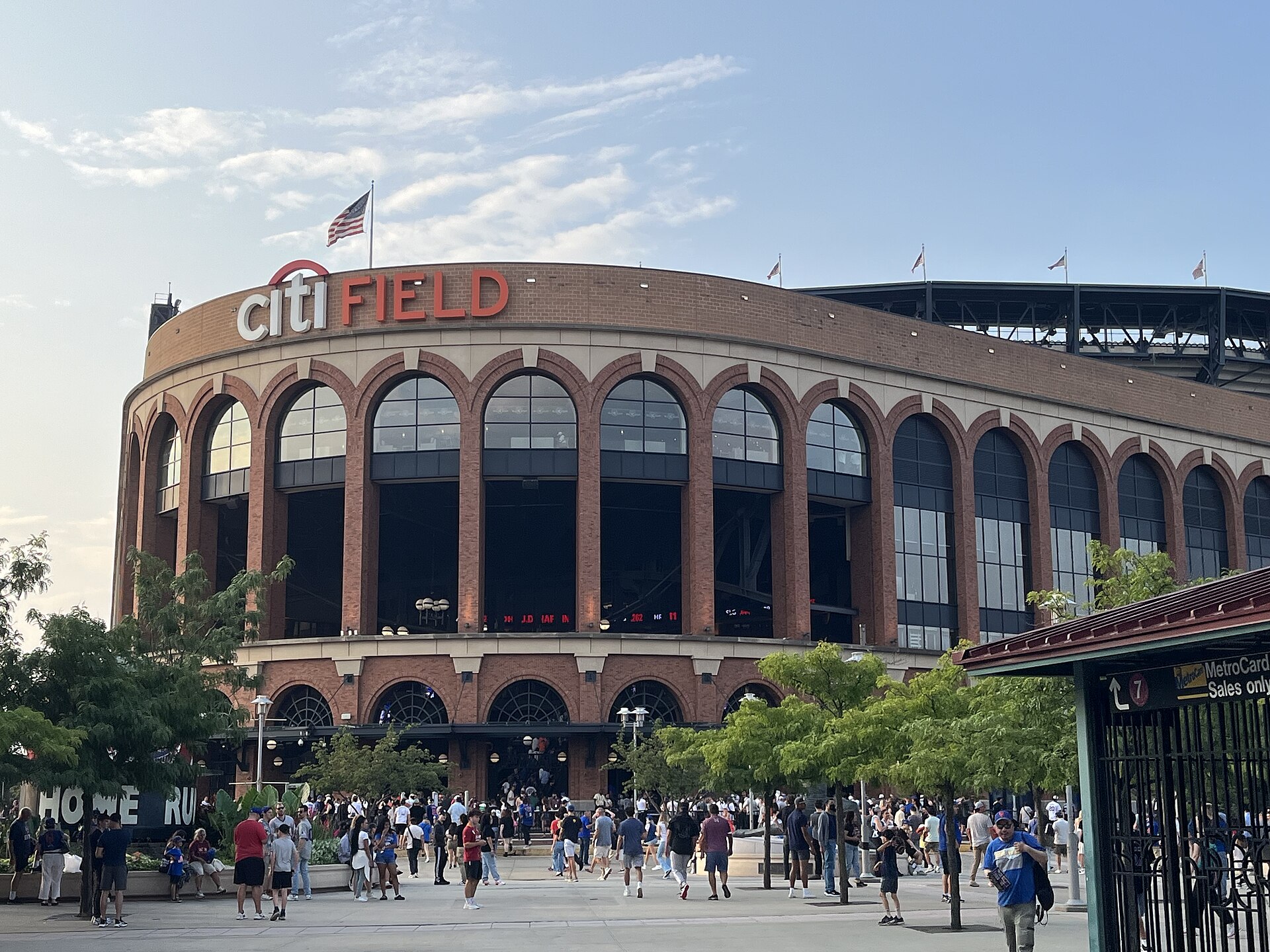
Citi Field's main entrance in 2024. Photo by LostplanetKD73, July 2024, via Wikimedia Commons. CC0, no rights reserved.
Why did the Mets leave Shea Stadium?
Shea Stadium opened in 1964 as a multipurpose stadium, and even after the Jets left for New Jersey following the 1983 season and it was retrofitted for baseball alone, its seats sat far from the field compared with the wave of intimate ballparks being built across the majors. The Mets had been looking to replace it since the 1990s. In 1998 the team unveiled a preliminary model with a retractable roof and a movable grass field, and it scouted sites as far afield as Mitchel Field and Belmont Park on Long Island, Sunnyside Yard in Queens and the West Side Yard in Manhattan before settling on the parking lot beyond Shea's left field. The path to money was bumpier. In December 2001, days before leaving office, Mayor Rudy Giuliani announced tentative agreements for new stadiums for both the Mets and Yankees, with taxpayers covering half the construction; his successor, Michael Bloomberg, used an escape clause to cancel the deals as unaffordable, only to discover a clause that let the teams leave the city on 60 days' notice if the city backed out. The final agreement, reached in 2006, projected a $610 million ballpark with the Mets paying $420 million, and locked in a 40-year lease keeping the team in New York through 2049. Ground broke on November 13, 2006.
How much did Citi Field cost?
That depends on the source, and the disagreement is worth stating plainly. Wikipedia's infobox for the ballpark lists the cost at $900 million, roughly $1.35 billion in 2025 dollars. The same article's text describes it as an $850 million baseball park funded with $615 million in public subsidies, including New York City municipal bonds repaid by the Mets with interest, a structure that offsets property taxes for the life of the park. The final financing also involved the city and state contributing about $165 million for infrastructure and site preparation. The stadium was designed by HOK Sport, the firm now known as Populous, whose interior concept leaned on Pittsburgh's PNC Park, the favorite ballpark of then-Mets chief operating officer Jeff Wilpon, with nods to Great American Ball Park, Coors Field and Citizens Bank Park. Citi Field opened its gates for a college game between St. John's and Georgetown on March 29, 2009, hosted charity exhibitions against the Red Sox on April 3 and 4, and played its first regular-season game, a 6-5 loss to the Padres, on April 13, 2009.
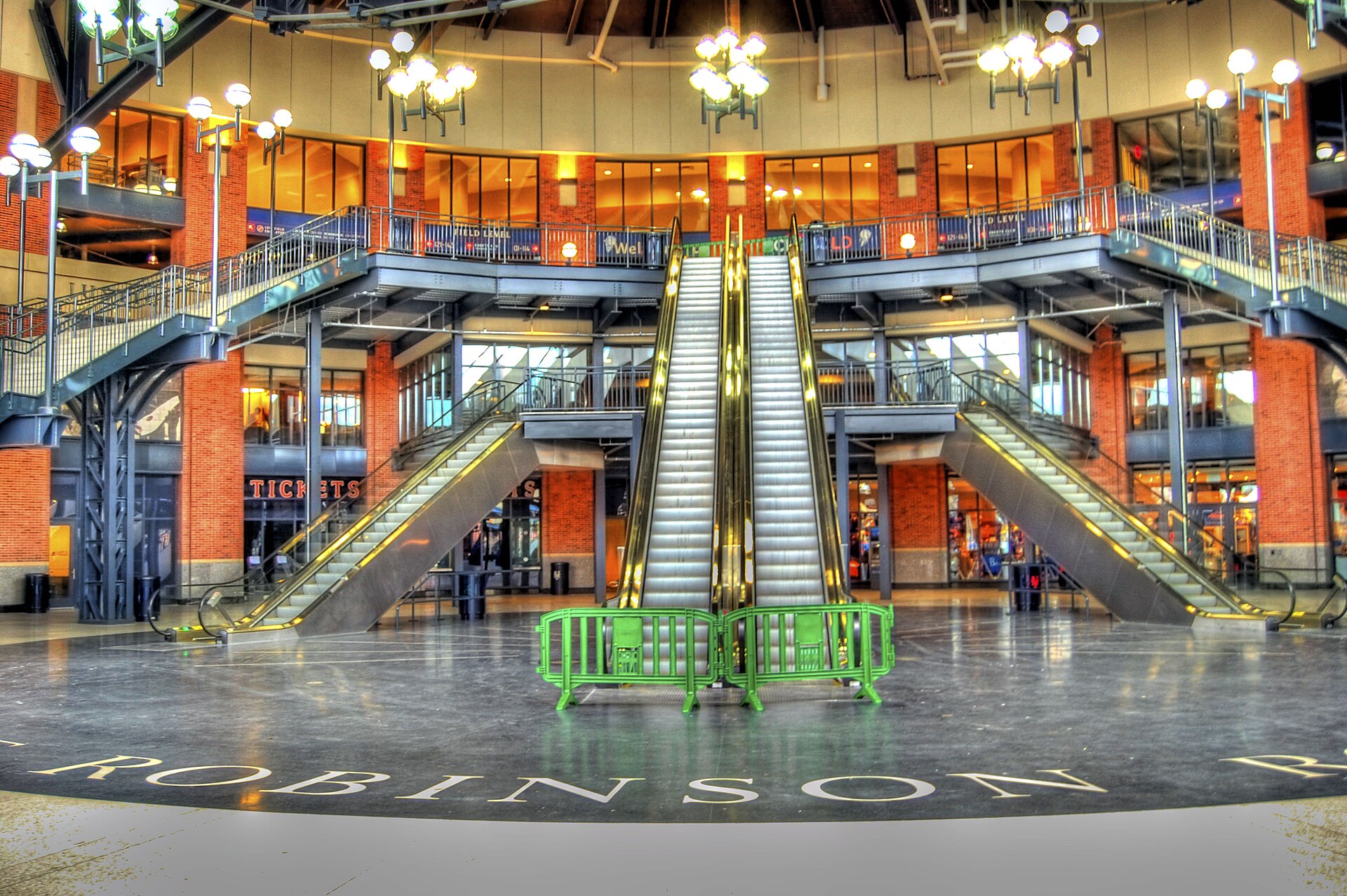
Inside the Jackie Robinson Rotunda. Photo by The Talented Mr. Nimo, via Wikimedia Commons. Creative Commons Attribution 2.0.
Why does a Queens ballpark honor Brooklyn?
The facade is Ebbets Field because Fred Wilpon, the Mets' principal owner when the park was designed, grew up in Brooklyn as a Dodgers fan. The rotunda beyond it honors Jackie Robinson: a 160-foot-diameter floor engraved with the nine values that defined his life, his quote "A life is not important except in the impact it has on other lives" circling the upper ring, and an eight-foot sculpture of his number 42. The rotunda was formally dedicated on Jackie Robinson Day, April 15, 2009. The homage ran deep: the green seats replace Shea's orange, blue, red and green rainbow as a tribute to the Polo Grounds, the Giants' home and the Mets' first park; a bridge motif threads the architecture in recognition of the city's 2,027 bridges; and the orange foul poles, still unique in the majors, came straight from Shea. The Brooklyn tilt went too far for many fans, who found the Mets nearly invisible in their own home. Wilpon later conceded the point, telling The New Yorker that "all the Dodger stuff" was "an error of judgment on my part." The team added Mets imagery and championship banners during 2009, built a Mets Hall of Fame and Museum beside the rotunda for 2010, and painted the outfield walls Mets blue in 2012.
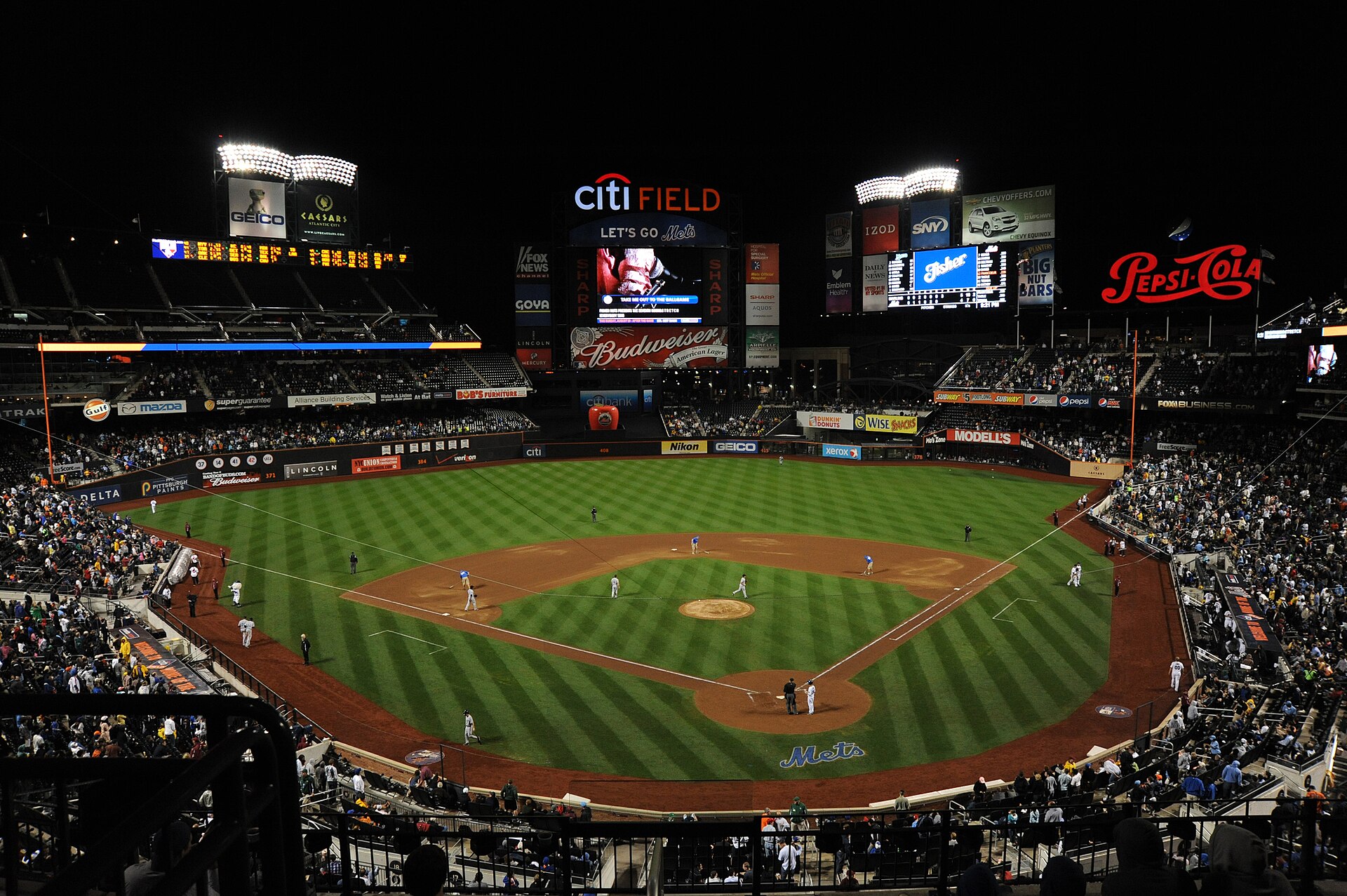
A night game against the Marlins in August 2010, the park's second season. U.S. Coast Guard photo by Petty Officer 3rd Class Casey J. Ranel, via Wikimedia Commons. Public domain.
What about the apple?
Shea Stadium's most beloved gimmick crossed the parking lot too. When a Met homers, the Home Run Apple rises from its housing in the center-field batter's eye, just as it did at Shea since 1980. The new apple, built by the Minneapolis engineering firm Uni-Systems, is more than four times the size of the old one. The original Shea apple first stood in Bullpen Plaza, then moved outside in 2010 to Mets Plaza between the rotunda and the Mets-Willets Point subway entrance, where it became the ballpark's meeting point. On April 15, 2022, the Mets unveiled William Behrends' statue of Tom Seaver beside it, anchoring a plaza that now gathers the franchise's whole history in one spot.
Has Citi Field changed since 2009?
Repeatedly. The Padres complained during the very first series that the bullpens blocked their view, and the pens were rotated 90 degrees after the season. The park played as an extreme pitcher's park early on, so before 2012 the Mets brought the fences in, lowered the left-field wall from 16 feet to 8, and cut right-center from 415 to 390 feet. Capacity has held at 41,922 since 2012, more than 15,000 seats fewer than Shea. The record crowd remains the 45,186 who watched the 2013 All-Star Game, and the regular-season record of 44,466 dates from April 2016. The club also shares the building: New York City FC has played part-time at Citi Field since 2022, and Gotham FC has staged selected matches there.
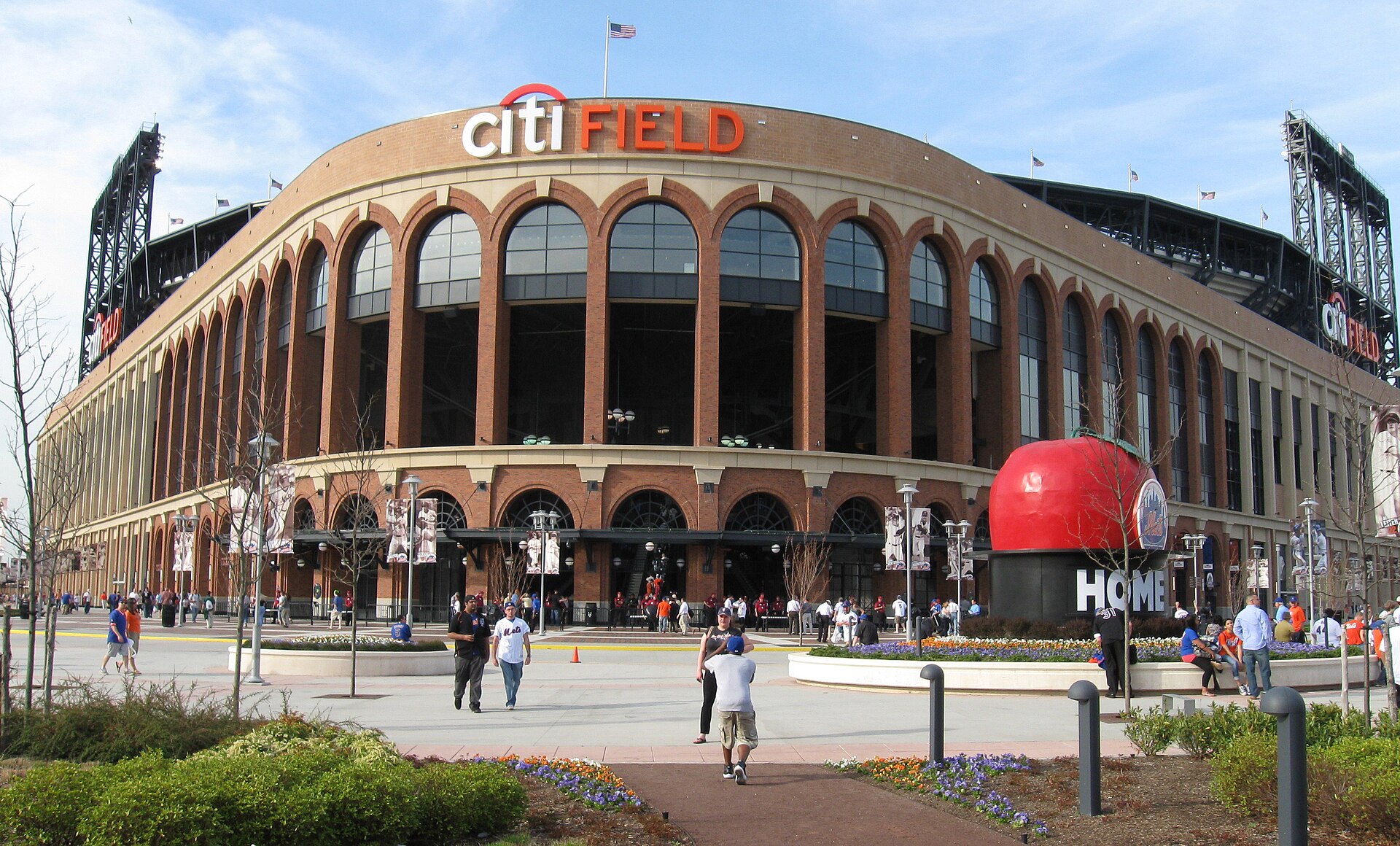
The original Shea Stadium Home Run Apple outside the rotunda entrance. Photo by Richiek, via Wikimedia Commons. Creative Commons Attribution-Share Alike 3.0.
Who owns and runs Citi Field?
The stadium belongs to the New York Mets through a wholly owned subsidiary, Queens Ballpark Company, and the team operates it; the land underneath belongs to the City of New York. The 2006 agreement gave the club a 40-year lease running to 2049. Citigroup bought the naming rights in November 2006 for $20 million a year over 20 years, with an option to extend to 40, then the richest naming deal in sports. The naming did not calm down quickly. During the 2008 financial crisis, with Citigroup holding $45 billion in federal rescue funds, Maryland congressman Elijah Cummings called the sponsorship "indefensible and unacceptable" and urged the bank to find a way out of the contract; the Wall Street Journal reported in February 2009 that Citigroup had considered breaking the deal. The bank answered that no bailout money would pay for the name, kept it, and repaid the government in full by 2014. Citi Field then made its own history fast: it hosted the 2013 All-Star Game, the first the Mets had staged since Shea's inaugural 1964 season, and in the fall of 2015 it hosted World Series games for the first time, drawing 44,859 for the Game 5 finale on November 1, when the Kansas City Royals won 7-2 in twelve innings to take the title on the Mets' home field. The deal drew fire during the 2008 financial crisis, when Citigroup received $45 billion in federal rescue funds; the bank said no bailout money would pay for the sponsorship, kept the name, and repaid the government in full by 2014.
Where can you eat or drink at Citi Field?
The food became a headline in itself. The official Citi Field dining guide, read on October 25, 2026, lists outposts of New York favorites around the concourses: Pat LaFrieda's for steak sandwiches and burgers, Shake Shack, Fuku's fried chicken, Tacombi, and Rao's Italian specialties among them, alongside ballpark standards. Concession lineups change season to season, so the club's dining guide is the page to check for the current roster. Outside the gates, the Willets Point neighborhood keeps its own long tradition of pregame eating along Roosevelt Avenue.
Sources
- Wikipedia, Citi Field
- MLB.com, Citi Field A-Z Guide
- MLB.com, Citi Field Dining Guide
- MLB.com, Citi Field Tours
Visiting Citi Field
- Address: 41 Seaver Way, Flushing, Queens, in Flushing Meadows-Corona Park next to the USTA Billie Jean King National Tennis Center.
- Getting there: The 7 train and the Long Island Rail Road both stop at Mets-Willets Point, steps from the rotunda and Mets Plaza. Driving routes and parking details are on the club's A-Z guide.
- Tickets: Sold through the Mets' official site; season-ticket and group packages are separate listings there.
- Ballpark tours: As read on the Mets' tours page on October 25, 2026: 60-minute guided tours run on non-game days, departing from the Shea Gate, priced at $25 for adults and $20 for children, with free non-game-day parking in Lot G.
- Don't miss: The Jackie Robinson Rotunda at the main entrance, the original Shea Home Run Apple and Tom Seaver statue in Mets Plaza, the Shea Bridge over the right-field concourse, and the Mets Hall of Fame & Museum next to the rotunda when it is open.
Hours, tour prices and transit details above come from the club's official pages, read on October 25, 2026.