Bryant Park: A Potter's Field, a Crystal Palace and New York's Most Famous Park Comeback
The nine-acre rectangle behind the New York Public Library's Fifth Avenue flagship calls itself one of the world's busiest public spaces, and on a sunny weekday that is easy to believe. What is harder to believe is everything else this ground has been: a burial ground for the poor, the endpoint of a forty-one-mile aqueduct, the site of a glass exhibition hall that drew a million visitors, a Civil War encampment, a construction staging yard, and, as late as the 1970s, a place the city had nearly given up on. Bryant Park's rescue in the 1980s became the textbook case for privately managed public parks. This is how the ground changed hands and purposes for two centuries, and who owns it today.
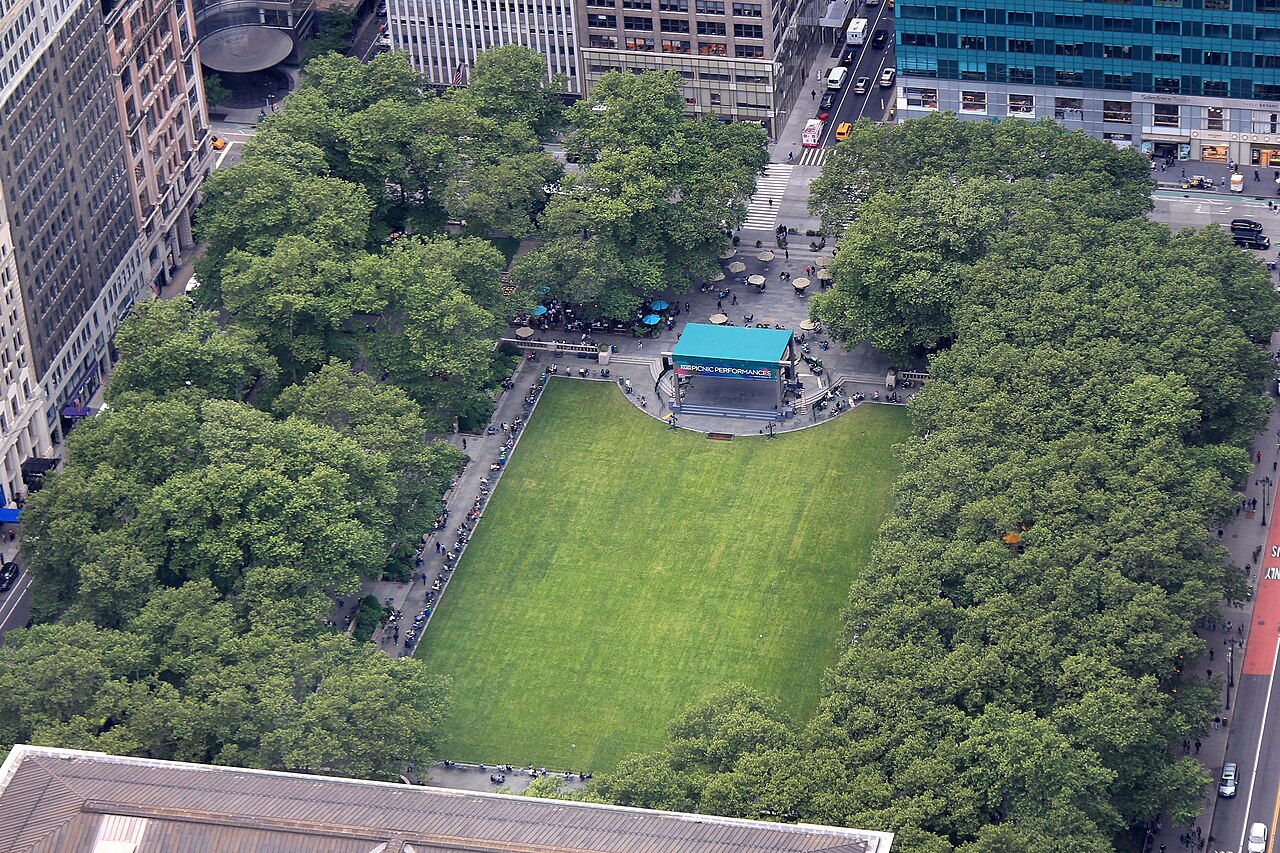
Bryant Park from One Vanderbilt in 2022, with the lawn and the Picnic Performances stage. Photograph by Larry D. Moore, via Wikimedia Commons. CC BY 4.0.
From potter's field to reservoir walls
The site's public life began early. In 1686 the colonial governor, Thomas Dongan, designated the area public property, and in 1822 the land came under the jurisdiction of New York City. One year later the city turned it into a potter's field, a burial ground for unknown and indigent New Yorkers, which operated until 1840. The graves were cleared for a project that transformed the city: the Croton Distributing Reservoir, built between 1839 and 1842 on the adjacent plot where the library now stands. The reservoir was a man-made, four-acre lake held behind granite walls fifty feet high and twenty-five feet thick, and it was the visible endpoint of the original Croton Aqueduct, which carried fresh water forty-one miles from upstate and cost $11.5 million, opening officially on July 4, 1842. New Yorkers did not just benefit from the reservoir; they visited it. Promenades along the tops of the walls offered some of the best views in the city.
The land of the old potter's field next door became Reservoir Square. The Common Council ordered a park built there in 1846; it was formally laid out as Reservoir Park in 1870 and given a $72,000 renovation a year later. The reservoir itself outlived its usefulness as the city built bigger water systems, and after years of delays it was demolished, a date the park's own history gives as 1900, while the Parks Department places the removal in the 1890s. Either way, the walls came down for the library that now occupies the spot. Fragments of reservoir foundation were found during later excavations and are built into the library's base.
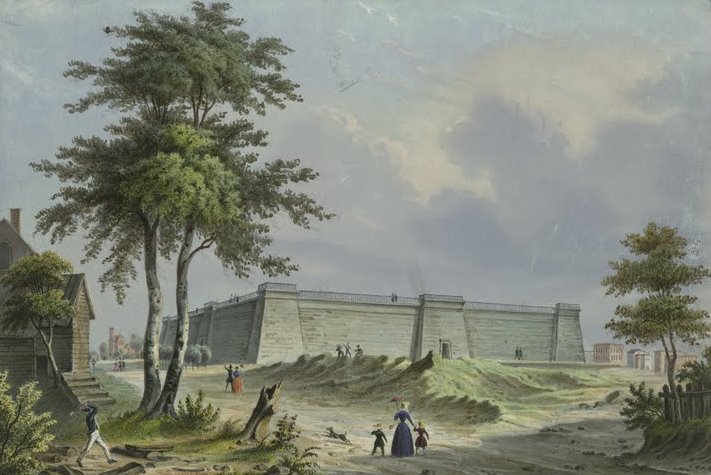
The Croton Distributing Reservoir in 1850, where the library now stands. Unknown artist, public domain, via Wikimedia Commons.
The Crystal Palace and the tower next door
In 1853, Reservoir Square hosted one of the most ambitious buildings ever raised in America. Inspired by London's Great Exhibition of 1851, New York built its own Crystal Palace for the Exhibition of the Industry of All Nations, designed by Georg Carstensen and Charles Gildemeister in the shape of a Greek cross of glass and iron, crowned by a dome one hundred feet across. President Franklin Pierce spoke at the opening on July 14, 1853. More than four thousand exhibitors showed the industrial wares and art of the age, and over a million visitors came, one of the country's first great tourism booms, though the sponsors still lost $300,000. The exhibition closed on November 1, 1854, and the building survived only four more years: on October 5, 1858, the Crystal Palace burned to the ground.
Its companion structure had gone first. The Latting Observatory, a 315-foot iron-and-wood tower built beside the fairground in 1853, was for a moment the tallest structure in the United States, taller than anything in the city, with steam elevators carrying visitors to views of Staten Island, Queens and New Jersey. It burned in 1856. Between the two fires, the square also saw harder use: during the Civil War it was an encampment for Union troops, and the draft riots of July 1863 reached its very edge, when a mob burned the Colored Orphan Asylum on Fifth Avenue between 43rd and 44th Streets.
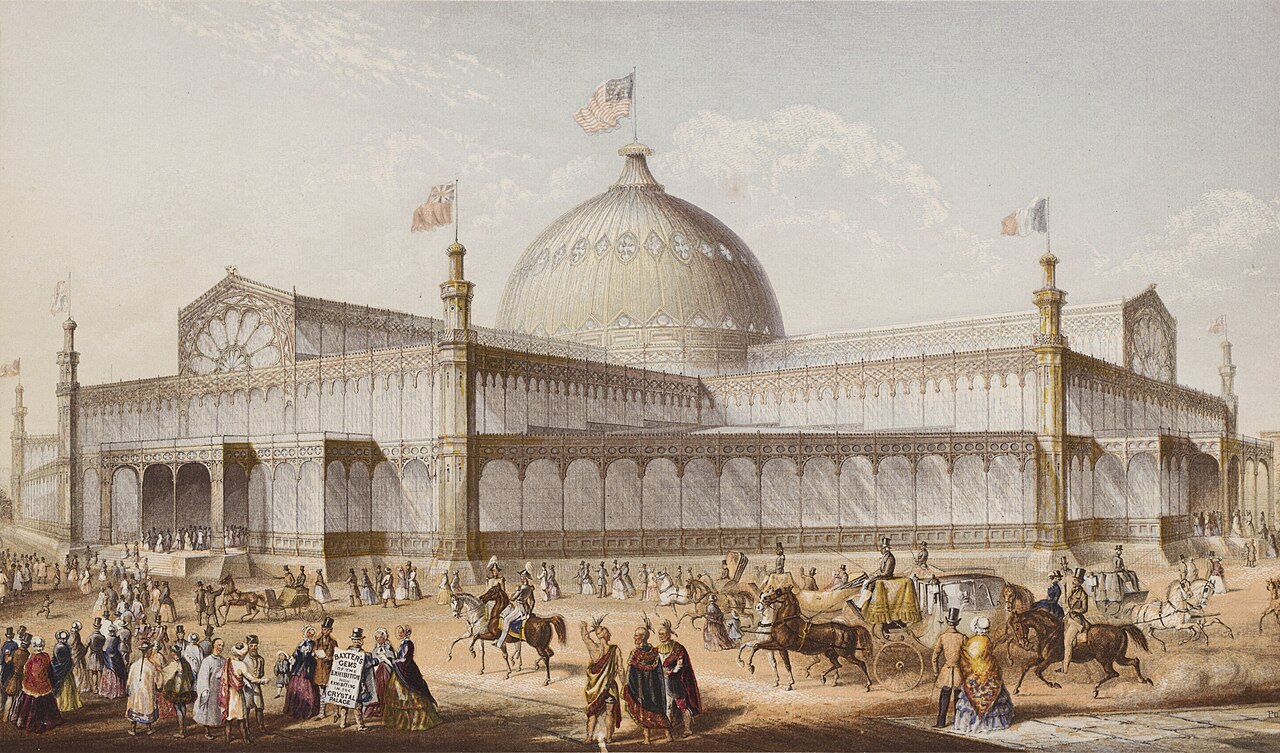
The New York Crystal Palace, from the illustrated description of the building published in 1853. Karl Gildemeister, public domain, via Wikimedia Commons.
A name, a library and a subway
In 1884 the square was renamed Bryant Park, honoring William Cullen Bryant, the Romantic poet, civic reformer and longtime editor of the New York Evening Post, who had died in 1878. Around the same time the city approved the designs of John Merven Carrère and Thomas Hastings for the New York Public Library's Beaux-Arts central building on the old reservoir site; it was completed in 1911, with a raised terrace at the rear looking over the park. The park's next decades were rough. From 1922 to 1927, construction of the IRT subway along 42nd Street closed the park's north half as contractors used it to store equipment and debris, prompting a 1936 New Yorker writer to call it one of the most "badgered and turned-up lots in the world." In 1932 a full-size replica of Federal Hall went up behind the library for the Washington bicentennial, then stood boarded up until it was demolished in April 1933.
The park's present bones date from the redesign that followed. An Architects' Emergency Committee competition chose a plan by Queens architect Lusby Simpson: a great central lawn, formal paths, stone balustrades, allées of London plane trees and, at the west end, an oval plaza around the Josephine Shaw Lowell Memorial Fountain. Robert Moses, the new parks commissioner, pushed the plan through in 1934 with consulting architect Aymar Embury II and landscape architect Gilmore D. Clarke, and the rebuilt park opened on September 14, 1934. It was this French classical design that the Landmarks Preservation Commission cited in 1974 when it made Bryant Park a Scenic Landmark, calling it "a prime example of a park designed in the French Classical tradition."
Decline and the most studied comeback in urbanism
Designation could not stop the decline. By the 1960s and 1970s the elevated lawns and hedges hid drug dealing, and by 1979, in the park corporation's own retelling, the city seemed to have given up on Bryant Park. That year the Rockefeller Brothers Fund asked the sociologist William H. Whyte, known as Holly, to study the place; his verdict was that if you hired the dope dealers yourself, you could not assemble a more villainous crew. In 1980 the fund backed a new nonprofit, the Bryant Park Restoration Corporation, founded by Andrew Heiskell, chairman of Time Inc. and of the New York Public Library, and Daniel A. Biederman, a young downtown-management consultant. Their seven-year push added maintenance, kiosks and events, and by the corporation's account crime in the park fell by 92 percent while annual visitation doubled.
In the summer of 1988 the city approved the corporation's rebuilding plans: new entrances to open sight lines from the street, a landscape plan by Hanna/Olin with lush perennial plantings by Lynden Miller, restored monuments, renovated restrooms, and two restaurant pavilions with four concession kiosks designed by Hardy Holzman Pfeiffer Associates to generate revenue. The rebuilt park reopened in April 1992 to praise from urbanists and the press, and by the late 1990s a sunny weekday could draw some 4,000 people at lunchtime. The Bryant Park model, a nonprofit managing a public park with earned revenue, has since been exported to parks across the country.
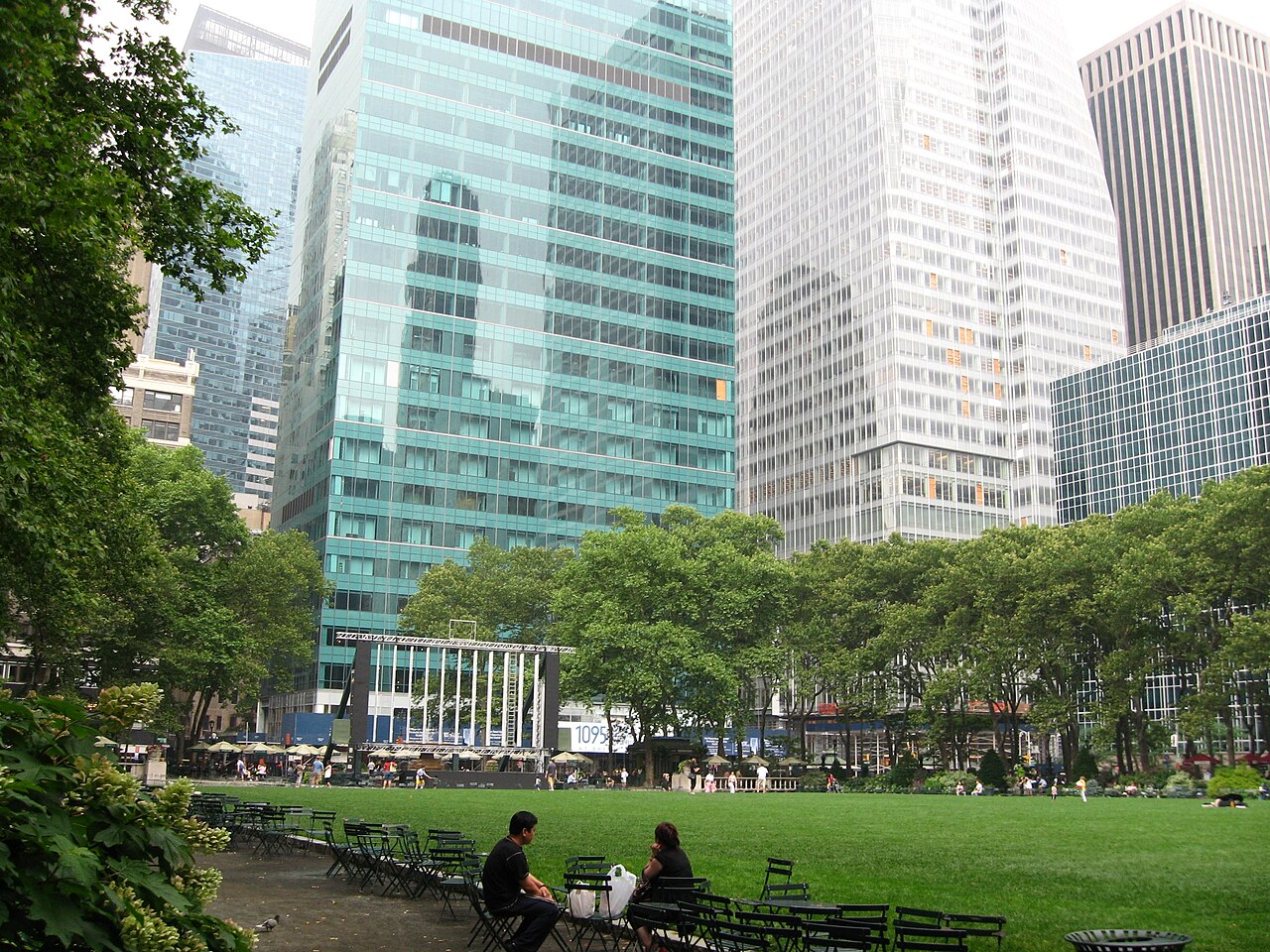
The lawn and its movable chairs, the signature of the rebuilt park. Photograph by Jim Henderson, public domain, via Wikimedia Commons.
Who owns Bryant Park today?
The ownership has never changed: Bryant Park is public land, part of the city park system under the New York City Department of Parks and Recreation, as it has been since the 1840s. What changed in 1980 is who runs it. The park is managed, programmed and maintained by the Bryant Park Corporation, the nonprofit private management company Biederman and Heiskell founded with support from the Rockefeller Brothers Fund, under agreement with the city. The corporation, not the Parks Department, hires the gardeners, sets the events calendar, licenses the kiosks and raises the money. It is the oldest and most cited arrangement of its kind in the country, and the corporation is explicit that the park remains public property that it manages on the city's behalf.
Where can you eat or drink at Bryant Park?
The park's own listings split the options between year-round and seasonal. Year-round kiosks include Breads Bakery, Casa Toscana, Joe Coffee and Wafels & Dinges, plus a park shop for souvenirs. In the colder months the Winter Village takes over the lawn with a skating rink, the Rinkside Bar by Stout NYC, the Lodge food hall and bar, and rows of holiday shops; warmer months bring back outdoor spots like the Café 'cito and Canoe Bar, along with the park's picnic provisions. The mix changes with the seasons, which is half the point: the corporation programs the park the way a manager programs a mall, so there is always a reason to come back.
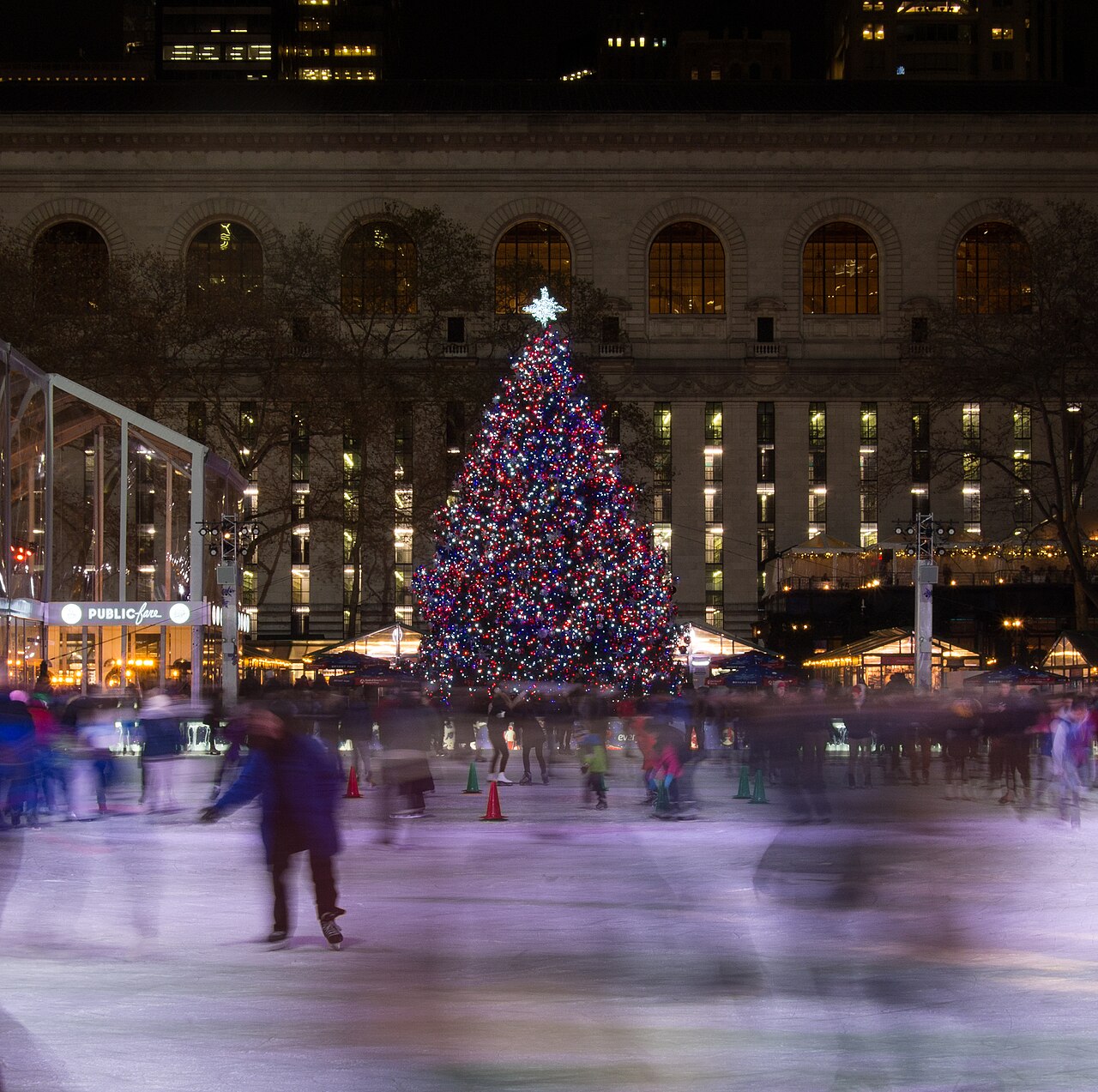
The Winter Village rink and holiday tree, with the library's rear facade behind. Photograph by Rhododendrites, via Wikimedia Commons. CC BY-SA 4.0.
Sources
- Bryant Park Corporation, History of Bryant Park
- Bryant Park Corporation, Management and Board
- NYC Parks, Before They Were Parks, The Daily Plant, March 2, 2009
- Bryant Park Corporation, History of Bryant Park: Modern Times
- New York Courts, Bryant Park: A History
- Bryant Park Corporation, Shop + Eat
Visiting Bryant Park
- Address: The park fills the block behind the New York Public Library, between Fifth and Sixth Avenues and West 40th and 42nd Streets.
- Hours and admission: The park is free and open daily; hours shift by season and are posted at bryantpark.org.
- Year-round food: Breads Bakery, Casa Toscana, Joe Coffee and Wafels & Dinges kiosks, listed on the park's Shop + Eat page.
- Seasonal: The Winter Village skating rink and holiday shops run through the cold months; the Lawn, carousel, ping pong, board games and Picnic Performances anchor the warm months.
Facts above were read on the official pages on October 31, 2026. Kiosk lineups and seasonal programs change, so confirm on bryantpark.org before you go.