Why Was the Original Pennsylvania Station Demolished?
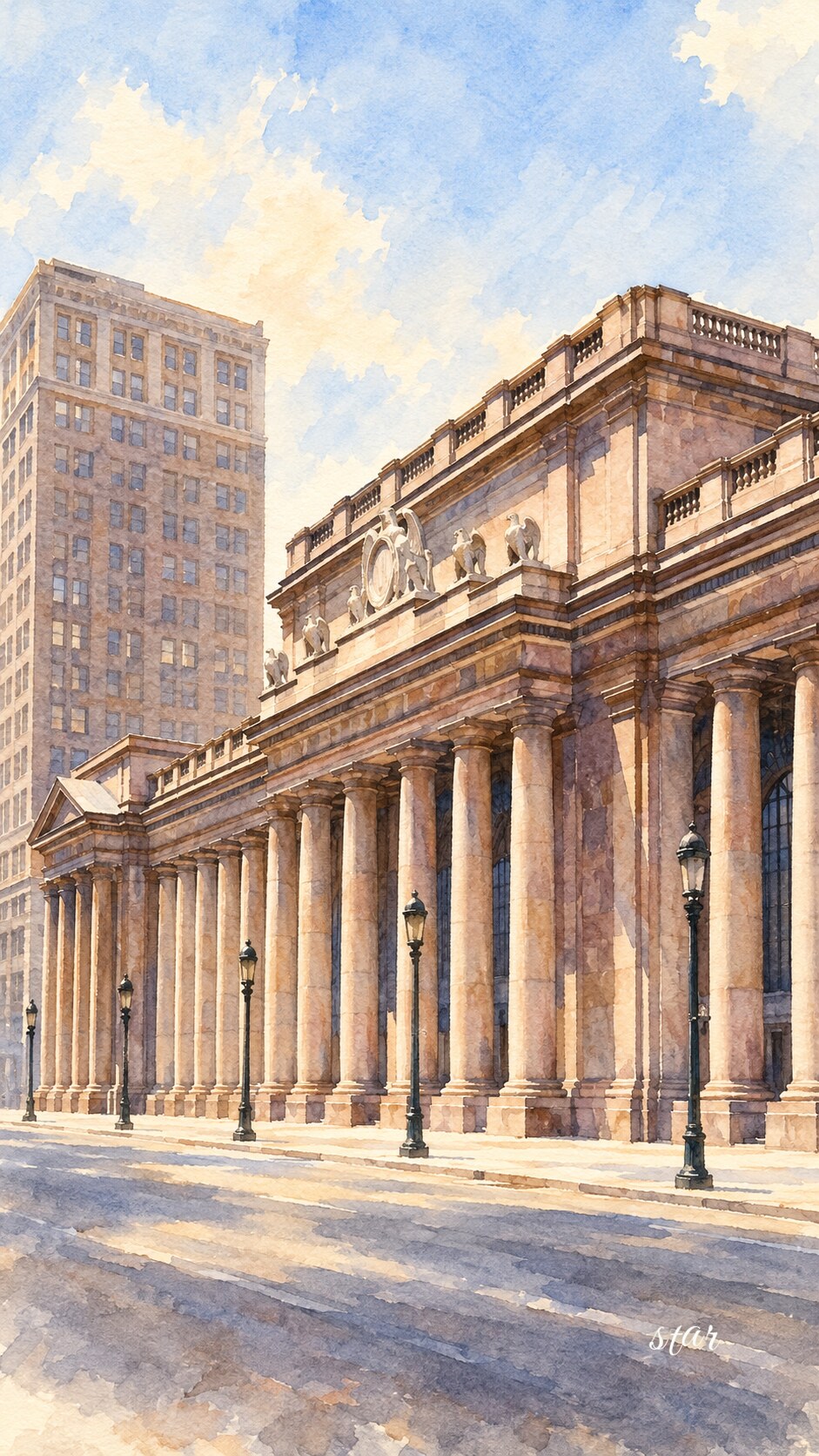
Original watercolor art illustration by Solomon Rokowsky. Based on a public-domain historical photograph.
The original Pennsylvania Station was demolished beginning on October 28, 1963, because the Pennsylvania Railroad was losing money on passenger trains and its Midtown land had become worth more than the station on top of it. The railroad sold the air rights, traded its palace for a smaller, rent-free station underground, and took a stake in the Madison Square Garden arena and office complex that rose in its place. The deal made business sense at the time, but the loss of one of America's great buildings shocked the country and helped create New York's landmarks law.
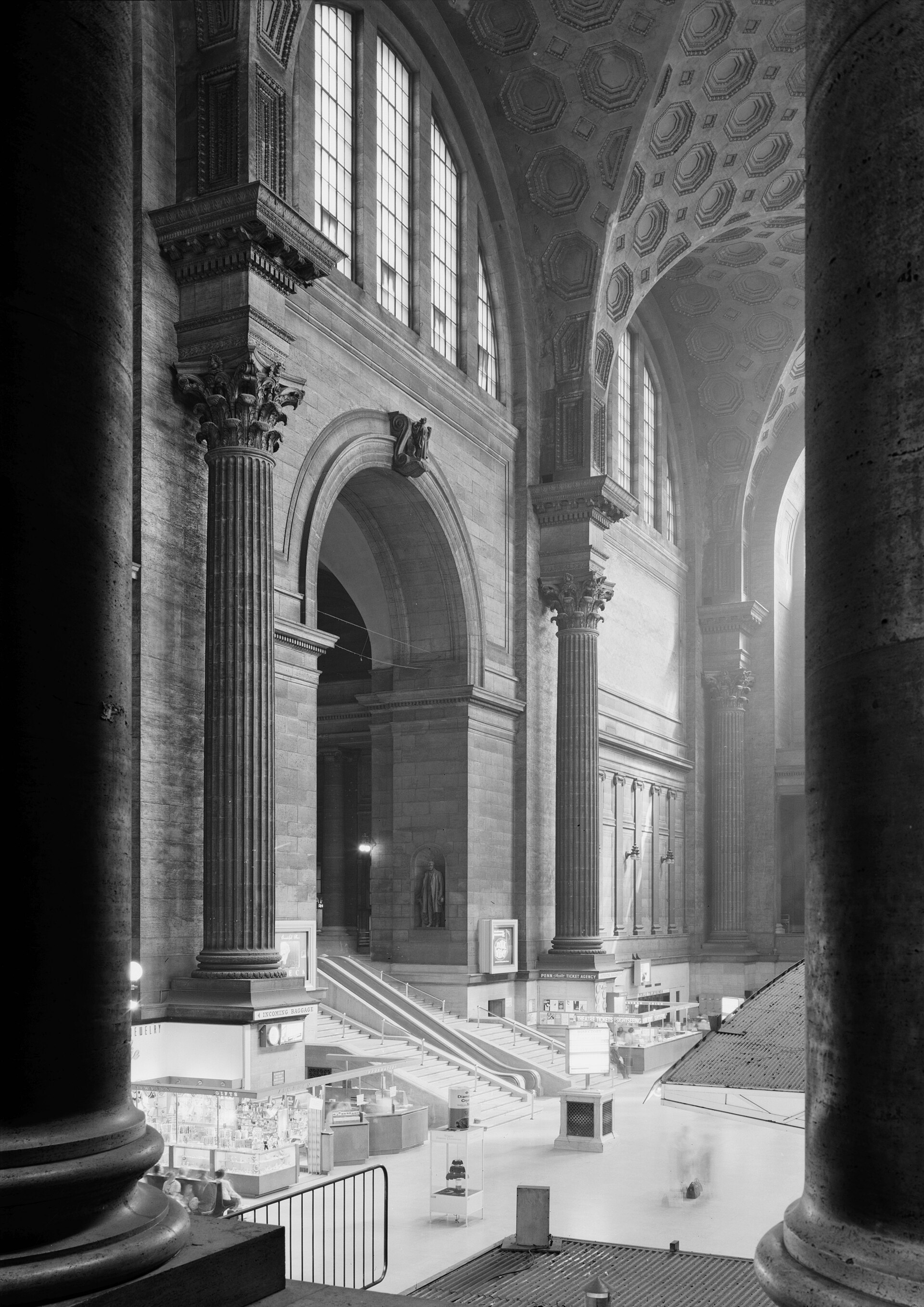
The main waiting room of the original Penn Station, modeled on the Baths of Caracalla in Rome. Cervin Robinson for the Historic American Buildings Survey, via Wikimedia Commons. Public domain.
What was the original Penn Station like?
Pennsylvania Station opened on November 27, 1910, as the New York gateway of the Pennsylvania Railroad. The building covered eight acres and two full city blocks, from Seventh to Eighth Avenues and from 31st to 33rd Streets. The PRR hired McKim, Mead & White, the firm behind many of the era's grandest buildings, and Charles Follen McKim gave New York a Beaux-Arts masterpiece in pink granite, with a colonnade of Doric columns along Seventh Avenue.
Inside, the materials were almost defiantly luxurious. The lower walls were lined in travertine sourced from Campagna in Italy, while the upper walls were steel framework clad in plaster decorated to resemble the stone below. The centerpiece was the main waiting room, inspired by the Baths of Caracalla in Rome, with a coffered vaulted ceiling 150 feet high. Beyond it, the concourse and train shed were framed in soaring steel and glass. The Historic American Buildings Survey, which documented the station before its destruction, treated the head house and train shed as one of the great architectural works of New York City.
For more than half a century, this was how millions of people met New York. Arriving passengers climbed from the platforms into a room built like a Roman bath, passed through arcades lit by daylight, and stepped out into Midtown. The building was not just a station; it was the city's front door.
The original Pennsylvania Station in 1910, the year it opened, with the McKim, Mead & White colonnade on Seventh Avenue. Photographer not identified, via Wikimedia Commons. Public domain.
Why did the railroad want it gone?
The short answer is money. After World War II, Americans abandoned trains for cars and airplanes, and the Pennsylvania Railroad's passenger business shrank year after year. The railroad optioned the station's air rights to the real estate developer William Zeckendorf as early as 1954. The land under the terminal, two prime Midtown blocks, was suddenly the most valuable thing the railroad owned.
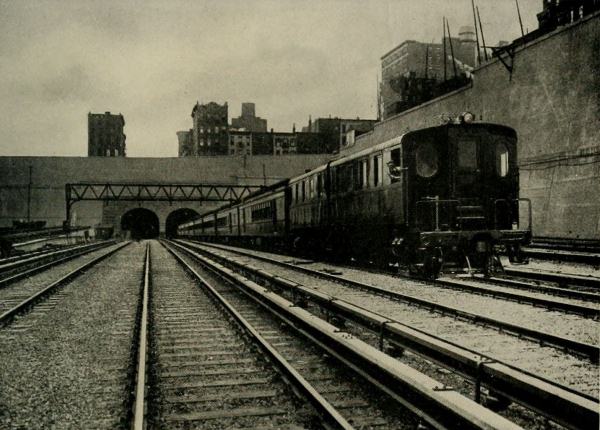
The final deal, announced in the early 1960s by Irving Mitchell Felt, president of Graham-Paige, the company that purchased the air rights, was simple and brutal. The Pennsylvania Railroad would get a brand-new, air-conditioned, smaller station completely below street level at no cost, plus a 25 percent stake in the new Madison Square Garden complex. In exchange, the 1910 building would come down, and a new Madison Square Garden arena and the Pennsylvania Plaza office towers would be built over the tracks. The trains never stopped running; the station was demolished around them.
Preservation was barely an option on the table. New York had no landmarks law yet, and there was no legal mechanism to stop an owner from tearing down even a beloved building. The railroad was a private company in financial trouble, and to many businessmen of the era the old station looked like an oversized relic.
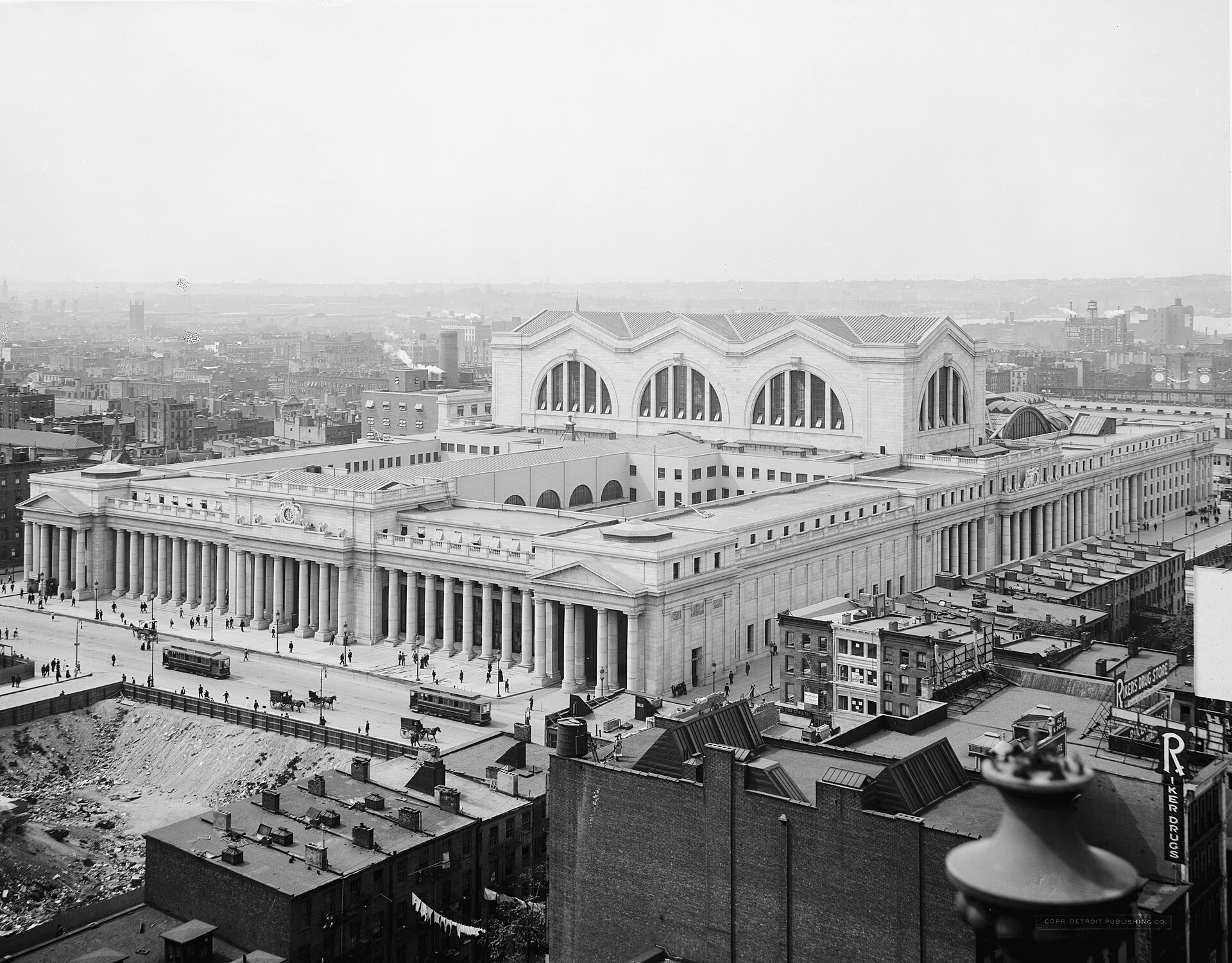
Pennsylvania Station from the air in the 1910s, filling two city blocks between Seventh and Eighth Avenues. Detroit Publishing Company, via Wikimedia Commons. Public domain.
What happened when demolition began?
Demolition started on October 28, 1963, and it did not go quietly. Architects and writers protested in a way New York had rarely seen over a building. A group calling itself the Action Group for Better Architecture in New York picketed the station. The New York Times covered the demonstration under the headline "Picket; Penn Station Demolition Begun; 6 Architects Call Act a 'Shame.'" Ada Louise Huxtable, the paper's architecture critic, wrote in 1963: "The tragedy is that our own times not only could not produce such a building, but cannot even maintain it."
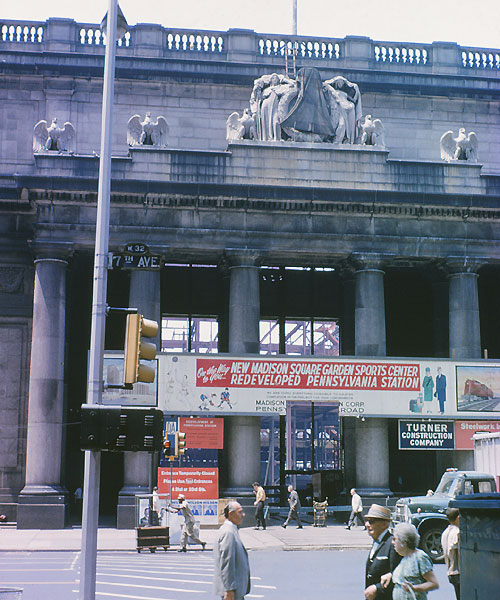
Demolition of the original Penn Station in progress, June 25, 1966. Photo by Hikki Nagasaki, via Wikimedia Commons. Public domain.
The most quoted judgment came from the architectural historian Vincent Scully, who captured exactly what the trade meant: "One entered the city like a god; one scuttles in now like a rat." The demolition created international outrage, and some commentary at the time compared the head house unfavorably to other losses like the old Waldorf-Astoria, razed for the Empire State Building, though defenders of the deal called the demolition progressive in an age of declining rail travel.
Not everything was lost to the landfill. The station's 22 eagle sculptures, each carved with a two-ton presence, were scattered to new homes. Surviving eagles stand at the United States Merchant Marine Academy at Kings Point on Long Island, the Long Island Rail Road station in Hicksville, the Valley Forge Military Academy in Pennsylvania, and as far as Vinalhaven, Maine. Pieces of granite and decorative ironwork ended up in the New Jersey Meadowlands, some of it dumped as fill.
What did New York lose, and what changed?
What replaced the palace was functional and little loved. The new Madison Square Garden opened on February 11, 1968, with Two Penn Plaza and the office slabs of Pennsylvania Plaza around it, and the station itself became a cramped underground complex of low ceilings and fluorescent light. Scully's rat line stuck because it was accurate: passengers still arrived by the millions, but now they scurried through corridors under an arena.
The backlash, however, changed American preservation. The head house's demolition is widely cited as a catalyst for the architectural preservation movement in the United States, particularly in New York City. In 1965, two years after the wrecking began, New York passed its landmarks preservation act and created the Landmarks Preservation Commission. When Grand Central Terminal faced a similar threat in the following decade, that law held, and in 1978 the United States Supreme Court upheld it. Preservationists are fond of the bitter joke that Penn Station died so that Grand Central could live.
The story has a partial happy ending. Senator Daniel Patrick Moynihan, who had shined shoes in the old station during the Great Depression, championed for decades the idea of expanding the terminal into the James A. Farley Post Office, McKim, Mead & White's 1912 companion building across Eighth Avenue. Moynihan Train Hall, a $1.6 billion conversion designed by Skidmore, Owings & Merrill, opened on January 1, 2021, restoring daylight and grandeur to at least part of the complex. Amtrak and Long Island Rail Road passengers now wait under a 92-foot-high steel-and-glass skylight in the Farley building's old mail sorting room. It is not the old Penn Station, nothing will be, but it is an admission that the city got 1963 wrong.
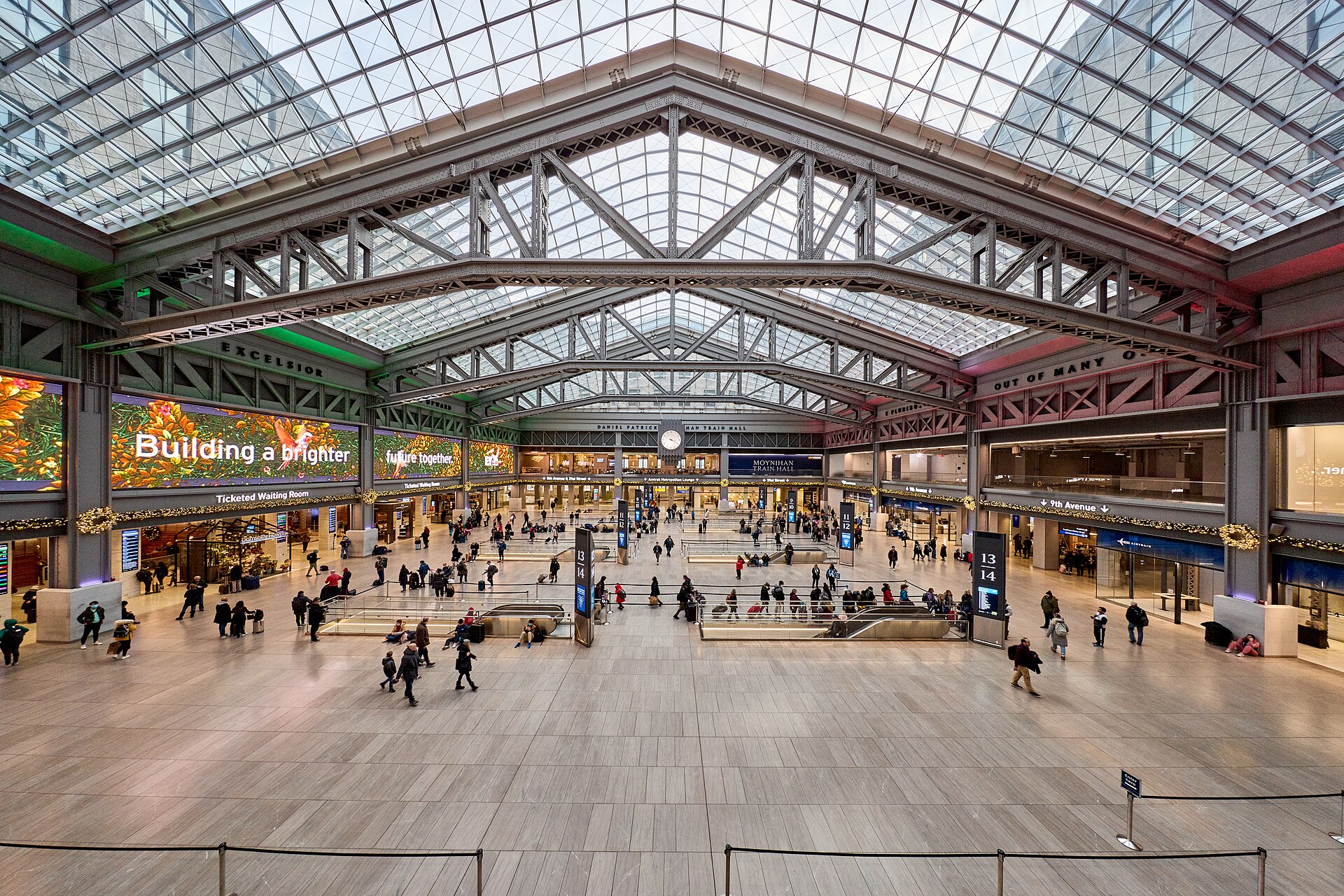
Moynihan Train Hall in the Farley Post Office building, opened January 1, 2021, across Eighth Avenue from Penn Station. Photo by D. Benjamin Miller, via Wikimedia Commons. CC0.
Who owns Penn Station today?
Amtrak. The national railroad describes itself as "the owner and steward of New York Penn Station," responsible for maintaining all of the station's platforms, tracks, signals, fire life safety systems and tunnel monitoring. Three railroads run trains through it: Amtrak, the Long Island Rail Road and NJ Transit.
The arena overhead has a different owner. Madison Square Garden, the 1968 arena that rose where the head house stood, belongs to Madison Square Garden Entertainment Corp., which lists the Garden first among the venues in its portfolio. The station's next rebuilding changed hands as well: in April 2025 the U.S. Department of Transportation announced it was taking control of the roughly $7 billion reconstruction project away from the MTA, putting the federal government and Amtrak in charge of redesigning the station Amtrak already owns. The trains, the arena and the reconstruction project share two city blocks, but they answer to different owners.
Where can you eat or drink at Penn Station today?
The best answer is across Eighth Avenue. Moynihan Train Hall's official directory lists a full food hall: Avra for Greek seafood, Pastrami Queen, Burger Joint, La Esquina for tacos, E.A.K. Ramen, NAYA for Middle Eastern bowls, Sauce Pizzeria, H&H Bagels, Alidoro for Italian sandwiches, and Vesuvio Bakery, plus Blue Bottle Coffee, Birch Coffee, Starbucks, Cha Cha Matcha, Maman, Laduree, Davey's Ice Cream, Pressed Juicery, YONO Sushi by BondST, Chopt, and Threes Brewing for beer. According to the train hall's official site, Moynihan Train Hall at 421 Eighth Avenue is open to the public daily from 5:00 AM to 1:00 AM; overnight, from 1:00 AM to 5:00 AM, Amtrak and LIRR services are available only at Penn Station across Eighth Avenue. Listings and hours here were read on the official pages on November 3, 2026.
Sources
- Amtrak Media, "Infographic: New York Penn Station" (December 2024)
- Amtrak, New York Penn Station page
- U.S. Department of Transportation, announcement taking control of the Penn Station overhaul (April 2025)
- Associated Press, "Trump administration takes over $7B reconstruction project for NYC's Penn Station" (April 17, 2025)
- Madison Square Garden Entertainment Corp., "MSG Entertainment Completes Spin-Off From Sphere Entertainment" (April 2023)
Visiting Penn Station
Pennsylvania Station sits below Madison Square Garden between Seventh and Eighth Avenues from 31st to 33rd Streets, serving Amtrak, the Long Island Rail Road and NJ Transit, with the 1, 2, 3, A, C and E subway lines adjacent. Moynihan Train Hall, at 421 Eighth Avenue in the Farley Post Office building, is open to the public daily from 5:00 AM to 1:00 AM, and its main hall, with the skylight and the original steel trusses, is free to enter. Nothing visible remains of the 1910 head house above ground, but the platforms and tracks are original, and the eagles that survive stand elsewhere around the region. These details were read on the official pages on November 3, 2026.