Why Is Times Square Called Times Square? The Newspaper, the Subway and the Ball
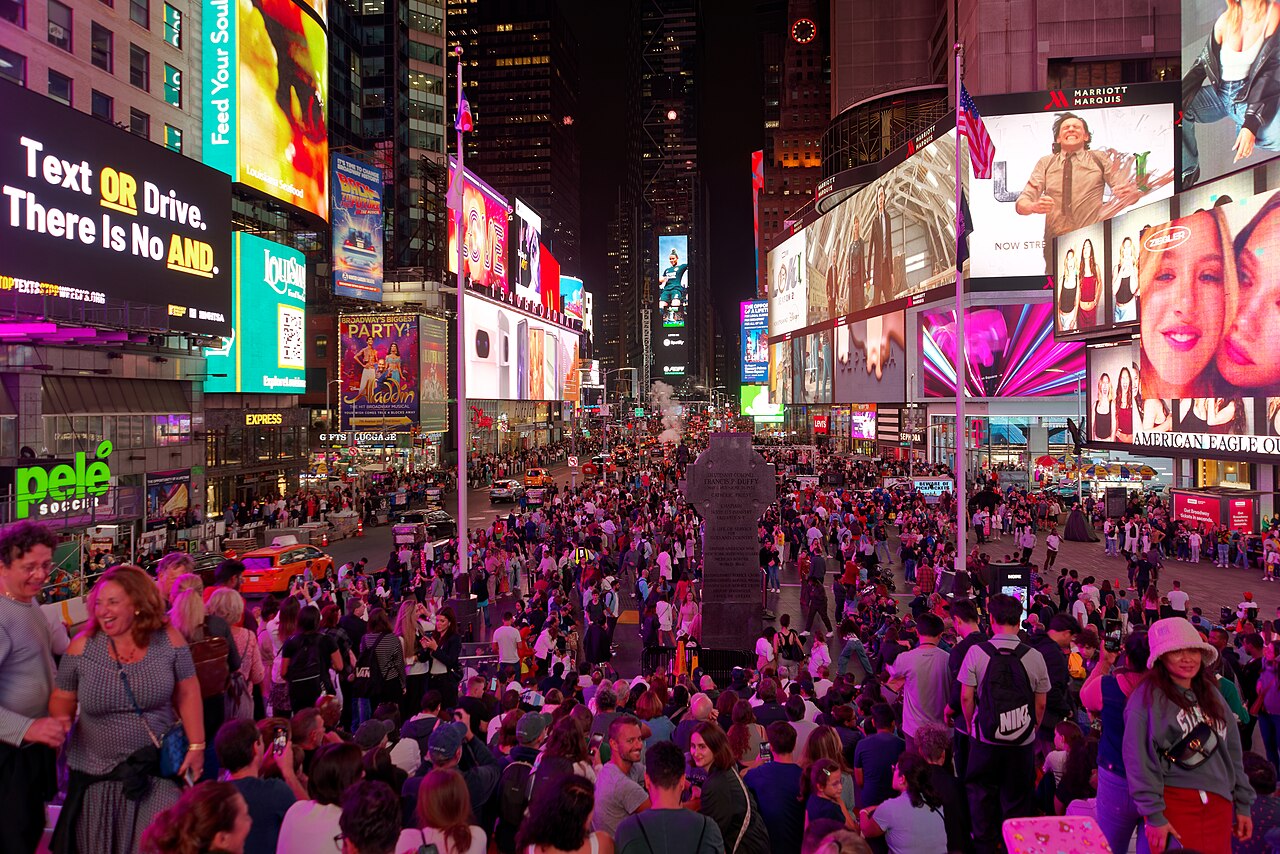
Times Square at night. Photograph by Jakub Hałun, via Wikimedia Commons. CC BY 4.0.
Times Square is the bowtie-shaped junction where Broadway crosses Seventh Avenue between 42nd and 47th Streets. It took its name in April 1904 from The New York Times, which was finishing a headquarters tower on the small triangle at its south end. The name was only a few months older than the subway station underneath, and the New Year's Eve Ball came a few years after that. This article covers how each piece got there, using the Times Square Alliance's own history pages, the paper's own archive, the New York Public Library and city records.
What was here before Times Square?
The intersection was Long Acre Square, named after London's carriage district. The Times Square Alliance's history page, drawn from a Museum of the City of New York essay, says the square served as the early site of William H. Vanderbilt's American Horse Exchange, and that in the late 1880s it was a large open space surrounded by drab apartments. The New York Public Library's history of the district notes that the city's growth pushed the theater district into the area in the 1880s and 1890s.
Electricity changed the square's character. The Alliance credits theater advertisements and street lights with making the area safer and more inviting, and NYPL records that Broadway earned the nickname "The Great White Way" around the time it became possibly the first street in America fully lit by electric light. The moniker moved uptown with the theaters, and NYPL notes that advertiser O.J. Gude has been credited as its creator. On the triangular plot where the tower would rise stood the Pabst Hotel, shown in an NYPL photograph.
Why is it called Times Square?
Because of the newspaper. Adolph S. Ochs, the owner and publisher of The New York Times from 1896 to 1935, chose the highly visible triangle between Broadway, Seventh Avenue and 42nd and 43rd Streets for a new headquarters. According to the paper's own 2004 centennial account, Mayor George B. McClellan signed the resolution renaming Long Acre Square on April 8, 1904, and the next morning's headline read "Times Square Is the Name of City's New Centre." The Times argued the name grew out of the need for a distinctive title for the subway station in the tower's basement, since "Forty-second Street" would have collided with Grand Central's stop and "Broadway" with many others.
The sources disagree about how active the paper was in the change. Ochs told the Syracuse Herald, as quoted on the Alliance's history page, "I am pleased to say that Times Square was named without any effort or suggestion on the part of The Times." Yet the Alliance's New Year's Eve history says Ochs "had successfully lobbied the city" for the renaming, and NYPL writes that The Times and the Interborough Rapid Transit Company together petitioned the city. The Times's 2004 account, citing its 1904 archive, credits IRT president August Belmont with suggesting the change to the Rapid Transit Commission.
The new subway mattered as much as the new name. The Alliance says that in 1905, its first year of operation, the IRT's Times Square station served almost five million passengers, and that by the late 1920s subway lines, elevated lines and bus routes all stopped at West 42nd Street. NYPL calls the station the system's most important hub from the start, and says it remains the city's most used transit station.
What was the Times Tower?
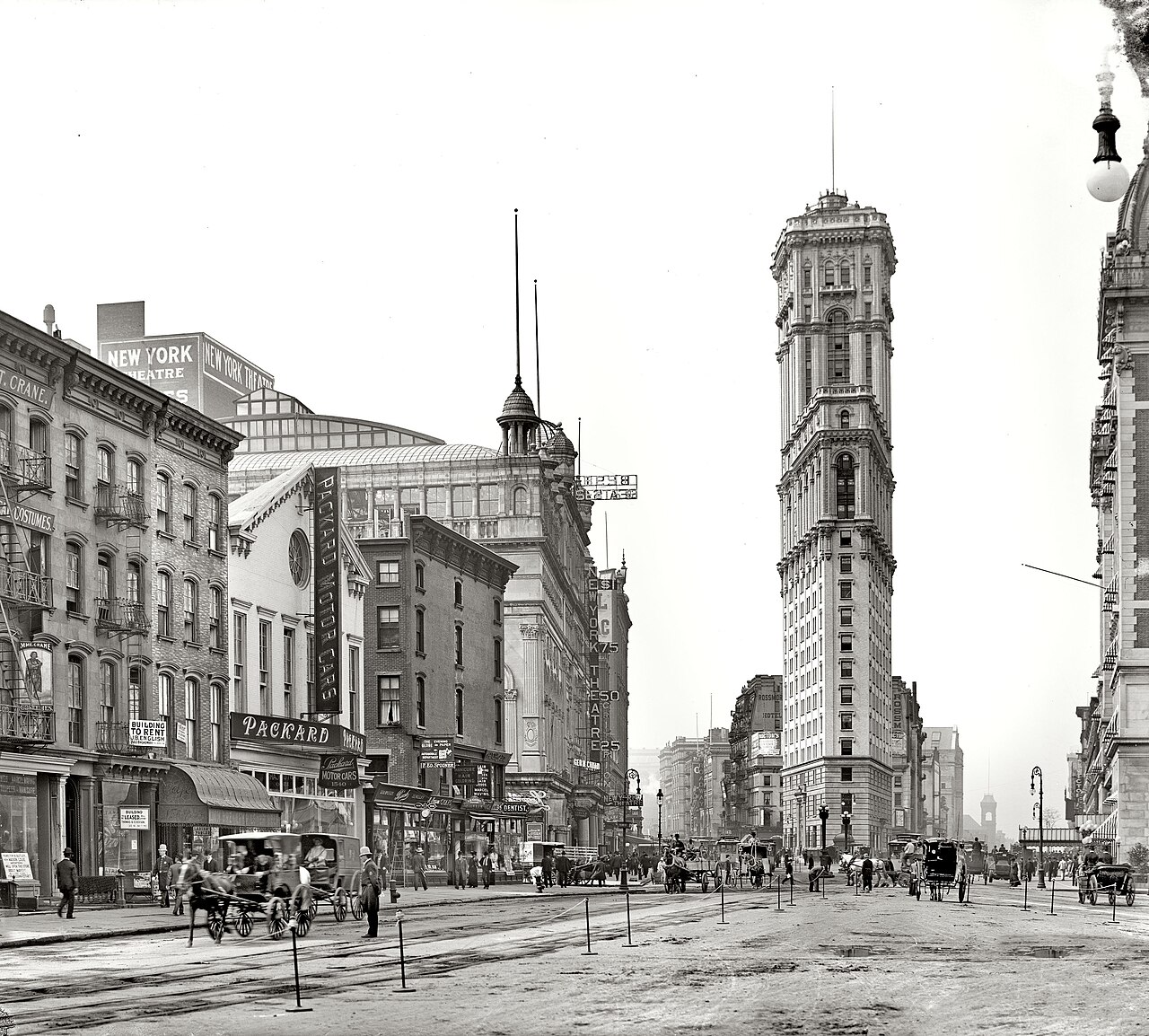
The Skyscraper Museum says Ochs hired architect Cyrus Eidlitz and his partner Andrew McKenzie to design a 25-story skyscraper modeled on Giotto's campanile, the medieval bell tower of the Florence Cathedral, which the publisher had admired on his European travels. The Alliance describes it as the second-tallest building in the city at the time. A 1904 advertisement quoted by The Times went further, boasting it would "probably be the tallest skeleton structure in New York, measuring 430 feet in all," so the sources differ on the ranking. The Alliance's ball history adds a qualification: second-tallest, or the tallest if measured from the bottom of its four sub-basements, which were built to handle the weight of the paper's printing presses.
The Times moved in during January 1905, per the Alliance. The museum says the building served as the paper's headquarters and printing plant from 1905 to 1913, with the press levels connected directly to the subway platforms for distribution. The Alliance's ball history says the paper outgrew the tower and relocated to 229 West 43rd Street in 1914, so the sources differ by about a year on the move. The building survives as One Times Square, the tower the ball drops from.
How did the New Year's Eve Ball start?
The first New Year's Eve party in the square came with the tower. The Alliance says revelers began celebrating in Times Square as early as 1904, when an all-day street festival marking the tower's official opening ended in fireworks set off from the building's base; it reports more than 200,000 attendees. Two years later the city banned the fireworks, so Ochs arranged a different signal: at midnight on December 31, 1907, a 700-pound iron-and-wood ball, five feet across and lit by one hundred 25-watt bulbs, was lowered from the tower's flagpole. It was built by a young immigrant metalworker named Jacob Starr, and for most of the twentieth century his company, sign maker Artkraft Strauss, lowered it. That first year, the Alliance says, waiters in the "lobster palaces" around the square wore battery-powered top hats flashing "1908" in tiny bulbs.
The ball has dropped every year since, with two exceptions: 1942 and 1943, when the ceremony was suspended for the wartime "dimout" and crowds greeted the year with a minute of silence and chimes from sound trucks. The Alliance lists the redesigns: a 400-pound wrought-iron ball in 1920, a 150-pound aluminum ball in 1955, an apple version for the "I Love New York" campaign from 1981 to 1988, a rhinestone-and-strobe upgrade in 1995, a crystal ball for the millennium, an LED ball for the 2007 centennial, and then, in 2008, a permanent Big Ball, twelve feet across and nearly six tons, with 2,688 crystal triangles and 32,256 LEDs, built by the owners of One Times Square. In November 2025 a ninth version, the Constellation Ball, debuted: 12.5 feet across, 12,350 pounds, with 5,280 Waterford crystals in round shapes.
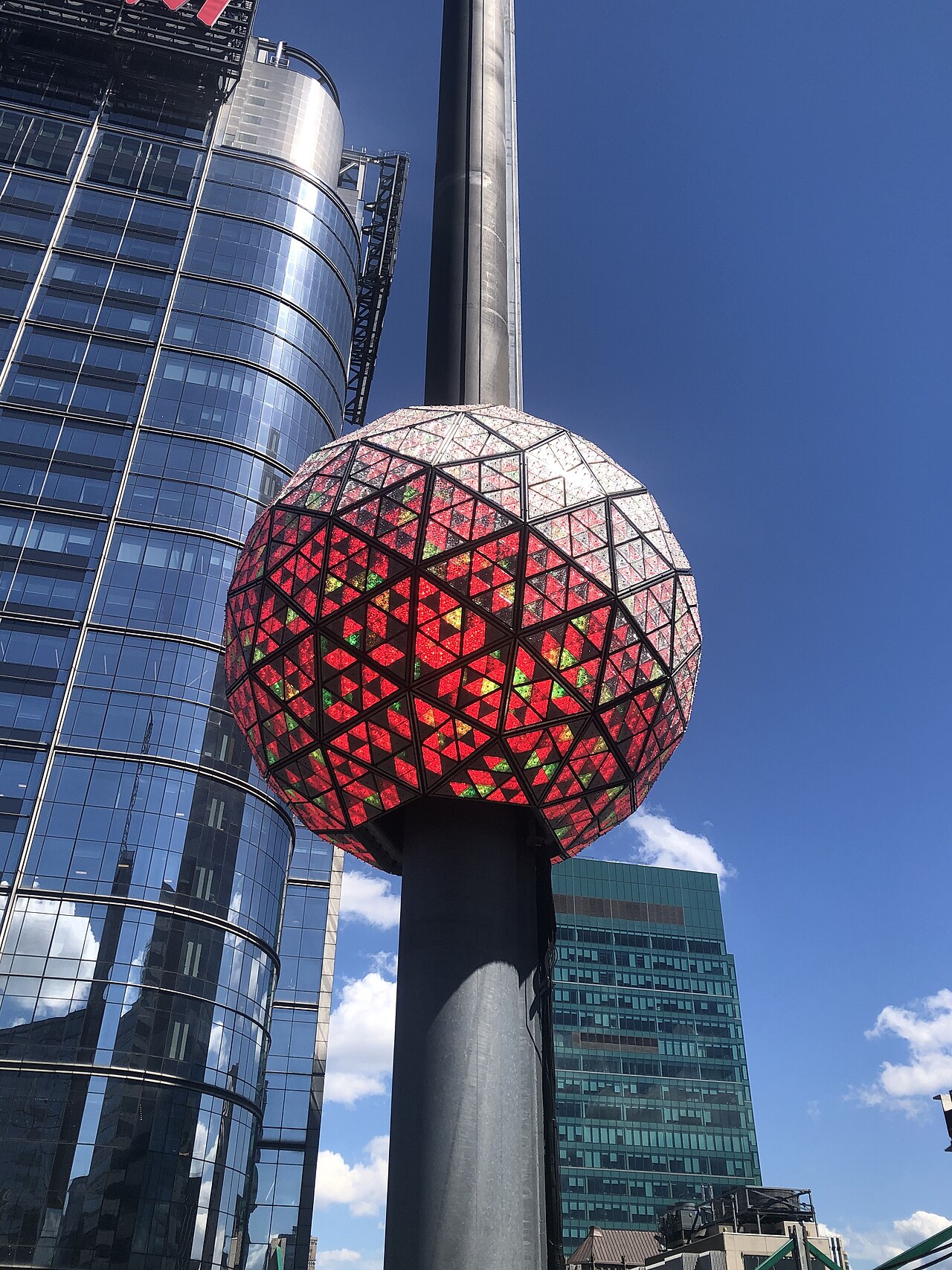
The New Year's Eve Ball above One Times Square. This photo shows the 2008 "Big Ball" design; a new Constellation Ball debuted in November 2025. Photograph by Scu ba, via Wikimedia Commons. Public domain (CC0).
What happened after the Times left?
The Times kept the tower until 1961, when it sold the building to Douglas Leigh, the designer behind many of the square's spectacular signs. The Alliance says Leigh stripped it to its steel frame and re-clad it in white marble as the headquarters of the Allied Chemical Corporation. NYPL notes that in later decades the electronic billboards on the building brought in more revenue than leasing it to tenants would. Jamestown, the tower's current owner, announced a $500 million redevelopment in April 2022 that it says will open much of the interior to the public for the first time in decades, with a viewing deck, a museum experience and event space. It calls the signage at One Times Square among the most valuable in the world.
The wider square had a harder century. The Alliance and NYPL both describe how the Depression turned many theaters into "grinder" houses, how peep shows and the sex trade spread after the 1960s, and how crack cocaine drove crime up in the late 1980s; NYPL cites a 1960 New York Times article calling West 42nd Street "the 'worst' in town." Redevelopment began with the 42nd Street project of the 1980s and 1990s, which NYPL says is sometimes called "Disneyfication." The Times Square Alliance, the district's business improvement district, was founded in 1992; it says its district covers most of the territory from 40th to 53rd Streets between Sixth and Eighth Avenues, plus Restaurant Row on West 46th Street. In May 2009 the city's Department of Transportation closed Broadway to vehicles between 47th and 42nd Streets under its Green Light for Midtown pilot, creating more than three acres of pedestrian plazas where traffic lanes had been.
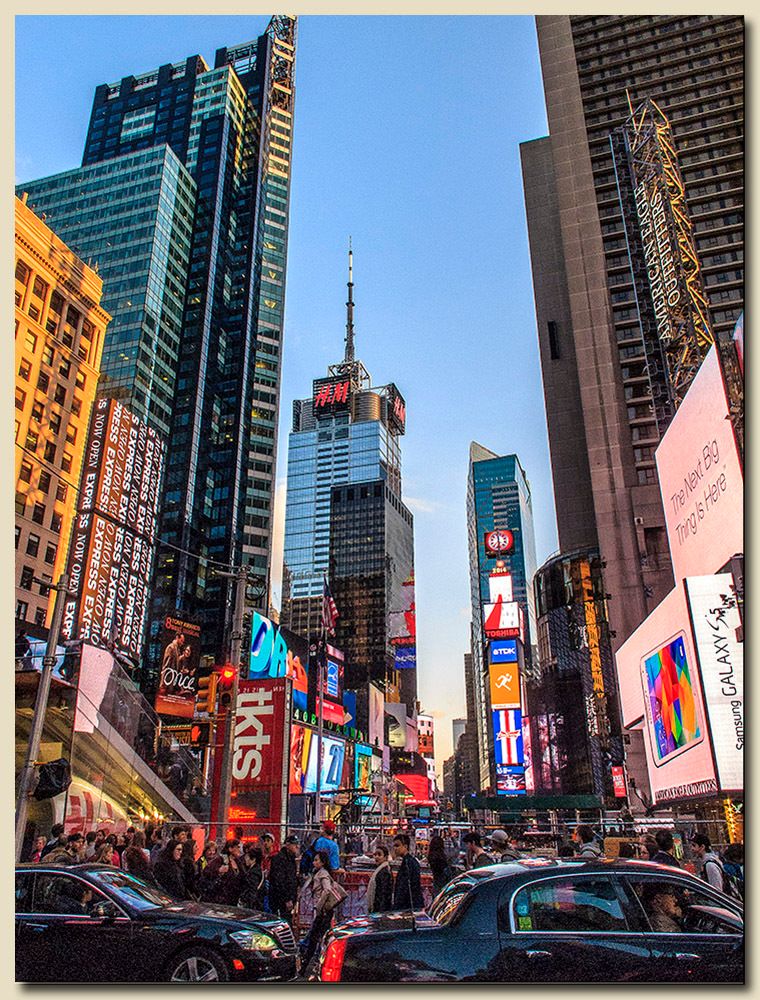
Times Square looking north from the TKTS booth. Photograph by Allen Lubitz, via Wikimedia Commons. CC BY 4.0.
Who owns Times Square?
Times Square is public space: its streets and pedestrian plazas belong to the city, and the 2009 plaza conversion was a city Department of Transportation project. The Times Square Alliance, founded in 1992, says it "works to improve and promote Times Square," running public safety and sanitation crews, arts programming and events including New Year's Eve. The district's most famous private property is One Times Square, owned by Jamestown, which is carrying out the redevelopment described above.
Where can you eat or drink at Times Square?
Times Square is a public square, so it runs no restaurants of its own. Eating and drinking there has its own history: NYPL describes the "lobster palaces" of the early twentieth century, such as Churchill's, as expensive restaurants with orchestras, dancing and floor shows, a defining feature of early Times Square until Prohibition. Today the Times Square Alliance maintains an online dining guide for the district, and its district includes Restaurant Row, the block of West 46th Street between Eighth and Ninth Avenues. The Alliance's site lists current restaurants there.
Sources
- Times Square Alliance, History of Times Square
- Times Square Alliance, NYE History & Times Square Ball
- Times Square Alliance, About the Alliance
- The New York Times, 100 Years Ago, an Intersection's New Name: Times Square, April 8, 2004
- New York Public Library, The Changing Face of Times Square
- The Skyscraper Museum, TEN TOPS: Times Tower
- Jamestown, One Times Square
- NYC Department of Transportation, Green Light for Midtown press release, May 19, 2009
Visiting Times Square
- Location: The junction of Broadway and Seventh Avenue, running roughly from 42nd to 47th Streets. The Times Square Alliance's district covers most of the area from 40th to 53rd Streets between Sixth and Eighth Avenues, plus Restaurant Row on West 46th Street.
- Hours: Times Square is public space and open at all hours. The pedestrian plazas on Broadway between 42nd and 47th Streets have been car-free since May 2009.
- Subway: The Alliance's Getting Around page lists Times Sq-42 St (1, 2, 3, 7, N, Q, R, W), 42 St-Port Authority (A, C, E) at 8th Avenue, and 49 St (N, R, W) at 7th Avenue.
- Tickets: None needed for the square. TDF runs the TKTS Times Square booth for same-day discount theater tickets, per TDF's site.
Checked against the Times Square Alliance getting-around page and TDF's TKTS page. The Alliance's site lists current alerts and events.