Trump Tower: How a Bonwit Teller Site Became a 58-Story Tower With 68 Floors on Paper
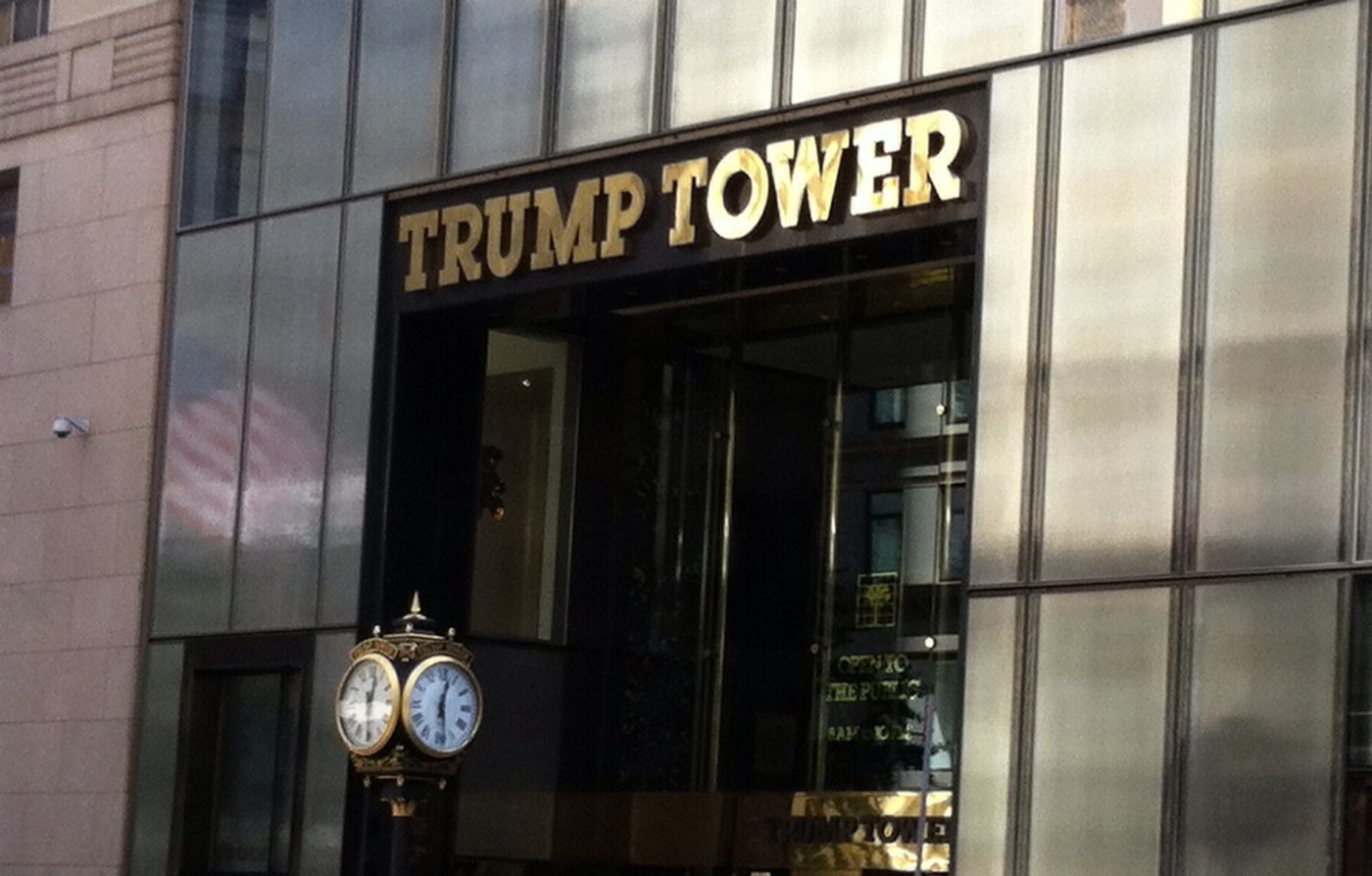
The entrance to Trump Tower at 725 Fifth Avenue. Photograph by SJJohnson, via Wikimedia Commons. CC BY-SA 4.0.
Trump Tower is the bronze-glass tower at Fifth Avenue and 56th Street that Donald Trump built on the site of the Bonwit Teller department store and finished in 1983. It is also a building whose numbers do not quite add up, whose lobby is legally a public space, and whose ownership is split between the people who live upstairs and a commercial condominium that carries a mortgage. This article follows what the sources say about how it was planned, what was torn down to make room, how tall it really is, and who owns what today.
What stood on the site before Trump Tower?
The site was the Bonwit Teller flagship. A Forbes history by the department-store writer Michael Lisicky describes it as a 12-story limestone and granite store designed by Warren and Wetmore, the architects of Grand Central Terminal. It was built as the home of M.I. Stewart and Co., which opened in October 1929, eight days before the stock market crashed. Forbes says Stewart failed within five months and Bonwit Teller took over the building. Bonwit Teller then stayed on Fifth Avenue for almost five decades.
By the late 1970s the store was losing money. Forbes says Trump learned that its owners needed cash and pressed them for years to sell. The Trump Organization's own 40th-anniversary page for the tower dates his interest to 1971, when he was still working on the Grand Hyatt. It says he persuaded the store's owner, Genesco, to sell, and that the land belonged to the Equitable Life Assurance Society, which traded the land for a 50 percent stake in the project. The same page says Trump also negotiated for the air rights above the neighboring Tiffany flagship. Forbes says he bought the Bonwit Teller building in January 1979 for $15 million.
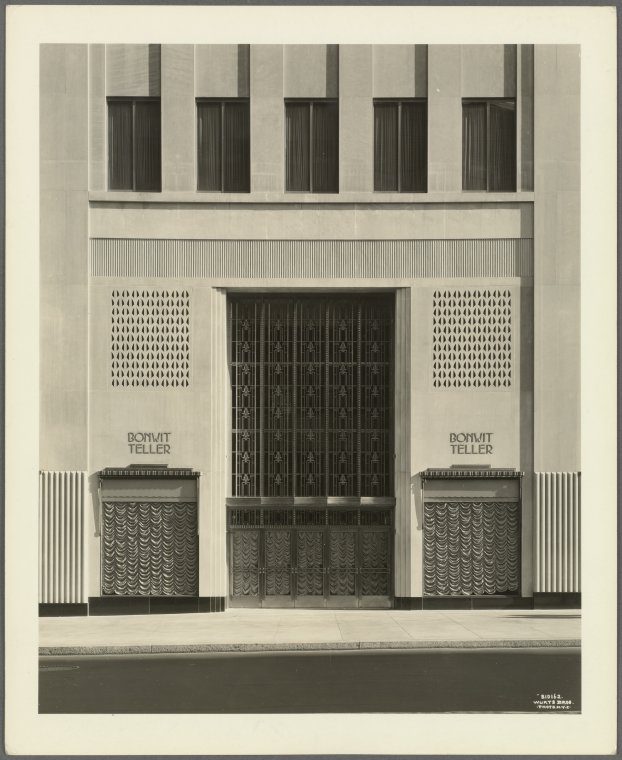
The entrance of the Bonwit Teller New York flagship, circa 1930 to 1939. New York Public Library Digital Collections, via Wikimedia Commons. CC BY-SA 4.0.
How was Trump Tower planned?
The New York Times reported on March 1, 1979 that Trump proposed to tear down the Bonwit Teller building and put up a $100 million, 60-story tower of bronze-colored glass combining stores, offices and condominium apartments. He told the Times he hoped to begin construction the following January and finish in about two and a half years. The Times said the plan needed approval from the City Planning Commission, Manhattan Community Board 5 and the Board of Estimate, at a time of growing concern about tall, bulky buildings in Midtown. The Bonwit store was due to close on July 30.
The same article gave the design team as the architectural firm Poor, Swanke, Hayden and Connell, with Der Scutt as the partner in charge. It said the building would be the first on the avenue with a retail atrium. The plan called for a 100-foot corridor of shops leading to an atrium with five floors of retail, a block-through open-air public terrace on the fourth floor, 13 floors of offices, 40 floors of condominium apartments and two mechanical floors. The sawtooth facets, 28 sides in all, were meant to give more apartments a corner window and to complement the five-sided IBM tower going up at 57th Street and Madison Avenue.
Forbes adds that Scutt tried to steer Trump toward a design that fit the dignified Fifth Avenue district, but Trump insisted on a bronze-colored glass skyscraper. Forbes quotes Scutt telling New York magazine in 1980, "If Donald hasn't built it, it's not any good. And it has to flash to be good."
What happened to the Bonwit Teller sculptures?
This is the part of the story preservationists still bring up. Forbes says that as the store was prepared for demolition, preservationists urged Trump to save two Art Deco elements: a pair of 15-foot bas-relief sculptures of semi-nude women dancing with scarves, and a large nickel-plated grille over the main entrance. They were promised to the Metropolitan Museum of Art. Forbes says Trump agreed to donate them as long as removal was not unreasonably expensive or difficult.
On June 5, 1980, according to Forbes, a demolition crew jackhammered the sculptures off the building and removed the grillework. The Met had been given no advance notice. Forbes says a Trump Organization spokesman, John Baron, told the New York Daily News that the stones were not good enough to justify saving them, and that removal could have set the schedule back two weeks. Baron told the New York Times he did not know what had happened to the grillework. The New York magazine writer Christopher Bonanos, in a 2023 history of the tower, adds that Trump used undocumented Polish laborers for the demolition, which Bonanos describes as having been done in an underhanded way. That is Bonanos's account, and this article repeats it only as his.
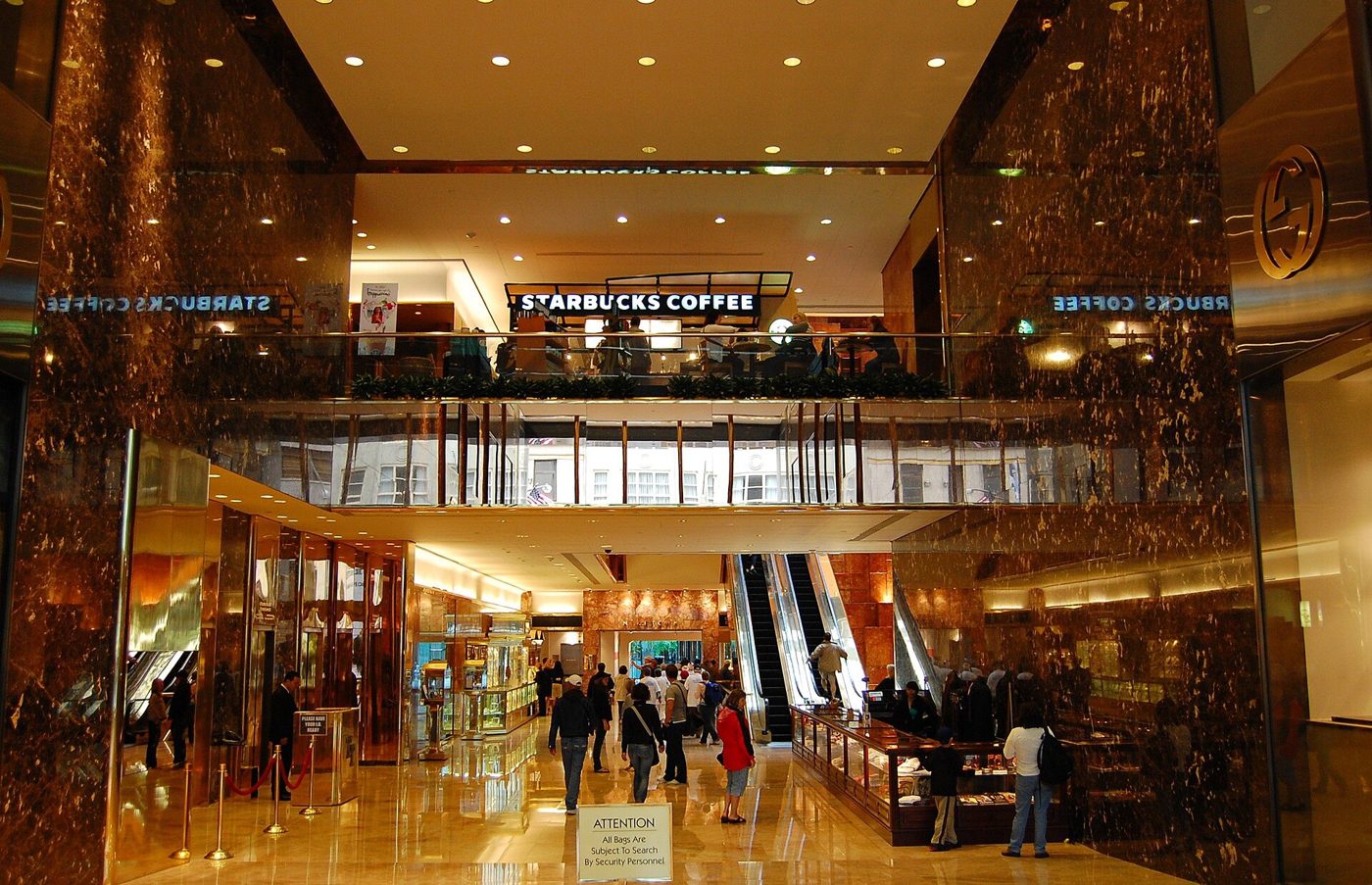
The atrium of Trump Tower. Photograph by Fletcher6, via Wikimedia Commons. CC BY-SA 3.0.
Why does Trump Tower have 68 floors on paper and 58 in reality?
The sources give both numbers. A 2022 Real Deal report calls it a 58-story building, while the floor numbering inside runs to 68. Bonanos explains the gap: the atrium and office levels together rise about 300 feet but are not 30 physical floors, so Trump started numbering the residential floors at 30, and the top apartment became the 68th floor instead of the 58th. Bonanos says the topping-out party in July 1982 celebrated the concrete reaching the "68th" floor.
The 1979 Times article had described a 60-story building with 40 residential floors, so the planned height changed between the proposal and the finished tower. This article follows the sources in saying 58 physical stories and a 68th floor in the numbering.
Bonanos also reports that the frame is concrete rather than steel, a choice he says suited apartments because steel towers move and creak in the wind. The mayor at the time, Ed Koch, toasted the topping-out with the words, "May all who dwell within know only happiness."
What was the atrium, and why is it a public space?
The six-story skylit atrium is the part of Trump Tower most visitors actually see. Jerold Kayden, writing in the Municipal Art Society's directory of privately owned public spaces (a profile first published in 2000), says Trump obtained zoning floor-area bonuses in return for the covered pedestrian space, two outdoor landscaped terraces on upper floors, and additional retail space. In his words, the covered space is "legally required to be open and accessible to the public." Kayden describes red, pink, orange and beige marble, a multistory water wall, five sets of switchback escalators and a long marble bench inside the Fifth Avenue entrance. He notes that members of the public may sit at the movable tables and chairs on the concourse level without buying anything, and that a passageway connects the space to the indoor public space at 590 Madison Avenue. The Municipal Art Society warns that the profile was published in 2000 and may not reflect current conditions.
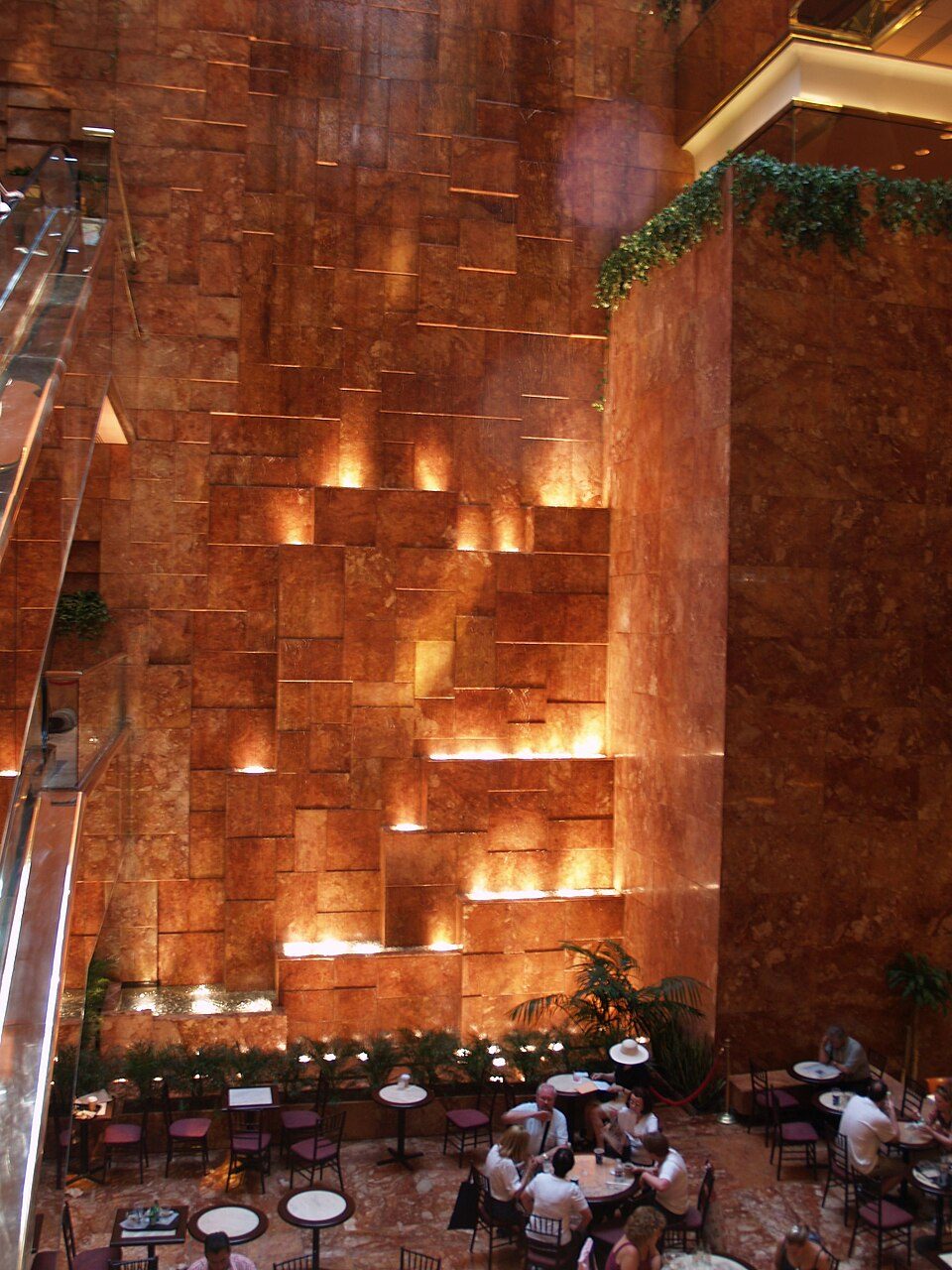
The waterfall wall inside the Trump Tower atrium. Photograph by HelveticaFantic, via Wikimedia Commons. CC BY-SA 2.0.
How did critics and buyers react in 1983?
The Trump Organization's anniversary page quotes the critic Ada Louise Huxtable calling the tower a "dramatically handsome structure" and Paul Goldberger of the Times calling its interior "warm, luxurious, and even exhilarating." Bonanos adds that the AIA Guide described the building as "flamboyant, exciting, and emblematic of the American Dream" but also compared its aesthetics to wine coolers rather than champagne, and that Huxtable was much tougher on the finished building than on its form.
On the residential side, Bonanos says more than half the apartments were sold by the time the tower opened, and that an initial one-bedroom started at about $500,000. He says Trump kept the top three floors for himself, first decorated by the designer Angelo Donghia, and later remade the penthouse. He lists early buyers and renters including Steven Spielberg, Sophia Loren, Johnny Carson and Michael Jackson. He also says some of the less famous buyers made their money in questionable ways, citing reporting by Wayne Barrett of The Village Voice.
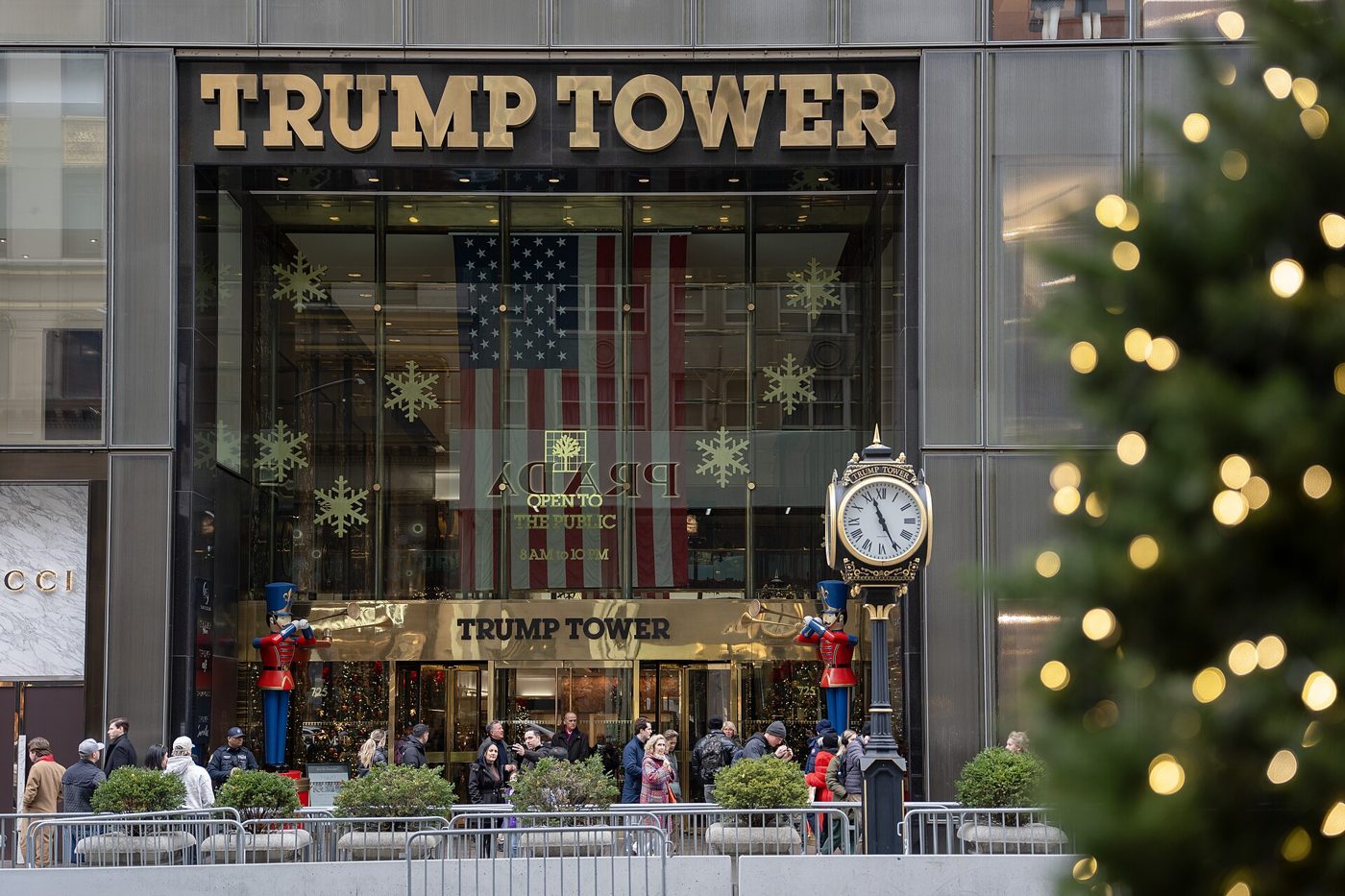
The main entrance to Trump Tower at Christmas. Photograph by Quintin Soloviev, via Wikimedia Commons. CC BY 4.0.
How did the tower become Donald Trump's headquarters and a television set?
The Trump Organization's page says the tower became the company's headquarters. It says Trump's NBC show The Apprentice and Celebrity Apprentice, produced with Mark Burnett Productions from 2004, used a boardroom inside the tower, and that on June 16, 2015 Trump announced his run for president after riding the escalator in the lobby. Bonanos says the Apprentice sets were built on one floor, separate from the real offices and apartments.
The retail story changed over the years. The company page says Gucci's flagship lease was signed in 2006, that the space once occupied by NikeTown, connected to the lobby, was taken over by LVMH, and that Tiffany unveiled a renovated store on the 57th Street corner in 2023. Bonanos wrote in October 2023 that the upper levels of the atrium were roped off and that the lobby now sells Trump-branded merchandise from a store and a bar called 45 Wine and Whiskey. The company page lists the Trump Store, Trump Sweets, Trump Grill and 45 Wine and Whiskey as current lobby businesses.
Can you eat or drink inside Trump Tower today?
Yes. The building's own site, trumptowerny.com, lists several food and drink places in and around the atrium, and the Trump Organization's dining page describes them. This is what those official pages say, as read on October 13, 2026.
- Trump Grill. The official page says it sits in the corner of the atrium and serves classic American food, with prime steaks, seafood, salads, pastas and sandwiches, under Executive Chef Kamila Singh. The page gives hours of 11 a.m. to 4 p.m., Monday through Sunday.
- Trump Café. The Trump Organization describes it as a casual spot in the atrium with hot entrees, salads, sandwiches and coffee, and the building site mentions New York-style pizza. The two building pages disagree on hours: the Trump Café page says 11 a.m. to 4 p.m. Monday through Sunday, while the Contact page says 8:30 a.m. to 4 p.m. Monday through Friday. Check before you go.
- 45 Wine & Whiskey Bar. The Trump Organization says it is a bar in Trump Tower with handcrafted cocktails and memorabilia from Trump's first term. The Contact page gives hours of 3 p.m. to 9 p.m. daily.
- Trump Pizza and Trump Sweets. The Trump Organization's dining page lists a brick-oven pizzeria and an ice cream parlor with more than 24 rotating flavors in the atrium. The Contact page gives Trump Sweets hours of 11:30 a.m. to 4:30 p.m. Monday through Friday and 11:30 a.m. to 5 p.m. on Saturday and Sunday. It gives no separate hours for Trump Pizza.
The building page also shows "open daily 8AM - 10PM" at the top of its Contact page, without saying what that refers to. Hours can change, so confirm with the venue. This article does not list prices, because the official pages read did not state them.
Who owns Trump Tower today?
No single source says who owns the whole building, and that is because the building is divided. The residential apartments are individually owned condominiums. A 2022 Real Deal report says the Trump Organization refinanced a $100 million mortgage on the commercial condo, meaning the office and retail space, of the 58-story, 257,000-square-foot building at 725 Fifth Avenue. It says the lender was the San Diego-based Axos Bank, that Eric Trump signed on behalf of the Trump Organization through an entity called Trump Tower Commercial LLC, and that the previous $100 million loan was from Ladder Capital. The Real Deal says Forbes valued the building at $285 million that November and that the city's 2022 market value was $246.2 million. It also reported occupancy of 78.9 percent at the end of 2020.
Bonanos, writing in 2023, likewise says the holder of the refinanced mortgage is Axos. The tower still carries the Trump name on the building and the Trump Organization still describes it as its headquarters. The sources do not say who holds title to the individual apartments, which would be recorded in city property records. Trump's own residence is in the building, per Bonanos.
Sources
- The New York Times, 60-Story Tower Sought For Bonwit-Teller Site (March 1, 1979)
- Forbes, How Donald Trump Took Down Bonwit Teller, A Fifth Avenue Landmark (October 3, 2020)
- The Trump Organization, Celebrating 40 Years of Trump Tower
- Curbed, A History of Trump Tower and How It Made Donald Trump (October 2, 2023)
- Municipal Art Society, Privately Owned Public Space: 725 Fifth Avenue / Trump Tower
- The Real Deal, Trump Tower Mortgage Refinanced for $100M (March 9, 2022)
- Trump Tower NYC, Contact (hours of Trump Grill, Trump Café, 45 Wine & Whiskey Bar, Trump Sweets)
- Trump Tower NYC, Trump Grill
- Trump Tower NYC, Trump Café
- The Trump Organization, Trump Dining
Visiting Trump Tower
- Address: 725 Fifth Avenue at East 56th Street, Manhattan.
- Atrium: The Municipal Art Society's profile, first published in 2000, says the covered pedestrian space is legally required to be open and accessible to the public, and that visitors may sit at the concourse tables without buying anything.
- Hours: The sources read do not give current opening hours for the atrium or its terraces, so none are listed here.
- Upper floors: The offices and apartments above the retail levels are private.
- Dining and drinks: Trump Grill, Trump Café, 45 Wine & Whiskey Bar, Trump Pizza and Trump Sweets are listed by the building and the Trump Organization. Hours differ between pages for the café, so confirm with the venue.
Checked against Municipal Art Society privately owned public space profile. Confirm hours and ticket rules there.