The Majestic Theatre: Chanin's "Modern Spanish" House, Home of The Phantom of the Opera for 35 Years
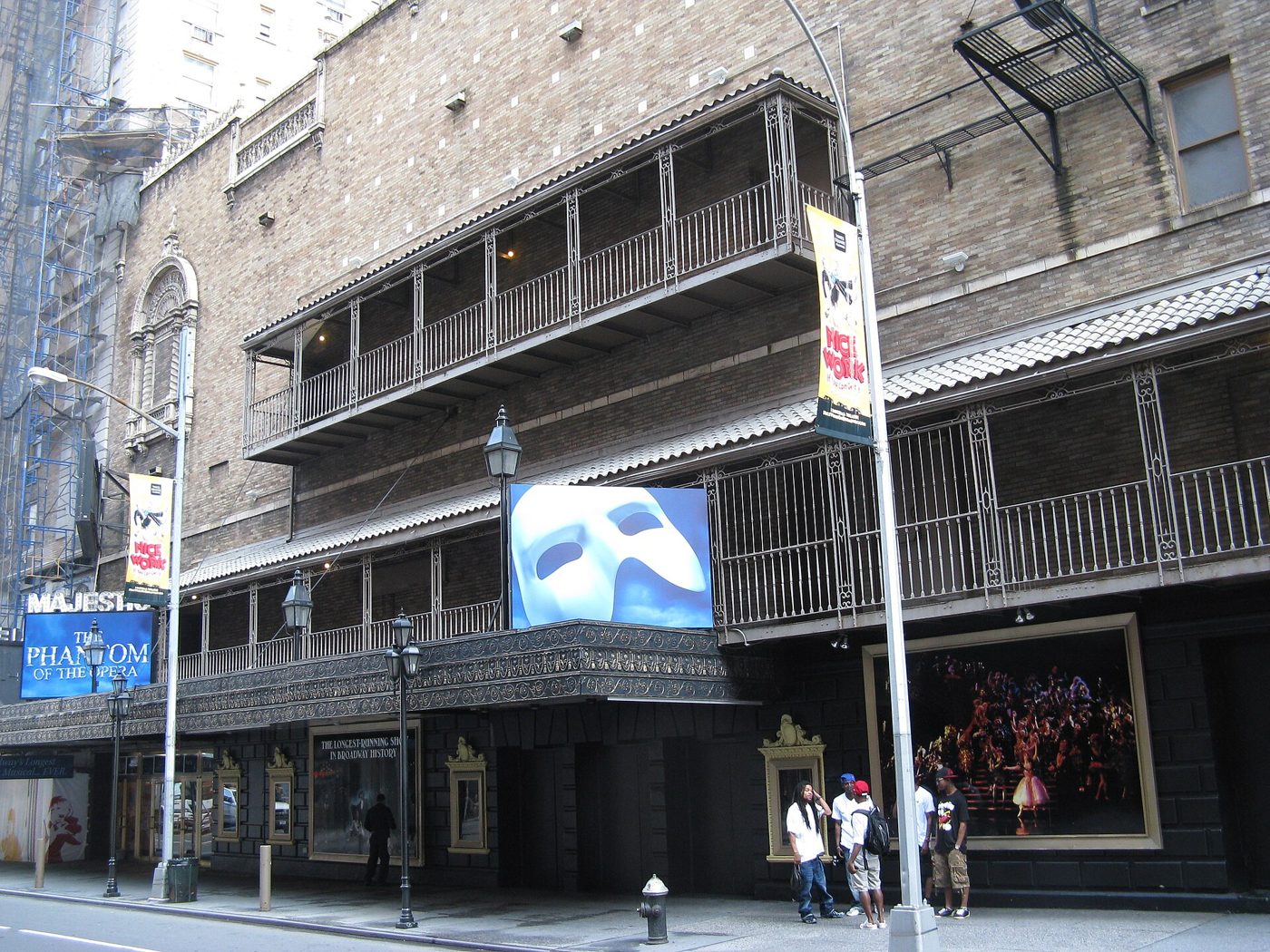
The Majestic Theatre facade on West 44th Street with a Phantom of the Opera banner, May 2012. Photograph by Yair Haklai, via Wikimedia Commons. CC BY-SA 4.0.
What is the Majestic Theatre?
The Majestic Theatre on West 44th Street opened on March 28, 1927 (per the Internet Broadway Database, IBDB) and is best known as the home of The Phantom of the Opera for 35 years, from January 26, 1988 to April 16, 2023. Both the exterior (LP-1355) and the first-floor interior (LP-1356) are New York City landmarks, designated by the Landmarks Preservation Commission (LPC) on December 8, 1987 after hearings in June and October 1982. The LPC said the Majestic "survives today as one of the historic theaters that symbolize American theater for both New York and the nation." The Shubert Organization owns and runs it, according to its own site.
Its address is written two ways. The Shubert Organization and the LPC give 245 West 44th Street (the LPC lists 245-257 West 44th), and IBDB says 247 W. 44th St. Both are the same building.
Who built the Majestic, and why was it so big?
The Chanin Organization built it. The LPC says it was one of three theaters, with the Theatre Masque (now the John Golden) and the Royale, built together with the Lincoln Hotel (now the Milford Plaza) as a single project at the western end of the block between Broadway and Eighth Avenue and West 44th and 45th Streets. The alley between the hotel site and the theaters became popularly known as Shubert Alley. The report quotes a Chanin brochure which described the three as built for different purposes: the 800-seat Theatre Masque for "artistic" or "intimate" plays, the 1,200-seat Royale for musical comedy, and the 1,800-seat Majestic, "the largest legitimate theatre in the Times Square district," as a house for revues and light operas. The LPC adds that the Majestic's large size let the Chanins plan the small Theatre Masque next door as an intimate house.
The architect was Herbert J. Krapp, who the LPC says designed all of the Chanins' theaters and was the most prolific architect of the Broadway theater district. The Chanin brothers, Irwin and Henry, finished the project in 1927; the LPC quotes a newspaper account of the brothers pushing home two golden rivets at the top of the 30-story Lincoln Hotel and putting the cost of their west side operations at $12,000,000.
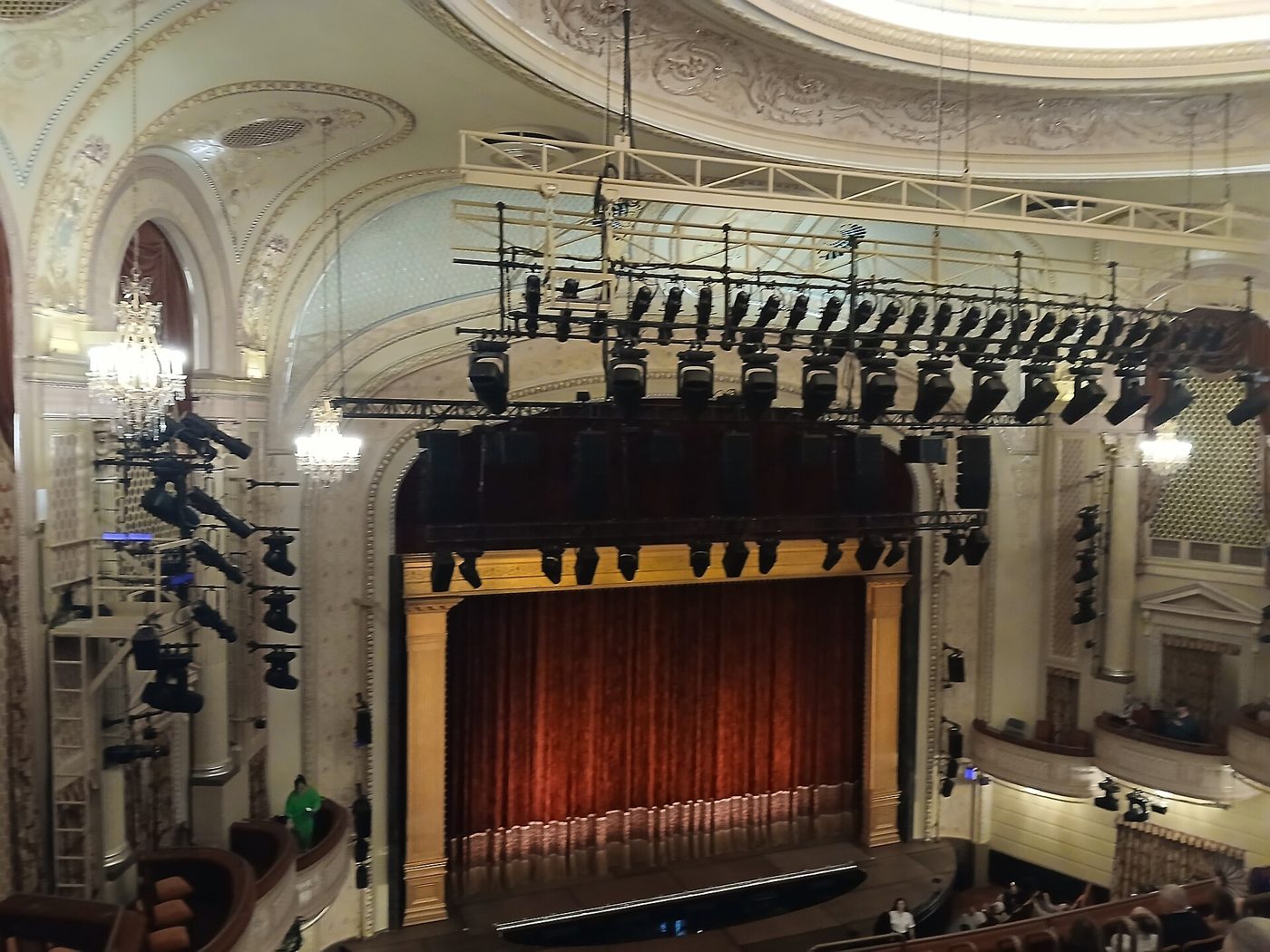
The auditorium and proscenium of the Majestic Theatre, April 2025. Photograph by Epicgenius, via Wikimedia Commons. CC BY-SA 4.0. Gypsy was playing.
What does "modern Spanish" mean on the facade?
The LPC says the Chanins had Krapp design the complex in what they called the "modern Spanish" manner. The three theater facades are related through a rusticated terra-cotta base and a Roman-brick wall above, with round-arched windows and terra-cotta ornament inspired by the Spanish Renaissance. The report says the chief ornaments of the Majestic's facade are a highly ornamental blind stylized Palladian window with spiral columns, and two long wrought-iron galleries with simulated Spanish-tile roofs. The Shubert Organization's page describes the same design as a terra-cotta base with Spanish brick-wall ornamentation and arched windows, with a stylized Palladian motif above the entrance.
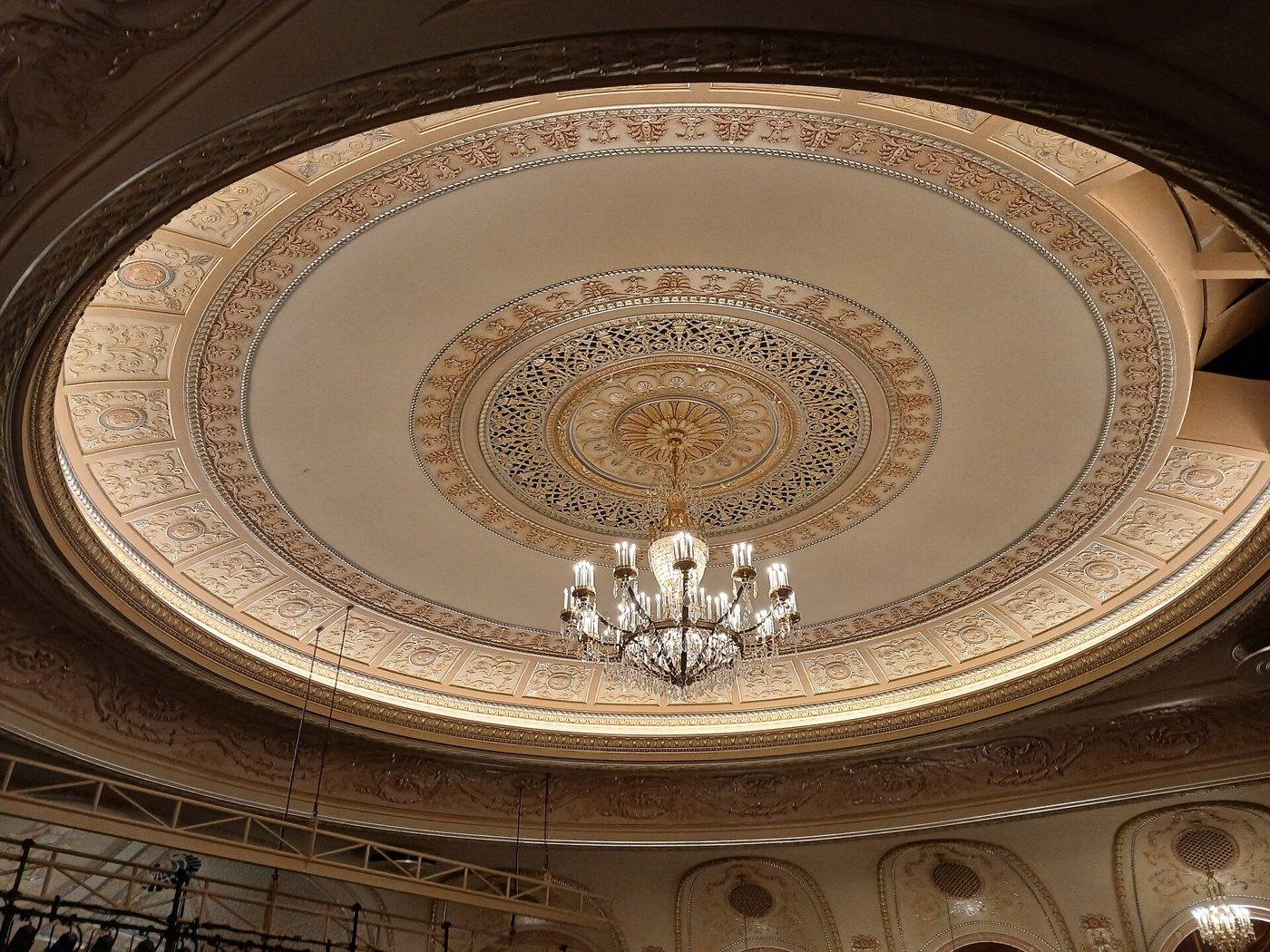
The domed ceiling and chandelier, April 2025. Photograph by Epicgenius, via Wikimedia Commons. CC BY-SA 4.0.
What is the "stadium" plan?
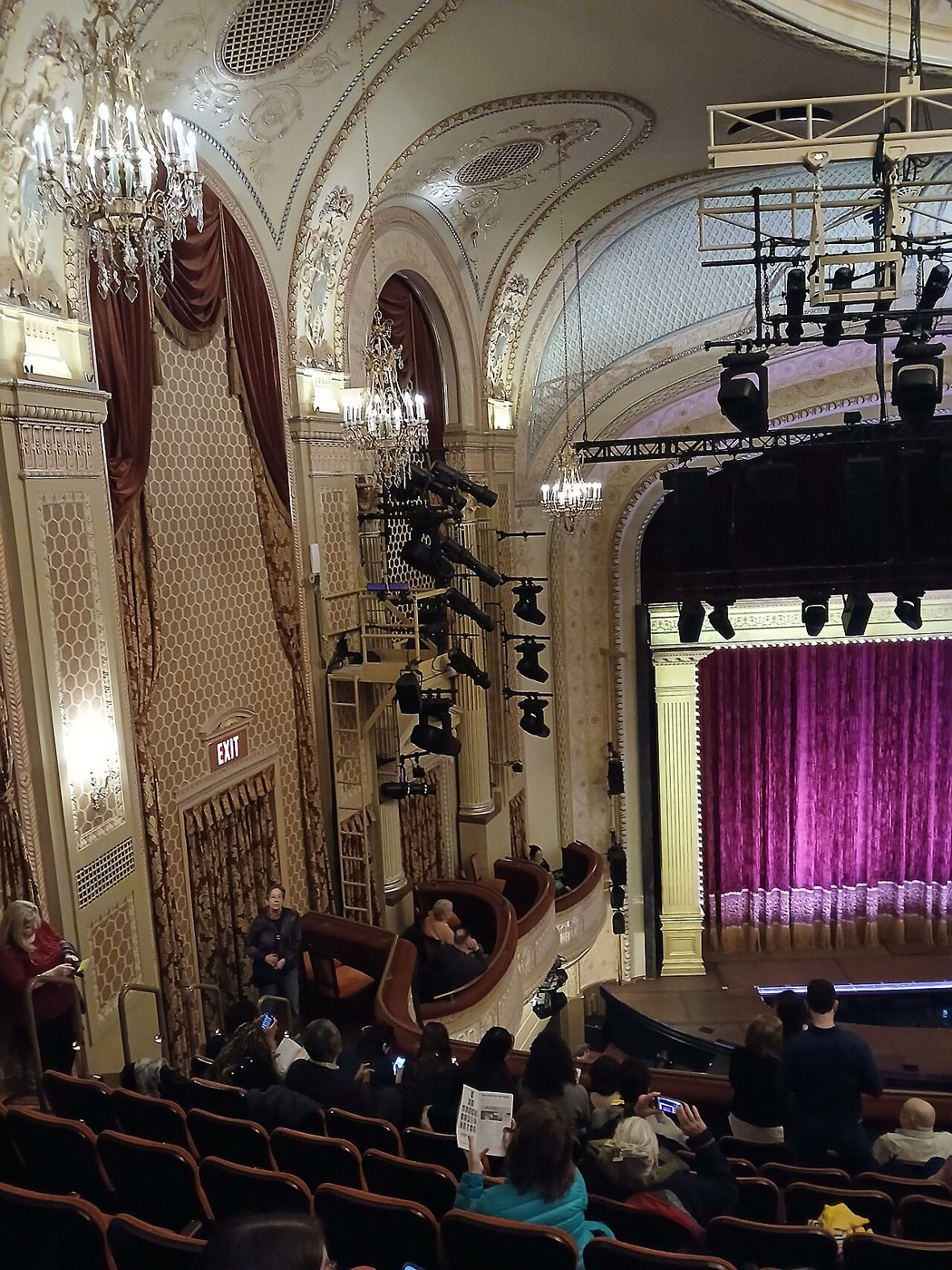
The interior is where the LPC says the Majestic departs from the Spanish look. It describes a grander house, "three hundred seats larger" than the Chanins' 46th Street Theater, their first on Broadway, and built on the same "stadium" plan. The lobby is depressed so that the rear rows of the orchestra sit above it, and the seats are arranged on two slopes: gradual for about half the depth, then steeper, with each row two steps higher than the one below. The balcony is cantilevered, so no columns block sight lines, and the report notes the house has a single balcony. The Shubert Organization's page makes the same point in modern terms. It says Krapp conceived something like stadium seating decades before it became common in movie theaters, and calls the single large balcony forward-looking, since today's producers hesitate to book houses with two balconies.
The LPC adds that Chanin believed the plan would democratize seating. All seats were reached through the same lobby, a foyer-promenade that runs nearly the depth of the building, with a grand staircase rising to the rear of the orchestra. The report calls the lobby a broad, impressive space under a coved ceiling and says both the lobby and auditorium are covered in gilded plasterwork in the Louis XV style, in gold and ivory. The house curtain, valance and box drapes were gold and rose silk damask, and a main lounge below the orchestra level was in the English style. The LPC also notes seats said to be three inches wider than ordinary theater chairs and an unusually large rigging loft.
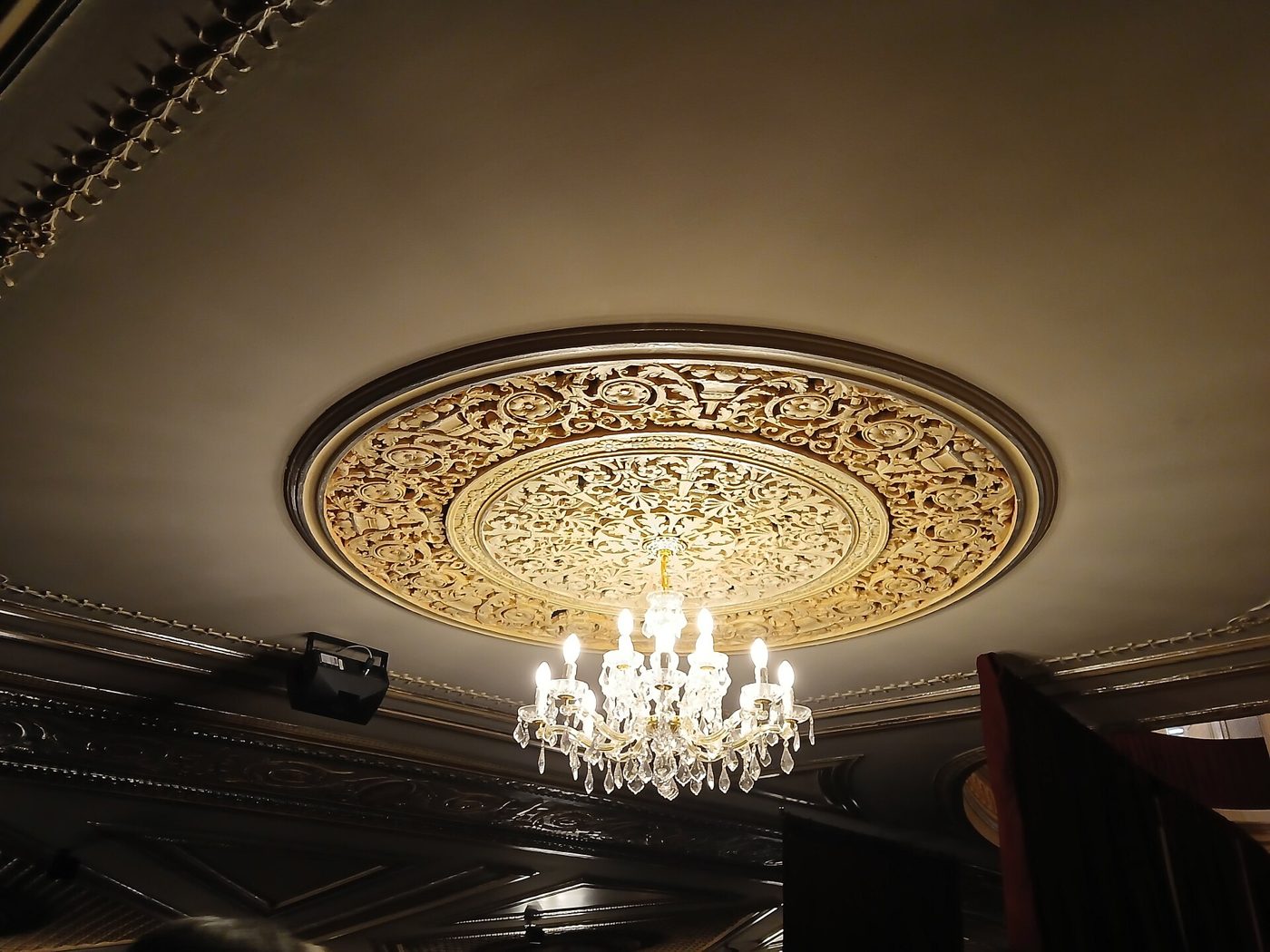
The ceiling medallion and chandelier. Photograph by Epicgenius, via Wikimedia Commons. CC BY-SA 4.0.
How long did the Phantom of the Opera run at the Majestic?
IBDB lists The Phantom of the Opera at the Majestic from January 26, 1988 to April 16, 2023, which is 35 years. NPR and the BBC both put the total at 13,981 performances, and the BBC says the show stayed at the Majestic the entire time. Playbill called it the longest-running show in Broadway history when it ended its run.
The Phantom is one chapter in a long list. The Shubert Organization says the inaugural production was a revue, Rufus LeMaire's Affairs (1927), followed by Sigmund Romberg's operetta The Love Call. It names Cary Grant, then known as Archie Leach, in A Wonderful Night (1929) and John Gielgud in The Patriot (1928) among 1920s performers. Jimmy Durante appeared in Strike Me Pink (1933), and Ethel Merman and Durante led Stars in Your Eyes (1939). The Shubert page then lists the Rodgers and Hammerstein run: Carousel (1945), Allegro (1947), South Pacific (1949) and Me and Juliet (1953). IBDB dates Carousel here from April 19, 1945 to May 24, 1947, South Pacific from April 7, 1949 to May 16, 1953, and Me and Juliet from May 28, 1953 to April 3, 1954. IBDB dates The Music Man from December 19, 1957 to October 22, 1960 and Camelot from December 3, 1960 to January 5, 1963. The Shubert page adds that 42nd Street opened at the Winter Garden and later moved to the Majestic.
How many seats does the Majestic have?
IBDB lists approximately 1,645 seats. The Shubert Organization's specifications table lists a total of 1,681, but the rows add up to 1,645 seated (885 in the orchestra, 292 in the front mezzanine, 436 in the rear mezzanine and 32 in boxes) plus 36 standing places. So the two figures agree on the seated count. When the house opened, the LPC and the Chanin brochure both said 1,800. The article follows IBDB and the Shubert table and does not use the 1,800.
Who owned the Majestic before the Shuberts?
The sources give two versions of how the Shuberts got it. The Shubert Organization says that in 1930 the Chanins transferred ownership of all three houses to the Shuberts. IBDB says the theater was built by the Chanin Brothers and "traded to the Shuberts during the Depression (in exchange for the Century Theatre on Central Park West)." Both say it ended up with the Shuberts. The article does not say which account is more exact.
What is on stage now?
IBDB's list shows Gypsy from December 19, 2024 to August 17, 2025 and Beaches, A New Musical from April 22 to May 24, 2026. The Shubert Organization's page features Purple Rain, which it labels "coming soon", and IBDB lists Purple Rain with a start date of April 12, 2027. This article did not confirm any production currently playing in the theater.
Where can you eat or drink at the Majestic Theatre?
The Shubert Organization's page says no outside food or beverage is permitted unless medically necessary. Theatre Refreshment Company describes itself as the exclusive concessionaire for the Shubert Organization's Broadway theatres in New York City. This article did not find an official list of what is sold at the Majestic, and no restaurant inside it. Check the Shubert page for the current show before you go.
Who owns the Majestic Theatre today?
The Shubert Organization lists the Majestic on its own theater pages and describes the Chanin transfer to the Shuberts. IBDB also describes the Shubert acquisition. This article did not find a deed or a public record to confirm the current legal owner of the building, so it names the Shubert Organization as the operator and as the owner its own site describes. The exterior and the first-floor interior are landmarks, so changes to them need LPC approval.
Sources
- The Shubert Organization, Majestic Theatre
- Internet Broadway Database, Majestic Theatre
- NYC Landmarks Preservation Commission, Majestic Theater exterior designation report, LP-1355 (December 8, 1987)
- NYC Landmarks Preservation Commission, Majestic Theater first-floor interior designation report, LP-1356 (December 8, 1987)
- NPR, Phantom of the Opera takes a final Broadway bow (April 15, 2023)
- BBC News, Broadway curtain call for The Phantom of the Opera
- Playbill, A Majestic Finale: The Phantom of the Opera Ends History-Making Broadway Run
- Theatre Refreshment Company, concessionaire for the Shubert Organization
Visiting the Majestic Theatre
- Address: 245 West 44th Street, New York, NY 10036, between Broadway and 8th Avenue (Shubert Organization).
- Policies: everyone attending needs a ticket, latecomers are seated at management's discretion, children under four are not admitted, and no outside food or beverage is allowed unless medically necessary.
- Accessibility: the Shubert page says the theater is not completely wheelchair accessible. There are no steps from the sidewalk into the theater, wheelchair seating is in the orchestra, and the mezzanine is up 3 flights (51 steps) with no elevator or escalator.
Checked against Shubert Organization Majestic Theatre page. Confirm hours and ticket rules there.