The Lyric Theatre: How the Old Apollo and Lyric Became One Broadway House
What is the Lyric Theatre?
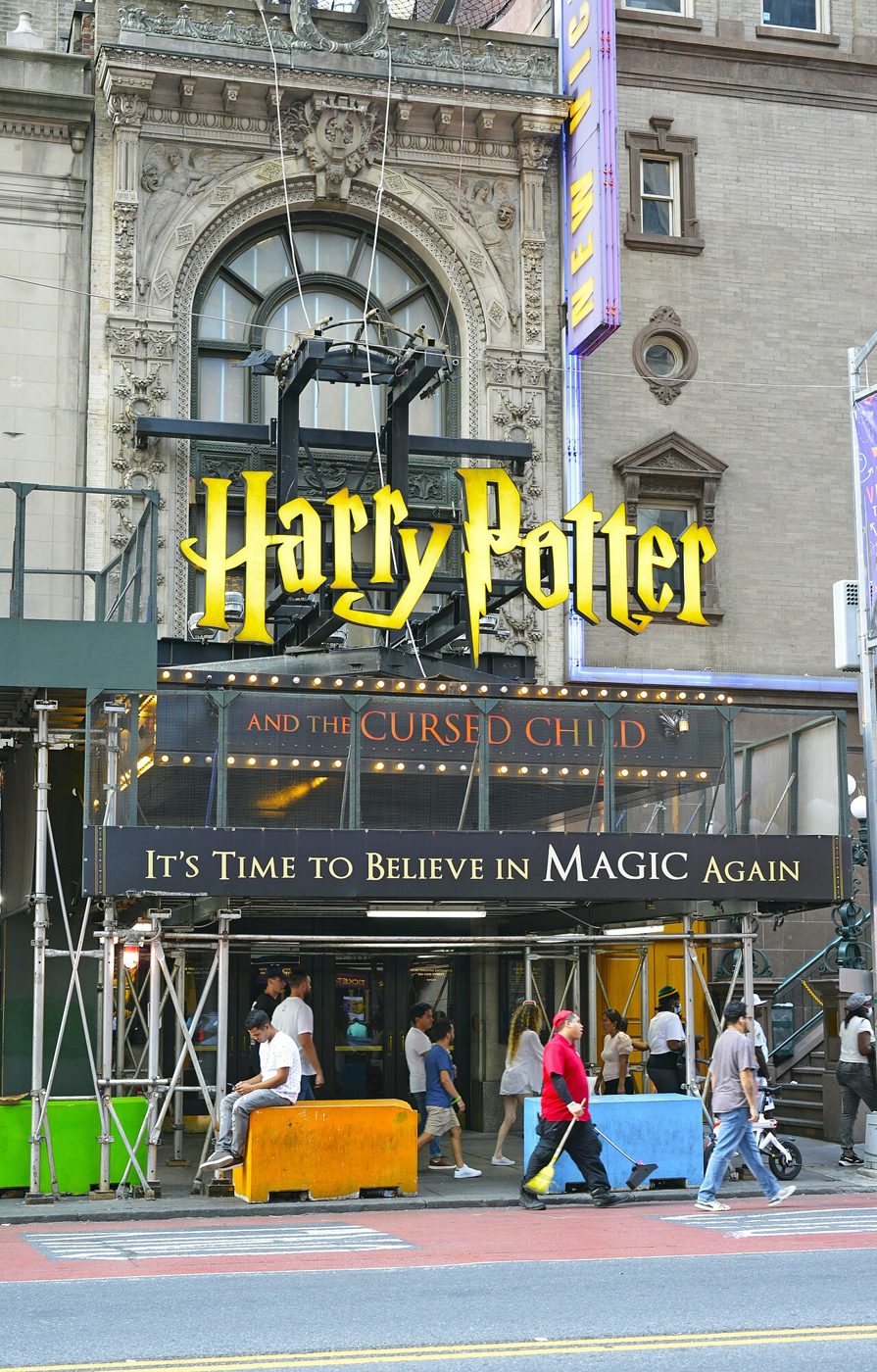
The Lyric Theatre is a Broadway musical house in the Times Square Theater District. It is also two old theaters in one. The current building was made in 1996 to 1998 by joining the Apollo Theatre and the original Lyric Theatre, two playhouses on the north side of West 42nd Street between Seventh and Eighth Avenues. New 42, the nonprofit that manages the historic 42nd Street theaters, says the Apollo and Lyric "were combined to form what is now the Lyric Theatre." The Ambassador Theatre Group (ATG) says today's Lyric was built over the foundations of the original Lyric (1903) and Apollo (1920) theaters. It has had four names and several operators since the merger, and it now houses Harry Potter and the Cursed Child.
Before going further, the facts that sources disagree on. The address is one. IBDB lists the Lyric at 213 West 42nd Street. ATG's venue page says the main entrance and box office are at 214 West 43rd Street, and the Times Square Alliance lists 214 West 43rd Street as well. The two are not in conflict as much as they describe different doors, because the old Lyric's entrance was on 42nd Street while its auditorium lay on the 43rd Street side. This article gives 43rd Street for visitors, since that is the entrance ATG tells guests to use. Seat counts are the second problem and are covered below.
What was the original Lyric Theatre?
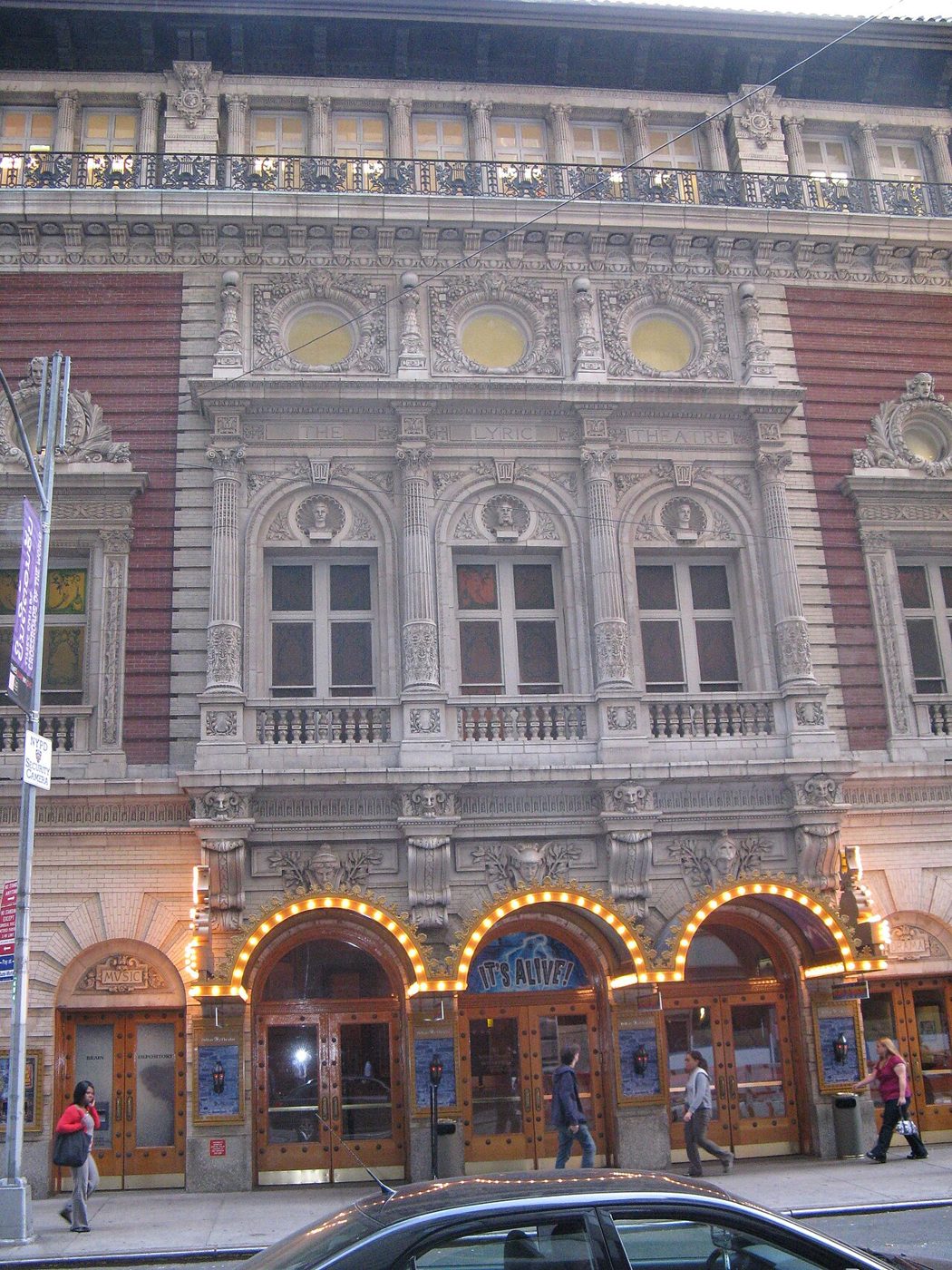
New 42 says the original Lyric was built in 1903 by the composer Reginald de Koven and designed by the architect V. Hugo Koehler. It had a 42nd Street entrance leading to an auditorium on the 43rd Street side of a T-shaped lot. It was devoted to light opera, and the 42nd Street facade was decorated with masks, lyres and muses. The auditorium was painted light green and rose with ivory and gold plaster reliefs on the ceiling, and the 43rd Street facade, brick and terra cotta with a copper roof and iron balconies, resembled an Italian Renaissance mansion.
The Lyric opened on October 12, 1903 with Richard Mansfield in Old Heidelberg, per New 42. Until 1905 the Shubert brothers worked from offices above its lobby. Later bills included Fred and Adele Astaire in For Goodness Sake in 1914, the Marx Brothers in Coconuts by Irving Berlin and George S. Kaufman in 1925, and Cole Porter's Fifty Million Frenchmen. In 1934 the Lyric followed the trend of the time and became a movie house. The Times Square Alliance gives it 1,261 seats at the time of its opening.
And the Apollo?
New 42 says the Apollo Theatre on 42nd Street, not to be confused with the Apollo Theater in Harlem, was built in 1910 as a vaudeville house called the Bryant Theatre. The Selwyn brothers took it over in 1920. It shared a facade with the Times Square Theater and was the last addition to that block. The architects were De Rosa and Pereira, in the Adamesque style, and the auditorium lay on 43rd Street with a long, narrow hallway to the 42nd Street entrance. It opened as the Apollo on November 11, 1920. Macbeth with Lionel Barrymore followed, and W.C. Fields starred in Poppy in 1923. A Gershwin edition of George White's Scandals opened in 1924, and five more editions followed with stars including Ethel Merman, Jimmy Durante, Ray Bolger and Rudy Vallee.
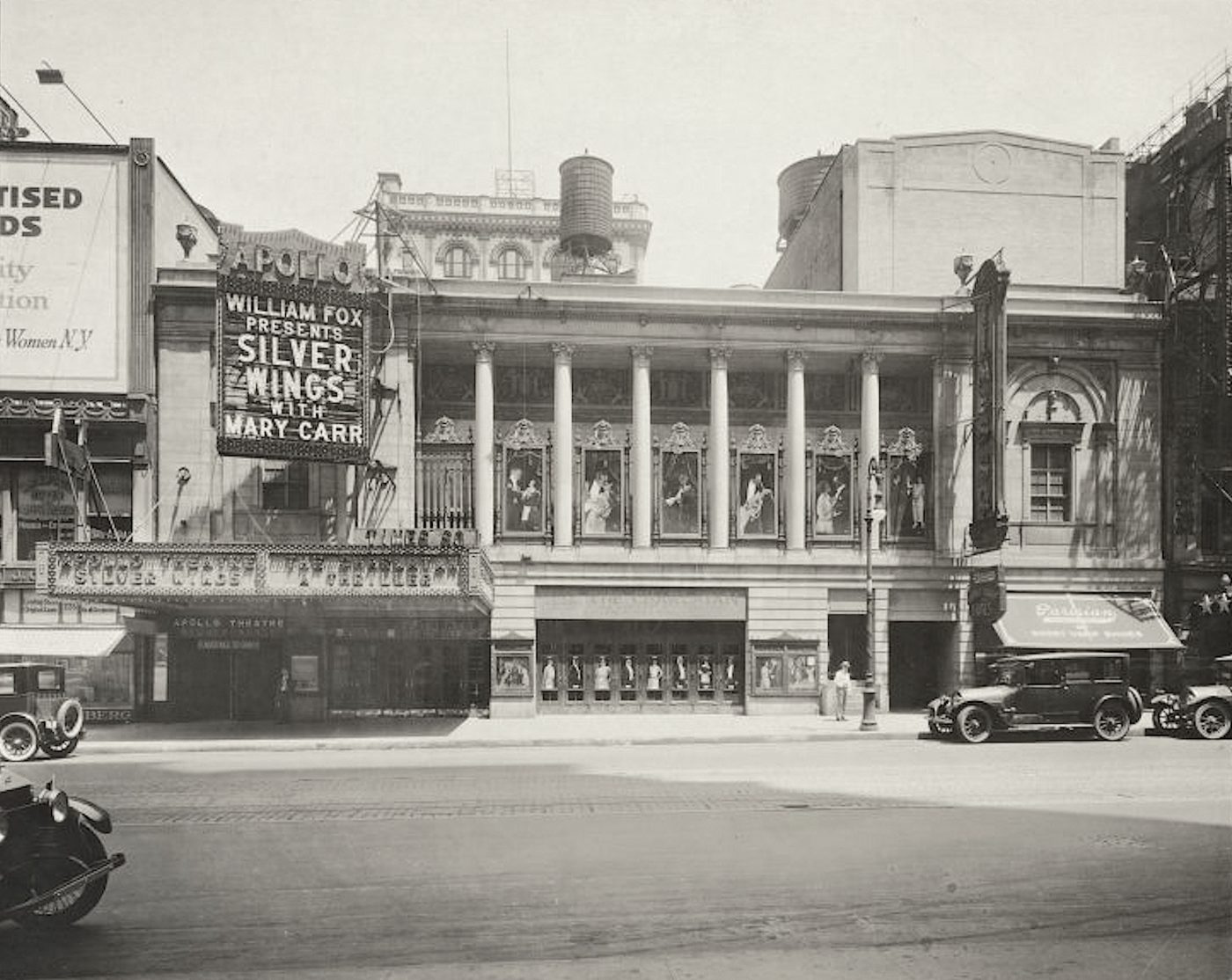
The Apollo Theatre entrance, left, and the Times Square Theatre on 42nd Street. Wurts Brothers photograph, public domain, via Wikimedia Commons.
From 1934 to 1938 the Apollo ran burlesque shows under Max Wilner, and after an outcry from religious, business and real estate interests it became a film venue. It ran foreign films for decades and X-rated films by the 1970s. It was renovated in 1978 with an entrance on 43rd Street, and legitimate theater returned with On Golden Pond. In 1987 the orchestra seats were removed, the floor leveled and the interior painted flat white, and the renamed Academy hosted concerts by 1990s acts such as the Smashing Pumpkins and Sonic Youth. New 42 says the venue closed in 1996. The Times Square Alliance lists the Apollo (1920) at 1,194 seats.
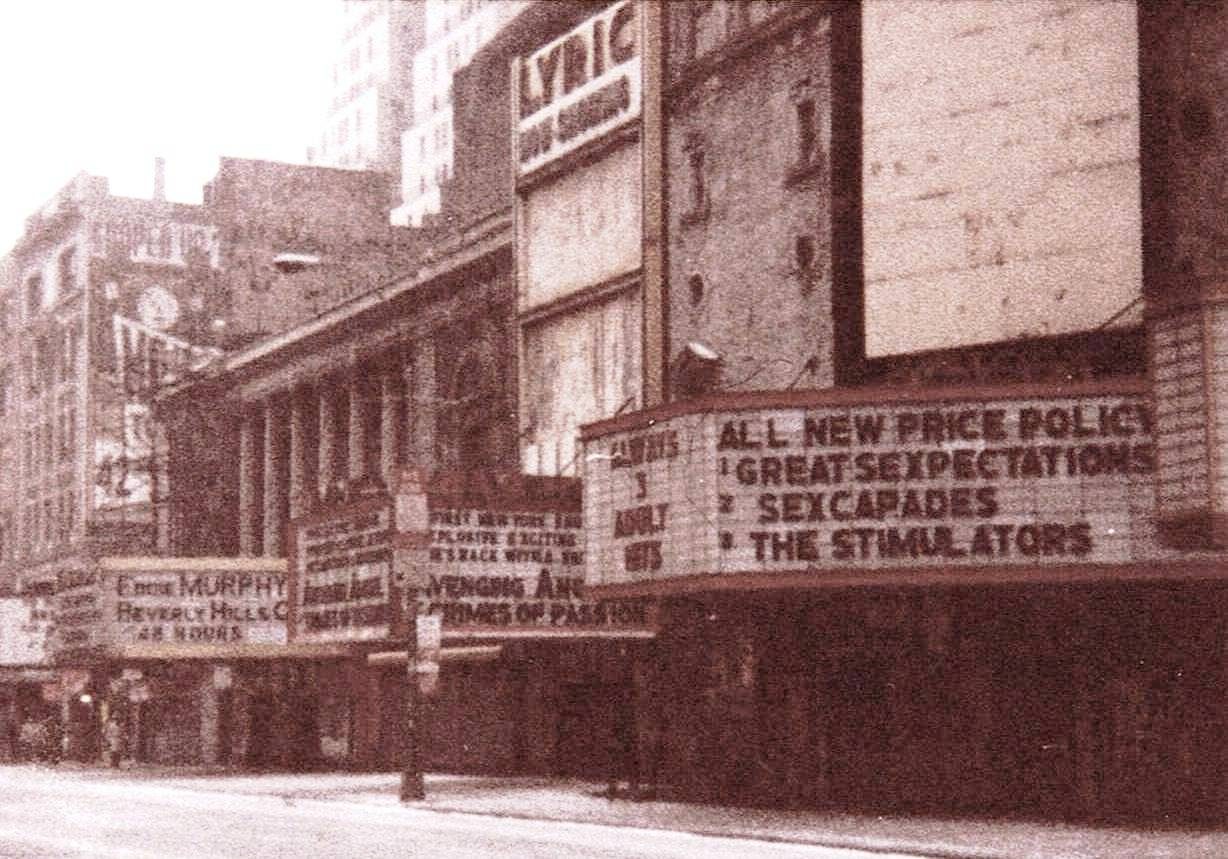
42nd Street in 1985, before the Lyric and Apollo were combined. Photograph by JGKlein, public domain, via Wikimedia Commons.
How did two theaters become one?
In May 1992 New 42 signed a 99-year master lease with the City and State of New York for seven historic theaters on the block: the Apollo, Empire, Liberty, Lyric, Selwyn, Victory and Times Square Theater. In June 1996 it signed a lease with Livent, the Toronto-based Broadway producer, for the Apollo and the Lyric. Construction to join them began in August 1996. The goal was an 1,850-seat musical house, per New 42. IBDB credits the architects Richard Blinder and Peter Kofman.
Opening dates differ. New 42 says Livent opened the combined theater on December 26, 1997 as the Ford Center for the Performing Arts with the New York premiere of Ragtime. Playbill says the Ford Center opened in 1998. IBDB's date for the new house is January 18, 1998. None of the sources explains the gap, so this article gives all three.
Why has the Lyric had so many names?
Operators and sponsors changed. After SFX bought Livent in August 1999, SFX ran the theater, and Clear Channel Entertainment later bought SFX and took over, per New 42. In 2005 a renovation renamed it the Hilton Theatre for the U.S. premiere of Chitty Chitty Bang Bang. In 2010, under an agreement with Foxwoods Resort and Live Nation, it became the Foxwoods Theatre and the home of Spider-Man: Turn Off the Dark. On May 20, 2013 Live Nation said it had completed the sale of the Foxwoods Theatre to Lyric Theatre, LLC, a subsidiary of ATG, per a Live Nation release. The Associated Press called the deal a purchase of the lease for about $60 million, and said the theater was Broadway's largest. In 2014 it became the Lyric.
After the Spider-Man show, New 42 lists On the Town (October 2014 to September 2015), Lord of the Dance: Dangerous Games (November 2015 to January 2016) and Cirque du Soleil's Paramour (May 2016 to April 2017). Then came a redesign for Harry Potter and the Cursed Child, the North American premiere of the London play.
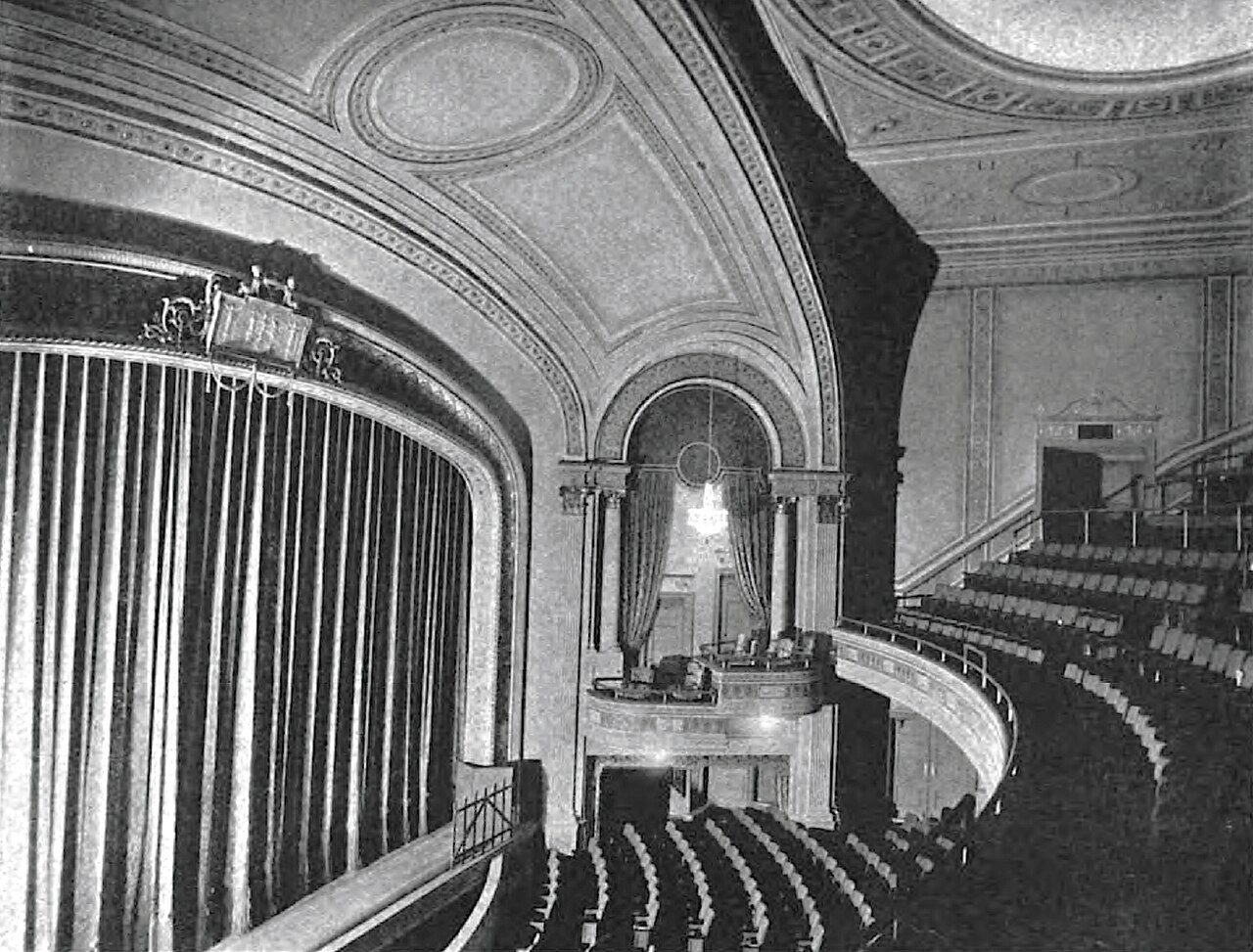
Looking toward the stage in the Apollo Theatre. Historic photograph, public domain, via Wikimedia Commons.
How many seats does the Lyric have?
It depends on who is counting, and when. Here are the figures found in the sources checked.
- New 42 describes the 1996 plan as an 1,850-seat theater.
- The Times Square Alliance says 1,896 seats today.
- Playbill reported in October 2018 that ATG announced in December 2016 a plan to reconfigure the house from 1,900 seats to approximately 1,500.
- IBDB lists approximately 1,622 seats.
These are different snapshots, since the theater was reconfigured for Harry Potter. This article cannot say which count is current. If a precise number matters to you, ask the theater's box office.
When did Harry Potter and the Cursed Child open at the Lyric?
Playbill says the show arrived on Broadway on March 16, 2018, which is consistent with the start of previews. IBDB lists the opening as April 22, 2018, and New 42 says the show opened in April 2018. ATG's venue page for the theater is built around the show, and as of this article it still names Harry Potter and the Cursed Child as the production at the Lyric. ATG says the theater was renovated for the show, a point Playbill also makes.
Where can you eat or drink at the Lyric Theatre?
ATG's venue information says there are four full-service bars and a Snack Shop inside the theater, and that guests can take snacks and drinks bought there to their seats. Outside food and drink are not allowed. This is a theater concession, not a restaurant. This article did not find a public restaurant or lounge inside the Lyric, and it could not confirm bar hours, which vary with performances. Check ATG's venue page before you go.
Who owns the Lyric Theatre today?
ATG says it owns the Lyric, and Playbill's 2018 article says the same. The 2013 sale was described by Live Nation as the sale of the theater to an ATG subsidiary and by the Associated Press as the purchase of a lease. The historic structure is part of the seven-theater package New 42 leases from the City and State of New York under the 1992 master lease. Taken together, the sources suggest ATG controls the theater under a lease, but this article did not find a deed or lease document, so it does not state the legal form of ATG's interest.
Sources
- New 42, Apollo and Lyric Theatres history
- ATG Tickets, Lyric Theatre venue information
- ATG Entertainment, Lyric Theatre
- Times Square Alliance, Lyric Theatre
- Internet Broadway Database, Lyric Theatre
- Playbill, Step Inside Broadway's Lyric Theatre (October 10, 2018)
- Live Nation, Live Nation Entertainment Sells Foxwoods Theatre (May 20, 2013)
- Associated Press, Lease to Broadway's biggest theater sold (2013)
Visiting the Lyric Theatre
- Entrance and box office: 214 West 43rd Street, New York, NY 10036, per ATG. IBDB lists 213 West 42nd Street.
- Outside items: ATG says outside food and drink, large professional cameras, flashlights, laser pointers and large luggage are not permitted.
- Box office hours: not stated here because the ATG page distinguishes advance sales from sales before curtain. Check the official ATG page.
Checked against ATG venue information page. Confirm hours and ticket rules there.