Is the United Nations Headquarters Actually in the United States? Slaughterhouses, Rockefeller and a 39-Story Truce
Yes. The United Nations headquarters stands on the eastern shore of Manhattan, between 42nd and 48th Streets along the East River, and it has been there since the middle of the last century. But the honest answer has a twist: the 18-acre site is owned by the United Nations itself and carries a special legal status, so although the buildings sit inside New York City and inside the United States, no American police officer, soldier or official may enter without the Secretary-General's consent. The story of how a run-down stretch of slaughterhouses became that semi-autonomous address involves a unanimous vote in Congress, a last-minute check from John D. Rockefeller Jr., and eleven architects from eleven countries who had to agree on one skyline.
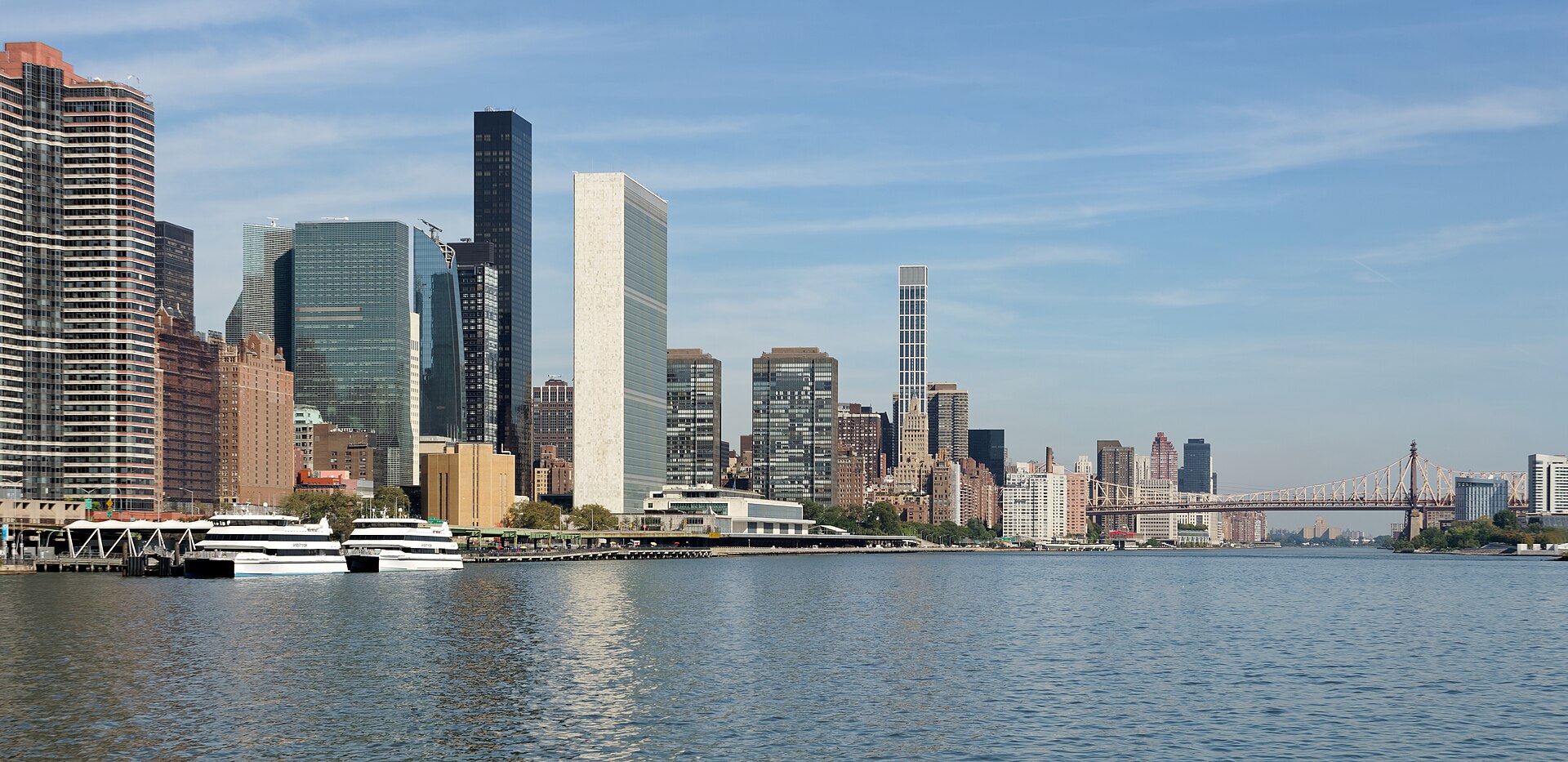
The UN headquarters on the East River shoreline, with the white marble north wall of the Secretariat at center. Photograph by Jakub Halun, via Wikimedia Commons. CC BY 4.0.
Is the UN headquarters on American soil or not?
It is both, depending on what the question means. The United Nations' own visitors' fact sheet says the site "is owned by the UN and has a special status within the US," and that no federal, state or local officer or official of the United States, whether administrative, judicial, military or police, may enter the headquarters except with the consent of, and under conditions agreed to by, the Secretary-General. That inviolability comes from the Headquarters Agreement between the United States and the United Nations, signed in 1947.
The fact sheet is equally clear about the limits of that status. The UN is bound by its agreement with the host country to prevent the headquarters from being used as a refuge for people trying to avoid arrest under American law, and people being extradited by the US Government are denied use of the headquarters for that purpose. So the compound is not foreign territory where a fugitive can simply step over a line and be free. The buildings are in New York, the land belongs to the United Nations as an organization, and a treaty controls what American authority can do inside the fence. The popular shorthand that the UN is "international territory" overstates it; the accurate version is that it is UN-owned, treaty-protected ground on Manhattan's east side.
How did the UN end up on the East River?
Not by a straight line. On December 10, 1945, the US Congress unanimously resolved to invite the young organization to make its permanent home in the United States. The General Assembly, meeting for its first session in London, decided on February 14, 1946 that the headquarters would be near New York City. Through the second half of 1946 a special UN site committee weighed locations in Philadelphia, Boston and San Francisco, and looked at suburban areas north of the city. Crowded Manhattan was not seriously investigated at first.
The breakthrough was money. John D. Rockefeller Jr. made a last-minute offer of $8.5 million to buy the present site, and the General Assembly accepted it by a large majority on December 14, 1946. New York City completed the parcel with additional gifts of property. What the UN bought was not glamorous: the fact sheet describes a run-down area of slaughterhouses, light industry and a railroad barge landing on the river's edge. Within six years that patch of meatpacking waterfront held the permanent headquarters of the United Nations.
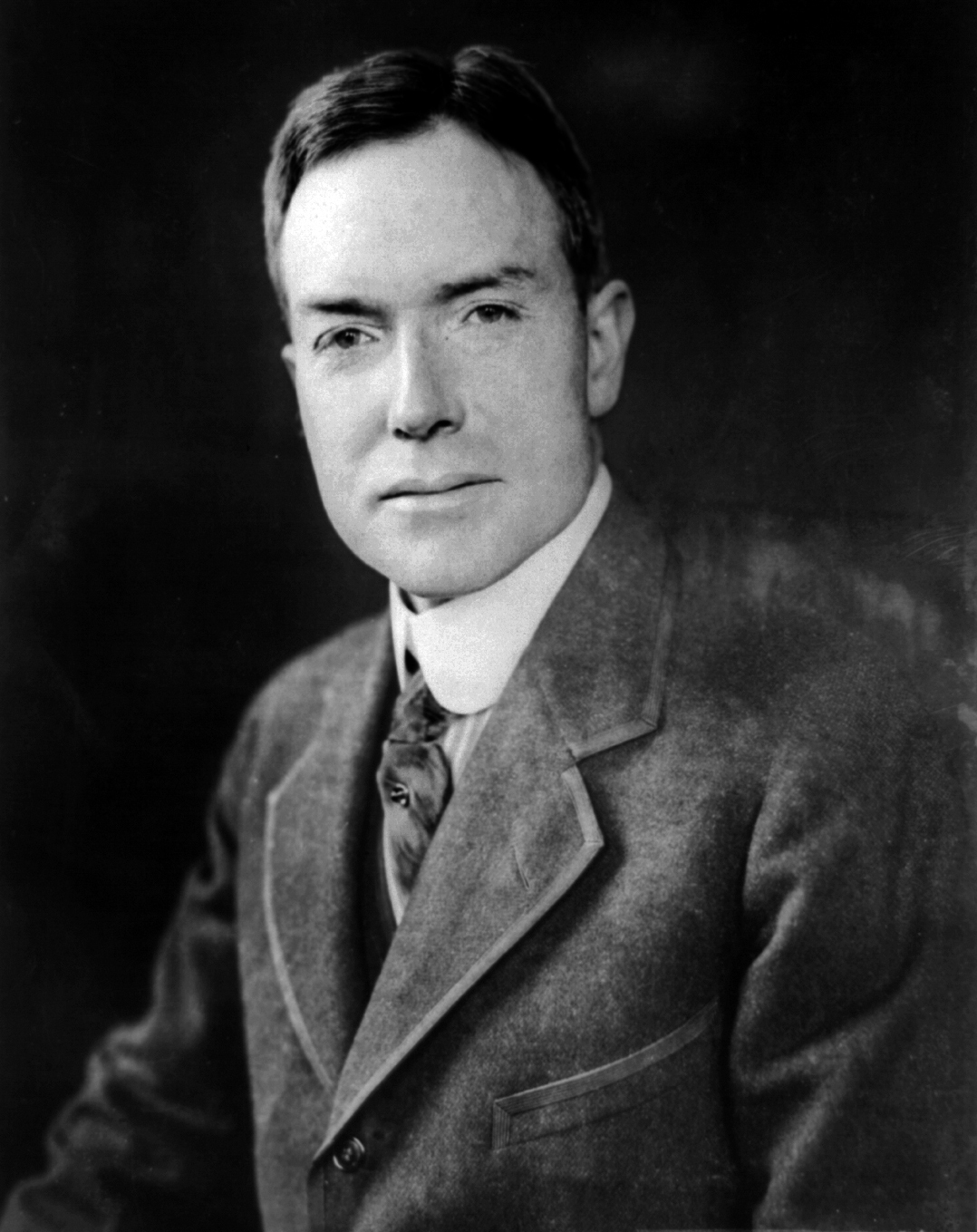
John D. Rockefeller Jr., whose $8.5 million offer bought the headquarters site. Photograph by Underwood and Underwood, via Wikimedia Commons. Public domain.
Who designed the United Nations headquarters?
Rather than run an international design competition, the UN's delegates decided the headquarters should be the joint project of leading architects from many countries. Wallace K. Harrison of the United States was appointed chief architect, with the title Director of Planning, and a ten-member Board of Design Consultants was assembled from architects nominated by their governments: Nikolai Bassov of the Soviet Union, Gaston Brunfaut of Belgium, Ernest Cormier of Canada, Le Corbusier of France, Liang Seu-Cheng of China, Sven Markelius of Sweden, Oscar Niemeyer of Brazil, Sir Howard Robertson of the United Kingdom, G. A. Soilleux of Australia and Julio Vilamajo of Uruguay.
The board began work in 1947. Because the 18-acre site was small, offices would have to go into a tall building, and the planners noted that firm bedrock, the Manhattan schist that carries the city's skyscrapers, lay near the surface, though it dips 60 feet or more below sea level between 46th and 47th Streets. The Secretariat tower went to the south end of the site for access to 42nd Street transit, and it was oriented north-south partly so its shadow would not fall across the rest of the complex. The original scheme was estimated at nearly $85 million. Under Secretary-General Trygve Lie the designers cut $20 million, largely by trimming the Secretariat from 45 stories to 39, shrinking the conference areas and using an existing building on the site for the library. The General Assembly approved the plan on November 20, 1947.
How was the headquarters built?
Quickly, by New York standards. Residential tenants were relocated at the organization's expense, the meat packers and barge operators left, and the old buildings came down. The construction contract was awarded in January 1949 to a combination of four large New York building firms. Trygve Lie laid the cornerstone on October 24, 1949, United Nations Day, with President Harry Truman present. Sealed inside the stone was a metal box holding a copy of the UN Charter and the Declaration of Human Rights, closed by Lie and Harrison; the stone itself is underground east of the library building, inscribed "United Nations" in the five official languages of 1949 with the date in Roman numerals. Secretariat staff moved into their offices in August 1950, and the General Assembly first met in its new hall at the opening of its seventh regular session in 1952.
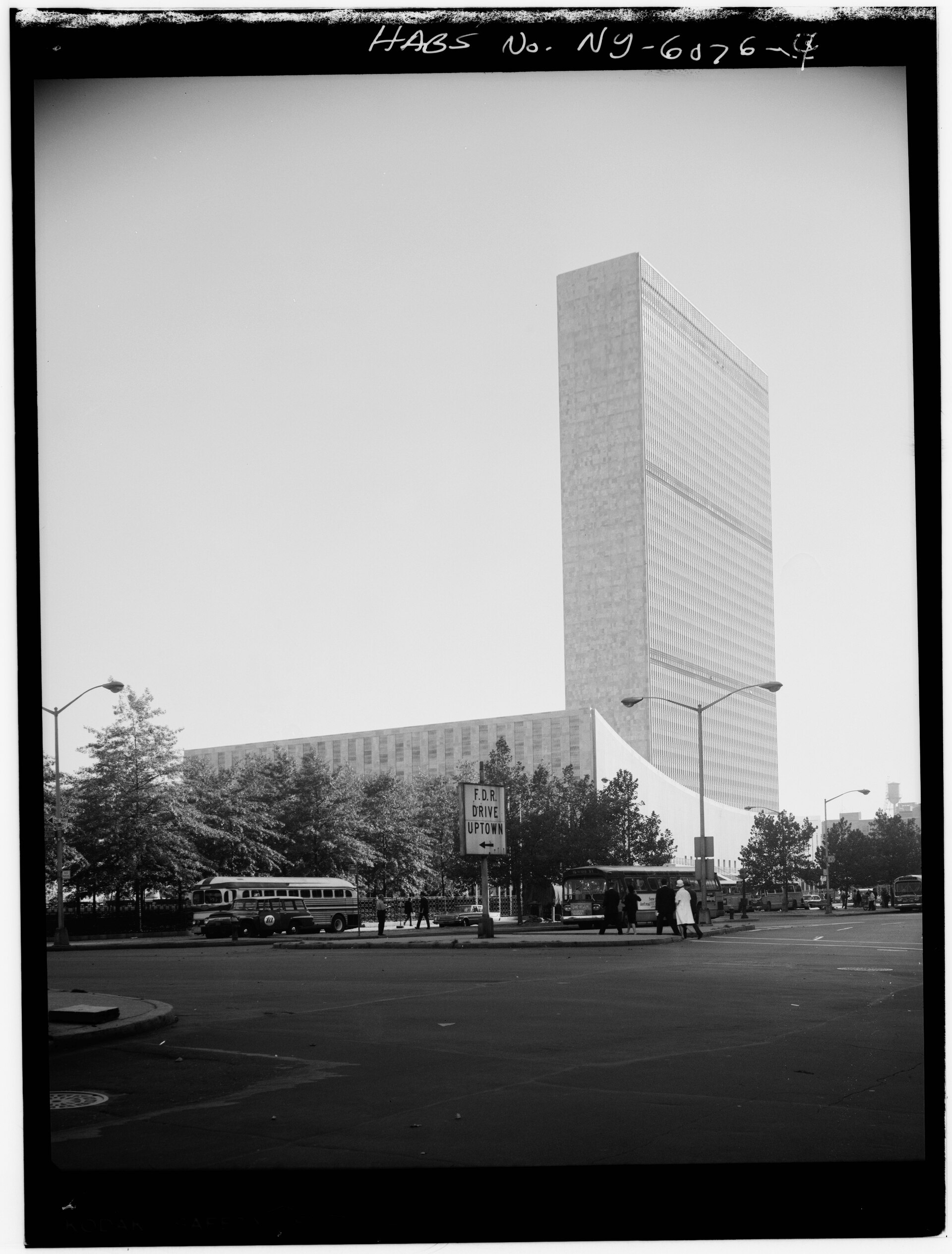
The Secretariat tower behind the curved wall of the General Assembly building, photographed for the Historic American Buildings Survey. Library of Congress, via Wikimedia Commons. Public domain.
The finished Secretariat is 550 feet tall and 39 stories, faced only in aluminum, glass and marble, with wide bands of green-tinted glass and windowless north and south walls clad in 2,000 tons of Vermont marble. The General Assembly Hall measures 165 feet long by 115 feet wide under a 75-foot ceiling, seats 193 delegations of six, and is flanked by two large murals by the French artist Fernand Léger. One detail is deliberate symbolism: the ceiling over the public gallery was left "unfinished," its pipes and ducts exposed, as a reminder that the work of the United Nations is never finished. The Conference Building, stretching along the river between the other two, holds the three council chambers: the Security Council chamber furnished by Norway and designed by Arnstein Arneberg in 1952, the Trusteeship Council chamber designed by Denmark's Finn Juhl, and the Economic and Social Council chamber, a gift from Sweden to a Sven Markelius design, renovated by Sweden again in 2013. At the southwest corner, the Dag Hammarskjöld Library was dedicated on November 16, 1961, in honor of the late Secretary-General, its construction made possible by a gift from the Ford Foundation.
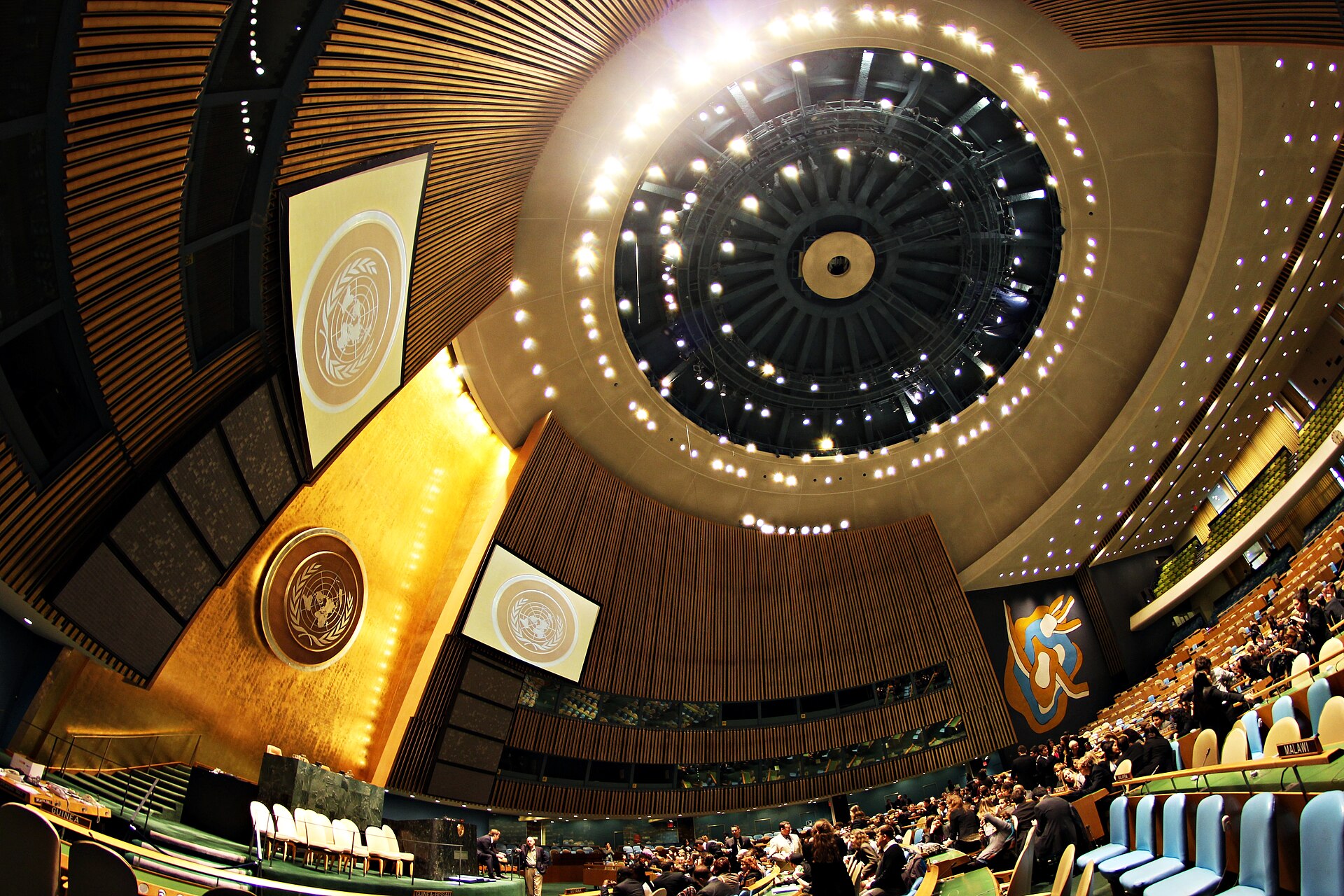
The General Assembly Hall, looking up into its dome. Photograph by Basil D Soufi, via Wikimedia Commons. CC BY-SA 3.0.
What has changed since 1952?
Mostly, the UN grew into its own buildings. When the plans were drawn in 1947 the organization had 57 member states and provision was made for 70; that number was passed by 1955. An expansion program completed in 1964 made space for 126 members, and in 1976 the General Assembly approved another round of major alterations to enlarge the Assembly Hall and the big conference rooms, finished in 1980. The largest project yet was the Capital Master Plan, a complete overhaul of the complex launched in 2008 and completed in 2014.
The grounds have their own collection. The flags of the 193 member states make a curved, 500-foot approach to the entrance. The circular pool in front of the Secretariat is floored with bands of crushed white marble and black pebbles gathered from the beaches of Rhodes by the women and children of that Greek island. At the pool's edge stands Barbara Hepworth's bronze "Single Form," set there in 1964 in memory of Dag Hammarskjöld, and a monumental staircase presented by the State of New York in his memory leads from the General Assembly plaza to the gardens, which hold gifts from member states including a Henry Moore bronze.
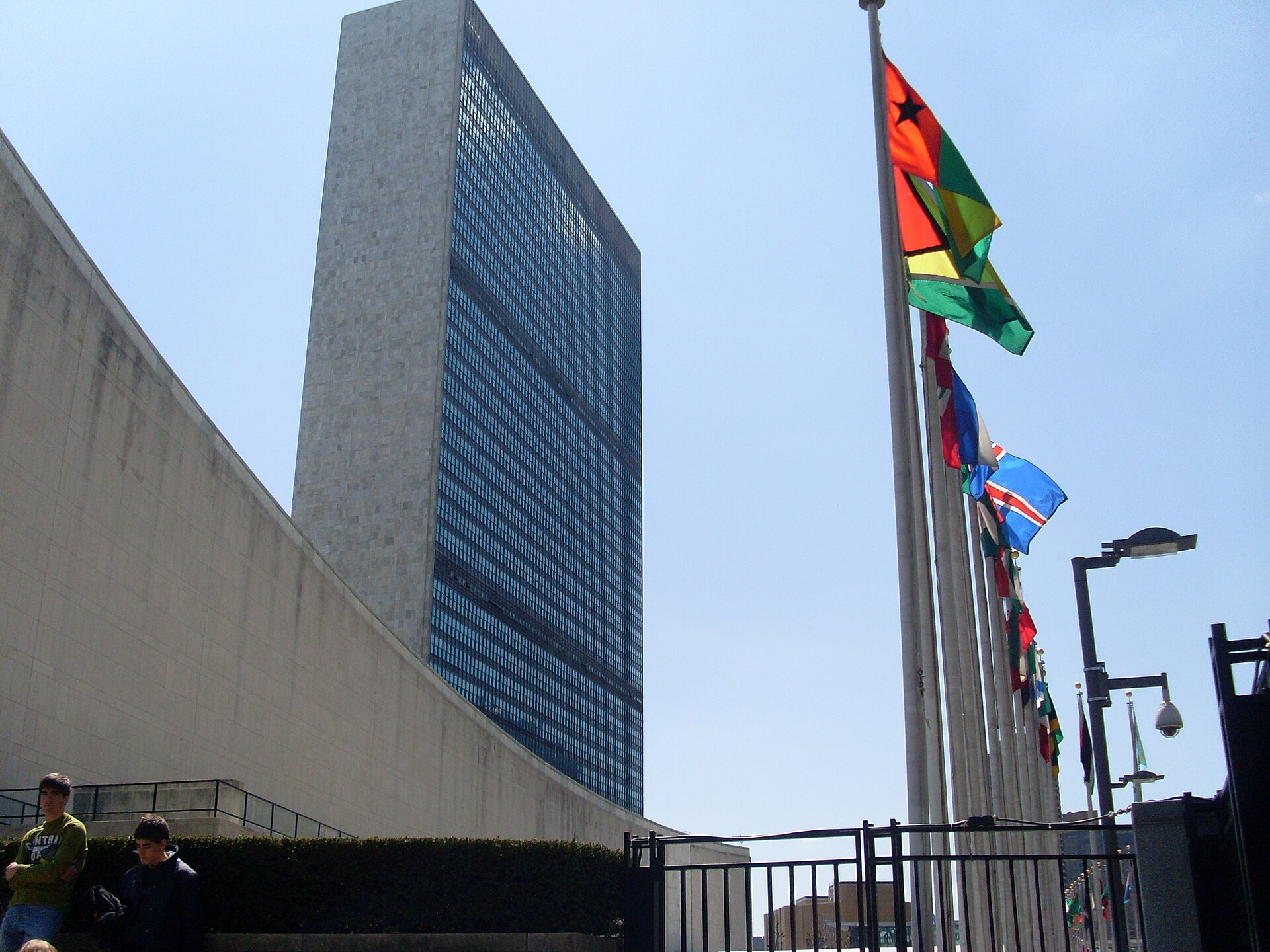
The Secretariat tower from the entrance, with member state flags. Photograph by Dendodge, via Wikimedia Commons. Public domain.
Who owns the United Nations headquarters today?
The United Nations does. The organization's fact sheet states plainly that the site is owned by the UN and holds a special status within the United States under the 1947 Headquarters Agreement. The land is not city or state property, and it is not a foreign embassy, because the UN is an organization of governments rather than a government itself. The practical consequences are the ones visitors notice: the compound is fenced and guarded by UN security, American officers enter only with the Secretary-General's consent, and the UN promises in return that the site will not shield anyone from arrest under US law.
Where can you eat or drink at the United Nations headquarters?
Visitors past security have one main option. The operator's own UN Cafes page lists a Visitors Café on the first basement level of the Visitor Center, open Monday to Friday, 9 a.m. to 5 p.m., featuring Starbucks coffee. The same page lists the Vienna Café in the General Assembly's first basement, the Lobby Café in the Secretariat, the Riverview Cafeteria in the Conference Building and the North Delegates Lounge, but those serve the working UN community rather than the touring public. The Visitor Center also holds the UN bookshop and gift shop. Hours here were read on the official pages on October 27, 2026, and the cafes keep diplomatic schedules, so confirm before you plan lunch around a visit.
Sources
- United Nations Visitors Services, History of United Nations Headquarters (fact sheet)
- Agreement between the United Nations and the United States regarding the Headquarters of the United Nations, 1947 (UN Treaty Series, vol. 11)
- Foreign Relations of the United States, 1946: memorandum on the headquarters site
- United Nations, Visit UN Headquarters
- United Nations, In-Person Guided Tours
- UN Cafes (official caterer listing)
Visiting the United Nations headquarters
- Address: The UN lists its visitor entrance at 46th Street and First Avenue, New York, NY 10017.
- Hours: Visitors Services lists weekday hours, Monday to Friday, 9 a.m. to 5 p.m.
- Admission: All visitors must register on the UN security website before arriving. Guided one-hour tours take in the General Assembly Hall and Security Council Chamber, meetings permitting, in the six official languages; children under 5 are not permitted on tours, and those under 18 need an adult.
- Getting there: The site is a short walk from Grand Central Terminal and its subway and Metro-North lines.
Facts above come from the UN pages listed in Sources. Tour availability and security rules change, so confirm on the official visit pages before you go.