Is the New Yankee Stadium on the Same Site as the Old One? The Ballpark That Moved Across the Street
No. The Yankee Stadium that opened in 2009 stands one block north of the original, on the former site of Macombs Dam Park. The first Yankee Stadium, the 1923 "House That Ruth Built," stood across East 161st Street on the south side, and its footprint is now a public ballfield called Heritage Field. The name, the frieze and the monuments all crossed the street. The ground they used to stand on belongs to the neighborhood again.
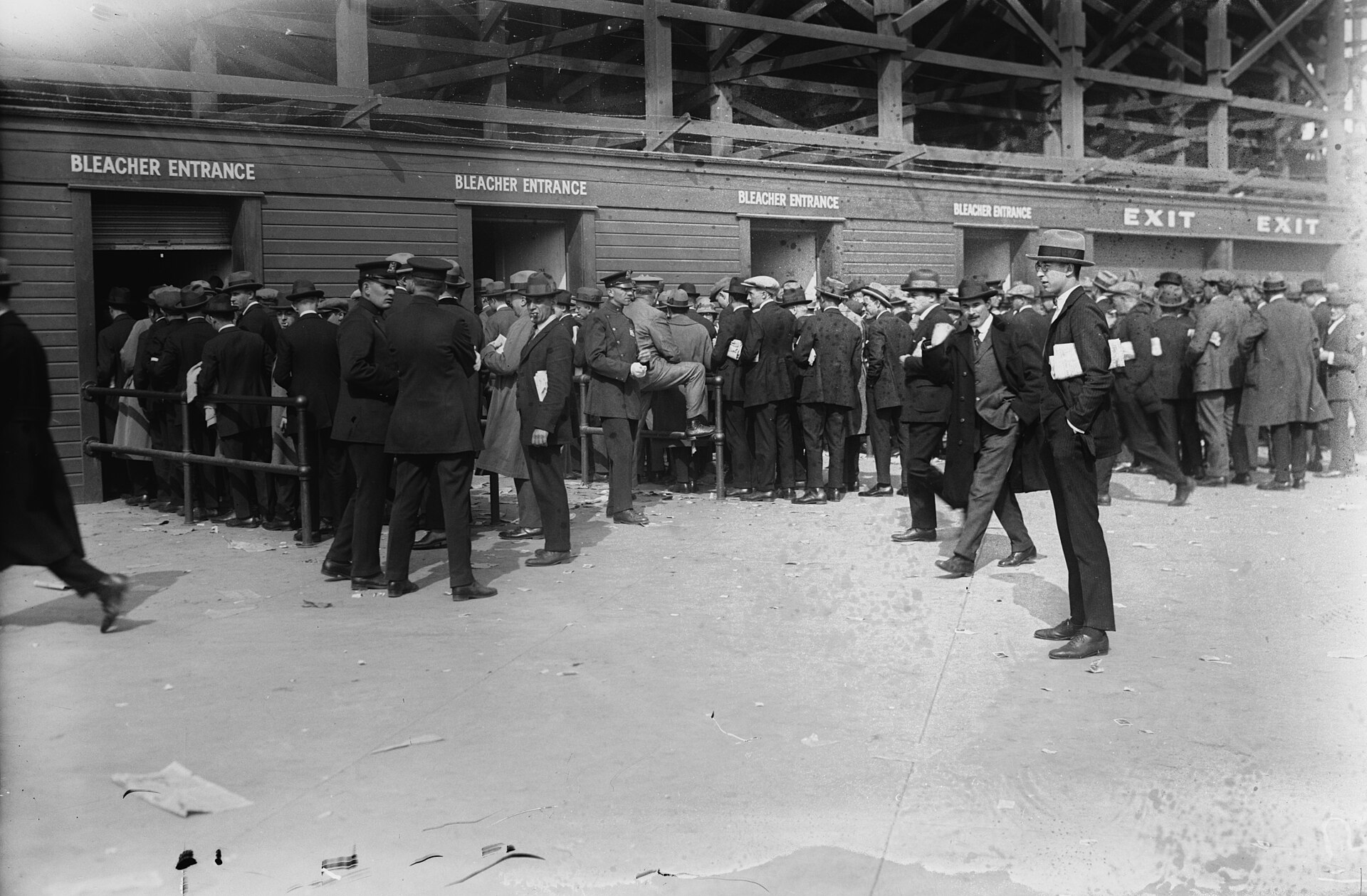
Fans lined up for bleacher seats for Game 1 of the 1923 World Series at the first Yankee Stadium, October 10, 1923. Bain News Service, via the Library of Congress and Wikimedia Commons. Public domain.
Where was the original Yankee Stadium?
The Society for American Baseball Research's history of the park says that Yankees owners Jacob Ruppert and Tillinghast L'Hommedieu Huston bought the contract of Babe Ruth from the Red Sox in December 1919, and that Ruth's drawing power soon made the Yankees unwelcome tenants of the Giants at the Polo Grounds. After considering sites in Queens, at Inwood at the northern tip of Manhattan and at 136th Street and Broadway, SABR says, Ruppert and Huston settled on a 12-and-a-half-acre lumber mill owned by the estate of William Waldorf Astor at East 161st Street and River Avenue in the Bronx, for which they paid $675,000. The site sat directly across the Harlem River from the Polo Grounds.
Ground broke in May 1922, and the Osborn Engineering Company finished the stadium in less than a year. SABR records that the first design called for a completely enclosed, circular stadium seating 80,000, and that the plans were modified so the upper decks ended at the flagpoles, letting light and air in. The building cost the Yankee owners $2.5 million.
Opening Day was Wednesday, April 18, 1923. SABR's account describes Governor Al Smith throwing out the first ball and John Philip Sousa's band playing the pregame music, before a crowd the papers estimated at 70,000 - surely an exaggeration, since the park held about 60,000. The Yankees beat the Red Sox 4-1 behind Bob Shawkey, and Ruth hit the stadium's first home run into the right-field seats in the third inning. Sportswriter Fred Lieb dubbed the building "The House That Ruth Built," and the name stuck for more than eight decades. That October the Yankees beat the Giants for the franchise's first World Series championship. MLB's centennial look back adds one neighborhood detail: the Giants thought so little of the new stadium that they dressed at the Polo Grounds and took taxis across the Macombs Dam Bridge for the Series opener.
How did the city end up rebuilding it?
By the late 1960s the stadium and the neighborhood had aged, and the Yankees, then owned by CBS, were hinting at leaving. SABR says Mayor John Lindsay first approached the team at the Mayor's Trophy Game in August 1970. In 1971 the city used eminent domain to take the stadium and the land, which by a strange chain of deals had ended up belonging to Rice University and the Knights of Columbus, and the Yankees signed a 30-year lease. Lindsay initially offered a $24 million renovation; SABR notes that officials later estimated the final cost near $100 million and perhaps closer to $150 million, and the true figure was never disclosed.
The Yankees played the 1974 and 1975 seasons at Shea Stadium while the old park was gutted. They returned on April 15, 1976, with an 11-4 win over the Minnesota Twins before 52,613 fans, and Shawkey, the winning pitcher of the 1923 opener, threw out the first pitch. The rebuilt stadium held 57,145, down from about 65,000. SABR records that the deepest part of the outfield, the old 490-foot "Death Valley," came in to 417 feet, and that the monuments to Ruth, Gehrig and manager Miller Huggins, which had stood in fair territory, moved behind the center-field wall - the beginning of Monument Park.
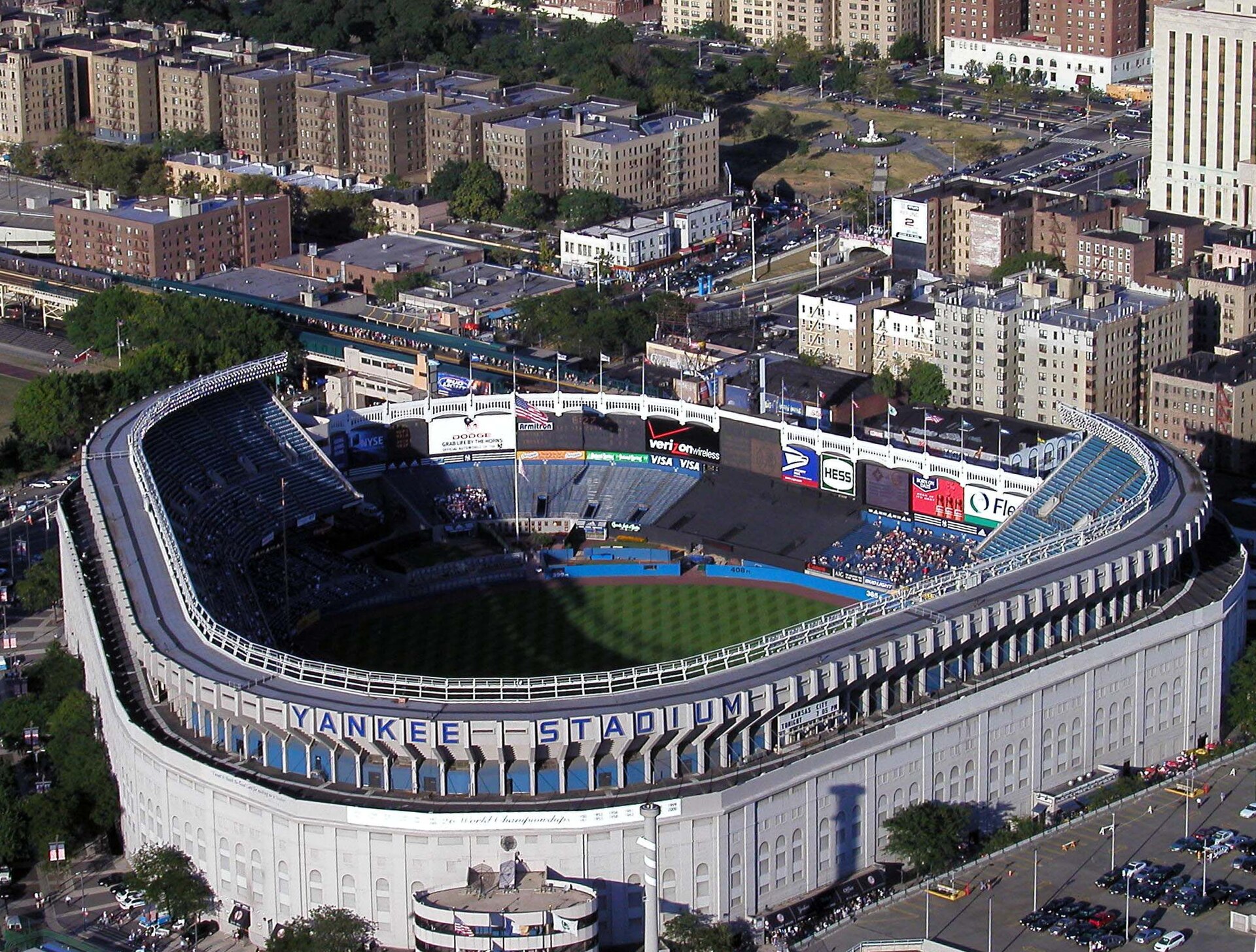
The renovated original Yankee Stadium photographed from a U.S. Army Blackhawk helicopter in August 2002, six years before it closed. Photograph by Severin St. Martin, via Wikimedia Commons. CC BY 2.0.
Why did the Yankees want a new stadium?
Wikipedia records that George Steinbrenner began campaigning for a new stadium in the early 1980s, only a few years after the renovation, and periodically threatened to move the team to New Jersey. In 1996 the architectural firm HOK studied four sites, including the West Side Rail Yards in Manhattan, and endorsed the West Side. On April 13, 1998, a 500-pound concrete and steel beam fell from the old stadium onto an empty seat hours before a game, and SABR says the accident gave Steinbrenner ammunition for his case. Mayor Rudy Giuliani announced tentative agreements for two new retractable-dome stadiums in December 2001, days before leaving office.
Michael Bloomberg called those deals "corporate welfare" and backed out of them, but by 2006 the city, the state and the Yankees had agreed on a new plan. The new stadium would go up across East 161st Street, in Macombs Dam Park. Groundbreaking came in August 2006.
So where exactly did the new stadium go?
On the park. Wikipedia gives the address as a 24-acre site in the Concourse neighborhood, the former Macombs Dam Park, one block north of the original stadium. NYC Parks, which lost the park to the project, says the city promised to replace every inch of the displaced parkland. The department rebuilt Macombs Dam Park in pieces, part of it on a rooftop over a parking garage, with a running track, ball fields, handball and basketball courts, a skate plaza and a playground, largely completed by 2010 and 2011.
The old stadium was demolished in 2010, and Heritage Field opened on its grounds. NYC Parks describes three championship-quality grass ballfields, with the southern baseball field aligned with the original stadium's footprint, plus a track-and-field competition space. A piece of the old roofline frieze was built into the park, and inscribed benches and viewfinders mark events from the stadium's history. In 2020 the field was renamed for Elston Howard, the first Black player on the Yankees. The park's name reaches further back: NYC Parks says the New York Legislature granted Robert Macomb permission to dam the Harlem River here in 1813, and his dam and grist mill operated until 1858.
What is the new stadium like?
The new stadium was designed by Populous, the firm formerly known as HOK Sport. Wikipedia says the exterior uses 11,000 pieces of Indiana limestone from the same quarry that produced the stone for the Empire State Building, with the stadium's name V-cut and gold-leaf lettered above each gate. Inside is the Great Hall, a 31,000-square-foot main concourse lined with banners of Yankee greats. The trademark copper frieze from the original stadium's roof was recreated above the outfield scoreboard. Baseball capacity is 46,537, the fifth-largest in the major leagues.
The cost is one place the sources disagree. Wikipedia puts the final price at $2.3 billion, including $1.2 billion in public subsidies, making it one of the most expensive stadiums ever built. SABR gives the stadium itself a price of more than $1.5 billion and says the city and state spent another $400 million on parking, parks and a new Metro-North station. The Yankees never sold naming rights.
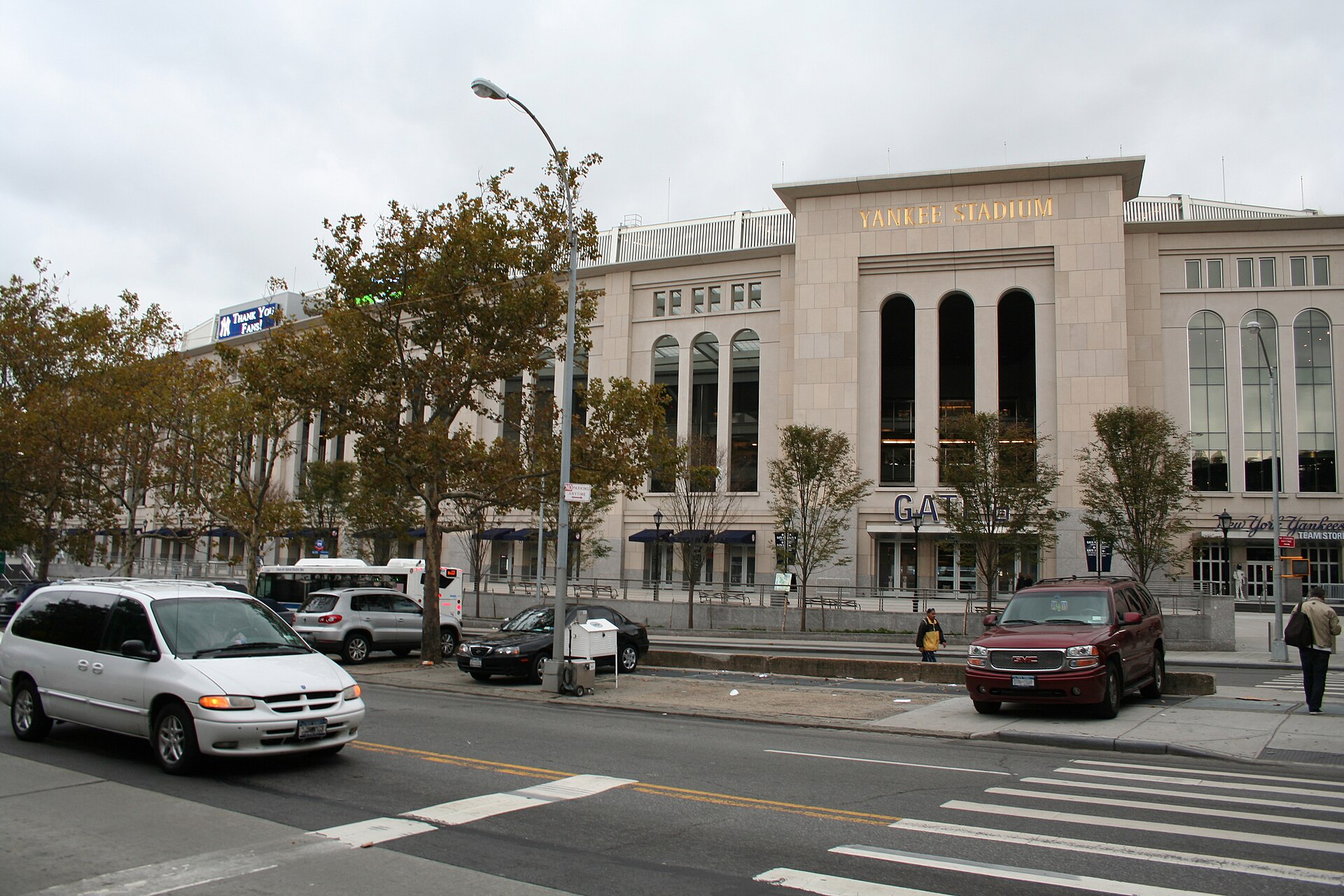
The current stadium from East 161st Street in October 2009, its first season. Photograph by K Danko, via Wikimedia Commons. CC BY-SA 3.0.
The stadium opened with a workout day on April 2, 2009, an exhibition against the Chicago Cubs on April 3, and the regular-season opener on April 16, 2009. Wikipedia records that the Yankees lost that first game 10-2 to Cleveland, that the bat Ruth used to hit the old stadium's first home run was placed momentarily on home plate before the Yankees' first at-bat, and that Jorge Posada hit the new stadium's first Yankee home run. The season ended better: the Yankees won the 2009 World Series in the building, their 27th championship, becoming the only team to win a World Series in the first season of two different stadiums. On October 30, 2024, the Los Angeles Dodgers became the first visiting team to clinch a World Series there.
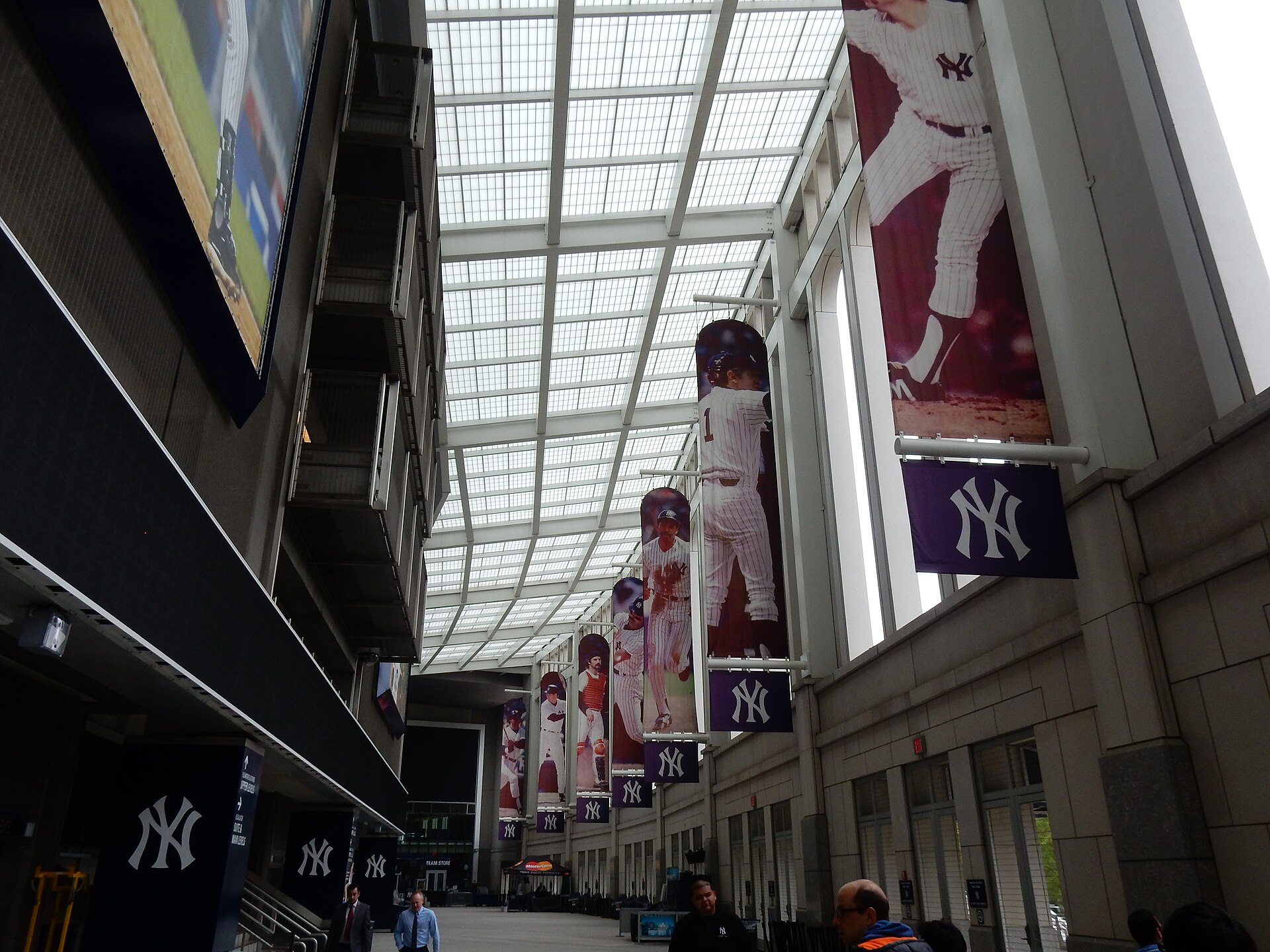
The Great Hall, the stadium's 31,000-square-foot main concourse, in 2016. Photograph by Kanesue, via Wikimedia Commons. CC BY 2.0.
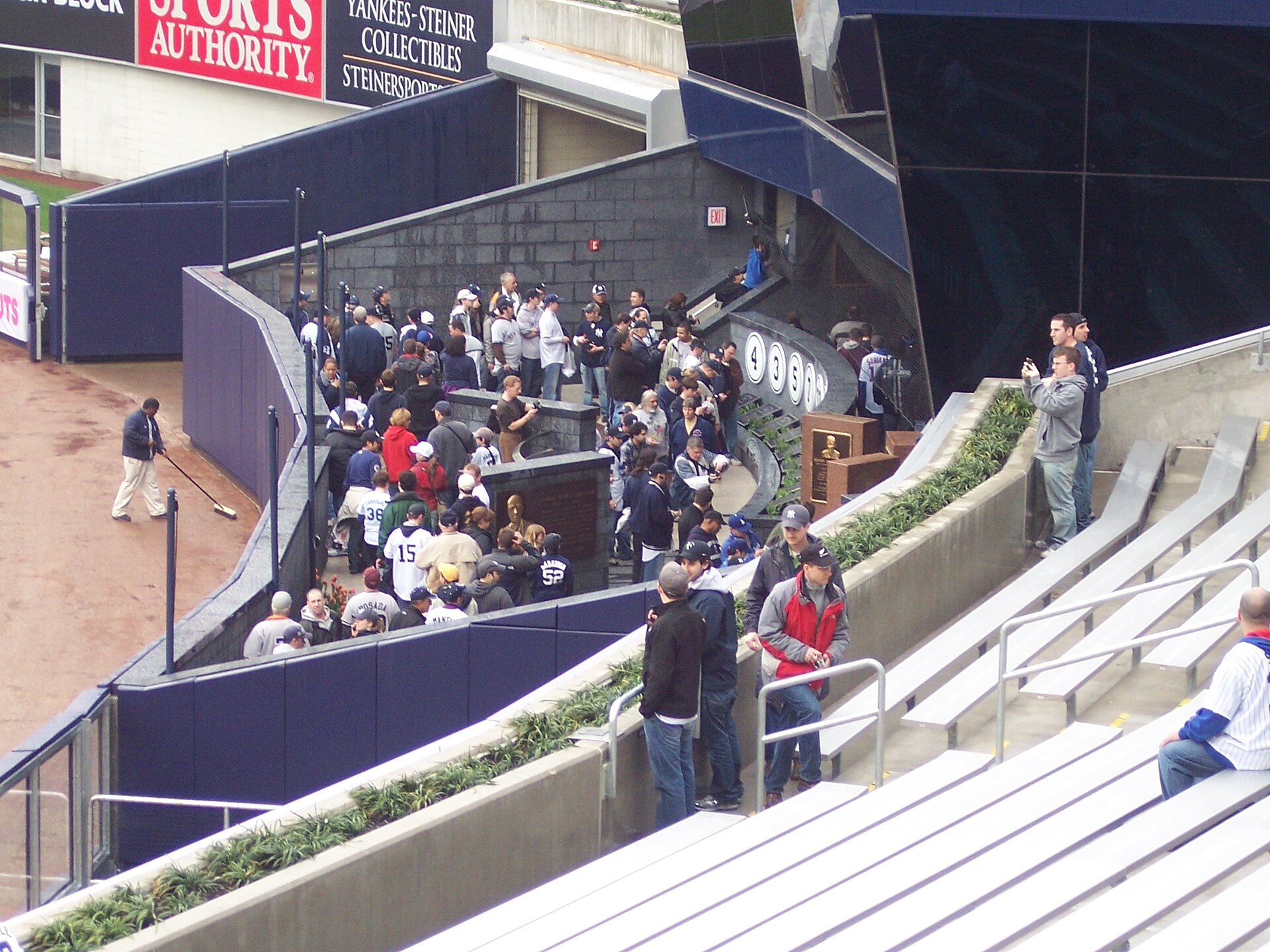
Monument Park in the stadium's first week, April 4, 2009. The monuments began in the original park, where they stood in fair territory until 1976. Photograph by The Silent Wind of Doom, via Wikimedia Commons. CC BY 3.0.
Who owns and runs Yankee Stadium?
The City of New York owns Yankee Stadium, as it has since the 1971 eminent-domain taking, and the Yankees operate it through Yankee Stadium LLC. The team itself is controlled by the Steinbrenner family's Yankee Global Enterprises. Food and hospitality at the stadium are run by Legends Global, the company the Yankees' 2026 dining guide credits, led at the stadium by Executive Chef Robert Flowers.
Where can you eat or drink at Yankee Stadium?
Wikipedia says the ballpark has 25 fixed concession stands and 112 movable ones. Two sit-down spots predate the 2026 season guide: a Hard Rock Cafe at the 161st Street and River Avenue entrance, which opened with the stadium in 2009 and stays open year-round, and NYY Steak beyond right field.
The Yankees' official 2026 dining guide lists the current stands by section, under the Legends Global culinary team led by Executive Chef Robert Flowers. Among the named offerings: a 99 Burger of two wagyu patties at Section 107, sushi burritos, hibachi and poke bowls at Section 127, Bobby's Burgers at Section 132, and hand-dipped ice cream at Sections 125 and 318, alongside ballpark staples throughout. The team points fans to yankees.com/eats for in-season updates. Listings here were read on the official pages on October 23, 2026.
Sources
- Society for American Baseball Research, Yankee Stadium (New York)
- Wikipedia, Yankee Stadium
- MLB.com, Yankee Stadium was unveiled 100 years ago
- NYC Parks, Macombs Dam Park Highlights: Elston Gene Howard Field
- NYC Parks, Yankee Stadium Redevelopment Project
- New York Yankees, Tours of Yankee Stadium
- New York Yankees, 2026 Yankee Stadium Dining Guide
Visiting Yankee Stadium
- Address: The stadium is at East 161st Street and River Avenue in the Bronx, directly served by the 161st Street - Yankee Stadium subway station on the 4, B and D trains and by the Yankees - East 153rd Street Metro-North station, which Wikipedia says opened May 23, 2009.
- Events: It is a working ballpark. Entry is by event ticket; the schedule is on the Yankees' official site.
- Tours: The Yankees' official tours page lists public tours that include Monument Park and the New York Yankees Museum presented by Bank of America, plus private, group and premium options. Confirm times and prices with the Yankees before going.
- Heritage Field: The old stadium's footprint, across 161st Street, is a free NYC Parks facility with ballfields and a track, open to the public.
Transit, tour and access facts above come from the Yankees' official pages and Wikipedia as noted. I did not verify current tour availability, so check before planning around it.