Is Madison Square Garden Actually at Madison Square? Four Arenas and a Name That Moved
No. Madison Square Garden has not stood anywhere near Madison Square for a hundred years. The arena that carries the name today sits between Seventh and Eighth Avenues from West 31st to West 33rd Street, on top of Pennsylvania Station, and it is the fourth building to be called Madison Square Garden. The first two really were at Madison Square, on Madison Avenue at East 26th Street. The name survived each move because, by the time the building left the square, it had become one of the most famous brands in entertainment.
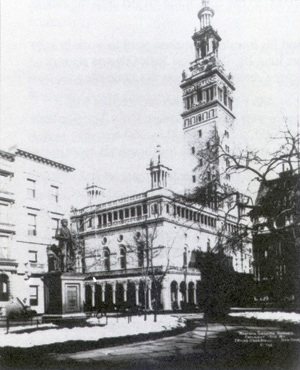
The second Madison Square Garden, designed by Stanford White and opened in 1890 on Madison Avenue at East 26th Street, with its tower modeled on the Giralda in Seville. Unknown photographer, via Wikimedia Commons. Public domain.
Where did the name come from?
The name comes from Madison Square, the park where Madison Avenue meets Broadway and Fifth Avenue at 23rd Street. Urban Archive, a history platform that works with New York cultural institutions, says the first Madison Square Garden was an existing arena just northeast of the square that William K. Vanderbilt bought and renamed in 1879. Wikipedia notes that the building had earlier been leased to P.T. Barnum. The drafty hall presented athletic attractions, most notably boxing matches featuring John L. Sullivan.
The first Garden did not last long, though the sources disagree about why and exactly when it went. Urban Archive says Vanderbilt, unable to make a profit, razed the building in 1889. Wikipedia says it was demolished in 1890 because of a leaky roof and dangerous balconies that had collapsed, causing deaths. Either way, the corner was cleared for a far grander replacement.
What was Stanford White's Garden?
The second Madison Square Garden opened in 1890 on the same site. Wikipedia says it was built by a syndicate that included J.P. Morgan, Andrew Carnegie, P.T. Barnum, Darius Mills, James Stillman and W.W. Astor, at a cost of $3 million. Stanford White of McKim, Mead & White gave them a Beaux-Arts structure with a Moorish feel, including a tower modeled on the Giralda, the bell tower of the Cathedral of Seville. The main hall measured 200 by 350 feet with permanent seating for 8,000, which Wikipedia says made it the largest hall in the world, and the building also held a 1,200-seat theater, a 1,500-seat concert hall, the largest restaurant in the city and a roof garden cabaret.
The tower carried one of the city's favorite ornaments. The Metropolitan Museum of Art says the architect gave Augustus Saint-Gaudens the commission for a weathervane for the tower: a gilded, nude Diana, goddess of the hunt, aiming her bow. The first, eighteen-foot-tall sculpture proved too large and was replaced in 1894 by a streamlined version five feet shorter. It became, in the Met's words, one of New York's most popular landmarks, and casts of it are in the Met's collection today.
The roof garden below the tower made darker history. Urban Archive notes that Stanford White was shot and killed there in 1906 by Harry Thaw, the husband of the showgirl Evelyn Nesbit, in one of the early century's most notorious trials. The second Garden went on to host horse shows, dog shows, bicycle races, boxing and the 1924 Democratic National Convention. But it never made much money. Wikipedia says the New York Life Insurance Company, which held the mortgage, decided to tear it down in 1925 and build its new headquarters on the site: the gold-crowned Cass Gilbert tower covered in this site's New York Life Building article.
Why did the Garden move to Eighth Avenue?
Boxing promoter Tex Rickard kept the name and took it across town. Wikipedia says the third Madison Square Garden, at Eighth Avenue between West 49th and 50th Streets, broke ground on January 9, 1925, was designed by theater architect Thomas W. Lamb, cost $4.75 million and was built in 249 days. It was dubbed "The House That Tex Built," and it could seat 18,496 for boxing.
The third Garden was a boxing and hockey house above all, but its most remembered nights were stranger. Wikipedia records a rally of 20,000 people there in 1939 by the German American Bund, an American Nazi organization. The landlord of its eventual replacement site, SL Green, notes another famous evening: it was at the third Garden that Marilyn Monroe sang "Happy Birthday, Mr. President" to John F. Kennedy at his 1962 birthday party.
The third Garden closed when the fourth opened in 1968. SL Green says the Eighth Avenue site was a parking lot from 1968 until Worldwide Plaza rose there in 1989, a full-block complex designed by David Childs of Skidmore, Owings & Merrill.
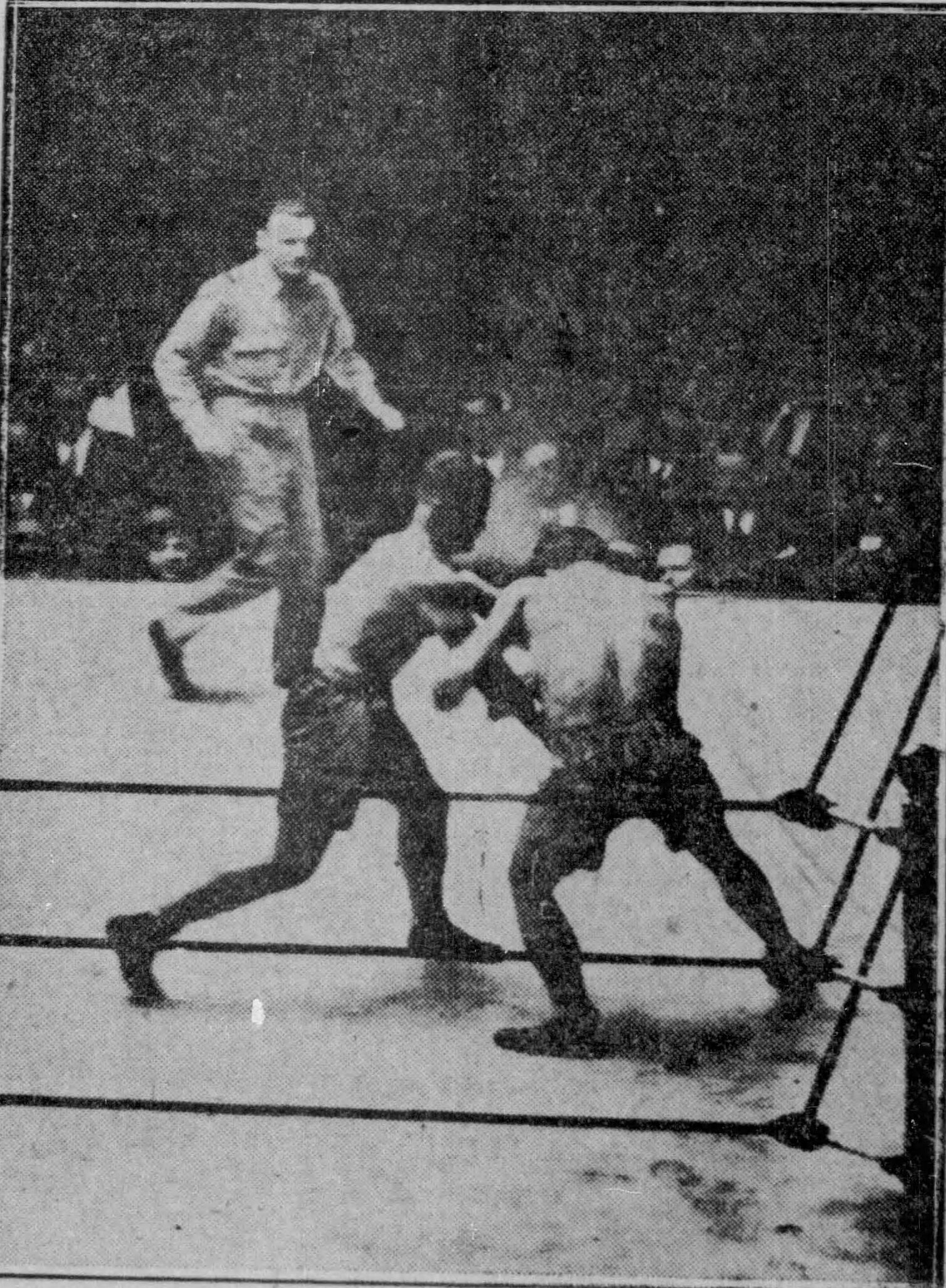
Paulino Uzcudun and Tom Heeney boxing at the third Madison Square Garden, April 1, 1927. Chicago Tribune, via Wikimedia Commons. Public domain.
How did the Garden end up on top of Penn Station?
The fourth Garden is inseparable from the building it destroyed. PBS's American Experience series says that in 1961 the financially strapped Pennsylvania Railroad announced it had sold the air rights above Pennsylvania Station, and that the company would tear down its own crowning jewel to build Madison Square Garden, a high-rise office building and a sports complex. Demolition began on October 28, 1963 and continued for three years.
The lost building was McKim, Mead & White's 1911 Beaux-Arts Pennsylvania Station, which occupied two full city blocks. New York City's Landmarks Preservation Commission says on its own history page that the Commission was created in 1965, while the demolition was under way, in response to the losses of historically significant buildings, "most notably, Pennsylvania Station." The Garden is therefore part of two stories at once: the story of the arena, and the story of how New York got its landmarks law.
Wikipedia says the new Garden broke ground on October 29, 1964, was designed by Charles Luckman Associates with Brisbin Brook Beynon Architects, and cost $123 million. It sits on a platform above the station's still-working train concourses. The New York Times reported that the fourth Madison Square Garden opened on February 11, 1968, with a "Salute to the U.S.O." starring Bob Hope and Bing Crosby.
What is the current Garden like?
The arena has been home to the New York Knicks and the New York Rangers since 1968, along with concerts and special events, and it markets itself as "The World's Most Famous Arena." Wikipedia says it was renovated from 1989 to 1991 at a cost of $200 million, and again from 2011 to 2013 at a cost of about $1 billion. The Madison Square Garden Company marked the end of that second project in October 2013, calling it a three-year, top-to-bottom "Transformation" that touched every part of the arena, from the first row to the last. Madison Square Garden Entertainment says its venues have flexible capacities ranging from 2,800 to 21,000 seats, with the Garden the largest of them.
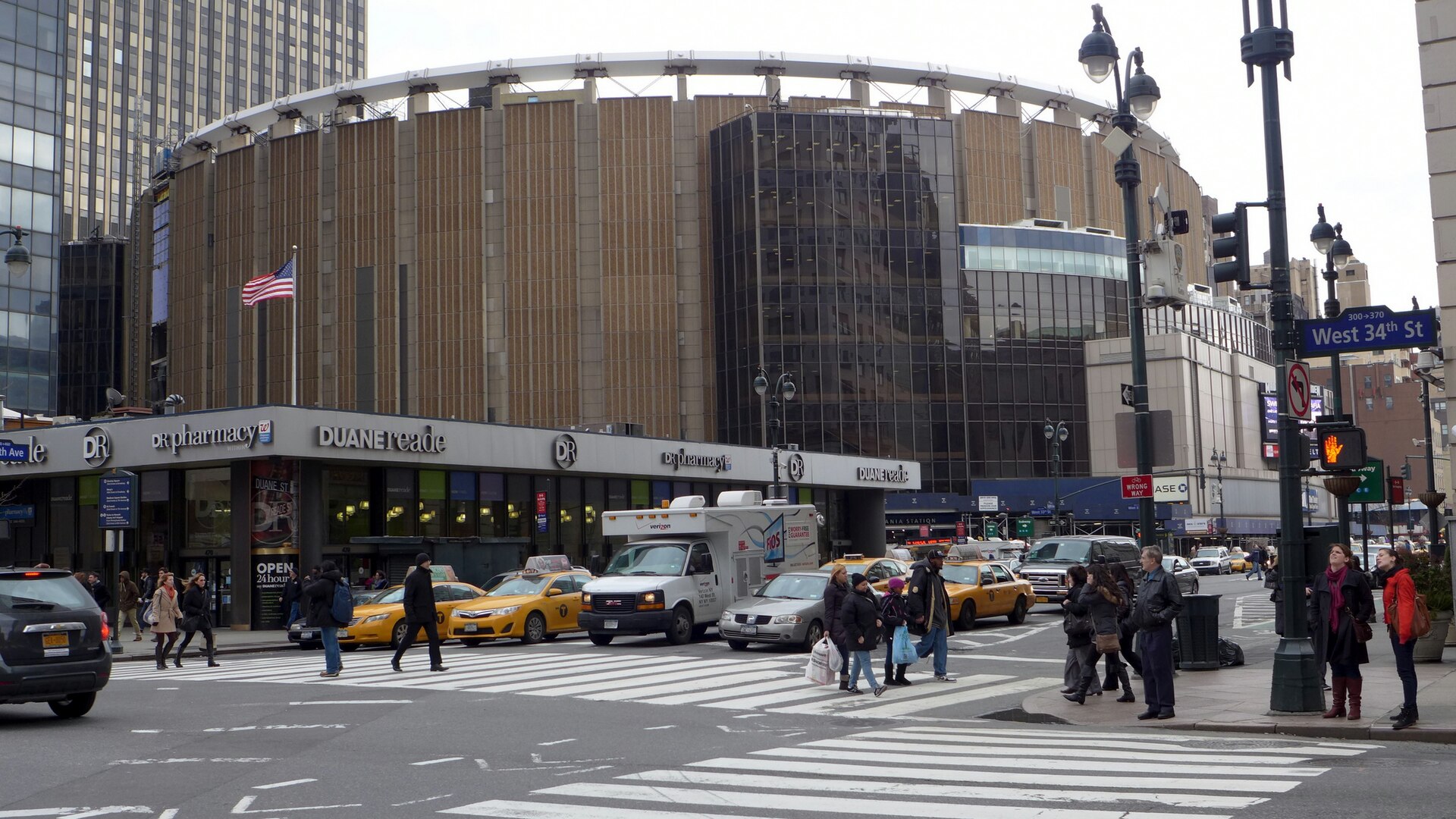
The current Madison Square Garden above Penn Station in February 2013, near the end of its three-year renovation. Photograph by Rich Mitchell, via Wikimedia Commons. CC BY 2.0.
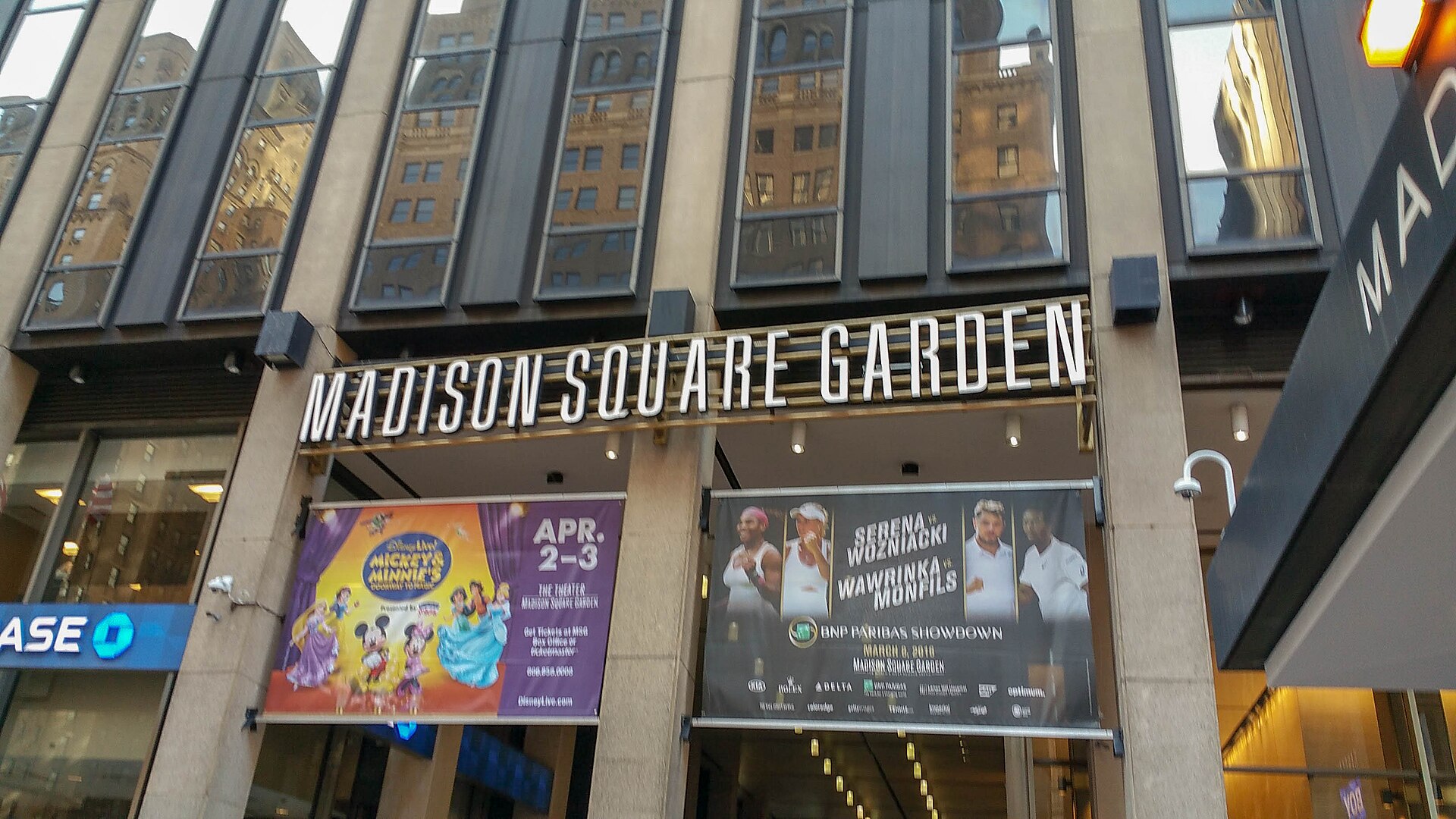
The Garden's front entrance on Seventh Avenue. Photograph by Andrew nyr, via Wikimedia Commons. CC BY-SA 4.0.
Who owns and runs Madison Square Garden?
The Garden is owned by Madison Square Garden Entertainment Corp., whose own company page lists its venues as the Garden, the Theater at Madison Square Garden, Radio City Music Hall, the Beacon Theatre and the Chicago Theatre. The corporate structure takes some untangling. A 2023 filing with the Securities and Exchange Commission explains that the company then called Madison Square Garden Entertainment spun off its traditional venue and entertainment business as a new public company, which took the Madison Square Garden Entertainment name, while the original company renamed itself Sphere Entertainment Co. The same filing says the Knicks and the Rangers, owned by the separate Madison Square Garden Sports Corp., play their home games at the Garden under long-term arena license agreements.
Where can you eat or drink at Madison Square Garden?
The Garden's official concessions page describes its food program as MSG Eats, with specialty vendors spread across the concourses. On the 100 level it lists Mighty Quinn's Barbeque, Carnegie Deli, Pat LaFrieda, Daily Burger, Brooklyn Dumpling Shop, Veselka, Chickies, Luchini Italian Sandwich Shop, Avenue Cantina, Shah's Halal, Dunkin' Donuts, Mike's Hot Honey, Paulie Gee's Pizza, TAO Sushi, Rock N' Lobster, Fuku and Insomnia Cookies, among others. The 200 level adds more stands, including SeoulBird Korean BBQ, 7th Street Burger and a second Carnegie Deli, and there are additional stands on the bridge and upper levels.
MSG says most locations open for all Knicks and Rangers games, and that guests can call Guest Relations at (212) 465-6225 to ask whether a location will be open for a specific event; it also warns that stands may be closed without notice. Its alcohol policy page says alcohol sales stop at the start of the fourth quarter for Knicks games and at the ten-minute mark of the third period for Rangers games, and that outside alcohol is not allowed. Listings and hours here were read on the official pages on October 21, 2026.
Sources
- Urban Archive, Many MSGs: Madison Square Garden and Its Many Incarnations
- Wikipedia, Madison Square Garden
- The Metropolitan Museum of Art, Augustus Saint-Gaudens, Diana
- The New York Times, New Madison Square Garden, Colorful and Comfortable, to Open Tomorrow, February 10, 1968
- PBS American Experience, The Rise and Fall of Penn Station: The Destruction
- New York City Landmarks Preservation Commission, About LPC
- SL Green, 825 Eighth Avenue (Worldwide Plaza)
- The Madison Square Garden Company, Madison Square Garden Unveils Completely Transformed Arena, October 24, 2013
- U.S. Securities and Exchange Commission, MSG Entertainment spin-off information statement, 2023
- Madison Square Garden Entertainment Corp., Our Company
- MSG, Madison Square Garden Concessions
- MSG, Madison Square Garden Tour Experience
Visiting Madison Square Garden
- Address: MSG's tour page puts its box office and tour desk on Seventh Avenue between West 31st and West 33rd Streets; Wikipedia lists the arena's address as 4 Pennsylvania Plaza. The arena sits directly above Penn Station.
- Events: The Garden is a working arena, not a drop-in attraction. Entry is by event ticket; the calendar is on MSG's official site.
- Tours: MSG's official site sells a 60-minute Madison Square Garden Tour Experience, listed at $48 to $49 including a $5 online service fee, with backstage access and, on non-game days, the Knicks and Rangers locker rooms. Confirm times and prices with MSG before going.
Location, tour and access facts above come from MSG's official pages, with the street address from Wikipedia as noted. I did not verify current tour availability, so check before planning around it.