The Flatiron Building: How an Awkward Plot Became a New York Landmark
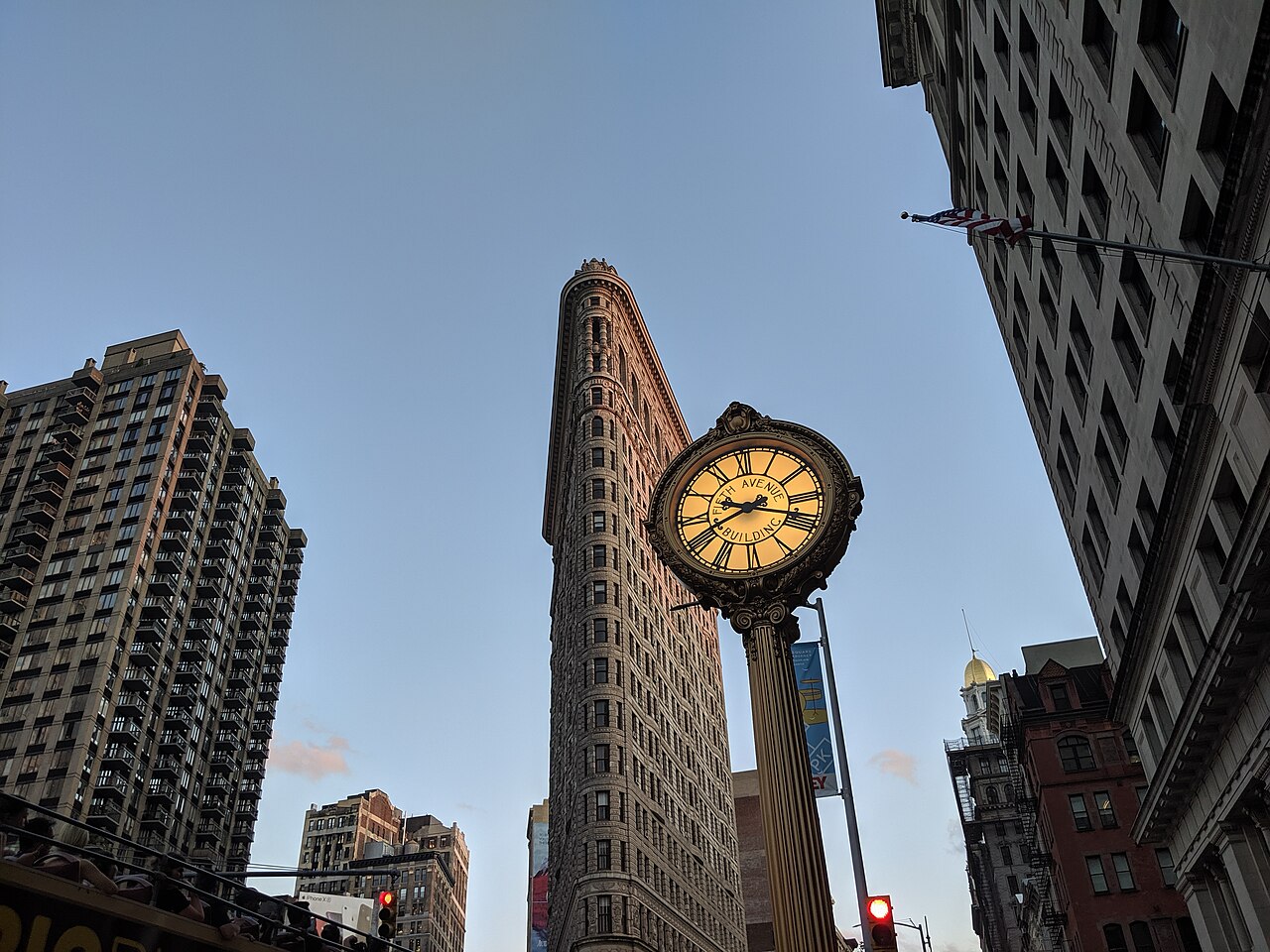
The Flatiron Building in 2019. Photograph by PortableNYCTours, via Wikimedia Commons. CC BY-SA 4.0.
The site's unusual geometry long predated the building. Broadway cuts diagonally across the Commissioners' Grid, producing irregular spaces that the Museum of the City of New York calls "bowties." The wedge south of Madison Square was especially conspicuous. Earlier, lower buildings occupied the site, but by the turn of the twentieth century its location made it valuable enough to support a much more ambitious structure.
The developer was the George A. Fuller Company, a major builder that helped separate the roles of architect and general contractor in large American projects. The company's founder, George A. Fuller, died before the building was completed, and the formal name honored him. New Yorkers, however, quickly favored a name suggested by the structure's resemblance to a cast-iron clothes iron. "Flatiron" proved more durable than "Fuller Building," eventually giving the surrounding district its name.
Chicago architect Daniel H. Burnham and his firm designed the building. Burnham was already known for major commercial work and for directing the 1893 World's Columbian Exposition. In New York, he paired modern engineering with a façade rooted in historic European design. The New York City Landmarks Preservation Commission described the building as a French Renaissance skyscraper. Its limestone and glazed terra-cotta exterior is richly ornamented, while the façade is organized in the classical manner of a column: a defined base, a long middle section, and a crowning top.
That traditional surface enclosed a modern steel skeleton. The frame allowed the building to rise on its thin footprint without relying on massive load-bearing masonry walls. Contemporary construction photographs held by the Library of Congress show the upper steelwork exposed above the completed floors, making the new method easy to see. At its narrow northern tip, the building is only about six feet wide. From Madison Square, the rounded point gives the structure the appearance of a ship's prow moving up the avenue.
The Flatiron was not New York's first skyscraper, nor was it the city's tallest when completed. Its importance came instead from the combination of height, siting, and visibility. The Landmarks Preservation Commission wrote that to New Yorkers in 1902 it represented "the very essence of modernity." Standing apart at a major intersection, it could be seen from long approaches along both Broadway and Fifth Avenue. Photographers quickly recognized its dramatic possibilities. Alfred Stieglitz and Edward Steichen were among the artists who used the building to portray a city being transformed by technology, scale, weather, and electric light.
Its setting also generated a famous piece of street lore. Winds deflected around the building were said to lift women's skirts near 23rd Street, attracting groups of men whom police would chase away. The phrase "23 skidoo" became associated with the spot, although the exact origin of the expression remains disputed. The Museum of the City of New York treats the story as part of the building's cultural history while noting that several explanations for the phrase circulated at the time.
Who owns the Flatiron Building today?
The building is now owned through Flatiron Owner LLC by a joint venture of the Brodsky Organization, the Sorgente Group, and the Gural family’s GFP Real Estate, with Brodsky serving as managing partner. That ownership followed two court-ordered auctions in 2023. Jacob Garlick submitted a $190 million high bid at the first auction but failed to pay the required deposit, so that sale never closed. A GFP-led group won the second auction in May for $161 million; Brodsky joined the ownership later that year. The owners are converting the former office building to luxury condominiums. New York State’s current offering-plan database identifies Flatiron Owner LLC as the condo sponsor, and a 2025 city environmental review names the same entity as the conversion applicant.

Preservation recognition followed as the building aged. New York City designated it an individual landmark in 1966, only a year after the Landmarks Preservation Commission began its work. It was added to the National Register of Historic Places in 1979 and later designated a National Historic Landmark. Those honors recognize both the architecture and the building's place in the history of American urban development.
More than a century after completion, the Flatiron Building still demonstrates a useful New York lesson: difficult land can inspire distinctive architecture. Burnham's design did not conceal the triangular site. It accepted the constraint and made the building's shape its identity. The result is a work that belongs to a particular intersection yet has come to stand for the city as a whole.
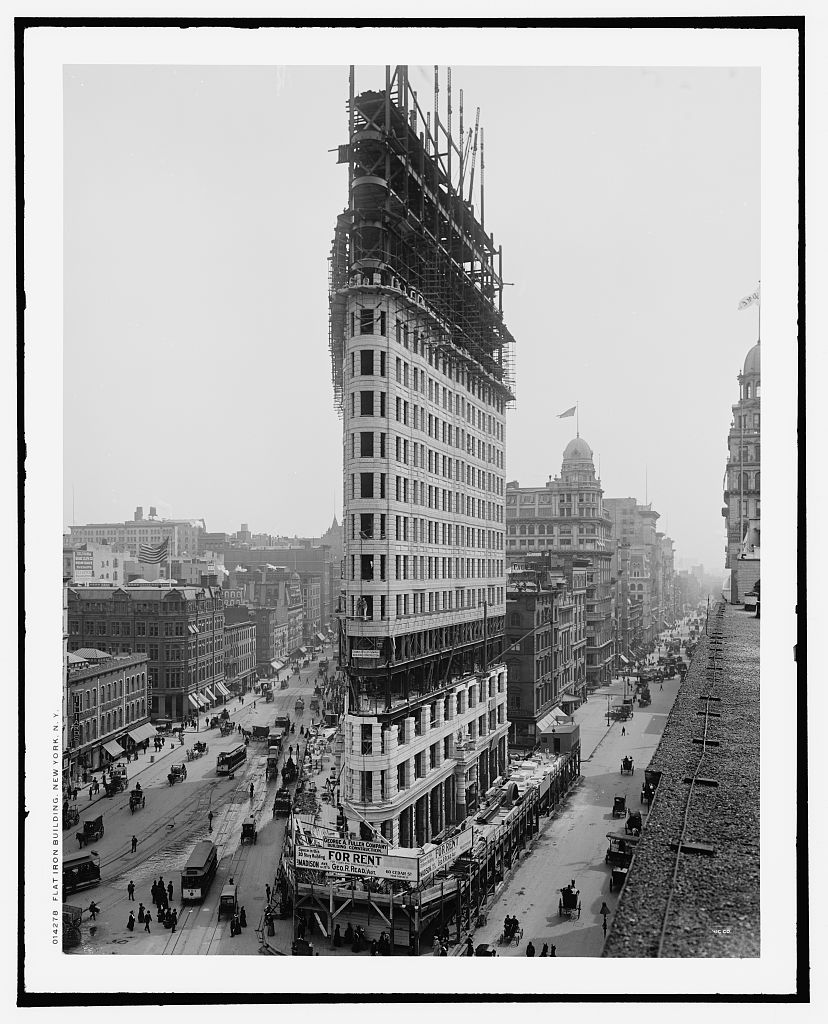
The Flatiron Building, ca. 1902. Detroit Publishing Co. Library of Congress, Prints & Photographs Division. No known restrictions on publication.
Sources
- NYC Landmarks Preservation Commission designation report
- National Park Service registration form
- Library of Congress historical photograph
- Museum of the City of New York: 23 Skidoo
- New York State Attorney General: Flatiron Building condominium offering plan
- NYC environmental review: Flatiron residential conversion
- NYREJ: Brodsky, Sorgente and GFP ownership partnership
- Public Buildings Reform Board portrait of Jeffrey Gural (public domain)
