Conference House: The Staten Island Manor Where Peace Talks Failed
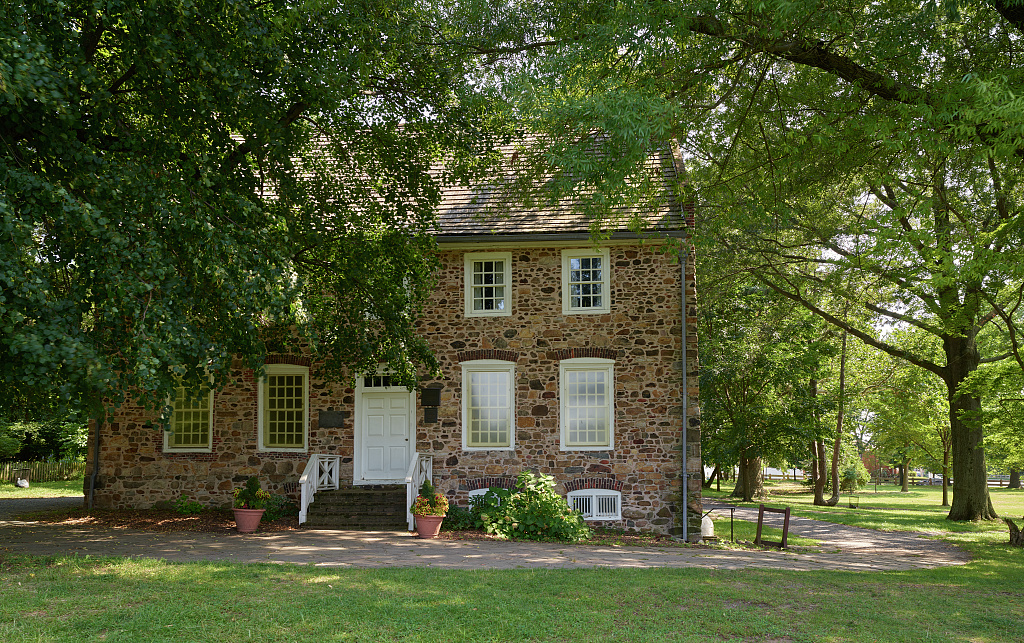
Conference House, August 26, 2018. Photograph by Carol M. Highsmith, Library of Congress. No known restrictions on publication.
At New York City’s southern edge, the Conference House looks across Raritan Bay toward New Jersey. Its thick fieldstone walls and steep roof belong to the seventeenth century, but the name remembers a single afternoon in 1776. Here, only weeks after the Declaration of Independence and shortly after the British victory at the Battle of Brooklyn, representatives of Britain and the Continental Congress met in a failed attempt to stop the Revolutionary War.
The house was built around 1680 by Christopher Billopp, an English immigrant and Royal Navy captain. In 1676, colonial governor Edmund Andros granted Billopp 932 acres at the southern tip of Staten Island. The estate grew to roughly 1,600 acres and became the Manor of Bentley. Billopp’s large two-story residence was a striking contrast to the smaller Dutch and English farmhouses scattered across the island.
The building is rectangular in plan, with two rooms opening from a central hall on each main level. Native fieldstone forms the massive exterior walls. High gabled ends contain fireplaces and chimney stacks, while brick parapets rise above the steep roof. A one-and-a-half-story kitchen wing, made partly of stone and partly of clapboard, was added later. The Landmarks Preservation Commission describes the house as an important New York example of “Medieval Survival” architecture: an early colonial building whose heavy masonry, gables and proportions retained forms associated with older English traditions.
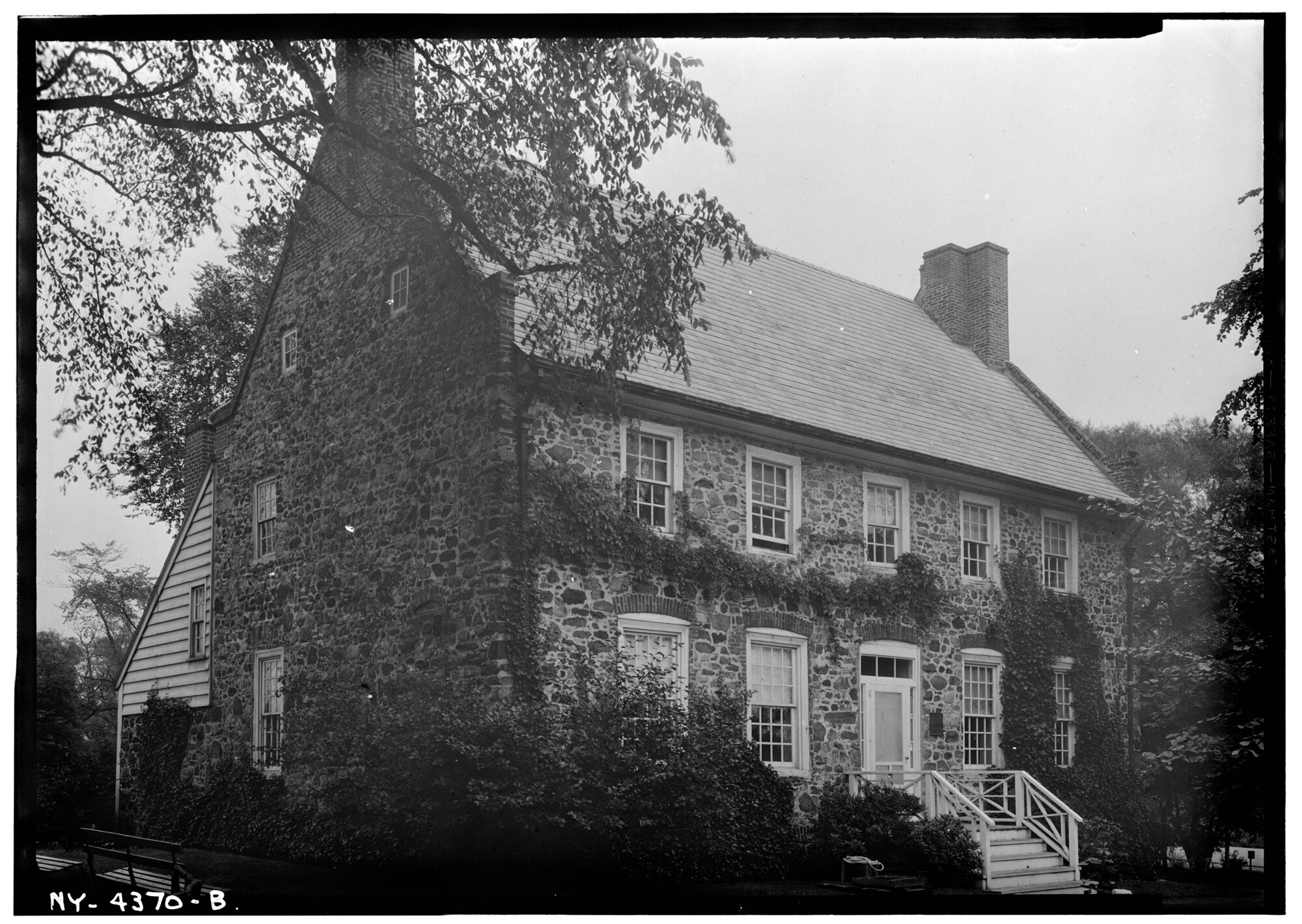
Conference House in a Historic American Buildings Survey photograph. Library of Congress. No known restrictions on U.S. government survey images.
By the Revolution, the manor belonged to Colonel Christopher Billopp, the builder’s great-grandson. He was a member of the provincial government and a committed Loyalist who commanded Staten Island militia on the British side. In 1776, when an enormous British force occupied Staten Island, his house was requisitioned for military use.
The meeting that gave the building its present name took place on September 11, 1776. Admiral Lord Richard Howe, acting for the British government, received Benjamin Franklin, John Adams and South Carolina delegate Edward Rutledge, who represented the Continental Congress. Howe’s barge carried the Americans from Perth Amboy to the house.
The setting may have been civil, with conversation and refreshments, but the two sides had incompatible instructions. Howe could offer concessions only if the colonies renounced rebellion. The congressional delegation could not negotiate away the independence declared in July. After about three hours, the meeting ended without an agreement. Four days later, British forces landed in Manhattan, and the war continued for seven more years.
The conference matters because it clarified how far the conflict had moved. This was no longer a dispute likely to be settled by limited concessions. Britain would not recognize independence, and the Americans would not surrender it. The house therefore commemorates a peace effort, but also the point at which the positions of the two sides could not be reconciled.
Colonel Billopp’s Loyalism cost him the estate. New York confiscated the property after the Revolution, and he moved with much of his family to New Brunswick, Canada. The old manor survived through less distinguished uses. NYC Parks records that it became a multifamily dwelling, a nineteenth-century hotel and even a rat-poison manufacturing site.
By 1926, the deteriorated house had passed to the City of New York. Restoration began that year and continued through the 1930s. Workers repaired the parlors, central hall, staircase, basement kitchen, roof, well and upper rooms. The grounds gained a colonial rose garden and thirteen trees representing the original states. The Conference House Association, founded in 1926, became the building’s steward in cooperation with the city.
The preservation work reflected the methods of its era, aiming to return the building to an eighteenth-century appearance rather than preserving every later alteration. The result still makes the original design easy to read: a substantial manor house built to project wealth and permanence at the edge of the colonial city.
Today, the Conference House is a public museum in Conference House Park, operated by the Conference House Association with NYC Parks and the Historic House Trust. It was designated a New York City landmark in 1967 and is listed on the National Register of Historic Places. The restored rooms interpret the Billopp family, colonial domestic life and the 1776 meeting.
The house has outlived the manor system, the British empire in America and several periods of neglect. Its survival allows visitors to stand where diplomacy failed and to see how a seventeenth-century Staten Island residence became a monument to the difficult birth of American independence.