The Brooklyn Museum: From a Wheelbarrow Library to a McKim, Mead & White Palace
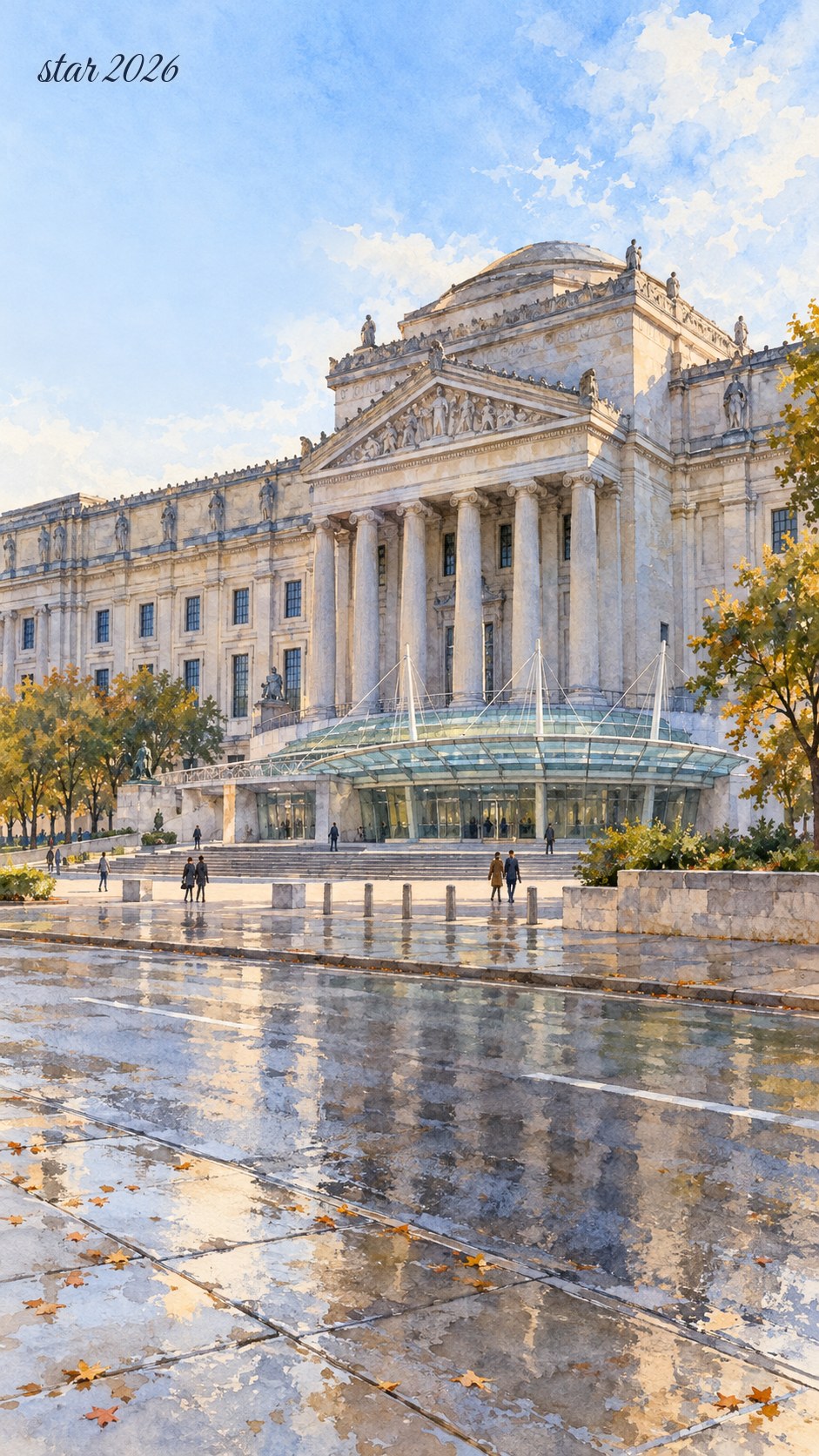
An original watercolor illustration of the Brooklyn Museum - a stylized illustration, not a photograph. Signed star 2026.
The Brooklyn Museum marked its 200th anniversary in 2023, which makes it older than the Brooklyn Bridge, older than Prospect Park and older than most of the borough around it. Today its collection holds more than 140,000 objects, and its home is a McKim, Mead & White palace on Eastern Parkway that the Landmarks Preservation Commission ranks among the firm's finest works. The building is only part of what was planned, its famous front staircase is gone, and the glass canopy at its entrance is barely twenty years old. Here is how it all happened, and who owns the museum today.
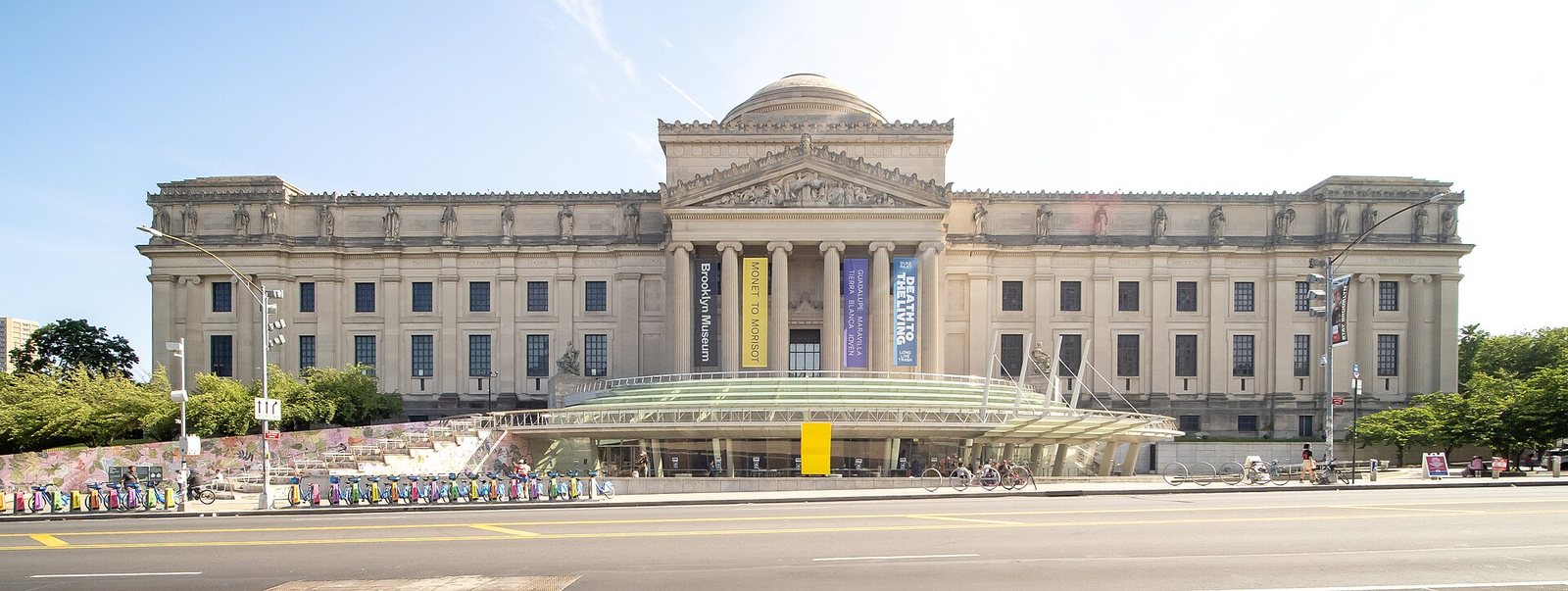
The Brooklyn Museum from Eastern Parkway, with the 2004 glass entrance pavilion in front of the McKim, Mead & White facade. Photograph by ajay_suresh, via Wikimedia Commons. CC BY 2.0.
How did a circulating library become a museum?
The museum begins with a wheelbarrow. On August 7, 1823, a group of Brooklyn citizens including Augustus Graham founded the Brooklyn Apprentices' Library to educate tradesmen and local youths; it became Brooklyn's first public circulating library, and Graham solicited book donations by pushing a wheelbarrow around town. The association was incorporated on November 20, 1824, and at a Fourth of July celebration in 1825 the Revolutionary War hero General Lafayette helped lay the cornerstone of its first building, at Henry and Cranberry Streets. Walt Whitman, then seven years old, was in the crowd, and Lafayette picked him up so he could see; Whitman retold the day decades later in his "Brooklyniana" series in the Brooklyn Standard. As a teenager, Whitman would even serve a stint as the library's acting librarian. The library held its first exhibition, of student drawings, mechanical displays and natural-science specimens, in 1842, the year before it merged with the Brooklyn Lyceum.
In 1842 and 1843 the Apprentices' Library consolidated with the Brooklyn Lyceum and took the name Brooklyn Institute, adding exhibitions, collections and lectures to its mission. In 1890 the Institute reorganized as the Brooklyn Institute of Arts and Sciences, which became the parent organization not only of the museum but of the Brooklyn Academy of Music, the Brooklyn Botanic Garden and the Brooklyn Children's Museum. The next year the New York State Legislature authorized the construction of a complex of museum and library buildings, and in 1892 and 1893 the Institute ran an architectural competition for the new museum. The Institute had by then grown into departments covering archaeology, architecture, astronomy, botany, fine arts and more; its Department of Photography, formed from the Linden Camera Club, began annual exhibitions in 1889 and made the Institute an early supporter of photography as an art form. The architectural competition of 1892 and 1893 drew designs for the new museum, and the winner was McKim, Mead & White.
How was the great building raised?
The 1891 state legislation had authorized not one building but a complex of free museums, libraries and educational buildings on the parkway, and the Institute named Franklin Hooper its first director that year. What rose was a single monumental museum, built in stages across three decades.
Brooklyn Mayor Charles A. Schieren laid the cornerstone of the museum building in 1895. The West Wing was completed in 1897, the collections were installed, and the building opened to the public as the "Museum of the Brooklyn Institute of Arts and Sciences." The East Wing and the Central Pavilion, with its celebrated Grand Staircase, were completed in 1907. In 1909, thirty allegorical statues designed under the direction of Daniel Chester French took their places on the facade, symbolizing literature, religion, philosophy, law, science and politics; the landmarks commission, describing the building decades later, counted twenty-eight heroic-size figures standing on the cornice and casting their shadows on the attic wall. The interiors of the East Wing and the Grand Court, finished in 1927, were the last sections completed according to McKim, Mead & White's original plans, and the full scheme was far larger than what was ever built.
The Historic Districts Council's construction history shows how piecemeal the work was: the West Wing went up from 1895 to 1897, the Central Pavilion and its dome from 1900 to 1905, the East Wing from 1904 to 1906, the Grand Staircase in 1906, and the remaining sections from 1913 to 1915. What visitors see today is the torso of a much larger dream, but a torso by McKim, Mead & White is still a palace.
What did get built was enough. Designating the building on March 15, 1966, the Landmarks Preservation Commission praised its facade as one of the great American fronts in the Eclectic Roman style: a long rectangle with a square central portion topped by a circular drum and a low saucer dome, a hexastyle portico at the center and handsome pavilions marking the ends, all of it "of monumental scale and grandeur."
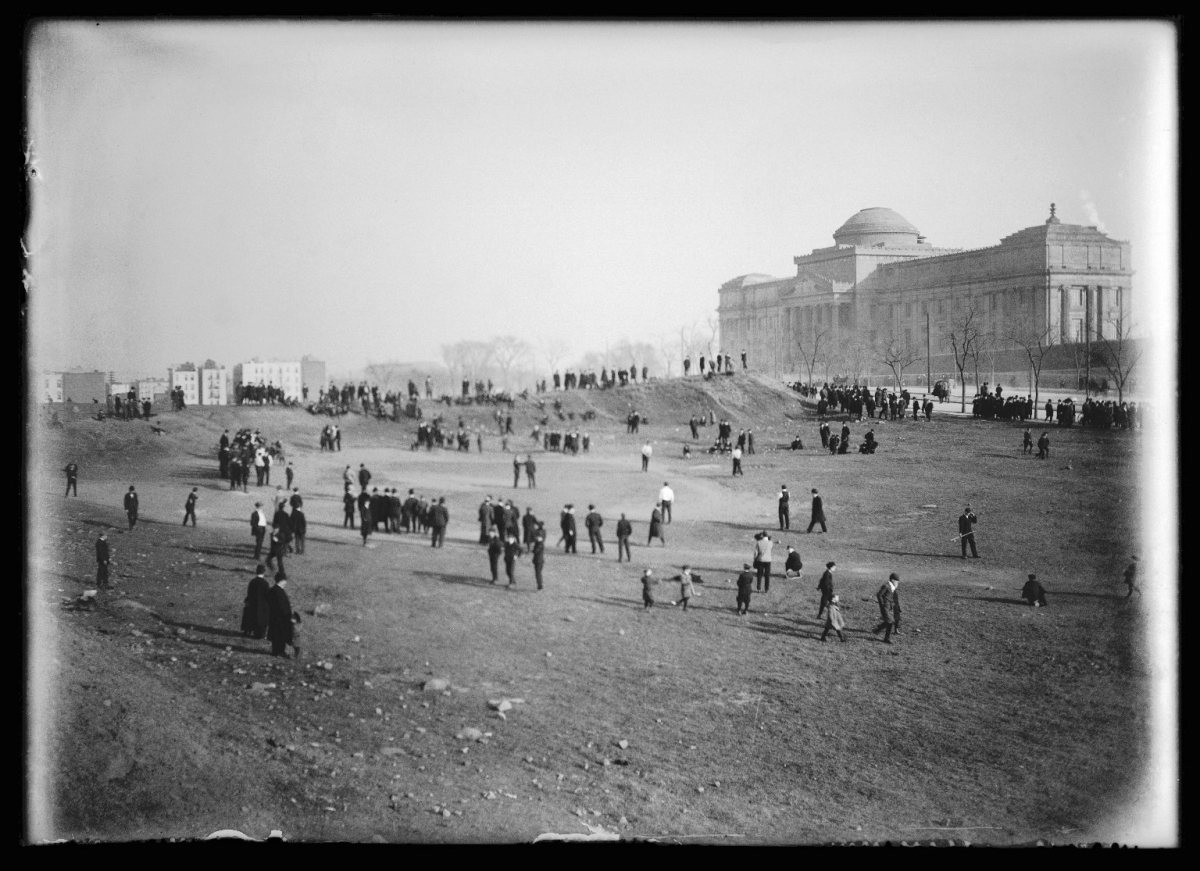
The museum around 1903 to 1910, with the original Grand Staircase still rising to the entrance. Photograph by the Brooklyn Museum, via Wikimedia Commons. No known copyright restrictions.
Why did the museum lose its front steps?
The Grand Staircase was the building's ceremonial front door, but by the 1930s the museum wanted a modern face. Between 1934 and 1935, as part of a broader modernization of the galleries, the front steps were removed and a new ground-level entrance was created; the Historic Districts Council records the work as directed by the modernist architect William Lescaze, and the landmarks designation simply notes that the building was "altered 1936." Visitors entered at street level for the next seven decades, and the staircase survived only in photographs and postcards.
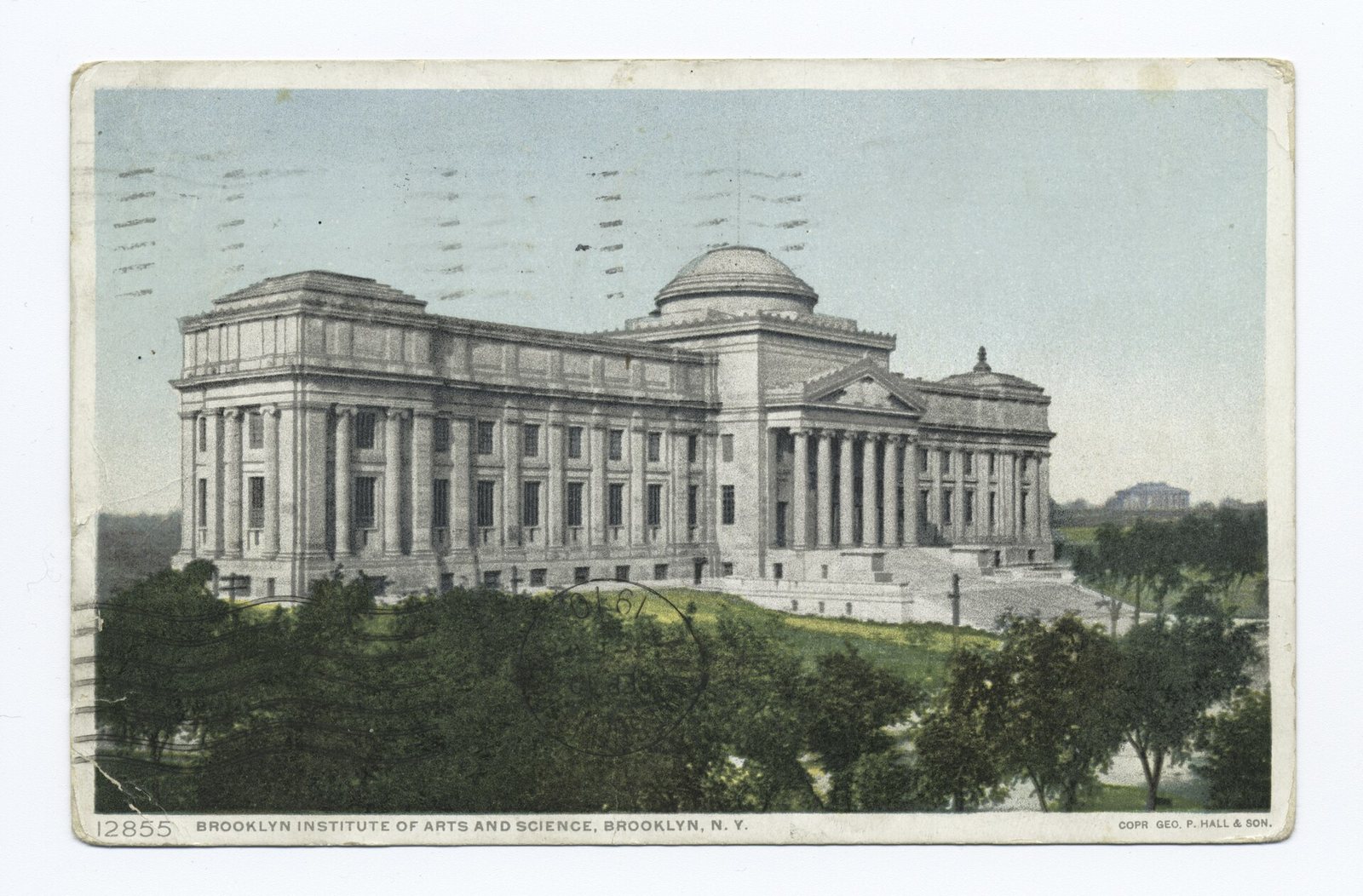
A vintage postcard of the museum with the Grand Staircase intact. Detroit Publishing Company, via Wikimedia Commons. Public domain.
The museum solved its entrance problem in the twenty-first century. In 2004 it unveiled the Martha A. and Robert S. Rubin Pavilion and Lobby, a glass-fronted entrance and public plaza designed by Polshek Partnership Architects and approved with the Landmarks Preservation Commission's permission, giving the building a welcoming front door again without pretending the staircase was still there. The same year, the trustees changed the institution's name from the Brooklyn Museum of Art back to the Brooklyn Museum.
How did the collection grow?
The Institute hired serious curators early. William Henry Goodyear, appointed the first Curator of Fine Arts in 1899, built the holdings with donors and collectors over more than two decades. Stewart Culin, who led the ethnology department from 1903, traveled to China, Japan, Korea and India acquiring works, including objects representing Ainu culture and Indian textiles, and later assembled the museum's foundational African and Islamic collections, a legacy the museum today presents with explicit context about how those collections were built. The result is an encyclopedic collection of more than 140,000 objects, and the museum celebrated its bicentennial in 2023 with exhibitions and programs across the building.
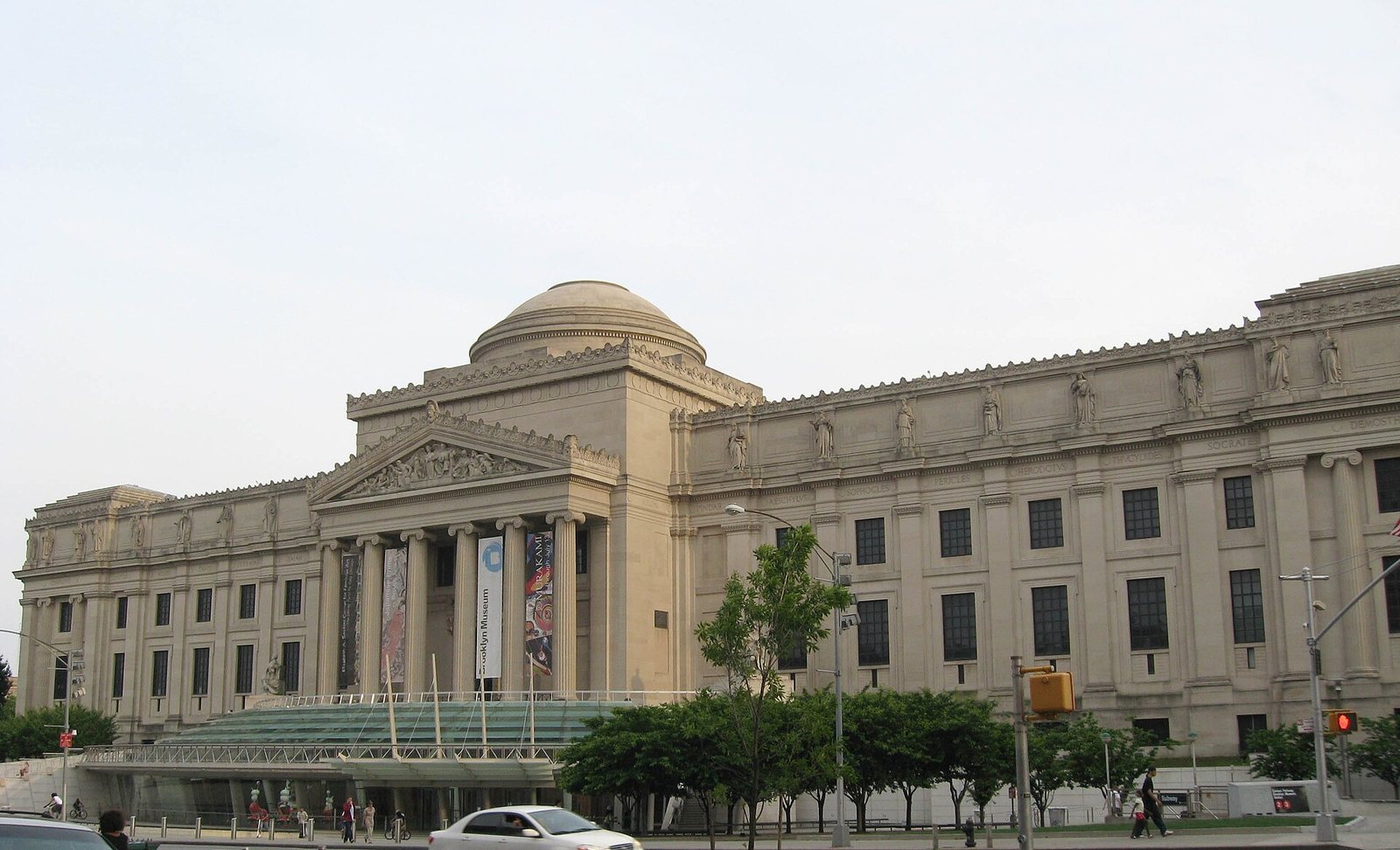
The full facade and saucer dome. Photograph by Jim Henderson, via Wikimedia Commons. Public domain.
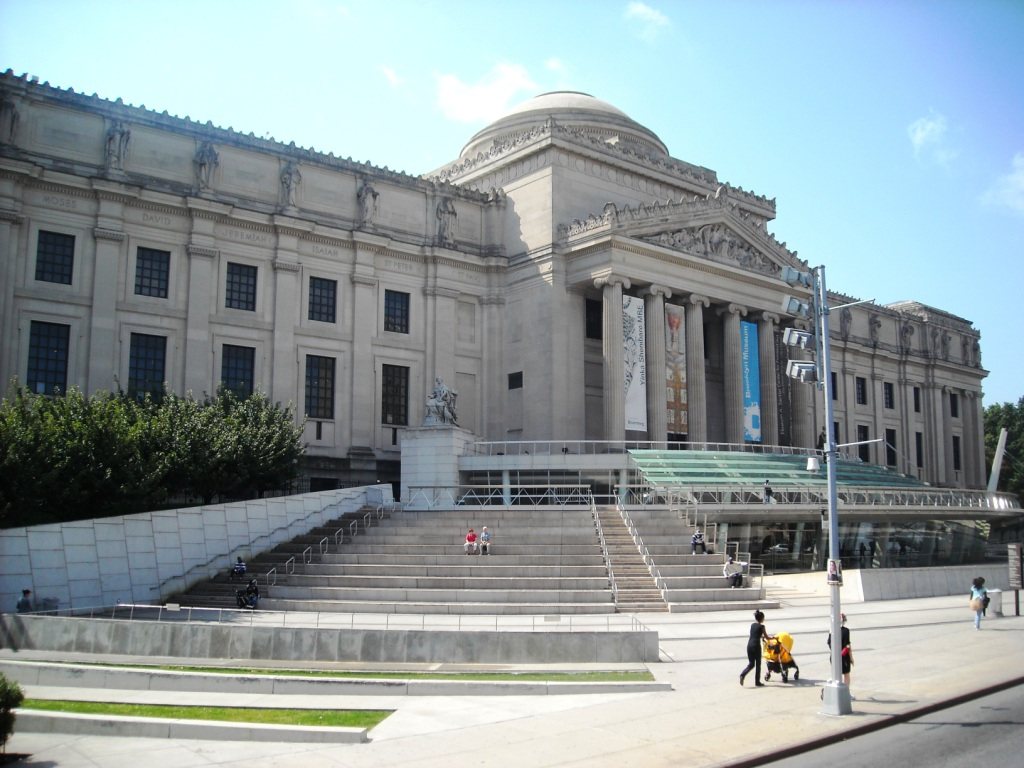
The glass entrance canopy added in 2004. Photograph by Elisa Rolle, via Wikimedia Commons. CC BY-SA 3.0.
What can you see at the museum today?
The Brooklyn Museum describes itself as one of the oldest and largest art museums in the country, housed in a landmark building in the heart of Brooklyn. Its encyclopedic collection of more than 140,000 objects represents cultures worldwide and more than 6,000 years of history, from ancient Egyptian masterpieces to significant American works and the installations of what the museum calls the only feminist art center of its kind. The bicentennial in 2023 was celebrated with exhibitions and programs across the building, two centuries after Augustus Graham's wheelbarrow rounds. The museum states its mission as bringing people together through art and experiences that inspire celebration, compassion, courage and the will to act.
Who owns the Brooklyn Museum today?
The museum answers this one itself: it is "a not-for-profit corporation whose Trustees operate the Museum in a building owned by the City of New York." In other words, the city owns the landmark building on Eastern Parkway, and a private nonprofit board runs the museum inside it. The arrangement is funded in part through the New York City Department of Cultural Affairs, which makes the Brooklyn Museum a member of the Cultural Institutions Group, the city's formal partnership with the nonprofit museums, gardens and cultural organizations that occupy city-owned property, the same structure behind the Brooklyn Botanic Garden next door.
Where can you eat or drink at the Brooklyn Museum?
Dining at the museum has a long history of its own: the first restaurant, a lunch and tea room with a view of the Brooklyn Botanic Garden, opened on the fourth floor in 1927. Today the museum operates the Brooklyn Museum Café in the lobby, close to the Rubin Pavilion entrance, for light fare between the galleries. Current menus and hours are listed on the museum's dining page.
Sources
- Brooklyn Museum, Timeline: 1823 to Today
- NYC Landmarks Preservation Commission, Brooklyn Institute of Arts and Sciences (Brooklyn Museum) (LP-0155), March 15, 1966
- Historic Districts Council, Six to Celebrate: Brooklyn Museum
- Brooklyn Museum, Public Support
- NYC Department of Cultural Affairs, Cultural Institutions Group
- Brooklyn Museum, Plan Your Visit
- Brooklyn Museum, Dining
Visiting the Brooklyn Museum
- Address: 200 Eastern Parkway, Brooklyn, NY 11238.
- Hours: Wednesday through Sunday, 11 a.m. to 6 p.m.; closed Monday and Tuesday.
- Getting there: The 2 and 3 trains stop at Eastern Parkway/Brooklyn Museum, in front of the building.
- Food: The Brooklyn Museum Café in the lobby.
Facts above were read on the official pages on November 2, 2026. Hours, ticket rules and café openings change, so confirm on brooklynmuseum.org before you go.