The Twin Towers: A New York Skyline Remembered
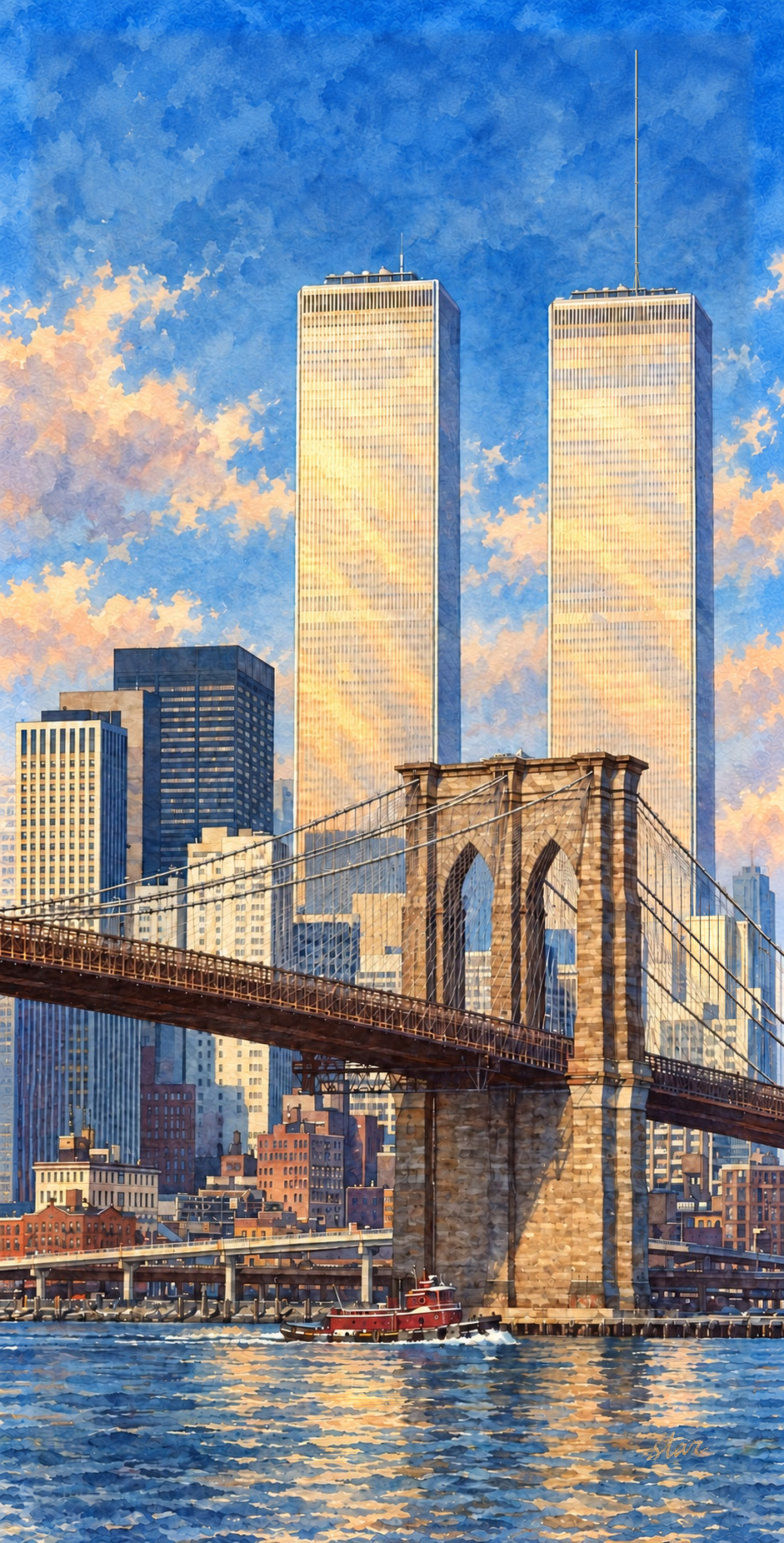
Original watercolour art illustration by Solomon Rokowsky. Adapted from a historical photograph by Balthazar Korab, 1976, Library of Congress, with the later North Tower antenna added using a 2001 Carol M. Highsmith photograph. Both references: No known restrictions on publication.
Before they became a place of mourning, the Twin Towers were a place where New York went to work. Their two silver rectangles rose above Lower Manhattan, unmistakable from the harbor and visible far beyond the city. They were offices, elevators, shops, restaurants and observation decks, but they also became something harder to measure: a familiar part of the skyline that people used to find their bearings. To remember the World Trade Center is to remember those ordinary lives as well as the extraordinary buildings around them.
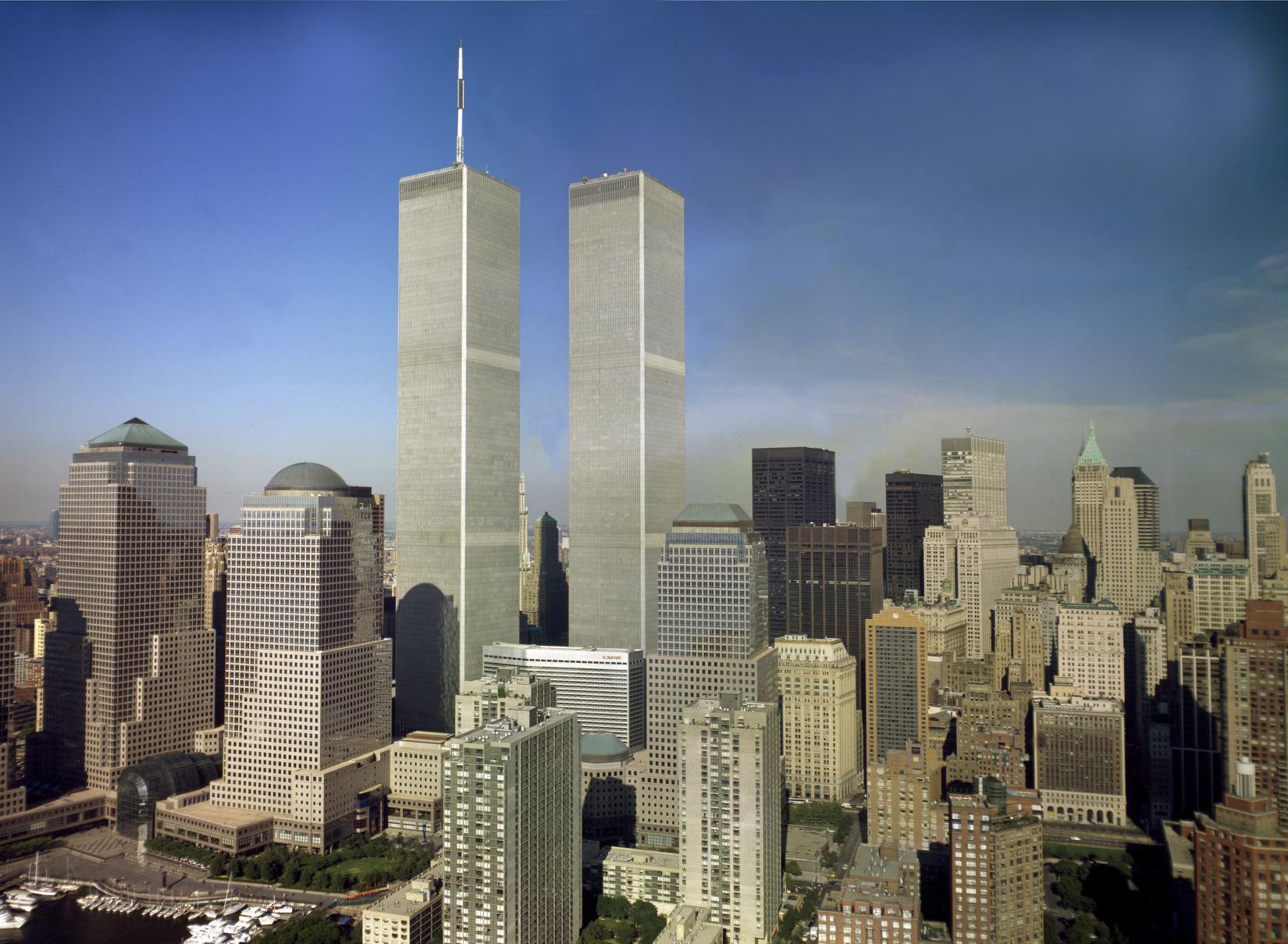
The original World Trade Center and Lower Manhattan, photographed in 2001, two months before the attacks. Carol M. Highsmith Archive, Library of Congress, Prints and Photographs Division. Owning record. Rights advisory: "No known restrictions on publication."
Why were the Twin Towers built?
The Port Authority of New York and New Jersey conceived the World Trade Center as a center for international business. In 1962 it settled on a site on the west side of Lower Manhattan, bounded by Vesey, Liberty, Church and West Streets, and selected Minoru Yamasaki as architect. Emery Roth & Sons handled production work. The eventual complex occupied 16 acres and contained seven buildings, with the North and South Towers standing around the Austin J. Tobin Plaza.
Construction began on August 5, 1966. Much of the first two years' work took place below street level, where foundations had to reach bedrock roughly 70 feet down. Excavated material helped create Battery Park City in the Hudson River. The North Tower received its first tenants in December 1970; the South Tower followed in 1971. The complex's ceremonial dedication took place on April 4, 1973.
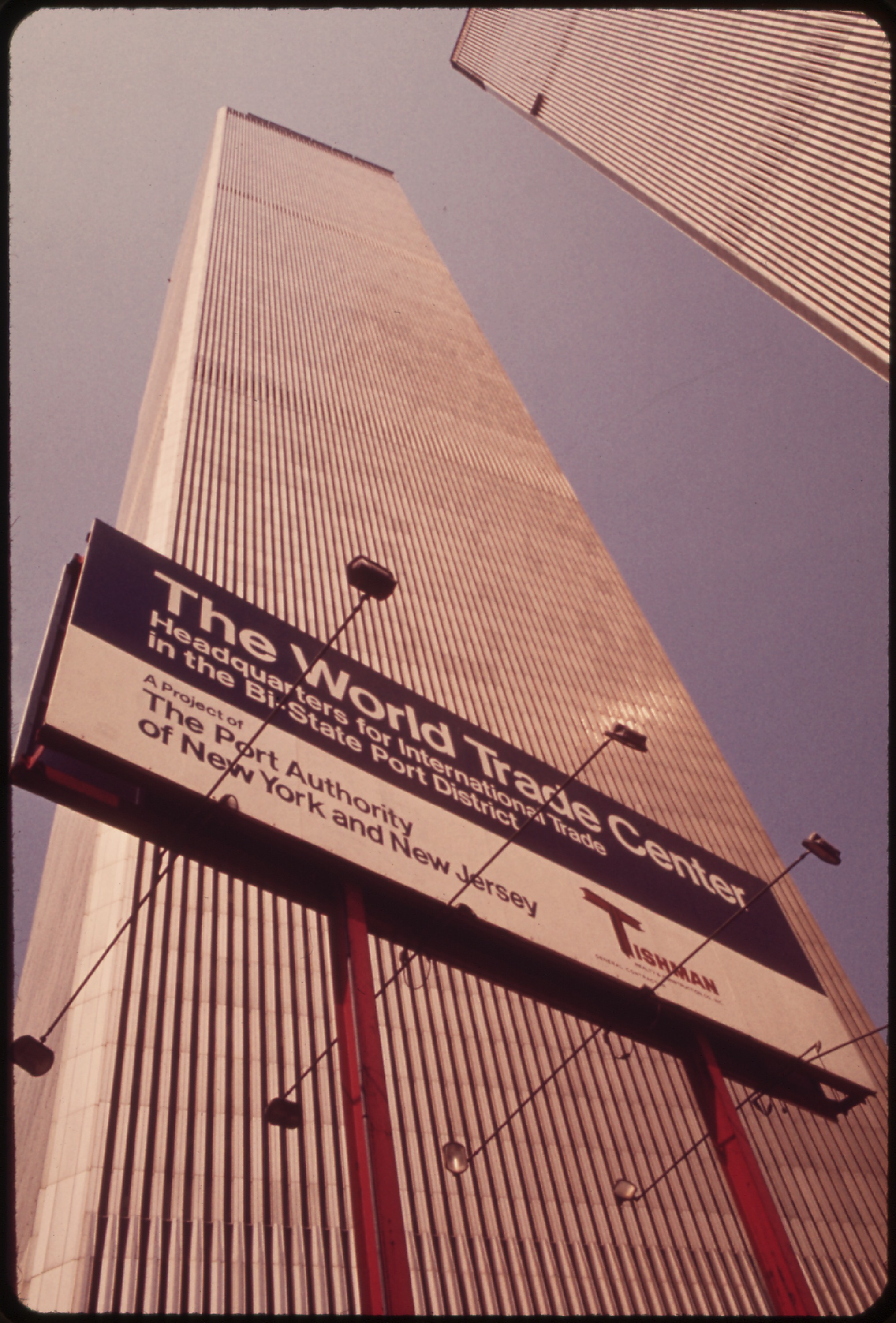
The towers from street level, May 1973. Photograph by Wil Blanche for the EPA's DOCUMERICA project, National Archives identifier 549915. Owning-source record and public-domain notice. U.S. government photograph.

What made their architecture different?
Each tower had 110 floors. The North Tower stood 1,368 feet high, before its broadcast antenna; the South Tower stood 1,362 feet. They briefly held the title of the world's tallest buildings. Seen from a distance, their almost unbroken silver surfaces could look startlingly simple. Up close, the facades resolved into closely spaced vertical columns and narrow windows, with Gothic-like arches at the base. Yamasaki used aluminum-alloy sheathing and repeated slender lines to give immense structures a finer grain.
That appearance was tied to the engineering. Yamasaki worked with engineers John Skilling and Leslie Robertson on a rigid exterior "hollow tube" of steel columns, connected by floor trusses to a central core. The exterior helped resist wind as well as support the building. An express-and-local elevator system used sky lobbies on the 44th and 78th floors, reducing the space that a conventional bank of elevators would have taken from the offices.
The towers did not win universal affection at first. Their scale and severe outline divided opinion, but their silhouette became one of New York's defining images. The contrast was part of their character: from the harbor, two enormous quiet forms; inside, a crowded working city.
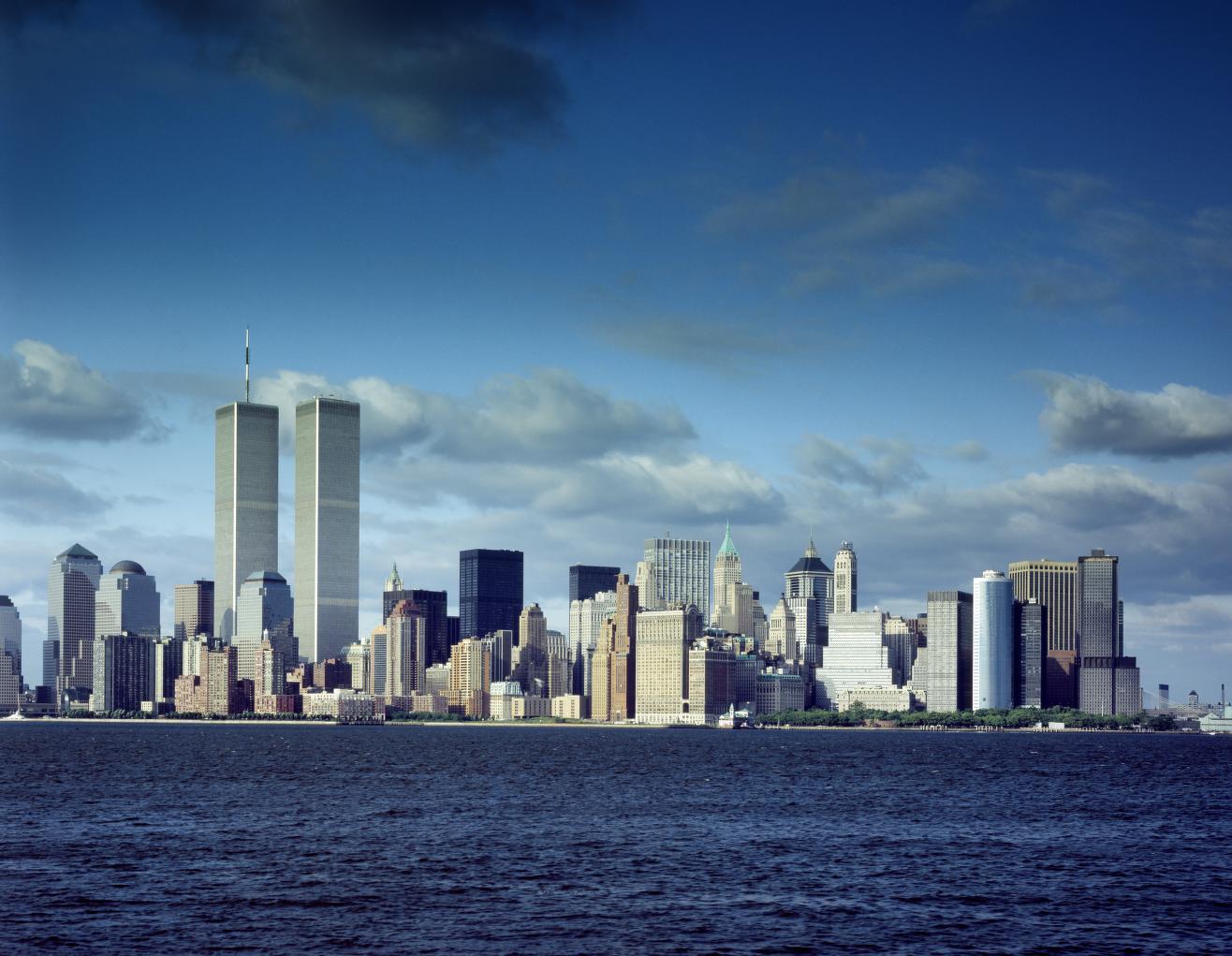
The Twin Towers in the waterfront skyline, photographed between 1980 and 2001. Carol M. Highsmith Archive, Library of Congress. Owning record. "No known restrictions on publication."
What was life like inside?
In 2001 the complex housed more than 430 businesses from 28 countries. People came for more than office work. The South Tower's observation deck, which opened in December 1975, offered an indoor observatory on the 107th floor and an outdoor platform on the roof. More than 46 million visitors experienced the view before the towers were destroyed. At the top of the North Tower, Windows on the World and its related restaurants employed about 450 people who spoke more than 60 languages.
The towers also entered the city's imagination through moments no architect could have planned. On August 7, 1974, Philippe Petit walked a cable between them without a safety net. His crossing made the space between the buildings as memorable as the buildings themselves.
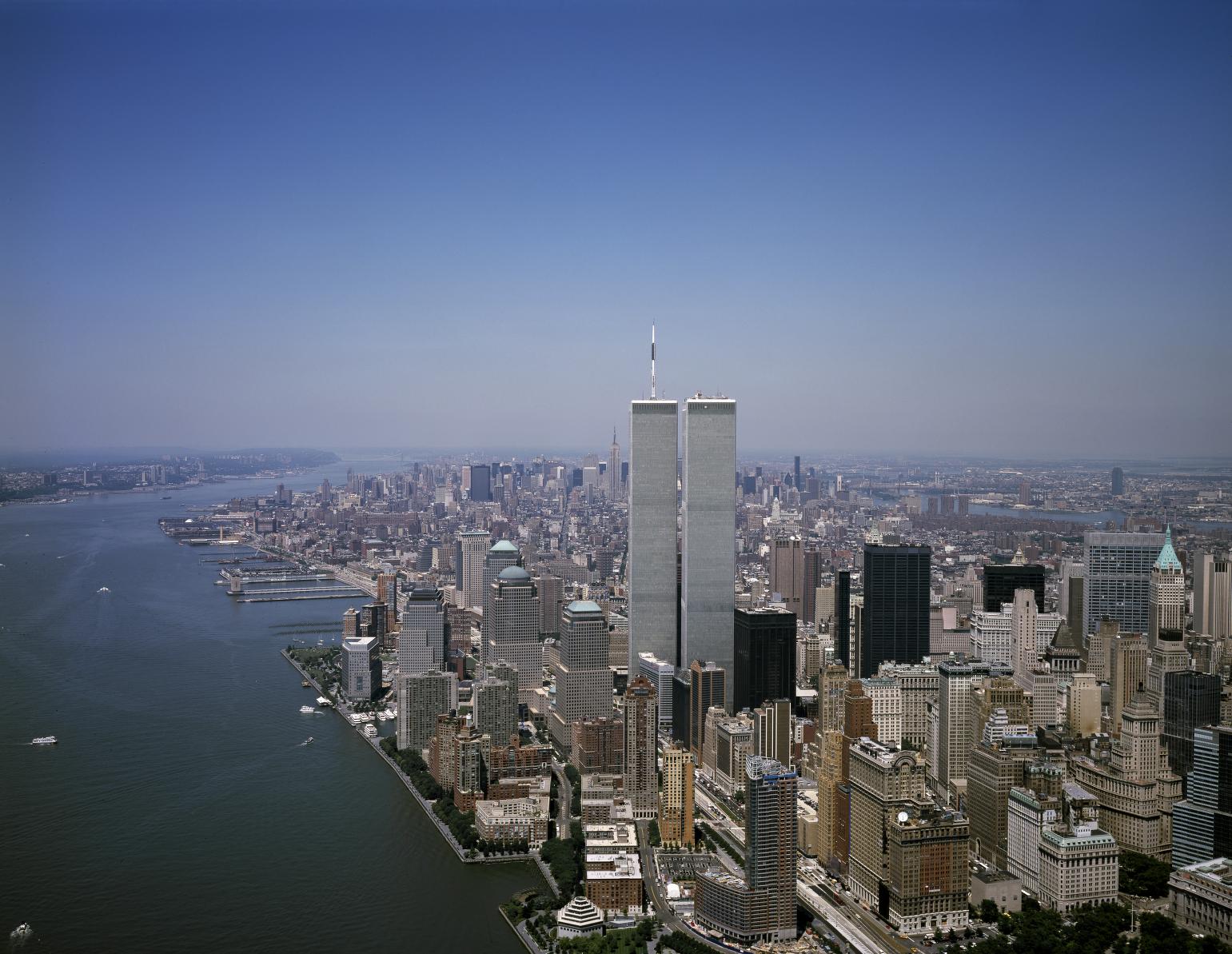
An aerial view along Lower Manhattan, photographed in 2001, one month before the attacks. Carol M. Highsmith Archive, Library of Congress. Owning record. "No known restrictions on publication."
September 11, 2001
On September 11, 2001, terrorists associated with al-Qaeda hijacked four commercial aircraft. American Airlines Flight 11 struck the North Tower at 8:46 a.m.; United Airlines Flight 175 struck the South Tower at 9:03 a.m. The South Tower collapsed at 9:59 a.m. and the North Tower at 10:28 a.m. What had been a normal working morning became a catastrophe for the people in the buildings, the responders trying to reach them, and families waiting for news.
The attacks in New York, at the Pentagon and near Shanksville, Pennsylvania, killed 2,977 people. The loss cannot be understood only through a skyline or a number. It included office workers, restaurant staff, visitors, aircraft passengers and crews, and people who entered danger to help strangers. The memorial that now occupies the towers' footprints gives names, rather than buildings, the final word.
The people who ran toward danger
Police officers, firefighters, EMTs, paramedics and ambulance crews answered the attacks with courage and purpose. While people were trying to escape, responders entered the towers, climbed toward the injured, guided evacuations, treated patients and worked in triage areas at their feet. Thousands of emergency personnel mobilized across the attack sites, and 441 first responders died that day. Their service took many forms. Paramedic Juana Lomi and EMT Yamel Merino, for example, responded in ambulances and helped injured and fleeing people near the towers; Merino was killed when the South Tower collapsed. Remembering those who went inside must also include the medical crews who stayed beside the buildings, and the rescue and recovery workers whose sacrifices continued long after the dust settled.
What stands on the site now?
The original towers no longer stand, but their footprints remain at the center of the National September 11 Memorial. Two reflecting pools, each nearly an acre in size, occupy those spaces. Bronze parapets bear the names of the people killed in the 2001 attacks and the six people killed in the World Trade Center bombing of February 26, 1993. The Memorial Glade honors rescue, recovery and relief workers, survivors and members of the local community who became sick or died from toxic exposure after the attacks.
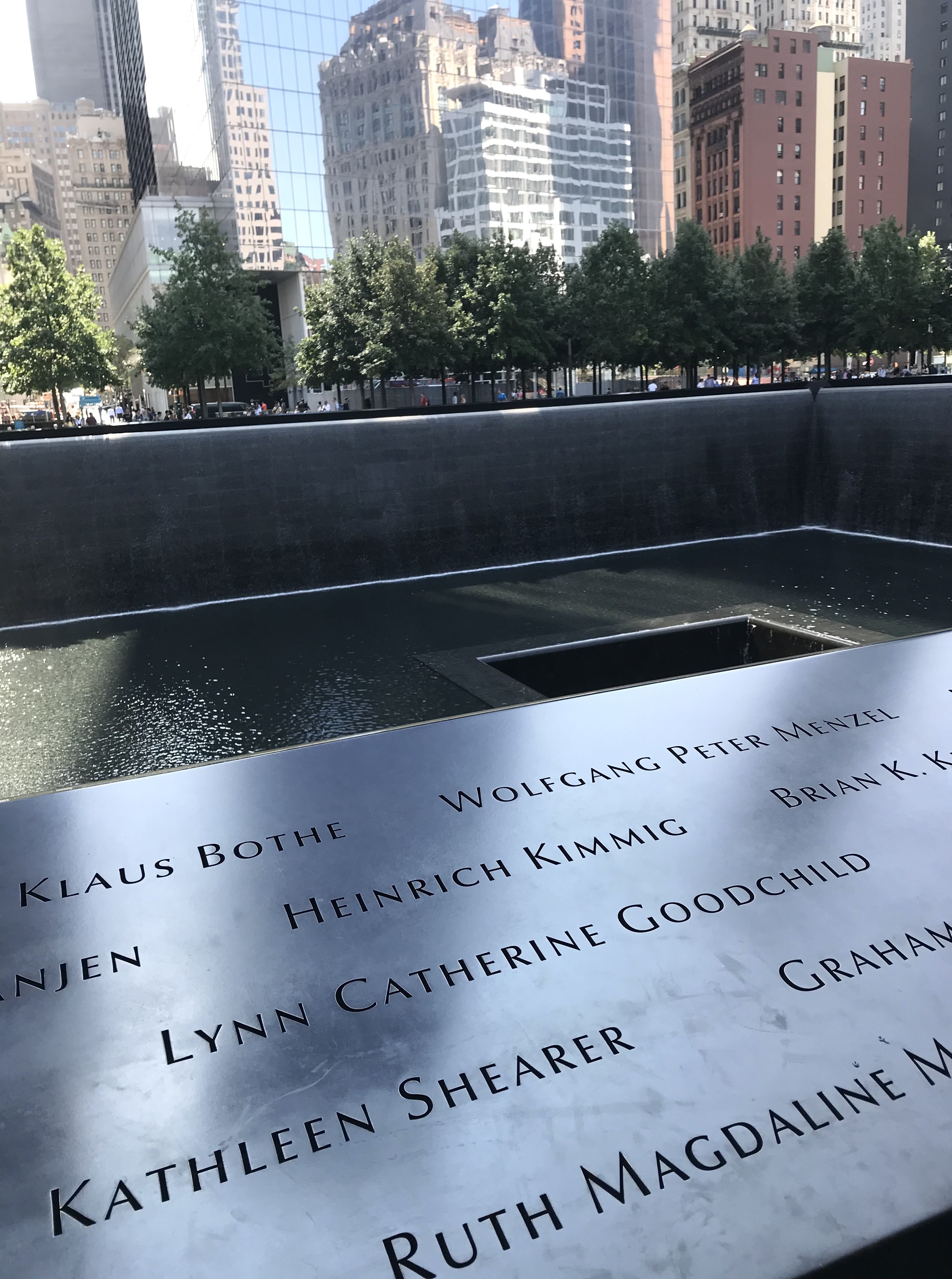
Names beside a reflecting pool at the 9/11 Memorial, August 1, 2019. Photograph by סיפן נוה (Saifunny), via Wikimedia Commons. CC BY-SA 4.0. Photograph reproduced unchanged.

The rebuilt World Trade Center campus includes One World Trade Center, the Oculus transportation hub, the Memorial and Museum, and the Perelman Performing Arts Center. These are distinct buildings and spaces, not substitutes for the people who were lost. A visit can hold both realities: the city's continuing life and the absence at its center.
Who owns the Twin Towers today?
There are no surviving Twin Towers to own. The Port Authority built and operated the original complex; the present World Trade Center is a campus operated by the Port Authority of New York and New Jersey, with separate buildings, businesses and institutions. The original towers should not be confused with today's One World Trade Center.
Where can you eat or drink at the World Trade Center?
Windows on the World was destroyed with the North Tower and is not a restaurant visitors can return to. Food and drink are available in the rebuilt campus, including Eataly and Gansevoort Liberty Market. These are practical places to pause during a visit, separate from the act of remembrance at the pools. Check the venues' own pages before going, as hours and individual counters change.
Sources
- World Trade Center Facts and Figures, 9/11 Memorial & Museum
- The World Trade Center, Skyscraper Museum
- Minoru Yamasaki, World Trade Center Architect, Smithsonian National Portrait Gallery
- World Trade Center History Timeline
- Events of the Day, 9/11 Memorial & Museum
- September 11 Timeline, 9/11 Memorial & Museum
- First Responder Tour, 9/11 Memorial & Museum
- Emergency Medical Bag: Two Female First Responders, 9/11 Memorial & Museum
- The Memorial, 9/11 Memorial & Museum
- Visit, 9/11 Memorial & Museum
- World Trade Center campus
- World Trade Center operator
- Food options, World Trade Center
Visiting the World Trade Center and Memorial
The Memorial is at 180 Greenwich Street. It is free and open daily, currently from 8 a.m. to 8 p.m. The Museum requires advance ticket purchase; check its official visit page for the current schedule. The Oculus connects the site with PATH and subway services. Allow time to walk the pools quietly and read the names. Hours and access can change; read on the official pages on November 4, 2026.