Poe Cottage: A Small Bronx House at the End of a Literary Life
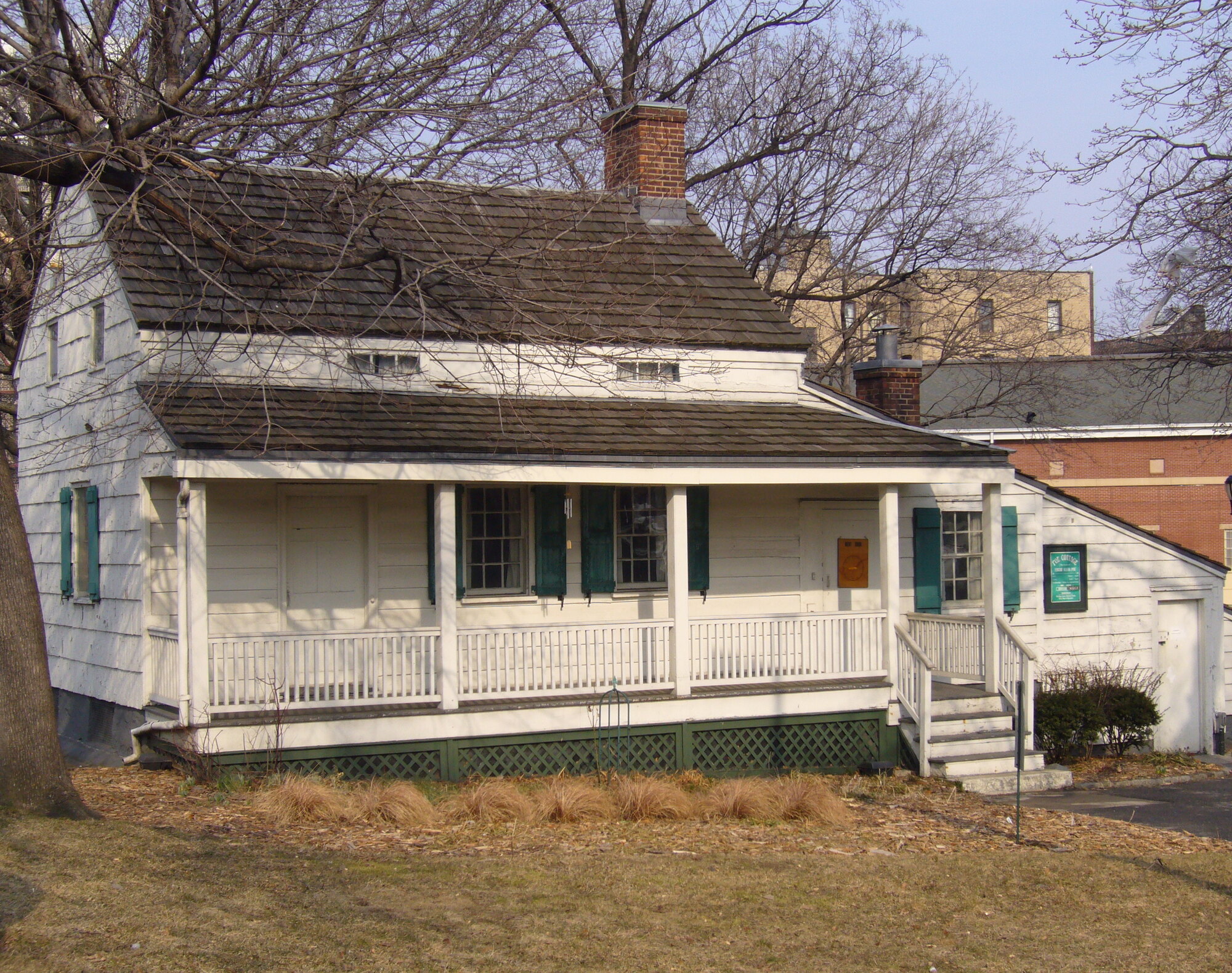
Edgar Allan Poe Cottage, 2007. Photograph by Zoirusha, via Wikimedia Commons. Public domain.
Edgar Allan Poe Cottage is easy to underestimate. The low wooden farmhouse in Poe Park has only five rooms: a kitchen, parlor, bedchamber, and two small attic rooms. Yet this modest building in the old village of Fordham became the last permanent home of Edgar Allan Poe and the setting for some of his final, most enduring work.
The cottage was built around 1812, probably by John Wheeler, when Fordham was still a rural settlement north of New York City. It represents a type of one-and-a-half-story working-class farmhouse that once filled the area but has otherwise vanished. Horizontal clapboards, a steep shingled roof, broad porch, simple windows, and a central chimney give it an architecture based on economy rather than display.
Poe, his wife Virginia, and her mother Maria Clemm moved here in spring 1846. The cottage belonged to John Valentine, and Poe rented it for $100 a year. Virginia was gravely ill with tuberculosis. The family hoped that Fordham’s fields, orchards, and cleaner air would offer relief from crowded Manhattan, but their circumstances were severe. Contemporary accounts describe poverty as well as sickness, and the house’s simplicity makes that hardship tangible.
Virginia died in the cottage in January 1847. The bed associated with her final illness remains part of the museum’s interpretation. Poe stayed in Fordham after her death, struggling with grief, illness, and unstable finances while continuing to write. The cottage years produced “The Cask of Amontillado,” “Eureka,” “The Bells,” and “Annabel Lee,” among other work. “The Raven,” sometimes casually linked to every Poe site, was written earlier in Manhattan.
The contrast between the house and the writing is striking. “Eureka” attempted a sweeping account of the universe. “The Bells” turned sound and repetition into an increasingly dark sequence, while “Annabel Lee” gave lost love the atmosphere of a legend. These works emerged from rooms whose scale is almost domestic to the point of compression. The cottage does not explain Poe’s imagination, but it shows the physical world in which his last phase unfolded.
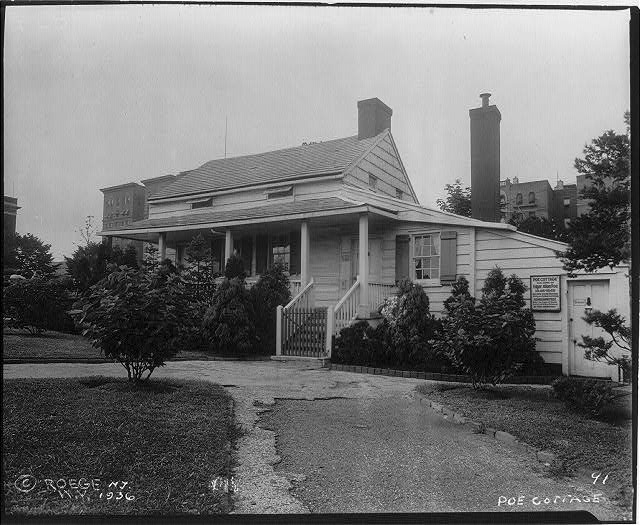
Poe Cottage, 1936. W. J. Roege, Library of Congress. No known restrictions on publication.
Poe left on a trip in 1849 and died in Baltimore on October 7 under circumstances that remain disputed. Maria Clemm then sold the household possessions and left Fordham. The cottage’s association with Poe gradually transformed it from an ordinary rented home into a literary landmark.
By the early twentieth century, Fordham’s redevelopment threatened the building. Streets widened, houses disappeared, and the cottage stood in the path of change. Poe Park opened across the road in 1902, creating a possible refuge. The New York Shakespeare Society raised money to save the structure, and in 1913 it was moved several blocks north into the park. The preserved cottage opened to the public on November 15 of that year.
Relocation changed the setting, but it kept the building itself from demolition. The New York City Landmarks Preservation Commission designated Poe Cottage in 1966, calling it one of the Bronx’s few surviving early nineteenth-century wooden farmhouses. It joined the National Register of Historic Places in 1980. These honors recognize both its architectural rarity and its place in American literature.
Today NYC Parks owns the cottage, while the Bronx County Historical Society operates it as a museum in cooperation with the Historic House Trust. The Society has administered the site since 1975. Rooms are furnished to evoke Poe’s residence, with period objects and several pieces traditionally associated with the family, including a desk, rope bed, and wicker rocking chair.
Poe Cottage survives because New Yorkers decided that an unpretentious building could carry national significance. Its power lies in its smallness. Against the expanding city outside, the cottage preserves the scale of Poe’s daily life: a sickroom, a worktable, a porch, and a handful of rooms where poverty, grief, and literary ambition occupied the same narrow space.