Park Central Hotel: The 1927 Giant Where Two Mob Hits Made History
The Park Central Hotel has been standing over Seventh Avenue at West 55th Street since the Roaring Twenties, and it carries two of the most famous nights and mornings in New York underworld history. Arnold Rothstein, the gambler said to have fixed the 1919 World Series, was mortally wounded here in 1928. Twenty-nine years later, Murder Inc. boss Albert Anastasia was shot dead in its barber shop. Both cases are unsolved. Around those events is a more ordinary story: a 1,600-room Renaissance Revival hotel that housed first ladies and comedians, hosted the NFL Draft, and changed names and owners across a century.
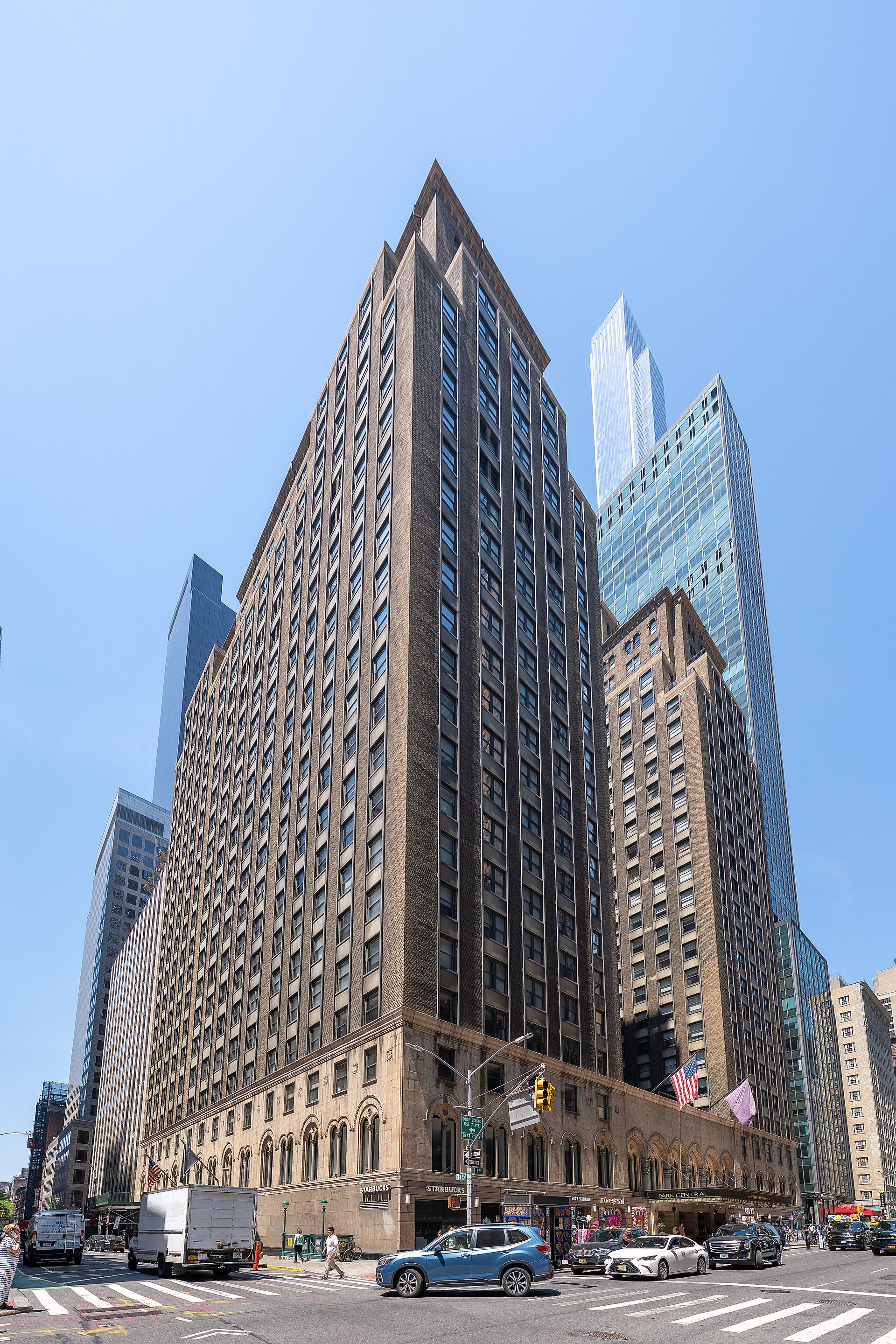
The Park Central Hotel at Seventh Avenue and West 55th Street. Photograph by Ajay Suresh, via Wikimedia Commons. CC BY 4.0.
What stood on the site?
New York's first apartment hotel. The Van Corlear, designed by Henry Janeway Hardenbergh, the architect who would later give the city the Plaza Hotel, was built on this block in 1879 and demolished in 1921. The apartment hotel was a new building type then, part residence and part hotel, and the Van Corlear held the block for four decades before the wreckers came. Its replacement was conceived on a much larger scale, at the moment when Midtown's hotel district was pushing north toward Central Park.
How did the Park Central rise?
The developer Harry A. Lanzer built the hotel and opened it on June 12, 1927. The architects were Gronenberg and Leuchtag, working in the Renaissance Revival style: a stone base with round-arched windows, twenty-five stories and about 357 feet of brick tower above. It was named for its proximity to Central Park, two blocks north, though as the record notes, it has no views of the park. The answer to the obvious question about the name, in other words, is marketing, not geography. The hotel occupies the eastern half of its block, between Seventh Avenue and Broadway; the western half belongs to 1740 Broadway, the former Mutual of New York tower with its famous weather beacon.
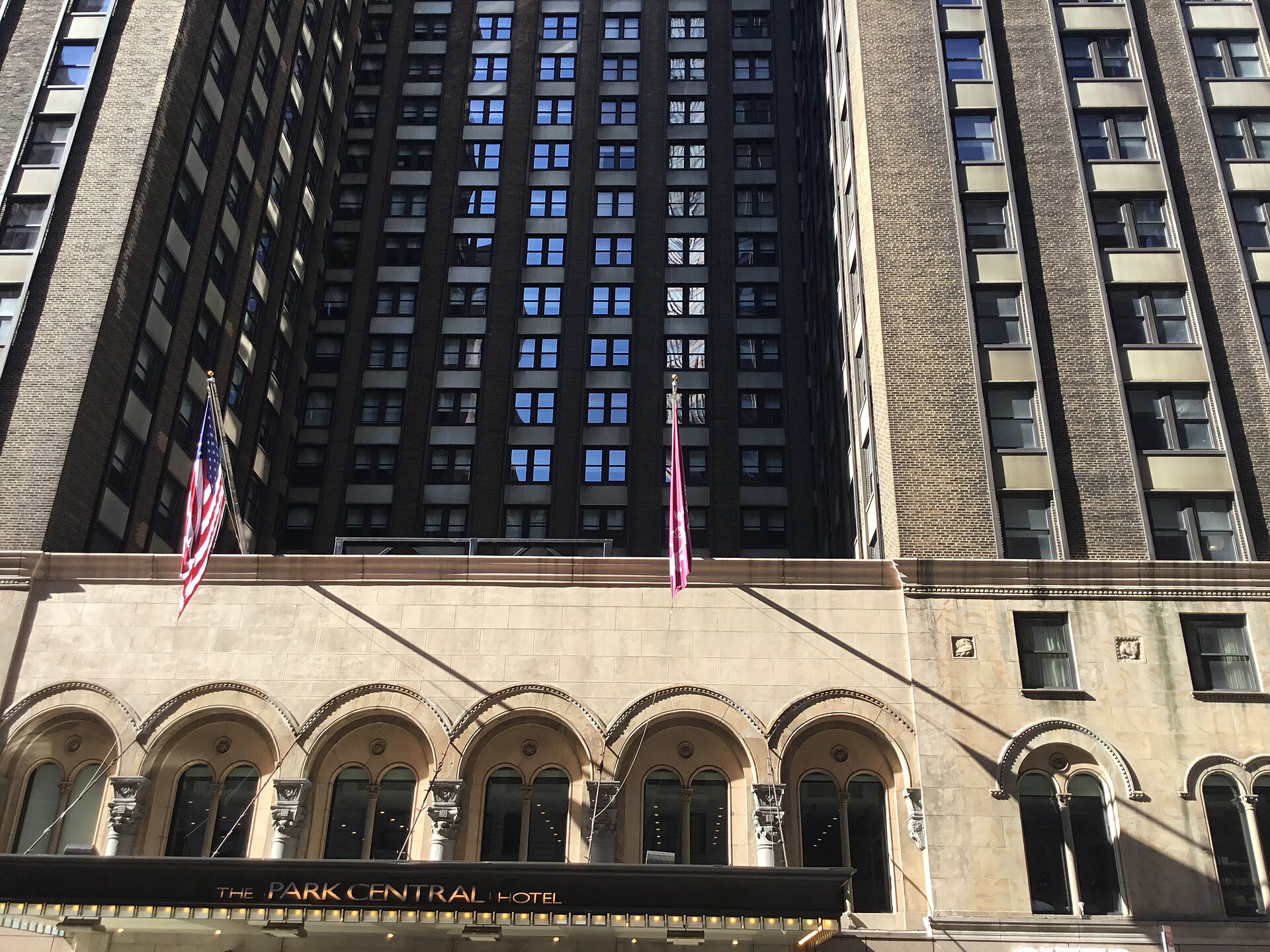
The Park Central's Seventh Avenue entrance canopy. Photograph by Kidfly182, via Wikimedia Commons. CC BY-SA 4.0.
Scale was the selling point. The Park Central opened with about 1,600 rooms, which made it one of the largest hotels in the neighborhood's boom. The count shrank steadily over the century: to 1,450 rooms by the 1980s, still the fifth-largest hotel in the city, to 950 by 2004, and to 761 rooms today, as later owners traded quantity for larger, more modern rooms.
Who stayed, and what happened here?
The guest book runs from politics to slapstick. Eleanor Roosevelt kept a suite at the hotel from 1950 to 1953, in her years as the country's former first lady turned public figure, the kind of long-stay resident big Midtown hotels of the era quietly counted on. Jackie Gleason lived here from 1955 to 1956, while filming The Honeymooners, and Mae West was a resident in her years back in New York. In 1933 the silent-film comedian Roscoe "Fatty" Arbuckle died in his sleep in his suite, of a heart attack. From 1980 to 1985 the hotel was the venue for the National Football League Draft, taking over from the Waldorf Astoria and passing the honor to the Marriott Marquis, back when the draft was a ballroom affair rather than a television spectacle.
The hotel also made its own nightlife. The Mermaid Room, created as its cocktail bar and nightclub in May 1946, was one of the city's known rooms; Billboard noted its opening-season shows in 1947, and the pianist Irving Fields and his trio played there from 1950 to 1966, a sixteen-year stand few rooms in New York have matched. Later alterations kept pace with the business: the facade was renovated in 2007, the swimming pool became event space in 2013, and that same year, at age eighty-six, the hotel completed what the Times called a head-to-toe makeover, the kind of renovation cycle that has kept a Jazz Age tower competitive into the boutique era.
Gangsters and Organized Crime
On the night of November 4, 1928, Arnold Rothstein was shot with a .38-caliber pistol. The next morning's New York Times reported that the gambler, who had lately claimed to be leaving gambling for real estate, was found collapsed at the West 56th Street service entrance of the Park Central Hotel, with $6,500 in his pockets, and that he refused to tell the police who shot him or where it happened. The Times account reads like a mystery story: Rothstein had asked the doorman to call a doctor and a taxi, police first theorized he had been shot across Seventh Avenue and plodded grimly through the hotel's avenue entrance, and a taxi driver picked the pistol out of the street. Surgeons at Polyclinic Hospital operated on the gambler's abdomen, but he died two days later without naming anyone. Later accounts, including the Times looking back in 1957, place the shooting inside the hotel, in Room 349; the disagreement between the police uncertainty of 1928 and the settled room number of retelling is part of the story. Rothstein was the model for the gentleman gangster, the man "said to have plotted to fix the 1919 World Series," and his murder remains unsolved.
On October 25, 1957, the hotel, by then renamed the Park-Sheraton, hosted the more famous hit. Albert Anastasia, whom the paper called the master killer of Murder Inc., the gangster troop that plagued the city from 1931 to 1940, sat down for a haircut in the hotel barber shop at Seventh Avenue and 55th Street at 10:20 in the morning. Two gunmen with scarves over their faces came in behind him and fired ten shots; five took effect, the Times reported the next morning, catching his left hand and wrist, his hip, his back as he stumbled into the mirror, and finally the back of his head. The killers dropped both pistols, one in a vestibule just outside the shop, and walked out into the midmorning traffic of Seventh Avenue. No one was ever convicted. The Mob Museum counts the barber shop killing among the storied mob rub-outs in the city's history, and the hotel's manager decades later called it, with professional detachment, the perfect crime. The barber shop closed soon after; by 2013 the space was a Starbucks, and the hotel's manager at the time told the Times the owners of 1957 had pushed the shop out.
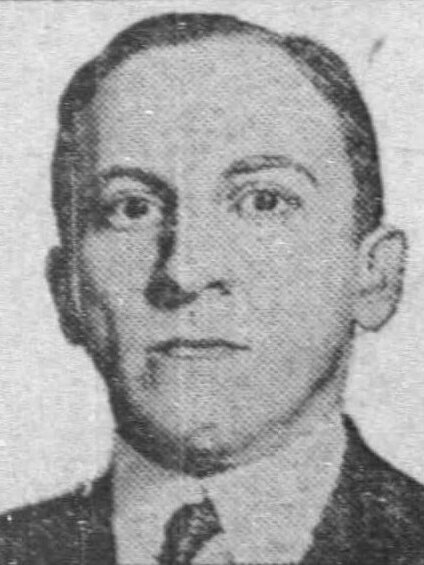
Arnold Rothstein in 1920. Photo: New York Daily News, public domain, via Wikimedia Commons.
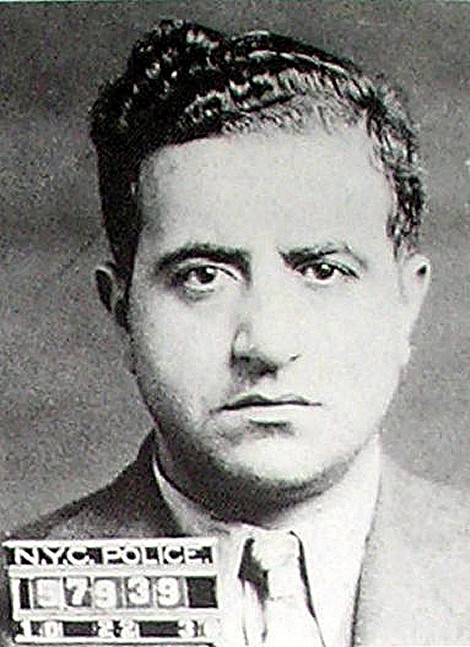
Albert Anastasia, NYPD mug shot. Photo: New York Police Department, public domain, via Wikimedia Commons.
Who owns the Park Central Hotel today?
The ownership trail is long, and the most recent step rests on reporting rather than a deed this article examined. Lanzer sold the hotel to Sheraton in 1948, and it became the Park-Sheraton, renamed the New York Sheraton in 1972. In 1983 Sheraton sold it for $60 million to V.M.S. Realty, which brought in Dunfey Hotels' Omni division to manage it as the Omni Park Central from January 1984. The developer Ian Bruce Eichner bought it in 1995, restored the original name, and converted the north side of the building into the Manhattan Club, a 286-unit timeshare at 200 West 56th Street.
In January 2012, LaSalle Hotel Properties announced in an SEC filing that it had acquired the 934-room Park Central for $396.2 million, with Highgate continuing to manage it. LaSalle merged into Pebblebrook Hotel Trust in 2018 after what The Real Deal described as a contentious bidding war with the Blackstone Group for control of LaSalle. As the surviving company trimmed its portfolio, it sold two New York hotels, and in December of that year The Real Deal reported that the Park Central went to Highgate Hotels and the LeFrak Organization. Today the Park Central operates as an independent hotel, and its official site says it is managed by Highgate. Whether title has changed hands since the 2018 sale is not stated in the sources read for this article, so this article stops there too.
Where can you eat or drink at the Park Central?
The hotel lists two on-site options. Twenty-Sevens, its bar and lounge, is named in homage to the hotel's 1927 origins and pitches itself to the Carnegie Hall crowd across the street. Central Market is the in-lobby grab-and-go counter for coffee, breakfast and baked goods. Hours were not stated on the pages read, so confirm before planning around them.
Sources
- Wikipedia, Park Central Hotel
- The New York Times, Rothstein, Gambler, Mysteriously Shot; Refuses to Talk, November 5, 1928
- The New York Times, Anastasia Slain in a Hotel Here; Led Murder, Inc., October 26, 1957
- The New York Times, Rothstein Killed in the Same Hotel, October 26, 1957
- The New York Times City Room, An 86-Year-Old's Head-to-Toe Makeover Is Complete, September 11, 2013
- LaSalle Hotel Properties, press release: acquisition of the Park Central Hotel, January 3, 2012 (SEC)
- The Real Deal, Pebblebrook sells two hotels to Highgate and LeFrak, December 3, 2018
- The Mob Museum, Reader's guide to Mob rub-outs
- Park Central New York, official site
Visiting the Park Central Hotel
- Address: The hotel lists itself at 870 Seventh Avenue, New York, NY 10019, between West 55th and 56th Streets. Its phone number is (212) 247-8000.
- Setting: The hotel promotes its walking access to Central Park, Carnegie Hall, Broadway, Times Square, Rockefeller Center and Fifth Avenue.
- Dining: On-site options are the Twenty-Sevens bar and lounge and the Central Market grab-and-go counter in the lobby.
- Staying there: It is a working hotel, not a museum; rooms are bookable on its official site, and there is no public tour of the Rothstein room or the barber shop, which no longer exists.
Facts above were read on the official pages on October 29, 2026. Dining hours and room offerings change, so confirm on parkcentralny.com before you go.